Explained
Elevated Dog Bowls, Explained
After reading this you will know how to size a raised feeder to your dog, which specs actually change daily life, and which marketing claims to ignore.
In this guide
An elevated dog bowl is just a stand that holds food and water off the floor so your dog does not have to lower its head as far. For twenty years these were sold as a health product, which is where most of the confusion comes from. Buy one for comfort and cleanup, size it by measuring your dog rather than by trusting the number on the box, and most of the shopping problem disappears.
The 30-second version
- Buy for comfort and cleanup, not for health. The old claim that raised bowls prevent bloat is not supported by the veterinary research, and one large study of at-risk breeds pointed the other way, so treat a raised feeder as a posture and housekeeping product.
- Rim height is the only height that matters. Overall product height includes sidewalls, splash guards and trays, so a tall-sounding feeder can put the bowl surprisingly low, and a listing that only quotes total height is hiding the number you need.
- Removable stainless bowls are close to non-negotiable. Plastic feeding surfaces scratch with daily use, and scratched plastic holds residue and odor that rinsing does not clear, while steel bowls lift out and survive a dishwasher for years.
- Height alone does not reduce mess. Containment does, which means splash guards, deep rims, or a tray or reservoir that catches overflow, so if your complaint is a wet floor buy for containment features and not for elevation.
- Treat the word adjustable with suspicion. Ask what the actual range is, because several feeders advertise multiple settings that span only a couple of inches at the tall end, which is a fixed-height feeder with extra parts.
The products this guide is about
Our verdict on each, with the full reasoning on the companion review.
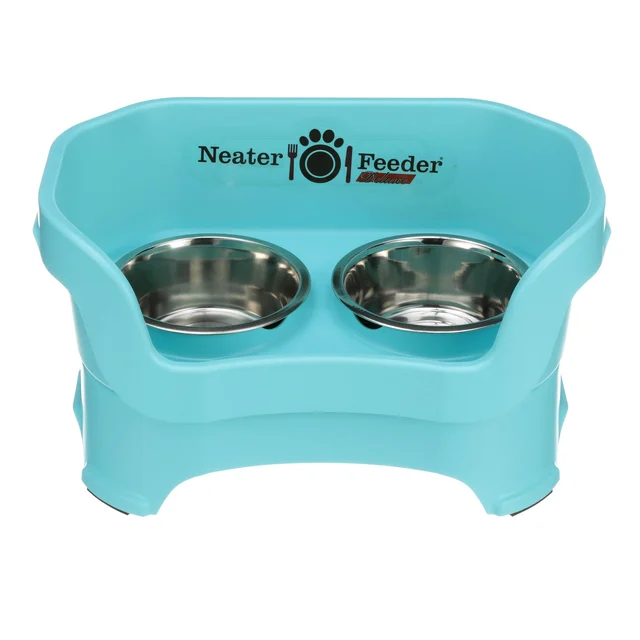
- Buy Neater Pets Neater Feeder Deluxe The only feeder here engineered around spilled water, with removable stainless bowls and a drainage reservoir that catches the mess instead of your floor. Amazon
- Buy IRIS USA Elevated Feeder with Airtight Storage, Large Raised stainless bowls sitting on an airtight kibble bin, which replaces the feeder and the food container with one very stable object. Amazon
- It depends Petmate Easy Reach Diner A tall, simple one piece diner with stainless bowls that is right for a genuinely big dog and wrong for everyone else. Amazon
- Skip IRIS USA Height Adjustable Elevated Feeder Four height settings that span barely two inches, a plastic trough instead of steel bowls, and folding legs no kitchen floor needs. Amazon
What actually matters
- Bowl rim height. This is the distance from the floor to the top edge of the bowl, and it is what your dog actually reaches for. A common rule of thumb puts the rim somewhere around the lower chest or elbow so the neck stays roughly level instead of craning upward. If your dog braces or reaches up to eat, the feeder is too tall.
- Bowl material and removability. Removable stainless steel is the standard worth holding out for. It does not scratch into a residue trap, it does not absorb odor, and being able to lift the bowls straight into a dishwasher is the difference between cleaning them and meaning to. Molded plastic troughs give this up.
- Spill and splash control. Raised bowls move water around rather than eliminating spills. What genuinely reduces mopping is containment: splash guards around the bowls, deep rims, a catch tray, or a drainage reservoir that collects overflow you empty on your own schedule.
- Stability and footprint. Wide and low beats tall and narrow. A big dog leaning into a light plastic frame on tile can push it across the room. Look for a broad base, rubber feet or a weighted or fillable body, and be wary of folding or telescoping legs that trade rigidity for a feature you will not use.
- Sizing to the dog, not the breed name. Manufacturers size by weight class, but two dogs of the same weight can differ several inches at the shoulder. Measure your dog standing, then compare against the rim height, and buy from a seller with an easy return in case the fit is wrong.
- Cleaning burden. Count the parts you will handle daily. Bowls that lift out, a body that wipes down or goes in the dishwasher, and no hidden crevices under a tray. If a feeder has a water reservoir, that is one more thing to empty regularly or it becomes its own hygiene problem.
- Chew and durability risk. Splash guards, rubber feet and plastic trim are all things a determined chewer will investigate. For a dog that destroys things, prioritize steel bowls in a simple heavy frame over clever molded features.
The specs, in plain English
Green flags vs red flags
Green flags
- The listing states the bowl rim height, not just overall dimensions
- Bowls are stainless steel and lift straight out for washing
- Real containment: splash guards, a catch tray, or a drainage reservoir, described specifically rather than as spill resistant
- Wide base with rubber feet, a weighted body, or storage underneath that adds mass where you want it
- A size range that spans small through large, so the height is chosen for the dog instead of guessed
- Long-term owner reports mentioning years of use rather than a first-week impression
Red flags
- Bloat prevention or health benefit claims in the product copy, which tells you the seller is behind on the evidence
- Adjustable height with no stated range, or a range that spans only a couple of inches
- Molded plastic troughs instead of removable bowls
- Only overall height listed, with the rim height nowhere on the page
- Folding or telescoping legs on a feeder meant to sit in one spot, which costs rigidity for portability you do not need
- A tall narrow stand with a small footprint and no grip on the feet, which a large dog can shove across tile
Who's who: the brands
- Neater Pets - Built its reputation on mess containment, with splash guards and a drainage reservoir engineered around spilled water rather than height alone.
- IRIS USA - Storage-focused plastics maker whose best pet products combine raised stainless bowls with airtight bulk kibble bins.
- Petmate - Long-running mass-market pet brand known for simple one-piece diners with removable steel bowls at friendly prices.
- Frisco - House brand of a large pet retailer, competing on price with conventional steel-bowl stands and wide size ranges.
- PetFusion - Design-led brand aiming at furniture-grade materials such as bamboo and finished wood for owners who want the feeder to blend into a room.
- OurPets - Value-oriented maker of raised feeders and comfort bowls at friendly prices.
How to read a listing without getting fooled
Start by hunting for the bowl rim height and ignore everything until you find it. If the listing gives only overall height, check the dimension diagram or the manufacturer page, and treat a missing rim height as a reason to look elsewhere. Next, read the bowl description literally: removable stainless steel means two steel bowls you can lift out, while feeding surface, tray, and trough usually mean molded plastic. Then decode the spill language. Spill resistant and no mess are marketing words that often mean nothing more than a slightly raised edge, so look for a description of where spilled water physically goes, because a tray or reservoir is a mechanism and a lip is a hope. When you see adjustable, find the lowest and highest settings, and if the numbers are absent assume the range is narrow. Capacity figures in cups are about the bowls, not the stand, so they tell you nothing about fit. Finally, discount any health language entirely. If a listing leads with bloat prevention or digestive benefits, treat it as a signal about the seller rather than about the product.
How much should you spend?
Raised feeders span a wide range, and what you are paying for at each step is fairly predictable. At the low end you get a simple molded frame with two removable stainless bowls, which is a completely legitimate purchase if your dog is tall enough for the one height on offer and mess is not your main problem. The middle of the market is where the useful engineering lives: real containment such as splash guards and drainage, a wider size range so the rim height matches your dog, a heavier or ballasted base, and build quality that survives years of dishwasher cycles. That is where most buyers get the best return. Paying above that usually buys appearance rather than function, meaning bamboo, finished wood, ceramic inserts, and a feeder that looks like furniture in an open-plan kitchen, which is a valid thing to want but not a performance upgrade. The one premium worth paying regardless of budget is for removable steel bowls, since the cheapest feeders that skip them cost you more in scrubbing and replacement than they save. Avoid spending extra on adjustability with a narrow range, on folding legs for a feeder that never moves, or on any price bump justified by a health claim.
Questions, answered
Do elevated bowls prevent bloat?
No. A large prospective study of at-risk breeds found a higher rate of gastric dilatation volvulus among dogs fed from raised bowls, and a later case control study found no relationship between feeder height and GDV at all. Both are observational, so neither proves cause either way, but nothing published supports raising the bowl as a preventive measure and part of the evidence points the opposite direction. One proposed explanation is that dogs eat faster from a raised bowl, and eating speed has a clearer link to risk than height does. This is general product information rather than veterinary advice, so ask your own vet what makes sense for your individual dog, especially with a deep chested breed.
How do I work out the right height for my dog?
Measure the dog rather than trusting a size chart. Have your dog stand normally and measure from the floor to the point of the elbow or the lower chest, then look for a feeder whose bowl rim lands roughly in that zone. The goal is a neck that stays close to level while eating instead of craning up. Buy from a seller with easy returns, because a couple of inches in either direction changes the fit noticeably.
Which dogs actually benefit from a raised feeder?
Tall breeds that otherwise have to splay their front legs or hunch, older dogs with arthritis in the neck, shoulders or elbows, dogs recovering from surgery, and dogs with mobility or swallowing conditions their vet has flagged. Healthy small and medium dogs generally do fine eating off the floor, and for those households the appeal of a raised feeder is tidiness and convenience rather than comfort.
Is stainless steel really better than plastic?
Yes, for practical reasons rather than exotic ones. Plastic scratches with daily use, and those scratches hold food residue and bacterial film that a quick rinse does not remove. Stainless resists scratching, goes through a dishwasher indefinitely, and does not hold odor. Some dogs also develop contact irritation around the muzzle from plastic bowls. Ceramic is a reasonable alternative if it is dishwasher safe and lead free, but it chips. Whatever the material, insist that the bowls lift out.
Will a raised feeder stop my dog from making a mess?
Only if it is designed to contain the mess. Elevation by itself tends to relocate the spill rather than prevent it. The features that make a measurable difference are splash guards standing above the bowl rim, deep containment trays, and drainage into a sealed lower reservoir you empty yourself. If a wet floor is your main complaint, shop for those mechanisms specifically and ignore height marketing.
Are height adjustable feeders worth it?
Sometimes, but check the actual range before you pay for the feature. Several adjustable feeders offer four settings that span barely two inches near the tall end, which fits no small dog, no puppy and few medium breeds, so you are buying flexibility you cannot use. Adjustability earns its price when the range is genuinely wide or when it comes as optional leg extensions on a well sized feeder, which lets you raise the rim for a tall or stiff dog without buying a second product.
Or jump to the head-to-head: Neater Pets Neater Feeder Deluxe vs IRIS USA Elevated Feeder with Airtight Storage, Large.