Explained
Dog Ramps and Stairs, Explained
You'll be able to read a dog ramp or stairs listing and know whether the incline, weight rating, and surface actually fit your dog.
In this guide
Dog ramps and stairs exist to remove impact from a dog's joints when they get into a car, onto a bed, or up a step. The category looks simple, but the specs that actually decide whether a dog will use the thing safely, incline, real-world weight margin, and surface grip, get buried under marketing language about color and folding tricks. This guide decodes those specs before you buy.
The 30-second version
- Incline beats length as a spec. a longer ramp only matters because it makes the slope gentler at the same height; judge the angle, not the inches.
- Buy weight capacity with margin. a dog in motion loads a ramp harder than its resting weight, so match capacity comfortably above your dog's weight, not right at the limit.
- Grip is a safety feature, not decoration. a textured or carpeted surface with non-slip feet keeps a nervous dog from associating the ramp with a scary slide.
- Ramps and stairs solve different problems. a ramp removes impact entirely for cars and tall furniture; stairs give a smaller step-up for low furniture and tight indoor spaces.
- Foldability is a real trade-off. the designs that pack small for a trunk are usually the ones with a steeper single fold, so portability and gentle incline pull in opposite directions.
The products this guide is about
Our verdict on each, with the full reasoning on the companion review.
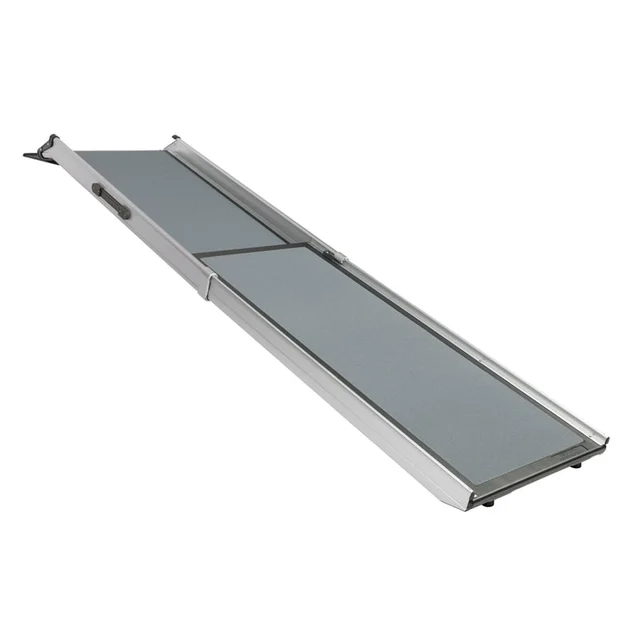
- Buy PetSafe Happy Ride Telescoping Dog Ramp The gentle-incline aluminum ramp that suits large and senior dogs getting in and out of a car.
- Buy Pet Gear Easy Step Bed Stair A stable four-step indoor staircase that wraps around furniture and hides storage inside.
- It depends PetSafe Happy Ride Folding Dog Ramp A light, affordable bi-fold car ramp that works for smaller dogs but asks for a steeper climb.
- Skip Precious Tails Deluxe High-Density Foam 4-Step Pet Stairs Soft foam steps that look cozy but compress under real weight and offer little lasting grip.
What actually matters
- Incline angle: the slope a dog actually climbs. A shallow angle asks less of hips, knees, and spines; a steep one turns a short ramp into a scramble that many dogs refuse.
- Weight capacity with margin: the rated maximum should sit well above your dog's actual weight, since a moving dog puts more force on a ramp than a dog standing still.
- Surface traction: a textured, rubberized, or carpeted tread gives paws something to grip. A smooth or slick surface undermines confidence even on a gentle slope.
- Non-slip feet or a locking connection: rubber feet or a car-hook system keep the base from creeping or sliding out from under a dog mid-step.
- Foldability and portability: how small the ramp collapses and how much it weighs determine whether it's realistic to carry and store, especially for car use.
- Extended length or telescoping range: the maximum length available sets how gentle the incline can get for a tall vehicle or high bed.
- Ramp vs. stairs fit: the right category depends on the height being climbed and whether the dog needs zero-impact access or just a smaller step.
The specs, in plain English
Green flags vs red flags
Green flags
- Weight capacity comfortably above your dog's actual weight, not right at the edge
- A textured, carpeted, or rubberized surface described explicitly, not just implied by photos
- Rubber feet or a hook system mentioned for keeping the base in place
- A working length long enough to keep the incline shallow at your vehicle or furniture height
- Clear folded dimensions and weight, so you know it will actually fit in your trunk or storage spot
Red flags
- Weight capacity listed at or barely above an average dog's weight with no stated margin
- No mention of surface texture or grip, especially on plastic or foam construction
- Reviews or owner reports describing wobble, flex, or sliding under a moving dog
- A short folded ramp advertised for tall SUVs without clarifying the resulting incline
- Foam or soft-cover construction marketed for large or senior dogs despite a soft, compressible base
Who's who: the brands
- PetSafe - Known for both telescoping and folding car ramp lines, spanning premium long-extension ramps to lighter budget folding models.
- Pet Gear - Focuses on indoor stepped stairs with furniture-friendly shapes like L-shaped corner designs and hidden storage.
- Precious Tails - Makes soft, foam-based indoor steps aimed at very small pets and low-height furniture rather than car or high-bed use.
- Solvit - Another common name in telescoping and folding car ramps, competing directly in the same large-dog, car-access niche.
- PetStep - Specializes in lightweight, rigid folding ramps aimed at portability for car and boat access.
How to read a listing without getting fooled
Start with the incline, not the price or the folded size. If a listing gives a folded length and an extended length, do quick mental math against your car's tailgate or trunk height; a ramp that barely reaches the height you need will be steep no matter what the marketing photos suggest. Next check weight capacity against your dog's actual weight, and treat the stated number as a ceiling you should stay well under, not a target. Then look specifically for language about the surface, texture, tread, or grip, since many listings show a photo of a textured surface but only describe the frame material in the text. Finally, separate portability claims from safety claims: a ramp being light and foldable says nothing about how gentle its incline is once extended, and the two often trade off against each other.
How much should you spend?
Cost in this category tracks length, frame material, and weight capacity more than brand name. The cheapest options are usually short, single-fold ramps or lightweight foam stairs built for small pets and low heights; they can be a perfectly good fit if that's genuinely your situation. Spending more typically buys a longer telescoping ramp with a higher weight rating, a more weather-resistant aluminum frame, and sturdier stepped stairs with real storage or furniture-matching design. The extra spend is worth it when you have a large, senior, or joint-sensitive dog and a tall vehicle or bed, since those are exactly the cases where a shallow incline and solid construction matter most. It's less necessary for a small, healthy dog using a low step indoors, where a simpler and cheaper stair or ramp does the job fine.
Questions, answered
How do I know if my dog needs a ramp or stairs?
Think about the height and the dog. A ramp removes impact entirely with a continuous slope, which makes it the better choice for cars, tall beds, and any dog with hip, knee, or spine sensitivity. Stairs give a series of smaller steps, which work well for lower furniture indoors and for dogs that don't need a fully impact-free climb. Many households end up with both: a ramp for the car, stairs for the couch or bed.
What weight capacity should I actually look for?
Look well above your dog's current weight, not right at it. A dog stepping onto a ramp with any momentum or hesitation puts more force through it than its resting weight suggests, and weight can also change over a dog's life. If your dog is a large or growing breed, err toward a higher-rated ramp even if it costs more up front.
Why does a longer ramp matter if my dog is small?
Length controls incline, and incline controls how hard the climb feels regardless of the dog's size. A small dog going up a steep short ramp works just as hard, proportionally, as a large dog on the same angle. If your vehicle or bed is tall, a longer ramp keeps the slope manageable no matter what size dog is using it.
Are foldable ramps as safe as rigid telescoping ones?
They can be, but there's a trade-off. Folding ramps that collapse into a smaller package for the trunk usually do so with a single hinge, which tends to create a steeper angle at the same overall height compared with a telescoping ramp that stays rigid and long. For a small or medium dog and a lower car, a folding ramp is often fine. For a large or senior dog and a tall SUV, the shallower angle of a telescoping design is usually worth the extra size and weight.
How do I train a dog that's scared of a ramp or stairs?
Start flat. Lay the ramp on the ground with no incline at all and lure the dog across it with treats until it's comfortable with the surface and the sound underfoot. Gradually raise the incline over several short sessions rather than asking for the full climb on day one. A stable, grippy ramp builds trust faster than a wobbly or slick one, which is one more reason surface quality and a solid base matter.
Is a ramp or stairs safe for a dog recovering from surgery or with arthritis?
In general, a gentle-incline ramp is considered kinder to a healing or arthritic dog than jumping or climbing stairs, since it avoids sudden impact. This is general product information, not veterinary advice. If your dog has a diagnosed joint, spine, or mobility condition, or is recovering from a procedure, check with your veterinarian on what incline, height, and activity level are appropriate before introducing any ramp or stairs.
Or jump to the head-to-head: PetSafe Happy Ride Telescoping Dog Ramp vs Pet Gear Easy Step Bed Stair.