Explained
Dog Life Jackets, Explained
After reading this you will be able to judge any dog life jacket by its handle, its foam placement and its fit, and ignore every buoyancy claim on the label.
In this guide
A dog life jacket looks like a simple purchase until you notice that every single one claims superior buoyancy and none of them are certified by anybody. Human life vests are tested and approved against a published standard; dog flotation devices are not, so the numbers on the hangtag are the manufacturer grading its own homework. What separates a good vest from a decorative one is physical construction you can check with your hands: where the foam sits, how the handle is attached, and whether the neck and the chest adjust independently.
The 30-second version
- Nothing here is certified. No marine safety authority approves flotation devices for dogs, so buoyancy ratings, "maximum flotation" and "rescue handle" are marketing phrases with no test behind them. Judge construction, not claims.
- The handle is the feature you will actually use. The common emergency is not drowning, it is a dog that cannot climb back onto a boat, dock or paddleboard, and you lifting a soaked animal straight up with one hand.
- Foam belongs under the dog, not beside it. Panels along the flanks look substantial on a shelf and do very little. Under-chest and belly foam is what rotates a tiring dog back toward horizontal and keeps the nose clear of the water.
- Fit is the product, not a comfort detail. A vest that slides back over the shoulders traps the front legs and pushes the head down, which is worse than wearing nothing. Measure girth, and buy a jacket that adjusts neck and chest separately.
- A jacket buys time and a grip, never permission to stop watching. No vest makes a dog safe alone near water, stops a current, or keeps a dog from going under a dock. Supervision is the safety device; the jacket is the backup.
The products this guide is about
Our verdict on each, with the full reasoning on the companion review.
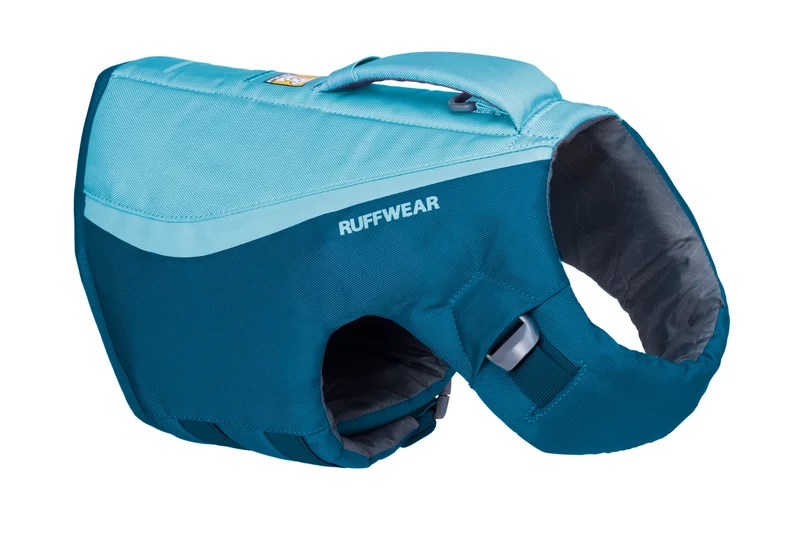
- Buy Ruffwear Float Coat The jacket engineered around the moment you have to haul a soaked dog vertically out of the water. Amazon
- Buy EzyDog DFD Dog Life Jacket Most of the Ruffwear's engineering for a lot less, with the flotation in the right place and a handle that holds. Amazon
- It depends Outward Hound Granby Splash Dog Life Jacket Excellent value for a light dog in calm water, and not the jacket you want under a seventy pound dog in chop. Amazon
- Skip Vivaglory Ripstop Dog Life Jacket Lists every feature the good jackets have, then falls down on the two that decide outcomes: fit and the handle. Amazon
What actually matters
- A structural lift handle. It should be stitched into the load-bearing webbing that wraps the dog, not tacked onto the outer shell. Grip it and pull hard before you buy. A handle that puckers the fabric around its stitching is a steering aid, not a rescue point.
- Handle position over the shoulders. A handle set forward, above the shoulders, brings a lifted dog up roughly level. One placed at the mid back folds the dog at the waist, which is both harder on your arm and frightening for the dog.
- Under-chest and belly foam panels. Turn the jacket over and look at the underside. A full foam panel beneath the chest and belly keeps a tired dog horizontal. A thin belly band with straps floats a fresh dog fine and offers much less once the dog is exhausted.
- Independent neck and girth adjustment. Most dogs do not land on one size at both the neck and the rib cage. A jacket that only cinches at the girth will ride up into the throat or slide backward, and a telescoping or separately adjustable neck fixes the dimension that most often goes wrong.
- Head-up support late in a swim, not early. Every jacket floats a fresh dog. Differences appear at minute forty, in chop, and on older, heavy-chested or short-muzzled dogs. Owner reports from long swims are far more informative than any spec.
- Visibility. Orange and yellow are dramatically easier to track on grey water than blue, green or camo, and reflective striping earns its place at dusk and in low light.
- Comfort and dry time for the way you actually use it. Neoprene spreads load well and wears comfortably all day, but holds water and stays damp in a car or hatch. Thin ripstop dries fast and pads less. Neither is better in the abstract; pick for your routine.
The specs, in plain English
Green flags vs red flags
Green flags
- The handle visibly continues into the webbing that wraps around the dog's body, rather than stopping at the shell fabric.
- The underside photo in the listing shows continuous foam beneath the chest and belly, and the brand shows that photo without being asked.
- The size chart is built on girth measurements, with weight offered only as a rough secondary hint.
- The neck adjusts separately from the girth straps, by sleeve, buckle or its own strap.
- High-visibility color options with reflective striping, and a fit range described by breed shape rather than weight alone.
- Owner reports that describe long swims, tired dogs and successful boat lifts, not just how cute the vest looks.
Red flags
- The listing leads with a buoyancy number or the phrase "maximum buoyancy", since there is no standard behind either.
- Sizing is by weight only, or reviewers repeatedly report that a size runs small and runs small unevenly across body shapes.
- The word "rescue" appears in the product title while the handle is plainly a loop stitched to the outer shell.
- Reviews mention the foam needing to be broken in, which usually means stiff panels sitting along the flanks rather than conforming under the chest.
- No photograph of the jacket's underside anywhere in the listing.
- Reports of the vest sliding backward over the shoulders, or of shell fabric fraying within a single season of use.
Who's who: the brands
- Ruffwear - Performance dog gear brand that engineers around the lifting problem; its Float Coat integrates the handle into the vest structure and wraps foam under the chest, at the highest price in the category.
- EzyDog - Australian brand whose DFD puts flotation under the chest and belly with wide neoprene straps, offering most of the premium engineering for meaningfully less.
- Outward Hound - High-volume mainstream brand and the default purchase for many owners; wide size range, two webbing top handles and a front neck float, best suited to lighter dogs in calm water.
- Kurgo - Broad outdoor and travel gear line for dogs, widely stocked, generally mid-priced with conventional strap-and-panel vest construction.
- Vivaglory - Budget online brand with bright ripstop vests that list every premium feature on paper; owner reports point to inconsistent sizing and a handle better suited to steering than lifting.
- Unbranded marketplace sellers - Near-identical vests sold under rotating names with copied listing photos and no consistent sizing; the category where uncertified claims do the most damage.
How to read a listing without getting fooled
Start by ignoring the top third of the listing, which is where the buoyancy claims and the word "rescue" live. Scroll to the photographs and look for one specific image: the jacket photographed from underneath. If it does not exist, assume there is a strap rather than a foam panel down there. Next, read the size chart and check whether it asks for a girth measurement or only a weight range; weight-only sizing is a strong hint that fit was not designed carefully. Then look at the strap diagram and count the adjustment points, checking specifically whether the neck can be changed without changing the girth. Finally, filter the reviews toward the largest dogs and the longest swims. Comments from owners of small dogs in swimming pools tell you almost nothing about the failure modes that matter, while a review describing a soaked seventy pound dog lifted over a gunwale tells you everything. Photographs uploaded by owners are worth more than the brand's studio shots, because they show how the vest actually sits on a real body shape.
How much should you spend?
Price in this category tracks construction more closely than it tracks features, because features are cheap to list and construction is expensive to build. The budget tier gets you a bright vest with adjustable straps, webbing handle loops and flank foam, which is genuinely enough for a light dog paddling in a calm lake or a backyard pool a few times a summer. Stepping up to the middle of the market buys the two things that actually decide outcomes: foam positioned under the chest and belly, and a handle sewn into the load-bearing webbing. That is the largest jump in real capability anywhere on the price ladder, and for most owners it is where the money should stop. The premium tier adds refinement rather than a new capability: handle geometry that brings a large dog up level instead of folded, a neck that adjusts independently of the girth, and materials that survive repeated seasons. That refinement is worth paying for if your dog is large, if you boat in open or moving water, or if hauling the dog back aboard is a routine part of the day. It is not worth paying for if the dog swims occasionally in calm water. The one place not to economize is the gap between the cheapest vests and a jacket with a real lift point, because that gap is small in money and large in what the vest can actually do.
Questions, answered
Are dog life jackets certified or approved like human life vests?
No. Human personal flotation devices are tested and approved against a published standard, and no marine safety authority certifies flotation devices for dogs. There is no required buoyancy rating, no lift testing and no labeling rule, which is why two jackets can both claim maximum buoyancy and behave completely differently in the water. Because the claims are unregulated, the only reliable signals are physical: where the foam sits, how the handle is attached, and whether neck and girth adjust independently.
My dog is a strong swimmer. Does she need one?
Strong swimmers still tire, still get pulled by current, and still cannot climb a boat ladder. The jacket does two jobs: it adds endurance so a long swim back to shore stays survivable, and it gives you a handle so you can lift her out. Owners of confident retrievers consistently report the handle is the feature they end up using, not the flotation. It also does not replace you. No jacket makes it safe to leave a dog unattended near water.
How do I size one correctly?
Measure girth, the circumference of the rib cage at its widest point just behind the front legs, and buy to that rather than to weight. You should be able to slide two fingers under each strap and no more. Then test the fit by tugging the handle: the jacket must not slide backward over the shoulders, because a vest that rides back traps the front legs and pushes the head down. Deep-chested and barrel-chested dogs usually need to size up, and dogs that fall between sizes at the neck and the chest need a jacket that adjusts those two dimensions separately.
Can I really lift my dog by the handle?
On a jacket where the handle is stitched into the load-bearing webbing, yes, and that is the point of it. Test it dry at home first. Lift the dog briefly and watch the posture: the dog should come up roughly level rather than folded at the middle, and the stitching around the handle should not pucker or distort. If it does either, treat that jacket as a steering aid, not a rescue tool. When you do lift, pull smoothly rather than snatching, and support the chest with your other hand when you can.
Does a neck float help or get in the way?
It depends on the dog. A foam block at the throat genuinely helps puppies, nervous first-time swimmers and short-muzzled breeds keep the chin clear of the water. Confident, fast swimmers often dislike it, because it props the head higher than their natural swimming posture and makes the stroke feel wrong. If your dog swims strongly and resists the vest, a jacket without a neck float is usually the better match.
How do I get a dog comfortable wearing one?
Introduce it on dry land. Put it on indoors for short sessions with treats so the vest predicts good things rather than a scary lake, then let the dog walk and play in it. Move to shallow water where the dog can stand, then short swims close to shore, then longer ones. Stay in the water alongside for the first few sessions. A dog that has only ever worn the jacket at the moment of being put in deep water will associate the two, and that is harder to undo than to avoid.
Or jump to the head-to-head: Ruffwear Float Coat vs EzyDog DFD Dog Life Jacket.