Explained
Dog Muzzles, Explained
After reading, you'll understand the difference between a basket and a sleeve muzzle, how to measure your dog so a muzzle actually fits, and which materials and straps suit which jobs.
In this guide
Almost every muzzle mistake comes from one word doing two jobs. 'Muzzle' covers both a rigid cage that leaves the mouth free and a fabric tube that binds it shut, and listings rarely make the difference obvious. The second trap is sizing: many pages suggest a size by breed, which is close to useless when two dogs of the same breed can differ by an inch of snout. Get those two things right and the rest is detail.
The 30-second version
- Basket or sleeve is the first fork, and it decides whether the muzzle can be worn for an hour or only for a couple of supervised minutes.
- Panting is how dogs cool down, so anything that holds the jaw closed carries a heat risk that grows with temperature and stress.
- Measure, do not guess, because snout length and circumference vary far more within a breed than breed charts admit.
- Treats have to get through, since muzzle conditioning is built on rewarding the dog while the muzzle is on.
- A second strap is not optional, as a single neck strap is what most escape artists defeat on their first outing.
The products this guide is about
Our verdict on each, with the full reasoning on the companion review.
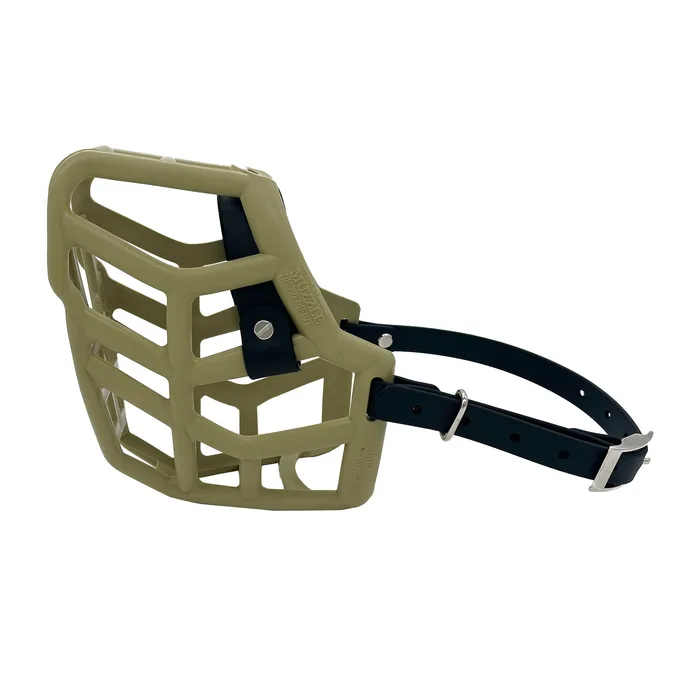
- Buy The Muzzle Movement Made-to-Order Basket Muzzle A made-to-order plastic basket on riveted biothane straps, sized from your own snout measurement rather than a breed chart.
- Buy Company of Animals Baskerville Ultra Muzzle The default basket muzzle: thermoplastic rubber, heat-shapeable at home, and easy to find in almost any pet shop. Amazon
- It depends JAFCO Regular Plastic Basket Muzzle A rigid, hand-made plastic basket built for long wear, still made to a design a police dog trainer drew up in 1974.
- Skip Trixie Muzzle Loop A polyester sleeve that holds the jaw shut, which the maker lists for short-term use and which most buyers use for far longer. Amazon
What actually matters
- Basket design - a cage that surrounds the snout and leaves the mouth free to open. This is the style suited to walks, vet visits, transport or any wear measured in hours rather than minutes.
- Snout circumference - the measurement around the snout at its widest point, taken with the mouth closed. Makers ask you to add clearance to this number, because a basket sized exactly to the closed mouth prevents panting just as effectively as a fabric sleeve would.
- Snout length - the distance from the stop out to the tip of the nose. Too short and the nose presses into the end of the basket; too long and the muzzle rides back into the dog's eyes when it sniffs the ground.
- Head or forehead strap - a second strap that runs over or behind the head, above the neck strap. It is what keeps the muzzle from being reversed off, which is why Company of Animals recommends using the Baskerville headstrap and collar loop together while a dog is still learning.
- Treat access - a hole in the front of the basket or gaps large enough to post food through. Without it you cannot reward a dog for wearing the muzzle, which makes conditioning far slower and the muzzle far less welcome.
- Nose pad - felt or foam padding on the bridge where the muzzle rests. It is a small part that decides whether a long wear ends with a comfortable dog or a rub mark.
- Rigidity - how much the basket flexes when pushed. Rigid polyethylene gives maximum security and holds its shape; softer thermoplastic rubber is more forgiving and can be reshaped with heat, at the cost of some absolute stiffness.
The specs, in plain English
Green flags vs red flags
Green flags
- The listing gives you a measuring method with snout length and circumference, not just a breed list.
- The maker states in its own words that the dog can pant, drink and take treats while wearing it.
- There is a second attachment point: a forehead strap, an occipital strap or a collar loop.
- The basket material is named explicitly, whether that is polyethylene, thermoplastic rubber or vinyl.
- Individual replacement parts and fit accessories are sold separately, which means the maker expects the muzzle to last.
Red flags
- The size chart is nothing but breed names.
- The product is described as 'anti-barking', which a basket muzzle does not do and a sleeve muzzle achieves only by binding the jaw.
- Photographs show the muzzle fitting tightly around a closed mouth with no clearance for panting.
- The words 'bite proof' appear as an absolute claim; there is no industry standard behind that term.
- A soft fabric design is marketed for walks, car travel or all-day use rather than for brief restraint.
Who's who: the brands
- Company of Animals - Makes the Baskerville range, including the Ultra, the Classic, a wide-fit model for broad-nosed dogs and a clear-look version, and is the line you are most likely to find in a shop.
- The Muzzle Movement - A UK maker producing made-to-order plastic baskets on biothane straps, with a measurement-led sizing process and a large catalogue of fit accessories.
- JAFCO - A small US maker that has been hand-building rigid plastic basket muzzles to a police dog trainer's 1974 design, with optional third straps.
- Trixie - A large European pet supplier whose range spans plastic basket muzzles, short-nose designs for flat-faced breeds and the fabric loop muzzles it lists for short-term use.
- Leerburg - A working dog supplier that carries plastic, leather and biothane muzzles alongside its own designs, and is a common route to specialist models.
How to read a listing without getting fooled
Start at the bottom of the listing, not the top. The marketing copy will tell you the muzzle is comfortable and secure; the specification block tells you what it is made of, how many sizes exist and, crucially, what the maker says about wear time. A phrase like 'for short-term use' is the manufacturer telling you the honest answer. Next find the sizing instructions and check whether they ask for two measurements or just a breed. If there is a chart, note which measurement wins when your dog straddles two sizes, because good makers say so explicitly. Then look at the photographs of the muzzle on a dog and check for visible clearance between the basket and the mouth. Finally, check what the strap arrangement actually is: a single neck strap, a neck strap plus a forehead strap, or a neck strap plus a collar loop, since that determines how easily the thing comes off.
How much should you spend?
This is a category where the budget tier is genuinely usable. A well-known off-the-shelf basket muzzle sits at the budget end and does everything the average owner needs, which is why it is our value pick; fabric sleeve muzzles sit in the same tier and are cheap for a reason. Mid-range buys you a rigid, hand-made basket from a specialist maker with options like extra straps and a treat hole. Premium means made to order: you send a measurement, wait, and get a muzzle built for your dog's face with add-on parts to fix any remaining rubbing or slipping. The premium tier is worth it when a muzzle is part of daily life or when off-the-shelf sizes have already failed you, and hard to justify for a dog that will wear one twice a year. Accessories such as scavenger guards, foam nosebands and replacement straps are usually priced separately.
Questions, answered
Will a muzzle stop my dog barking?
A basket muzzle will not, because the mouth can still open. That is by design: JAFCO explicitly lists barking alongside breathing and panting as things its muzzle does not inhibit. A sleeve muzzle muffles barking only because it binds the jaw shut, which is exactly the property that makes it unsafe for anything but brief use. If barking is the problem, it is a training and management issue rather than an equipment one.
Will a basket muzzle stop my dog eating things off the ground?
Not on its own, and makers are increasingly upfront about this. The gaps that let a dog pant and take treats are also large enough to admit a stone or a discarded chip. The Muzzle Movement says plainly that its muzzles are not scavenge-proof without the separate scavenger guard that clips over the front. If scavenging is your actual reason for buying, budget for that add-on or choose a basket with deliberately narrow openings.
Can my dog wear a muzzle in a crate or in the car?
Unsupervised muzzle wear is where things go wrong, because a muzzle can snag on a crate bar or a seatbelt and a dog cannot free itself. Even basket muzzles built for extended wear are meant to be worn while you are present. Company of Animals recommends supervision even though the basket design allows long wear. Treat the muzzle as equipment for times when you are with the dog, and take it off before you leave.
Do I have to muzzle my dog by law?
It depends entirely on where you live and how you are travelling. Some countries and regions require certain dogs to be muzzled in public, and airlines, railways and ferry operators often set their own rules for dogs in shared spaces. Those requirements often specify muzzling in public rather than a particular product, so a properly fitted basket muzzle normally satisfies them. Check the specific rule that applies to you before you travel rather than assuming.
Or jump to the head-to-head: The Muzzle Movement Made-to-Order Basket Muzzle vs Company of Animals Baskerville Ultra Muzzle.