

Pets
The Best Dog Muzzles: 4 Compared (and One to Skip)
We compared four muzzles on the things that actually decide whether one is safe to use: whether the dog can pant, drink and take treats in it, how the maker tells you to size it, and how long it is built to be worn.
The short version
The Muzzle Movement's made-to-order basket muzzle is the best overall, because it is built around a measurement you take yourself rather than a breed label, and the open basket leaves room to pant, drink and take food. The Baskerville Ultra is the value pick and the one most people should try first: it is stocked almost everywhere, the thermoplastic rubber basket can be heat-shaped to your dog's face in hot tap water, and Company of Animals states it allows panting, drinking and treats. JAFCO's hand-made plastic basket is the 'it depends' choice, right for a handler who wants a rigid, long-wear muzzle with an optional third strap and does not care that it looks like police kit. The Trixie Muzzle Loop is the one to skip for general use: it is a polyester sleeve that holds the jaw closed, and Trixie itself lists it as 'for short-term use'. A dog that cannot open its mouth cannot pant, and panting is how dogs shed heat. Whichever you buy, measure the snout for length and circumference and ignore the breed chart. Best for: anyone who needs a muzzle their dog can wear comfortably for a whole walk, a vet visit or a training session rather than for ninety seconds.
Our picks at a glance
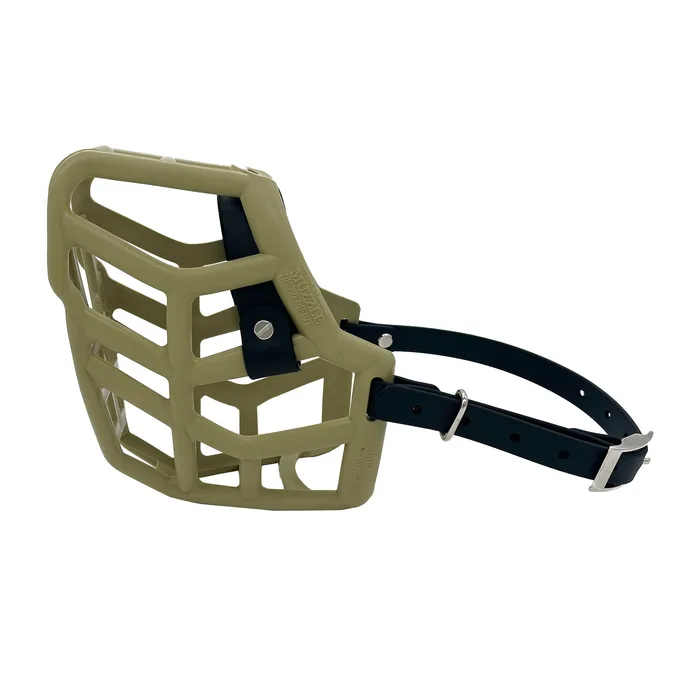
- The Muzzle Movement Made-to-Order Basket Muzzle - Buy. A made-to-order plastic basket on riveted biothane straps, sized from your own snout measurement rather than a breed chart.
- Company of Animals Baskerville Ultra Muzzle - Buy. The default basket muzzle: thermoplastic rubber, heat-shapeable at home, and easy to find in almost any pet shop.
- JAFCO Regular Plastic Basket Muzzle - It depends. A rigid, hand-made plastic basket built for long wear, still made to a design a police dog trainer drew up in 1974.
- Trixie Muzzle Loop - Skip. A polyester sleeve that holds the jaw shut, which the maker lists for short-term use and which most buyers use for far longer.
The verdict in 30 seconds
What mattered most
- Type
- Basket material
- Strapping
- Panting and drinking
- Treats through the front
- Intended wear time
A muzzle is a piece of safety equipment, in the same category as a seatbelt or a life jacket, and the buying decision is mostly a welfare decision. The market splits cleanly in two: basket muzzles, which surround the snout in a rigid or semi-rigid cage and leave the mouth free to open, and fabric sleeve muzzles, which wrap the snout and hold the jaws shut. Those two things are sold side by side under the same word, and they are not interchangeable. We looked at four widely available options across that split, checked what each maker actually claims on its own spec sheet, and picked on fit, ventilation and honest wear time.
A made-to-order plastic basket on riveted biothane straps, sized from your own snout measurement rather than a breed chart.
Best for: An owner who expects to muzzle regularly and wants the fit sorted properly the first time.
- The basket is molded plastic and the strapping is biothane, with straps riveted rather than stitched.
- Sizing runs off a measured snout length plus a size quiz, and the company says outright not to size by breed alone.
- Add-ons cover the usual fit problems: foam noseband, chin strap, head strap and a scavenger guard.
- Made to order, so there is a wait before it arrives.
- Some sizes in the range are pre-order only rather than in stock.
- The open basket means it will not stop scavenging unless you add the separate scavenger guard.
- It is the most expensive option here by a wide margin.
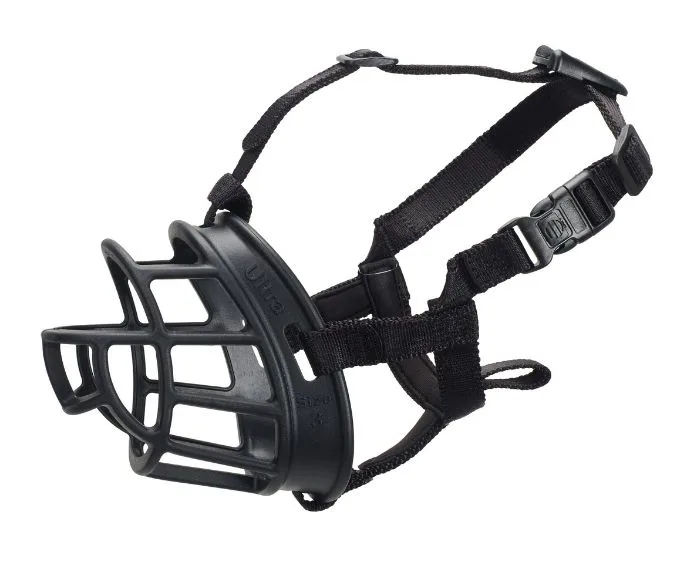
The default basket muzzle: thermoplastic rubber, heat-shapeable at home, and easy to find in almost any pet shop.
Best for: Almost anyone buying a first muzzle, and anyone who needs one this week rather than next month.
- Company of Animals states it is designed to let a dog pant, drink and enjoy treats while worn.
- The thermoplastic rubber basket can be softened in hot tap water and hand-shaped to your dog's face, then set in cold water.
- Ships with both a collar loop and a headstrap, which the maker recommends using together while a dog is still learning.
- Thermoplastic rubber flexes, so it is less absolutely rigid than a hard plastic basket.
- Broad, short-nosed dogs are pointed at a separate wide-fit model rather than this one.
- Getting the heat-shaping right is trial and error the first time.
- Off-the-shelf sizes still leave some head shapes between sizes.
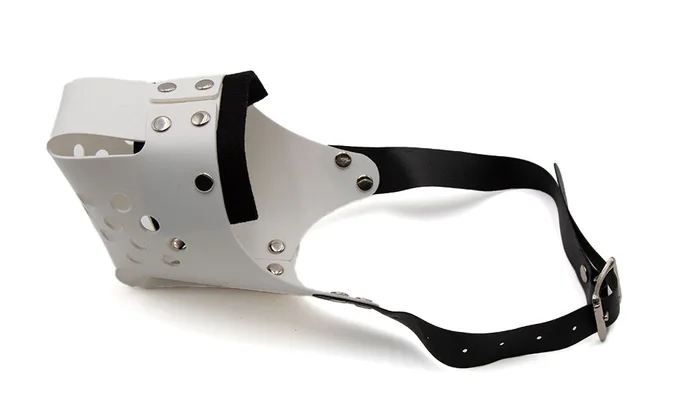
A rigid, hand-made plastic basket built for long wear, still made to a design a police dog trainer drew up in 1974.
Best for: Handlers who want maximum rigidity and all-day wear and are happy to order by measurement from a specialist.
- JAFCO says it is designed to be worn for extended periods without inhibiting breathing, barking or panting, and that dogs can drink from a bowl in it.
- Choice of rigid white or black polyethylene or clear vinyl, which is more pliable, with reinforced neoprene straps.
- A third strap is available in sizes 2 to 5 and 3X; the Rottweiler sizes come with it as standard.
- It looks like working kennel equipment, which some owners find draws more attention on a walk.
- Bought from a small maker or a specialist dealer rather than off a shop shelf.
- Options such as the third strap are set at the time you order.
- A rigid basket has no give, so a size that is slightly wrong stays slightly wrong.
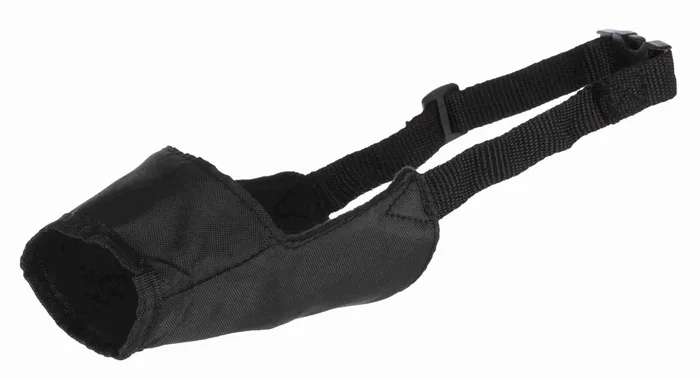
A polyester sleeve that holds the jaw shut, which the maker lists for short-term use and which most buyers use for far longer.
Best for: A clinic drawer, for brief restraint under direct supervision, and almost nothing else.
- Cheap, light and folds into a pocket.
- Six sizes covering an inner circumference from 12 cm to 35 cm, with a fully adjustable neck strap and snap-fit buckle.
- Genuinely useful for the ninety seconds a vet or nurse needs for a quick examination.
- It works by holding the jaws closed, so the dog cannot pant, and panting is how dogs shed heat.
- No drinking and no treats, which removes the reward you need for muzzle conditioning.
- Trixie's own product data lists it as for short-term use, which is not how most people end up using it.
- Wrong tool for walks, training sessions, car journeys or anything longer than a few minutes.
| Criteria | Made-to-Order Basket Muzzle Top pick | Baskerville Ultra Muzzle | Regular Plastic Basket Muzzle | Muzzle Loop |
|---|---|---|---|---|
| Verdict | Buy it | Buy it | It depends | Skip it |
| Best for | An owner who expects to muzzle regularly and wants the fit sorted properly the first time. | Almost anyone buying a first muzzle, and anyone who needs one this week rather than next month. | Handlers who want maximum rigidity and all-day wear and are happy to order by measurement from a specialist. | A clinic drawer, for brief restraint under direct supervision, and almost nothing else. |
| Price tier | $$$ · premium | $ · budget | $$ · mid-range | $ · budget |
| Type | Basket, made to order | Basket, off the shelf | Basket, made to order sizes | Fabric sleeve |
| Basket material | Molded plastic | Thermoplastic rubber (TPR) | Polyethylene or clear vinyl | Polyester |
| Strapping | Biothane, riveted | Webbing, collar loop and headstrap | Reinforced neoprene | Webbing, snap-fit buckle |
| Panting and drinking | Yes, open basket | Yes, stated by maker | Yes, stated by maker | No, jaws held closed |
| Treats through the front | Yes, open basket | Yes, stated by maker | Open basket, drinking possible per maker | No |
| Intended wear time | Extended wear | Daily walks or occasional use | Extended periods | Short-term use, per maker |
| How you size it | Measured snout plus size quiz | Nose length and circumference | Numbered sizes 0 to 5 plus 3X and two Rottweiler sizes | Inner circumference, six sizes |
| Fit adjustment | Optional foam noseband, chin and head straps | Heat-shape in hot tap water | Optional third strap, sizes 2 to 5 and 3X | Neck strap only |
Which one is right for you?
- An owner who expects to muzzle regularly and wants the fit sorted properly the first time. Buy it The Muzzle Movement Made-to-Order Basket Muzzle
- Almost anyone buying a first muzzle, and anyone who needs one this week rather than next month. Buy it Company of Animals Baskerville Ultra Muzzle
- Handlers who want maximum rigidity and all-day wear and are happy to order by measurement from a specialist. It depends JAFCO Regular Plastic Basket Muzzle
- A clinic drawer, for brief restraint under direct supervision, and almost nothing else. Skip it Trixie Muzzle Loop
How we judged the field
Five things decide whether a muzzle is worth owning. First, can the dog open its mouth in it, because that governs panting, drinking and whether you can reward the dog for wearing it at all. Second, does the maker tell you to size by measurement rather than by breed, since head shape varies enormously inside a breed and a muzzle that is too tight around the snout stops the mouth opening even if the basket looks roomy. Third, what is the basket actually made of, because rigid polyethylene, flexible thermoplastic rubber and coated fabric behave very differently on a dog that pushes. Fourth, how does it stay on, and specifically whether there is a second strap over the forehead or a collar loop to stop a determined dog from pawing it off. Fifth, how long the manufacturer says it is meant to be worn, which is a claim you can check and which separates the two halves of this market instantly.
The field splits along that last line. Basket muzzles are built for extended wear and are the correct answer for walks, vet visits, transport and training. Sleeve or grooming muzzles hold the jaw closed and are built for a brief moment of restraint, which is why their makers describe them in minutes rather than hours. We picked two basket muzzles we would happily recommend at opposite ends of the effort-and-cost scale, one rigid specialist basket that is right for some owners and wrong for others, and one sleeve muzzle to show exactly what the skip category looks like and why it is not a strawman: it is a competent product being sold into the wrong job.
The Muzzle Movement Made-to-Order Basket Muzzle
Buy itThe Muzzle Movement builds each muzzle to order around a measurement you take yourself, and that is the whole argument for it. The basket is molded plastic, the strapping is biothane, and the straps are riveted on rather than sewn, so there is no stitching to work loose. Sizes carry names rather than numbers, and the company is blunt that you should not choose by breed: you measure from the waterline to the tip of the nose, run their sizing quiz, and order what it returns. The maker lists the standard Rex muzzle at roughly 144 grams. Optional foam nosebands, chin straps and head straps let you fix rubbing or an escape artist without buying a second muzzle. The trade-offs are real: you wait while it is made, some sizes are pre-order only, and the open basket means it will not stop a determined scavenger unless you add the scavenger guard. Right for the owner who is going to muzzle regularly and wants it correct the first time.
Company of Animals Baskerville Ultra Muzzle
Buy itThe Baskerville Ultra is the one most people should try first, because it is stocked almost everywhere and it gets the important things right. The basket is thermoplastic rubber rather than hard plastic, and Company of Animals states it is designed to let a dog pant, drink and enjoy treats while worn, which is the entire point of a basket design. The clever part is the heat-shaping: hot tap water for a couple of minutes, bend the basket by hand to match your dog’s face, then cool it in cold water to lock the new shape. That covers a lot of heads that would otherwise fall between sizes. It comes with a collar loop and a headstrap, and the maker recommends using both while a dog is still learning to accept it. Sizing goes by nose length and circumference, and if the two disagree the maker says follow nose length. Being softer, it is less absolutely rigid than poly, and broad short-nosed dogs are pointed at the separate wide-fit model. Right for a first muzzle, or a fast one.
JAFCO Regular Plastic Basket Muzzle
It dependsJAFCO has been making essentially the same muzzle since 1974, when a police service dog trainer designed it, and it is still hand made in the USA. You choose rigid white or black polyethylene, or clear vinyl, which is noticeably more pliable and also heavier: a size 4 runs 4.3 ounces in polyethylene against 7.3 ounces in vinyl. Straps are reinforced neoprene. Sizes are numbered 0 through 5 with an extra 3X and two Rottweiler-specific sizes, and you can add a third strap in sizes 2 to 5 and 3X. JAFCO says it is designed for extended wear without inhibiting breathing, barking or panting, and that dogs can drink from a bowl with it on. What you give up is convenience and kerb appeal. It looks like working kennel equipment, you order it from a small maker or a specialist dealer, and options like the third strap have to be chosen up front. Right for handlers who want rigidity and all-day wear.
Trixie Muzzle Loop
Skip itThe loop muzzle is the one to walk past, and Trixie’s version is at least honest about itself. The product data lists polyester, an adjustable neck strap with a snap-fit buckle, six sizes from 12 cm to 35 cm inner circumference, and the phrase ‘for short-term use (e.g. vets, train rides, etc.)’. The problem is structural rather than a quality fault. A sleeve muzzle works by holding the jaws closed, so the dog cannot open its mouth to pant, cannot drink and cannot take a treat. Dogs shed heat mainly by panting, so a jaw-closed muzzle on a warm day or on an already stressed dog is a genuine risk, and it also removes the food reward that muzzle conditioning depends on. For the two minutes a vet needs to check an ear, it is a reasonable tool and many clinics keep one in a drawer. Bought as a general-purpose muzzle for walks, training or a car journey, it is the wrong shape of thing entirely. Right for a clinic drawer, not your walking kit.
Sources
Specs in this review come from these pages.
- Company of Animals - Baskerville Ultra Muzzle product page (companyofanimals.com)
- Company of Animals - Baskerville WIDE FIT Muzzle product page (companyofanimals.com)
- JAFCO Muzzles - product specifications and materials (jafcomuzzles.com)
- JAFCO Muzzles - sizing guide (jafcomuzzles.com)
- The Muzzle Movement - how to measure your dog for a muzzle (themuzzlemovement.com)
- Trixie - Muzzle Loop product data, items 1920 to 1925 (trixie.de)
The Muzzle Movement Made-to-Order Basket Muzzle vs Company of Animals Baskerville Ultra Muzzle: which should you buy?
Both of our buy picks are basket muzzles that let a dog pant, drink and eat, so the choice between them is about how much of the fit problem you want to solve yourself. The Baskerville Ultra asks you to take two measurements, pick the nearest size, and then close the gap with hot water and your hands. That works well and it works today, because the thing is on shelves. The Muzzle Movement asks you to take the measurement more carefully, feed it into their sizing quiz, wait while the muzzle is made, and then tune the fit with parts rather than with heat: a foam noseband if it rubs, a chin strap or head strap if your dog is inventive about removing things.
Pick the Baskerville Ultra if this is your first muzzle, if you need it soon, or if your dog has a fairly conventional head that will land inside a standard size. Pick The Muzzle Movement if the muzzle is going to be part of daily life, if a previous off-the-shelf muzzle has already rubbed or slipped, or if your dog sits at an awkward point between sizes. One honest caveat in the other direction: if your main problem is scavenging, neither is a complete answer out of the box. The Muzzle Movement’s open front needs their scavenger guard clipped on, and any basket with gaps wide enough to pass treats through is wide enough to pass something else through too.
What to look for
- Basket, not sleeve: if the design holds the jaws shut, it cannot be worn for more than a few supervised minutes, whatever the listing implies.
- Room to open the mouth: a basket that is the same circumference as your dog’s snout stops panting just as effectively as a sleeve, so aim for clear space around the muzzle, not a snug wrap.
- Sizing by measurement: the maker should ask for snout length and circumference; a chart that only lists breeds is a warning sign in a category where head shape varies wildly inside every breed.
- A second point of attachment: a forehead strap, occipital strap or collar loop is what stops a determined dog reversing out of the muzzle on the first walk.
- Treat permeability: you can only condition a dog to a muzzle by feeding through it, so check for a treat hole or gaps big enough to pass food.
- Padding where it sits: a felt or foam nose pad on the bridge is the difference between a muzzle a dog tolerates for an hour and one that leaves a rub mark.
Our final take
Buy a basket muzzle. That single decision does most of the work here, because it is what preserves panting, drinking and the food reward that makes muzzle training possible. The Muzzle Movement’s made-to-order basket is the best of these four if you are prepared to measure carefully and wait, and it gives you parts rather than guesswork when something rubs. The Baskerville Ultra is the sensible default, cheap and everywhere, with a heat-shaping trick that rescues most awkward fits. JAFCO suits handlers who want rigid, all-day equipment and do not mind ordering by number from a specialist. The Trixie loop is fine for the ninety seconds a vet needs and wrong for everything else people buy it for.
Questions, answered
Can my dog pant in a muzzle?
In a properly fitted basket muzzle, yes, and that is the single most important thing to check before you buy. A basket surrounds the snout with a cage that leaves the mouth free to open, so the dog can pant, drink from a bowl and take food through the gaps. A fabric sleeve muzzle does the opposite: it wraps the snout and holds the jaws closed, which stops panting entirely. Dogs shed most of their heat by panting, not through their skin, so a jaw-closed muzzle on a warm day or on a stressed, worked-up dog is a real risk rather than a theoretical one. If you can only remember one rule from this page, make it that one.
How do I measure my dog for a muzzle?
You need two numbers and neither of them is the breed. Measure the length of the snout from the stop, the shallow step where the muzzle meets the forehead just below the eyes, out to the tip of the nose. Then measure the circumference of the snout at its widest point, usually just below the eyes, with the mouth closed. Makers differ slightly on where they want you to start: The Muzzle Movement asks for the measurement from the waterline to the tip of the nose. Then follow that maker's own chart rather than a generic one, because baskets differ in shape. Company of Animals adds a useful tie-breaker for the Baskerville range: if your two measurements land in different size categories, go by nose length.
Is it cruel to put a muzzle on a dog?
A well-fitted basket muzzle that a dog has been conditioned to accept is not a punishment, it is a management tool, in the same way a seatbelt is not a punishment. Plenty of dogs wear one for reasons that have nothing to do with aggression: eating rubbish or rocks on walks, licking a wound, a vet visit that would otherwise need heavy restraint, or a legal requirement in a particular place. What is unfair is strapping a muzzle onto a dog cold, leaving it on too long, or using a design that stops normal behaviour like panting and drinking. The muzzle itself is neutral. How you introduce it and which type you buy are the parts that matter.
What about flat-faced breeds like pugs and French bulldogs?
Short-nosed dogs need a design made for their head shape, not a smaller version of a standard muzzle. There is barely any snout to hold a normal basket in place, so a standard model either slips off or presses on the nose. Manufacturers respond in two ways. Some sell a dedicated short-nose model that sits on a much shorter basket and relies on a forehead strap for stability; Trixie lists a short-nosed breeds muzzle of this kind. Others sell a wide-fit basket for large broad-nosed dogs, which is how Company of Animals covers staffies, boxers and bully breeds. Flat-faced dogs also have less thermal headroom to start with, so the panting rule matters even more.
How long does it take to get a dog used to a muzzle?
Longer than most people expect, and the process is the same positive-reinforcement work you would use for a crate or a nail trim. You start by rewarding your dog for looking at the muzzle, then for touching it, then for putting the nose in voluntarily for a second, and you build from there. Company of Animals describes exactly this approach for the Baskerville range: treats to encourage the dog to place its nose in, a few seconds of wear, then removal and an immediate reward. Because the reward has to be delivered through the muzzle, this only works with a basket design that lets food through. Plan on weeks of short sessions rather than an afternoon, and go back a step whenever the dog starts trying to paw it off.
Deciding between the top two? See our head-to-head: The Muzzle Movement Made-to-Order Basket Muzzle vs Company of Animals Baskerville Ultra Muzzle.
More Pets reviews
 The Best Dog Nail Grinders: 4 Compared (and One to Skip)
  The Best Dog Raincoats: 4 Compared (and One to Skip)
  The Best Dog Seat Belts and Car Harnesses: 4 Compared (and One to Skip)
  The Best Dog Shampoos: 4 Compared (and One to Skip)
  The Best Dog Training Collars: 4 Compared (and One to Skip)
  The Best Dog Winter Coats: 4 Compared (and One to Skip)