

Pet Supplies
The Best Dog Food Storage Containers: 4 Compared (and One to Skip)
We compared four airtight dog and cat food containers on seal design, pest and moisture resistance, capacity, mobility, and long term durability.
The short version
Buy the Gamma2 Vittles Vault Outback if you want one container that stays sealed for years, especially in a garage, mudroom, or anywhere humid. Buy the IRIS USA WeatherPro if the container lives indoors and you value wheels, a visible fill level, and one hand latches over maximum seal longevity. The simplehuman Pet Food Can is a genuine option only when the container is visible furniture in a kitchen, because you are paying for steel and looks rather than a better seal. Skip the Van Ness: its snap on lid seals inconsistently across units, and thin plastic failures come up too often for a product whose entire job is keeping air and insects out. Whatever you choose, leave the kibble in its original bag inside the container and wash and fully dry the container between bags. Best for: households storing a full bag of dry dog or cat food for a month at a time who want it to still taste right at the bottom of the bag.
Our picks at a glance
- Gamma2 Vittles Vault Outback Stackable Pet Food Storage Container - Buy. A threaded gasket lid that keeps sealing years after latch style containers have given up.
- IRIS USA WeatherPro Airtight Pet Food Container with Wheels - Buy. The easiest container to actually live with indoors, with a gasketed lid that punches above its price.
- simplehuman Pet Food Can - It depends. Beautifully made stainless storage that earns its place in a visible kitchen and nowhere else.
- Van Ness Pet Food Container with Fresh-Tite Seal - Skip. The cheapest option on the shelf, and the one whose lid you will end up checking every single time.
The verdict in 30 seconds
What mattered most
- Seal design
- Pest and moisture resistance
- Material
- Capacity range
- Mobility
- Everyday ergonomics
A pet food container has one job: keep air, moisture, and insects away from an expensive bag of kibble for a month at a time. Most of them do it adequately for a year and then quietly stop, because the failure is always the closure rather than the box. We looked at four widely sold options, from a threaded gasket workhorse to a stainless kitchen piece, and one budget staple that we think you should walk past.
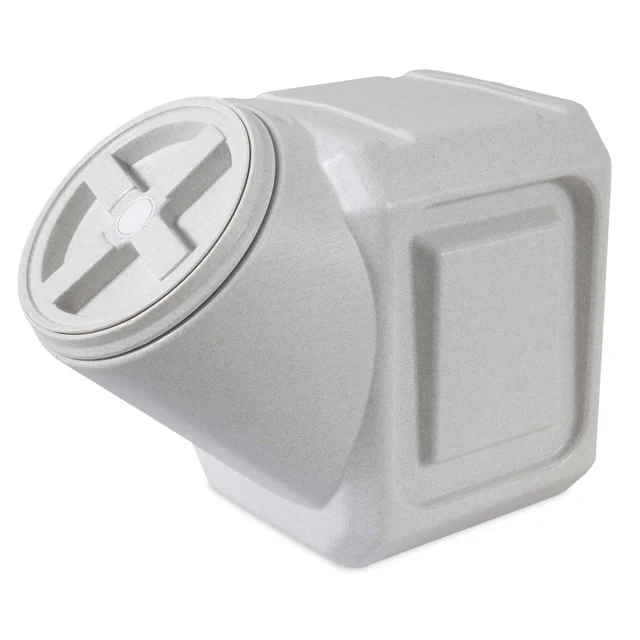
A threaded gasket lid that keeps sealing years after latch style containers have given up.
Best for: Anyone storing a full bag of kibble somewhere humid, hot, or pest prone, and anyone who wants to buy one container and stop thinking about it.
- Threaded lid compresses a gasket, so the seal does not depend on springy plastic clips
- Thick food grade HDPE body that owners report surviving garages, porches, and humid basements for years
- Squared tapered shape stacks, so two containers fit where one sprawling bin would
- Wide mouth makes it easy to drop a whole sealed bag inside rather than pouring loose kibble
- Lid needs a deliberate two hand twist, which is awkward when you are scooping one handed
- Opaque body means you lift the lid to check the level
- Stackable models have no wheels, so a full large size has to be tilted and walked
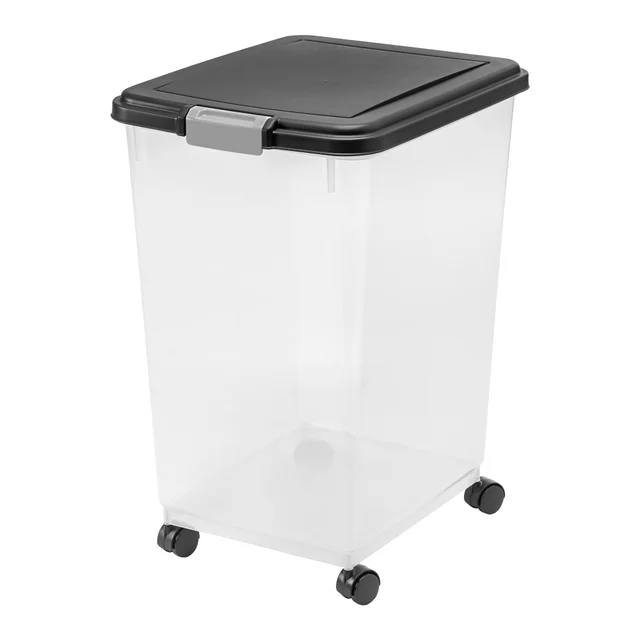
The easiest container to actually live with indoors, with a gasketed lid that punches above its price.
Best for: Indoor pantry, laundry room, or kitchen storage where you refill often and want wheels and a visible level without paying much.
- Gasketed lid with side latches seals far better than generic snap lid storage bins
- Casters make a full container easy to roll out, which means it actually gets cleaned
- Translucent body lets you check the level without breaking the seal
- Latches and the lid hinge are the wear points, and some owners report one failing under heavy use
- Thinner plastic than the Vittles Vault, and the clear body lets light at the food
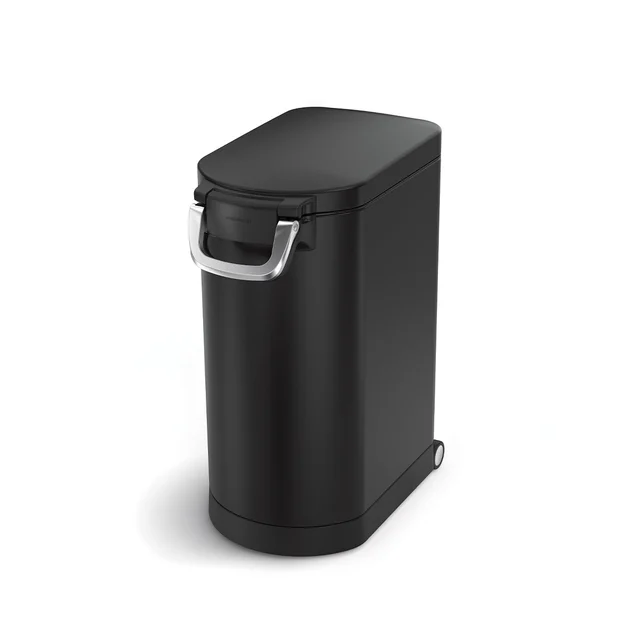
Beautifully made stainless storage that earns its place in a visible kitchen and nowhere else.
Best for: Kitchens and open plan spaces where the container is on display and a plastic bin would look wrong.
- Silicone gasket and locking handle seal well enough that owners report the kibble smell disappears from the pantry
- Steel does not absorb food oils or hold odor the way plastic slowly does
- Magnetic scoop clips under the lid, so it is never buried in the food
- Narrow upright footprint in three sizes and three finishes
- Costs a large multiple of the plastic options for no meaningful gain in seal quality
- Poor capacity for the footprint and the money, and heavy before you add food
- Brushed steel shows fingerprints, and a minority of owners report latch fussiness or shipping dents
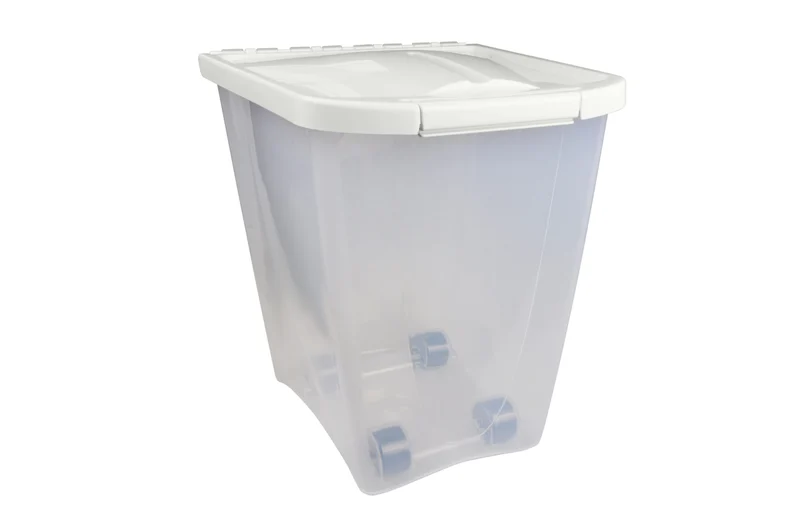
The cheapest option on the shelf, and the one whose lid you will end up checking every single time.
Best for: At most a small indoor canister for treats or a few days of food, where a perfect seal is not doing much work.
- Very inexpensive and stocked almost everywhere, in sizes from a few pounds up to a large bag
- Translucent smoke body shows the level,
- Snap on lid with side clips instead of a compressed gasket ring, and owner reports split sharply on whether it seals
- Repeated reports of clips cracking, lids that are hard to seat, and thin bodies splitting under load
- Inconsistency is the real problem: a seal that works on some units and not others is not one you can trust with a month of food
| Criteria | Gamma2 Vittles Vault Outback Stackable Pet Food Storage Container Top pick | IRIS USA WeatherPro Airtight Pet Food Container with Wheels | simplehuman Pet Food Can | Van Ness Pet Food Container with Fresh-Tite Seal |
|---|---|---|---|---|
| Verdict | Buy it | Buy it | It depends | Skip it |
| Best for | Anyone storing a full bag of kibble somewhere humid, hot, or pest prone, and anyone who wants to buy one container and stop thinking about it. | Indoor pantry, laundry room, or kitchen storage where you refill often and want wheels and a visible level without paying much. | Kitchens and open plan spaces where the container is on display and a plastic bin would look wrong. | At most a small indoor canister for treats or a few days of food, where a perfect seal is not doing much work. |
| Price tier | $ · mid-range | $ · budget | $$ · premium | $ · budget |
| Seal design | Threaded lid, gasket | Gasketed lid, twin side latches | Silicone gasket, locking handle | Snap on lid with side clips |
| Pest and moisture resistance | Strongest in this group | Good indoors, adequate in a dry garage | Very good, best used indoors | Inconsistent unit to unit |
| Material | Thick food grade HDPE | Food grade plastic, translucent | Steel with plastic lid components | Thin translucent plastic |
| Capacity range | Small canister up to a very large bag | Treat size up to a very large bag | Medium, large, and extra large | Small canister up to a large bag |
| Mobility | No wheels on stackable models, tilts and walks | Casters on larger sizes | Heavy before you add food | Rolls on some sizes |
| Everyday ergonomics | Two hand twist, opaque body | One hand latches, level visible | One hand latch, magnetic scoop | Lid can be fiddly to seat |
| Expected lifespan | Many years, few reported failures | Good, latches are the weak point | Long, steel does not degrade | Shortest, closure and body failures reported |
| Price tier | $ · mid-range | $ · budget | $$ · premium | $ · budget |
Which one is right for you?
- Anyone storing a full bag of kibble somewhere humid, hot, or pest prone, and anyone who wants to buy one container and stop thinking about it. Buy it Gamma2 Vittles Vault Outback Stackable Pet Food Storage Container
- Indoor pantry, laundry room, or kitchen storage where you refill often and want wheels and a visible level without paying much. Buy it IRIS USA WeatherPro Airtight Pet Food Container with Wheels
- Kitchens and open plan spaces where the container is on display and a plastic bin would look wrong. It depends simplehuman Pet Food Can
- At most a small indoor canister for treats or a few days of food, where a perfect seal is not doing much work. Skip it Van Ness Pet Food Container with Fresh-Tite Seal
How we judged the field
We do not run a lab. We synthesize manufacturer specifications and the pattern that shows up across owner reports once a container has been opened twice a day for a year. That last part matters more than spec sheets here, because pet food containers fail slowly: a latch that loosens, a gasket that flattens, a hinge that snaps in cold weather.
Four things did most of the sorting. Seal architecture came first, because a threaded lid compressing a full gasket ring behaves nothing like a snap latch pressing on a foam strip. Pest and moisture resistance came second, since that is where budget containers give up first, especially in garages, mudrooms, and basements. Ergonomics came third: capacity matched to a real bag size, a mouth wide enough for a scoop, and either wheels or a shape you can actually drag when it is full. Longevity came fourth, because a container that cracks in year two was never cheap.
One point up front, because it changes what you should buy. Most pet nutrition guidance favors keeping kibble in its original bag and setting the whole bag inside the container, since the bag carries a grease barrier and the lot code you would need in a recall. So the question is not just “how many quarts” but “does a sealed bag fit in here without a fight.”
This is the container most people should stop looking after. The lid threads down onto a gasket rather than clipping shut, so the seal is compressive and even, and it does not depend on plastic tabs staying springy. Reviewers who compare containers side by side consistently put it at the top for seal integrity, and owner reports skew heavily toward the same conclusion after multiple years: the gasket keeps working, the threads do not strip, and moisture stays out even in unconditioned spaces.
The body is thick food grade HDPE with a squared, tapered profile that stacks. Two of them side by side handle a multi dog household or a dog plus cat split without a sprawl of mismatched bins. The narrow footprint relative to volume is genuinely useful in a laundry room.
The tradeoffs are real but small. The lid takes a deliberate two hand twist, which is mildly annoying if you scoop while holding a leash, and it is opaque, so you check the level by lifting rather than looking. There are no wheels on the stackable models, though the shape tilts and walks easily enough. Owners also note the wide mouth is easier to load a bag into than the tall narrow competitors.
If you want one container that will still be sealing correctly when your puppy is a senior, this is it.
The value pick, and it is not a grudging one. The WeatherPro uses a gasketed lid held by two side latches, and owner reports put it comfortably above generic snap lid bins for seal and spill resistance. The casters matter more than they sound: a full large size container is heavy, and being able to roll it out from under a counter is the difference between refilling it properly and letting it sit.
The translucent body is the other quiet win. You can see the level without opening it, which reduces how often the seal gets broken.
What to know: the latches and lid hinge are the wear points, and a minority of owners report one giving up after heavy use or in a cold garage. The plastic is thinner than the Vittles Vault, and clear plastic lets light at the food, which is a reason to keep the bag inside rather than pouring loose kibble in. Humidity over years can also soften the seal’s performance.
For most households, the seal quality per unit of money here is hard to argue with, and the wheels make it the easier container to live with day to day.
The simplehuman is the one that gets bought for the kitchen rather than the garage, and that framing is fair. Brushed or coated steel, a silicone gasket, a locking handle that a determined dog cannot nose open, and a scoop that clips magnetically under the lid. Owner reports are unusually positive about two specific things: the seal genuinely kills the kibble smell in a pantry, and steel does not absorb food oils the way plastic slowly does.
It comes in medium, large, and extra large, in brushed steel, matte black, and white. The narrow upright footprint is designed to sit next to a trash can without looking like storage.
The reasons this is a “depends” rather than a straight buy: it costs a large multiple of what the plastic options cost, the capacity per unit of money is poor, and a few owners report latch fussiness or shipping dents. Steel also shows fingerprints, and it is heavy before you add food. None of that is disqualifying, it just means you are paying substantially for appearance and material quality rather than for a better seal than the top plastic containers deliver.
Buy it if the container lives somewhere you look at every day and you would otherwise hide a plastic bin. Skip it if it lives in a garage.
This is the container you find cheapest on the shelf, and the reason to walk past it. The Fresh-Tite lid is a snap on design with side clips rather than a compressed gasket ring, and owner reports split sharply: some get a tight close, others report that the lid is genuinely difficult to seat, that it pops loose, or that the clips crack. That inconsistency is the problem. A seal that works on some units and not others is not a seal you can rely on for keeping ants and moisture out of a large bag of food.
The plastic is also noticeably thinner than the alternatives, and there are repeated reports of bodies cracking under load or handles failing when the container is dragged full. The translucent smoke finish and the wheels on larger sizes are nice touches, but they do not offset a closure you have to check every time.
There is one narrow case for it: a small size, used indoors, for treats or a few days of food, where a perfect seal is not doing much work. For a full bag of kibble stored for a month, spend the modest step up and get a real gasket.
Gamma2 Vittles Vault Outback vs IRIS USA WeatherPro: which should you buy?
These two solve the same problem from opposite directions, and the right answer depends on where the container lives.
The Vittles Vault wins on seal and on survival. A threaded lid compressing a gasket has no small springy parts to fatigue, which is why it is the one that keeps getting recommended for garages, porches, barns, and anywhere humid or buggy. It is also the one owners report still working after many years. If your container will be somewhere hot, damp, or pest prone, this is not a close call.
The IRIS WeatherPro wins on daily convenience and on price. Wheels, a translucent body you can check at a glance, and latches you flip with one hand. In a climate controlled pantry or laundry room, its seal is more than adequate, and it is simply pleasanter to use. The counterargument is longevity: the latches and hinge are the parts that fail, and they fail before the Vittles Vault fails at anything.
Practical split: indoors and you refill often, take the WeatherPro. Anywhere with humidity, temperature swings, or pests, take the Vittles Vault and accept the two hand twist.
What to look for
- Gasket compression, not just a gasket. A threaded or clamped lid that squeezes a gasket ring beats a snap lid resting on foam. Ask how the seal is loaded, not whether one exists.
- Fit a whole bag. Most guidance favors leaving kibble in its original bag inside the container, for the grease barrier and the lot code. Check the mouth width, not only the quart rating.
- Food grade, BPA free plastic or steel. Storage bins repurposed from the hardware aisle are often neither.
- Wheels or a shape you can move. Large capacity plus no mobility means it never gets cleaned.
- Smooth interior corners. Kibble fat builds a film that goes rancid. You want to be able to wipe every surface and dry it fully.
- Latch and hinge quality. These are the parts that break. Metal pins and thick plastic tabs outlast thin flexing clips.
- Opaque or shaded body. Light accelerates fat oxidation, which is another point in favor of keeping the bag inside.
- Stackability if you feed more than one animal. Two matched containers beat four mismatched ones.
Our final take
The Gamma2 Vittles Vault Outback is the container to buy if you only want to buy one. Its threaded gasket lid is the most reliable seal in this group by a clear margin, and it holds up in exactly the conditions that destroy cheaper bins. The IRIS USA WeatherPro is the better everyday container for an indoor spot: wheels, a visible level, one hand latches, and a seal that is genuinely good for the money, with the caveat that latches are its weak point.
The simplehuman Pet Food Can is a legitimate purchase for a kitchen where the container is visible furniture, and steel does resist odor and oil in a way plastic does not, but you are paying for material and looks rather than a better seal. The Van Ness is the one to skip: too much variation in whether the lid actually seals, and too many reports of thin plastic failing, for a category where the entire job is keeping air, water, and insects out.
Whichever you pick, leave the kibble in its bag, wash and fully dry the container between bags, and do not top up fresh food on top of old.
Questions, answered
Should I pour kibble straight into the container or leave it in the bag?
Leave it in the bag and put the whole bag inside. Pet food bags are built with a grease barrier that keeps fat from soaking into plastic, and the bag carries the lot code and best by date you would need if there is ever a recall. The container then does the airtight, pest proof, and light blocking work around it. This is why mouth width matters as much as quart rating when you are choosing a size.
Do airtight containers actually keep food fresher than the bag alone?
Yes, mainly by slowing two processes. Oxygen and warmth oxidize the fats in kibble, which is what makes old food smell stale and taste off to a picky eater, and humidity encourages mold. A rolled and clipped bag does neither job well. A compressed gasket seal also keeps out pantry moths, ants, and rodents, which is the failure mode most owners actually run into.
What size should I get?
Match it to the bag you buy, not to your pet's weight. If you buy one large bag a month, get a container that swallows that whole sealed bag with room to close the lid comfortably. Buying too large is a mild waste of floor space, buying too small means you decant into a second bin and lose the point. Two matched stackable containers work better than one enormous one if you feed a dog and a cat.
How often should I wash it?
Empty and wash it between bags, not once a year. Kibble leaves a thin film of fat on the interior that goes rancid and then transfers that flavor to the next batch, which is a common reason a dog suddenly turns picky. Wash with warm soapy water, rinse, and let it dry completely before refilling, since trapped moisture in a sealed container is worse than no container. Do not top fresh food onto old.
Will these keep out ants, mice, and raccoons?
A compressed gasket seal handles ants, pantry moths, and moisture reliably, and it keeps a curious dog out. Rodents and raccoons are a different problem: they work on the closure and on the plastic itself, so a threaded lid on a thick walled container is much harder for them than a clipped lid on a thin one. If you store food in a barn, shed, or open garage with known rodent pressure, the threaded gasket design is the one here best suited, and even then keep it off the ground and check the lid seat each time.
Deciding between the top two? See our head-to-head: Gamma2 Vittles Vault Outback Stackable Pet Food Storage Container vs IRIS USA WeatherPro Airtight Pet Food Container with Wheels.
More Pet Supplies reviews
 Best Dog GPS Trackers: Which One Actually Finds Your Dog
  The Best Dog Grooming Clippers: 4 Compared (and One to Skip)
  The Best Dog Harnesses: 4 Compared (and One to Skip)
  The Best Dog Leashes: 4 Compared (and One to Skip)
  The Best Dog Life Jackets: 4 Compared (and One to Skip)
  The Best Dog Muzzles: 4 Compared (and One to Skip)