Explained
Dog Boots, Explained
After reading, you'll understand how to size a boot correctly, why closures decide whether it stays on, and which of the three boot types your dog actually needs.
In this guide
First-time buyers usually get tripped up in the same two places. They order by breed or body weight instead of measuring the paw, and they buy a single pair expecting it to handle snow, summer asphalt and rocky trail. Neither works. Dog boots are sized off a specific paw dimension that differs by brand, and the way a boot attaches matters more than what the upper is made of. Once those two ideas land, the rest of the category is easy to read.
The 30-second version
- Measure, do not guess, because paw dimensions in inches are the only sizing input that transfers into a correct fit.
- Front paws are often wider, which is why several brands sell boots in sets of two rather than four.
- The closure decides retention, and it has to grip the narrow spot above the dew claw rather than the wide part of the paw.
- Waterproof is not warm, so check for a named lining if cold rather than wet is the problem you are solving.
- Three hazards, three boots, since winter salt and snow, hot pavement and trail abrasion are not solved by the same construction.
The products this guide is about
Our verdict on each, with the full reasoning on the companion review.
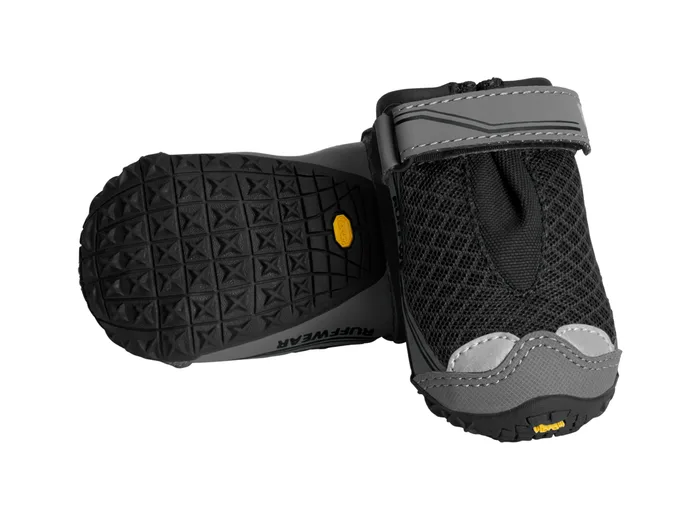
- Buy Ruffwear Grip Trex Dog Boots A genuine trail shoe for dogs, with a Vibram lugged outsole and the most convincing closure in the category. Amazon
- Buy PawZ Rubber Dog Boots A one-piece natural rubber boot with no strap to loosen, twelve to a pack, and the best value in paw protection. Amazon
- It depends Muttluks Original Fleece-Lined Muttluks A true winter boot with a fleece lining and a flexible leather sole, which is exactly why it is the wrong boot for summer.
- Skip Walkee Paws Deluxe Dog Boot Leggings Four molded boots permanently attached to leggings, which solves lost boots but narrows the fit window enough to rule out several kinds of dog.
What actually matters
- Paw width - the widest point across the paw when the dog is standing with full weight on it. This is the measurement Ruffwear sizes by, and it is the one that determines whether a structured boot slides on at all.
- Paw length - the distance from the back of the paw to the tip of the longest toenail, measured with the paw loaded. Muttluks sizes by this instead, which is why a size that fits in one brand means nothing in another.
- Closure position - where the strap or cinch tightens on the leg. Above the dew claw the leg narrows and a boot can hold, and any closure sitting lower will loosen as the dog walks.
- Outsole - the separate rubber layer between the pad and the ground. A lugged outsole is what buys traction and protection from rock and hot surfaces, and boots without one are barriers rather than shoes.
- Insulation - an actual lining material such as fleece, stated by the maker. Waterproofing and insulation are independent, and plenty of boots marketed for winter list neither.
- Pack size - how many boots come in a package, which ranges from two to twelve here. It affects both what you pay for a working set and how easily you replace the first boot to wear out.
- Wear surface - the ground your dog actually covers. Dry concrete chews through soles fastest, snow is gentlest, and Muttluks says boots wear fastest on dry concrete.
The specs, in plain English
Green flags vs red flags
Green flags
- A size chart built on measured paw dimensions in inches or centimetres, not breed names or body weight.
- The maker tells you to measure all four paws and to size down when you are between sizes.
- A named sole material or outsole partner rather than a vague claim about a rugged sole.
- Explicit care instructions, including how to wash the boot and how to maintain the sole.
- The maker states plainly which dogs the product does not suit, which is a sign the fit guidance is real.
Red flags
- Sizing given only as shoe numbers with a weight range attached and no paw measurement.
- One listing claiming winter warmth, hot pavement protection and trail durability at once with no lining or outsole named.
- Waterproof claimed for the whole boot when the sole is untreated leather or the upper is open mesh.
- No mention of a closure position or fit check, which usually means the closure was not designed around the leg's narrow point.
- Sets of four identical boots sold as the only option, which ignores that front and rear paws often differ.
Who's who: the brands
- Ruffwear - An Oregon outdoor pet gear brand whose boots are sized by measured paw width and sold in sets of two so front and rear paws can differ.
- Muttluks - A Canadian maker that has specialised in cold-weather dog boots since the 1990s and sizes by paw length rather than width.
- PawZ - Makes one-piece natural rubber slip-on boots sold twelve to a pack, a category of its own rather than a competitor to structured boots.
- Kurgo - A mainstream outdoor pet brand; check each model's pack size and sizing chart before assuming how many boots come in a box.
- Walkee Paws - Built its business on boots connected to leggings, aimed at owners whose main complaint is losing boots on walks.
How to read a listing without getting fooled
Start at the size chart, not the feature list, because it tells you how seriously the brand takes fit. If it asks for a paw measurement in inches or centimetres you can act on it; if it offers shoe numbers paired with body weight ranges, treat the fit as unverified. Then find the sole. A named outsole material or a stated leather sole tells you what the boot is for, while listings that only say rugged or anti-slip are describing nothing. Next, separate the waterproofing claim from any warmth claim, and look for an actual lining material before believing a boot is a winter boot. Check how many boots are in a package, since sets of two and sets of twelve mean very different things for cost and replacement. Finally, read the care and fit notes at the bottom of the page, because that is where honest makers put the limitations: how long the boots can stay on, which dogs they do not fit, and how quickly the soles wear.
How much should you spend?
Budget in this category means the rubber slip-on boots, which cost the least per boot and ship in packs with spares built in, and they are genuinely good rather than merely cheap for wet and salted pavement. Mid-range covers most fabric boots with a strap closure and a molded sole, along with the connected legging systems, and this is where the widest quality spread sits, so the sizing chart and the closure design should decide the purchase rather than the price. Premium buys a structured boot with a named outsole and a well-engineered cinch closure, or a purpose-built insulated winter boot, and the money goes into things you can see and verify. Be aware that some premium boots are sold two to a package, so the real cost of a working set is double the listed one. The most expensive mistake in this category is not overpaying, it is buying a mid-priced boot in the wrong size and never using it.
Questions, answered
Can my dog wear boots all day?
Generally no, and some makers say so directly. PawZ recommends taking its rubber boots off after an hour or two rather than leaving them on, since a sealed rubber boot traps moisture against the paw. Breathable fabric boots tolerate longer wear, but paws still need air and the closure needs rechecking. Treat boots as walk gear rather than something the dog lives in.
Will boots make my dog slip on hardwood floors?
It depends entirely on the sole. A lugged rubber outsole grips hard flooring well, and PawZ specifically markets its rubber boots as improving grip on hard floors. A smooth leather sole is a different story and is meant for snow rather than polished indoor surfaces. If indoor traction for an older or arthritic dog is your actual goal, look for products designed for that rather than repurposing outdoor boots.
Should front and rear boots be different sizes?
Often, yes. Ruffwear notes that dogs can have larger front paws than rear paws and tells owners to measure all four, which is exactly why it sells boots in sets of two. Check your boot maker's own sizing guidance for rear paws. Measuring all four paws costs you two minutes and prevents the most common fit failure.
How long should a set of boots last?
There is no honest single number, and Muttluks says as much, saying lifespan varies widely depending on the dog and the surface. Dry concrete wears soles fastest and snow wears them slowest, and dogs with an uneven gait chew through one boot well before the others. Rubber slip-on boots are consumables by design and ship with spares. Buying a style where you can replace a single boot rather than a set is worth more than it sounds.
Or jump to the head-to-head: Ruffwear Grip Trex Dog Boots vs PawZ Rubber Dog Boots.