

Pets
The Best Dog Boots: 4 Compared (and One to Skip)
We compared four very different approaches to paw protection on the things that actually decide whether boots work: how they stay on, how they are sized, and which hazard they are built for.
The short version
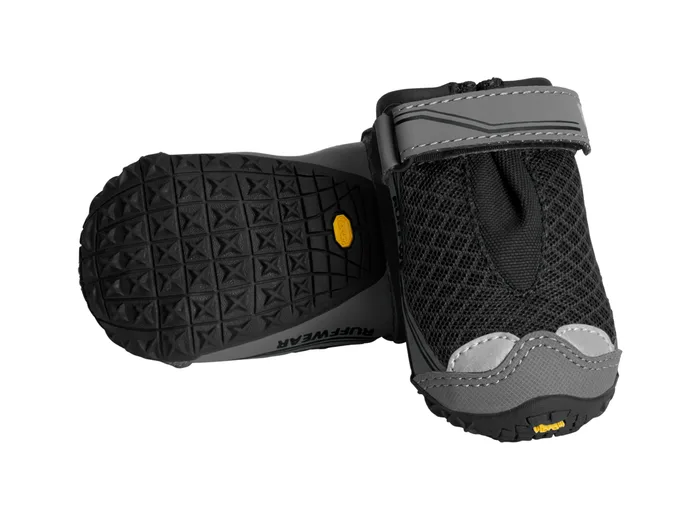
The Ruffwear Grip Trex is the best all-round dog boot, mostly because of its Vibram lugged outsole and a hook-and-loop cinch closure that Ruffwear says holds when wet. The value pick is PawZ Rubber Dog Boots, a one-piece natural rubber boot that stays on by stretch alone, comes twelve to a pack and is the most waterproof thing here. The Muttluks Original Fleece-Lined is a depends: it is the clearest answer to snow, ice and road salt thanks to a fleece lining and softshell outer, but the treated leather sole is wrong for hot summer pavement and rocky trail. We would skip the Walkee Paws Deluxe Dog Boot Leggings, because the maker's own fit guidance rules out small dogs, very large dogs, and short-legged breeds, and the molded boot has no lugged outsole or insulation. Measure every paw before you buy anything, since front and rear paws are often different sizes. Best for: owners who want to buy one set of boots that stays on the first time.
Our picks at a glance
- Ruffwear Grip Trex Dog Boots - Buy. A genuine trail shoe for dogs, with a Vibram lugged outsole and the most convincing closure in the category.
- PawZ Rubber Dog Boots - Buy. A one-piece natural rubber boot with no strap to loosen, twelve to a pack, and the best value in paw protection.
- Muttluks Original Fleece-Lined Muttluks - It depends. A true winter boot with a fleece lining and a flexible leather sole, which is exactly why it is the wrong boot for summer.
- Walkee Paws Deluxe Dog Boot Leggings - Skip. Four molded boots permanently attached to leggings, which solves lost boots but narrows the fit window enough to rule out several kinds of dog.
The verdict in 30 seconds
What mattered most
- Built for
- Sole
- Upper
- How it stays on
- Sizing measurement
- Boots per package
Dog boots fail for one reason more than any other: they come off. Not because the fabric was cheap, but because the closure could not grip the narrow spot above the paw or because the size was guessed instead of measured. The other thing buyers get wrong is treating the category as one product, when winter and ice-melt salt, hot pavement, and trail abrasion are three separate jobs solved by three different builds. We picked four boots that each answer a different one of those jobs, then judged them on closure design, sizing method, sole construction and what the maker will actually put in writing.
A genuine trail shoe for dogs, with a Vibram lugged outsole and the most convincing closure in the category.
Best for: Dogs that hike, run or scramble on rough ground, and owners who want boots that survive a season of real use.
- Non-marking Vibram outsole with a lugged tread grips rock, gravel and wet pavement.
- YKK hydrophobic hook-and-loop cinch closure that Ruffwear says keeps its holding power when wet.
- Sized by measured paw width in eight steps from 1.50 to 3.25 inches, so fit is a measurement rather than a guess.
- Sold in sets of two, so a full set of four means buying two sets.
- No insulation is listed, so it is a warm-weather and shoulder-season boot rather than a deep winter one.
- The polyester mesh upper is breathable but not waterproof.
- Needs a break-in period and a fit check partway into the first few outings.
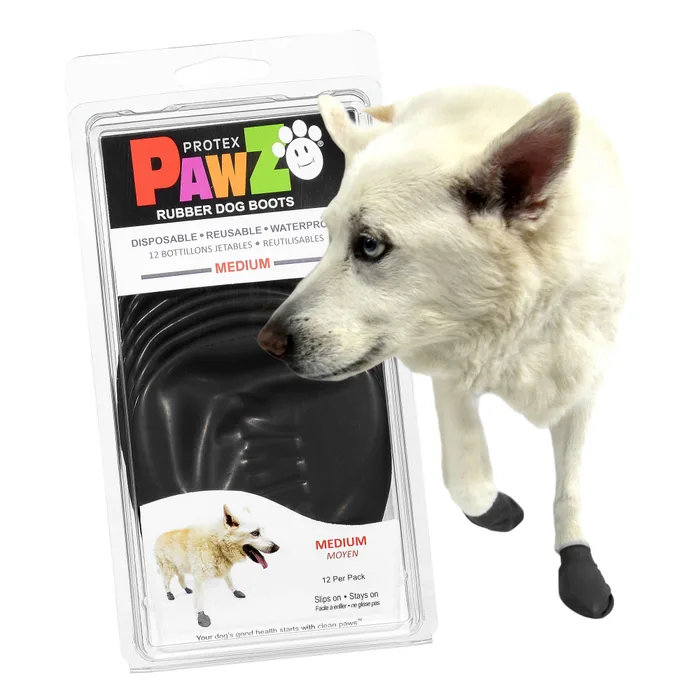
A one-piece natural rubber boot with no strap to loosen, twelve to a pack, and the best value in paw protection.
Best for: City and suburban dogs on salted or wet sidewalks, and anyone who needs to keep a bandaged paw clean and dry.
- Stays on by stretch alone, so there is no closure to work loose mid-walk.
- Waterproof one-piece rubber, which makes it the strongest option against road salt, slush and puddles.
- Twelve boots per pack in seven sizes means built-in spares and you replace one boot at a time.
- No separate outsole, so it does little against sharp gravel or rocky trail.
- No insulation, so it blocks salt and wet rather than cold.
- PawZ recommends removing them after one or two hours rather than leaving them on.
- Getting the first few on takes patience, and torn boots are a consumable.
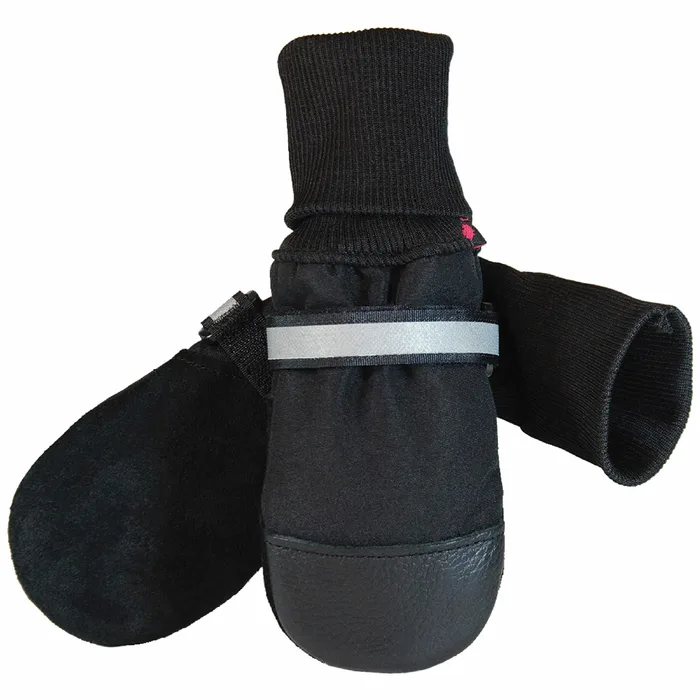
A true winter boot with a fleece lining and a flexible leather sole, which is exactly why it is the wrong boot for summer.
Best for: Dogs living somewhere with real winter, where snow, ice and de-icing salt are the whole problem.
- Fleece lining under a softshell outer that Muttluks describes as waterproof, breathable and windproof.
- Flexible treated leather sole moves with the paw instead of forcing a stiff gait.
- Four boots per package, and a rib-knit cuff that runs up the leg to keep snow and salt out.
- A leather sole is not what you want on hot pavement or sharp trail rock.
- Muttluks says the leather soles need re-treating after each wash.
- Muttluks notes boots wear out fastest on dry concrete and that water can seep through the stitching if a dog stands in water.
- Sized by paw length rather than paw width, so measurements from other brands do not transfer.
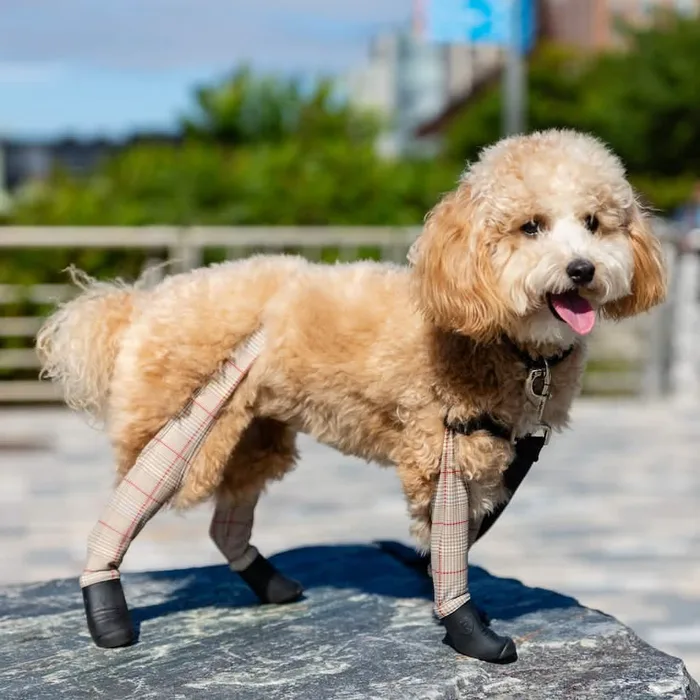
Four molded boots permanently attached to leggings, which solves lost boots but narrows the fit window enough to rule out several kinds of dog.
Best for: A medium, longer-coated dog on rainy city walks whose owner mainly wants legs and paws to stay clean.
- Boots are connected to the leggings, so a kicked-off boot cannot be lost on the walk.
- Molded in one piece with no seams, which Walkee Paws describes as fully waterproof.
- Leg coverage keeps mud and snowballs out of feathering on longer-coated dogs.
- Walkee Paws does not recommend them for dogs under five pounds, very large dogs, or large-pawed short-legged breeds such as Basset Hounds, Corgis and Dachshunds.
- The molded boot has no lugged outsole, and the cotton lining is not insulation.
- Everything is joined, so one torn boot or a snagged legging takes the whole set out of service, and active dogs need extra front straps sold separately.
| Criteria | Grip Trex Dog Boots Top pick | PawZ Rubber Dog Boots | Original Fleece-Lined Muttluks | Deluxe Dog Boot Leggings |
|---|---|---|---|---|
| Verdict | Buy it | Buy it | It depends | Skip it |
| Best for | Dogs that hike, run or scramble on rough ground, and owners who want boots that survive a season of real use. | City and suburban dogs on salted or wet sidewalks, and anyone who needs to keep a bandaged paw clean and dry. | Dogs living somewhere with real winter, where snow, ice and de-icing salt are the whole problem. | A medium, longer-coated dog on rainy city walks whose owner mainly wants legs and paws to stay clean. |
| Price tier | $$$ · premium | $ · budget | $$$ · premium | $$ · mid-range |
| Built for | Trail, gravel, hot pavement | Wet and salted sidewalks, wound cover | Snow, ice, de-icing salt | Rain and mud on city walks |
| Sole | Non-marking Vibram lugged outsole | One-piece rubber, no separate sole | Flexible treated leather | Molded TPE, no lug pattern |
| Upper | 100% polyester mesh with synthetic pigskin | Natural rubber | Softshell outer, fleece lining | Nylon and spandex leggings, cotton-lined boot |
| How it stays on | YKK hook-and-loop cinch closure | Stretch rubber above the paw | Rib-knit cuff plus strap above the dew claw | Leggings, chest strap, rear boot straps |
| Sizing measurement | Paw width, 1.50 to 3.25 in | Paw measurement in inches, 7 sizes | Paw length, Itty Bitty to XXL | Paw width plus dog height, 6 sizes |
| Boots per package | 2 | 12 | 4 | 4, connected to leggings |
| Insulated | None listed | None listed | Yes, fleece lined | Cotton lining, not insulation |
| Care | Cold wash, gentle cycle, air dry | Rinse and reuse, discard when worn | Cold wash, air dry, re-treat leather | Machine washable or rinse |
Which one is right for you?
- Dogs that hike, run or scramble on rough ground, and owners who want boots that survive a season of real use. Buy it Ruffwear Grip Trex Dog Boots
- City and suburban dogs on salted or wet sidewalks, and anyone who needs to keep a bandaged paw clean and dry. Buy it PawZ Rubber Dog Boots
- Dogs living somewhere with real winter, where snow, ice and de-icing salt are the whole problem. It depends Muttluks Original Fleece-Lined Muttluks
- A medium, longer-coated dog on rainy city walks whose owner mainly wants legs and paws to stay clean. Skip it Walkee Paws Deluxe Dog Boot Leggings
How we judged the field
Five things decide whether a set of dog boots is worth owning. First is the closure, because a boot that cannot grip the narrow spot above the paw will come off no matter what it is made of, and hook-and-loop that loses grip when wet is the classic failure. Second is the sizing system: a brand that asks for a measured paw dimension in inches is giving you a shot at a correct fit, while a shoe-style number with a weight range attached is asking you to guess. Third is the sole, because a lugged rubber outsole, a smooth leather sole and a thin rubber membrane are three genuinely different levels of protection. Fourth is what the boot is actually built to stop, since insulation, waterproofing and abrasion resistance are separate problems. Fifth is how the boots are packaged and replaced, because front and rear paws often need different sizes and one boot always wears out first.
The field splits cleanly into four approaches, so we took one strong example of each. Structured trail boots with real outsoles are the most capable and the most expensive, and Ruffwear’s Grip Trex is the reference point. Rubber slip-on boots are their own category, cheap and unbeatable at staying on, and PawZ effectively defines it. Insulated winter boots are a separate purchase built around warmth and salt exclusion, where Muttluks has been the standard for decades. Finally there is the connected legging approach, which is heavily marketed as the fix for lost boots and which we think most buyers should pass on. Every specification below comes from the maker’s own product page or sizing guide.
Ruffwear Grip Trex Dog Boots
Buy itThe Grip Trex is the boot other boots get measured against, and the reason is underfoot. Ruffwear uses a non-marking Vibram outsole with a lugged tread, so it behaves like a real shoe on rock, gravel and hot asphalt rather than like a rubber sock. The upper is 100 percent polyester mesh with a synthetic pigskin overlay, and the closure is a YKK hydrophobic hook-and-loop cinch that Ruffwear says keeps its holding power when wet. That closure is the part that matters, because it tightens around the narrow spot above the paw, which is where a boot has to grip if it is going to stay put. Sizing is by measured paw width from 1.50 to 3.25 inches, and Ruffwear tells you to measure every paw and size down if you are between sizes. The catch is packaging: boots come in sets of two, so a full set means buying twice, and no insulation is listed for deep winter. For hiking, running and summer pavement, this is the one.
PawZ Rubber Dog Boots
Buy itPawZ are the odd product in this category and also the one that most reliably stays on. Each boot is a single piece of natural rubber, closer to a heavy balloon than a shoe, and it grips the leg by stretch alone with no strap to work loose. That makes them the most waterproof option here and a strong answer to road salt, slush and wet sidewalks, and PawZ also pitches them for keeping a healing paw clean. They come twelve to a pack in seven sizes, so spares are built in and you replace individual boots as they tear rather than replacing a set. What you give up is structure. There is no separate outsole, so they do little against sharp gravel, and there is no insulation, so they are a barrier against wet and chemicals rather than warmth. PawZ says to take them off after an hour or two rather than leaving them on. For city dogs and short walks, this is the best value in dog footwear.
Muttluks Original Fleece-Lined Muttluks
It dependsMuttluks has been building the Original Fleece-Lined boot since the 1990s and it is still the clearest answer to real winter. The outer is a softshell the company describes as waterproof, breathable and windproof, the lining is fleece, and the sole is flexible treated leather that bends with the paw instead of fighting it. A stretchy rib-knit cuff runs up the leg above a strap that closes just above the dew claw, and that combination is what keeps snow and salt out of the boot. They come four to a package, which is a friendlier arrangement than buying two pairs. The trade-off is that this is a cold-weather boot and not much else. A leather sole is wrong for hot summer pavement and sharp trail rock, Muttluks itself says the soles need re-treating after each wash and that boots wear fastest on dry concrete, and its FAQ notes water can seep through stitching if a dog stands in water. Buy these if your problem is snow.
Walkee Paws Deluxe Dog Boot Leggings
Skip itWalkee Paws solves the falling-off problem by removing it: four molded TPE boots are permanently attached to nylon-spandex leggings held up by an elastic chest strap, so a kicked-off boot dangles instead of vanishing down a storm drain. On wet, muddy walks with a medium, longer-coated dog it does work, and the leg coverage keeps snowballs out of feathering. What makes it hard to recommend as a default is how narrow the fit window is by the maker’s own guidance: not for dogs under five pounds, not for very large dogs, not for large-pawed short-legged breeds such as Basset Hounds, Corgis and Dachshunds. On top of that, the boot is a molded shell with no lugged outsole for trail abrasion and a cotton lining rather than insulation, active dogs need extra front straps sold separately, and one torn boot takes the whole connected set out of service. Four separate boots serve most buyers better.
Sources
Specs in this review come from these pages.
Ruffwear Grip Trex Dog Boots vs PawZ Rubber Dog Boots: which should you buy?
The Grip Trex and PawZ are not really competing on the same axis, which is why owning both is a reasonable outcome. The Grip Trex is a shoe: a lugged Vibram outsole between the pad and the ground, a mesh upper that keeps grit out, and a cinch closure that is engineered around the one place a boot can actually hold. That structure is what buys you protection from sharp rock, broken glass and hot asphalt, and it is why it is the pick for anyone whose dog covers real distance on real terrain. It costs the most, it comes two boots to a package, and it takes a break-in period before your dog moves normally in it.
PawZ inverts every one of those choices. There is no outsole, no strap and almost no structure, just thin natural rubber that holds by stretch, and the result is a boot that stays on better than most strapped designs and costs a fraction as much per boot. It is the right call if your hazard is chemical and wet rather than sharp: salted sidewalks, slush, rain, a bandaged paw. Decide by asking what surface your dog spends time on. Rock, gravel or hot pavement means Grip Trex. Wet, salted city pavement, occasional use, or a dog that has already rejected structured boots means PawZ, and the low cost per boot makes it a cheap experiment.
What to look for
- Closure placement, not closure count: the strap or cinch has to tighten on the narrow spot just above the dew claw, because anything that closes over the wide part of the paw will slide off.
- A sizing system based on a measurement: brands that ask for paw width or paw length in inches give you a fit you can verify, while shoe-style numbers paired with a weight range are a guess dressed up as a size.
- A sole matched to your actual hazard: a lugged rubber outsole is for abrasion and heat, a smooth leather sole is for cold and flexibility, and a thin rubber membrane is for wet and chemicals.
- Insulation stated separately from waterproofing: a boot can be fully waterproof and still offer no warmth, so look for a named lining rather than assuming a winter-marketed boot is warm.
- Packaging that matches paw asymmetry: many dogs have wider front paws than rear paws, so sets of two exist for a reason and buying four identical boots often means two that fit badly.
- A stated break-in and fit-check routine: makers that tell you to recheck the closure fifteen minutes into a walk are being honest about how boots behave, and following that advice prevents most losses.
Our final take
Buy the Ruffwear Grip Trex if you want one set of boots that handles the widest range of ground and stays on while doing it, and accept that a full set means two packages. Buy PawZ if your problem is wet, salted or dirty pavement rather than sharp terrain, because nothing else stays on that well for that little. Add Muttluks Original Fleece-Lined only if you have genuine winter, and treat them as seasonal gear rather than year-round footwear. Skip the connected legging approach unless your dog sits squarely inside a fairly narrow set of size and coat requirements. Whatever you choose, measure all four paws with the dog’s weight on them before ordering, and size down when you are between sizes.
Questions, answered
Why do my dog's boots keep falling off?
Almost always because of size or closure placement, not because the boot is bad. A boot has to cinch on the narrow part of the leg just above the dew claw, and if the closure sits lower on the wide part of the paw it will work loose within a few hundred steps. Sizing too large is the other half of the problem, and both Ruffwear and Muttluks tell you to size down if your dog measures between sizes. Measure every paw, because front paws are commonly wider than rear paws and a set of four identical boots will not fit correctly. Check and retighten roughly fifteen minutes into the first few outings, which is guidance Ruffwear and Muttluks both give.
How do I actually measure my dog's paws?
Put your dog's paw flat on a sheet of paper with full weight on it, since a lifted paw is narrower than a loaded one. What you measure then depends on the brand. Ruffwear sizes by paw width, meaning the widest point across the paw while bearing weight, in steps from 1.50 to 3.25 inches. Muttluks sizes by paw length, measured from the back of the paw to the tip of the longest toenail. Walkee Paws asks for paw width plus your dog's height. That mismatch is why a size that fits in one brand tells you nothing about another.
Do dogs really need boots, or is paw balm enough?
Balm and boots do different things. A wax or balm puts a thin barrier on the pads that helps against drying, cracking and some salt exposure, and the ASPCA suggests massaging a vet-approved paw protectant in before winter walks. It does not stop a cut from broken glass, it does not stop hot asphalt from burning a pad, and it wears off during the walk. Boots are the answer when the hazard is physical: sharp rock, ice shards, hot pavement, chemical de-icers packed between toes. Many owners end up using balm for ordinary winter walks and boots for the harder conditions.
How hot is too hot for pavement?
The practical test is your own hand. Press the back of your hand flat on the pavement and hold it there for about seven seconds; if you cannot keep it there comfortably, your dog should not be standing on it. Asphalt holds heat long after the air has cooled, so an evening walk can still be a problem on a sunny day. Shade, grass and time of day change the answer more than the forecast does. If your walks are unavoidably on hot surfaces, a boot with a real rubber outsole between pad and ground is the point, which is where the Grip Trex separates itself from thin rubber slip-ons.
My dog refuses to walk in boots. What now?
The high-stepping refusal walk is normal and usually temporary. Start indoors with one boot for a couple of minutes, pair it with food, and build up to four boots and then to short outdoor walks over several sessions rather than one. Check that the boots are not too large, because a loose boot that shifts underfoot feels much worse to a dog than a snug one. Ruffwear says some dogs need a brief break-in period. Some dogs do better with a thinner, more ground-feeling design like PawZ, which is worth trying if a structured boot is a hard no.
Deciding between the top two? See our head-to-head: Ruffwear Grip Trex Dog Boots vs PawZ Rubber Dog Boots.
More Pets reviews
 The Best Dog Car Seat Covers: 4 Compared (and One to Skip)
  The Best Dog Chew Toys for Aggressive Chewers: 4 Compared (and One to Skip)
  The Best Dog Chews: 4 Compared (and One to Skip)
  The Best Dog Cooling Mats: 4 Compared (and One to Skip)
  The Best Dog Crates: 4 Compared (and One to Skip)
  The Best Dog Dental Care Products: 4 Compared (and One to Skip)