Explained
Automatic Pet Feeders, Explained: What to Look For
Understand every spec on an automatic pet feeder before you buy one, without the marketing noise.
In this guide
An automatic pet feeder dispenses set portions of food on a schedule so your cat or dog eats on time even when you're not home. This guide explains the parts and specs that actually affect reliability, so you can judge any feeder on its own terms.
The 30-second version
- Reliability beats features. A feeder that dispenses the right amount every time, without jamming, matters far more than an app or a camera. Judge the dispensing mechanism first.
- Match the feeder to the food. Most feeders handle only dry kibble in a specific size range. Wet food, semi-moist, or oddly shaped kibble need a different design entirely.
- Portion accuracy is a range, not a promise. Feeders dispense by rough volume, so real portions vary meal to meal. If your pet needs strict calorie control, expect to weigh occasionally and calibrate.
- Power backup is not optional. A feeder that only runs on wall power will skip meals during an outage. Battery backup is the single most underrated safety feature.
- Cleaning determines whether you keep using it. Food oils go stale fast. A feeder with removable, dishwasher-safe parts stays sanitary; one with sealed electronics near the food gets neglected.
The products this guide is about
Our verdict on each, with the full reasoning on the companion review.
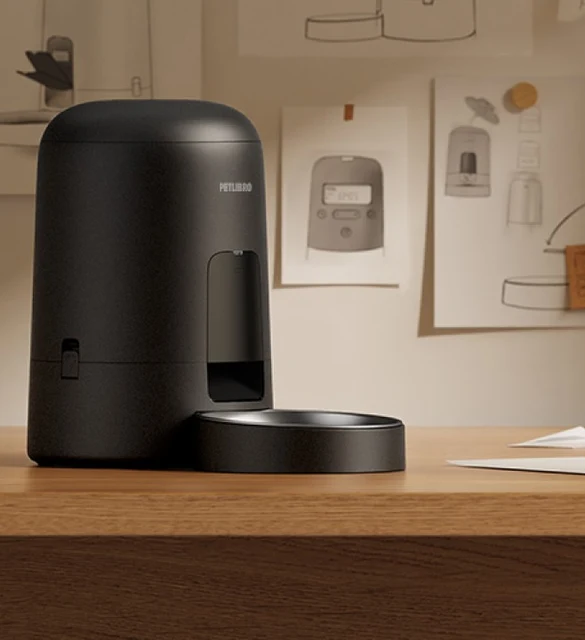
- Buy Petlibro Air WiFi Feeder The compact, cordless WiFi feeder that is a standout for single-cat homes.
- Buy PetSafe Smart Feed Automatic Dog & Cat Feeder (2nd Gen) The long-running expert favorite for dogs, with a conveyor mechanism and a vet-friendly slow-feed mode. Amazon
- It depends Whisker Feeder-Robot A premium 32-cup feeder with genuine anti-jam engineering - great if you'll pay for it. Amazon
- Skip Arf Pets Automatic Dog & Cat Feeder A popular basic auger feeder that works only with 'compatible' kibble and jams on anything oddly shaped. Amazon
What actually matters
- Dispensing mechanism. The auger, conveyor, or rotating tray is the part most likely to jam or over-dispense. A well-designed anti-jam mechanism is the difference between a reliable feeder and daily frustration.
- Portion control and scheduling. Look at how many meals per day you can program and how small each portion can be. Grazing cats and small dogs need fine, frequent portions; larger dogs need bigger ones.
- Hopper capacity vs. footprint. A bigger hopper means fewer refills for trips, but takes counter space and lets food go stale if it sits for weeks. Size it to how long food stays fresh, not the maximum you can fit.
- Power resilience. Battery backup keeps meals running during outages. Check whether batteries power the whole feeder or only the clock, and whether it alerts you when they're low.
- Cleaning and food safety. Removable, washable, ideally dishwasher-safe food-contact parts keep the feeder sanitary. Sealed or hard-to-reach chambers trap crumbs and oils.
- Multi-pet control. In a multi-pet home, a plain feeder becomes a free-for-all. Microchip or RFID lids that open only for the right animal are the only real fix for food theft between pets.
The specs, in plain English
Green flags vs red flags
Green flags
- Runs its schedule fully offline, with WiFi and app as extras rather than requirements
- Battery backup that powers actual dispensing, plus a low-battery alert
- Food-contact parts that fully detach and are dishwasher-safe
- A stated kibble size range and a visible anti-jam or stirring mechanism
- A low-food sensor and clear alerts when the hopper or batteries run down
- Portion sizes small and adjustable enough to match your specific pet
Red flags
- No power backup at all, so any outage means skipped meals
- Sealed or hard-to-reach food chambers you can't easily wash
- Vague or missing guidance on kibble size, a common cause of jams
- Core scheduling that stops working when the internet or app is down
- One large daily portion only, with no way to split meals for grazers
- Marketing that leads with cameras and voice recording but says little about dispensing reliability
Who's who: the brands
- PetSafe - Long-established pet-tech maker with a wide range of programmable dry-food feeders across price tiers.
- Sure Petcare (SureFeed) - Known for microchip-activated bowls aimed at multi-pet homes and portion or diet control.
- PetLibro - Popular for app-connected dry feeders that emphasize battery backup and food-level sensing.
- WOPET - Budget-to-mid feeders often bundling a small camera and app scheduling.
- Petkit - Design-focused smart feeders with app control and, on some models, freshness or drying features.
- Cat Mate / Pet Mate - Offers timed tray feeders, including wet-food options with ice-pack compartments.
- Arf Pets - Straightforward programmable dry feeders positioned around value and simple scheduling.
- HoneyGuaridan - Dry-food feeders that commonly include dual power and voice-record playback.
How to read a listing without getting fooled
Read a feeder from the food outward. Start with the food it's built for, dry only or wet-capable, and the kibble size it tolerates, because the wrong match jams the mechanism. Next check whether it can hit your pet's real feeding pattern: enough meal slots, small enough portions, and a slow-feed mode if your pet gulps. Then weigh the safety net, battery backup, low-food alerts, and offline scheduling, above the flashy extras like cameras and voice clips. Treat the app as a convenience layer, never the thing keeping your pet fed.
How much should you spend?
Entry-level feeders usually handle dry kibble and basic scheduling, and are fine if you want simple, reliable timed meals. Mid-tier models add conveniences like WiFi apps, food-level sensors, sturdier anti-jam mechanisms, and better battery backup. Premium feeders bring microchip or RFID access for multi-pet homes, wet-food handling with cooling, or cameras and two-way audio. Spend up only where a feature solves a problem you actually have, food theft between pets, a gulper, a strict diet, rather than for a longer feature list. A well-built basic feeder often outperforms a cheap smart one.
Questions, answered
Can automatic feeders handle wet food?
Most cannot. The majority are built for dry kibble and will spoil or clog with wet food. Wet-food feeders exist, using sealed trays and sometimes ice packs, but they hold only a day or two of meals and need frequent cleaning to stay safe.
Do automatic feeders jam?
They can, usually when kibble is larger or oddly shaped than the mechanism expects. Look for a stated kibble size range and an anti-jam feature like a stirring paddle or reversing motor. Matching your food to the feeder's spec prevents most jams.
What happens during a power outage?
It depends entirely on backup power. A feeder without a battery simply stops and skips meals. One with true battery backup keeps dispensing on schedule. Confirm the battery powers full feeding, not just the clock, before relying on it for trips.
Are automatic feeders accurate on portions?
Roughly, not exactly. Most dispense by volume, so real portions vary slightly meal to meal. That's fine for general feeding, but if your pet needs tight calorie control, weigh a few servings to calibrate and check occasionally over time.
Do I need a WiFi model?
Not necessarily. WiFi lets you adjust schedules and get alerts remotely, which is handy for travel. But the core job, feeding on time, should work without internet. If you rarely change schedules, a reliable non-connected feeder is often simpler and steadier.
How do feeders work with multiple pets?
A plain feeder feeds whichever pet reaches it first, so a fast eater can steal food. For real separation, use microchip or RFID lids that open only for a specific animal. That's the only dependable way to protect portions or a prescription diet.
Or jump to the head-to-head: Petlibro Air WiFi Feeder vs PetSafe Smart Feed Automatic Dog & Cat Feeder (2nd Gen).