Explained
Cat Litter Boxes, Explained
You'll know which box shape fits your cat, how to size it correctly, and which odor-control claims are worth paying for.
In this guide
A litter box looks like the simplest purchase in the pet aisle, but the shape you choose decides whether your cat uses it every day or starts avoiding it. This guide covers manual, non-electric litter boxes, meaning open pans, hooded boxes, top-entry cubes, and sifting systems. Automatic, self-cleaning robotic litter boxes work on different mechanics entirely and are their own category, not covered here.
The 30-second version
- Shape matters more than features. whether a box is open, hooded, or top-entry affects containment and access far more than any add-on.
- Size the box to the cat, not the shelf. a common rule of thumb is about one and a half times your cat's body length from nose to tail base.
- Odor control is a system, not a feature. carbon filters and covers help, but nothing replaces scooping daily and washing regularly.
- Access beats containment for kittens and seniors. a box that traps every grain of litter is worthless if a cat can't comfortably climb into it.
- Liners and clumping litter don't always mix with every box. claws shred liners and some sifting designs only work with non-clumping litter.
The products this guide is about
Our verdict on each, with the full reasoning on the companion review.
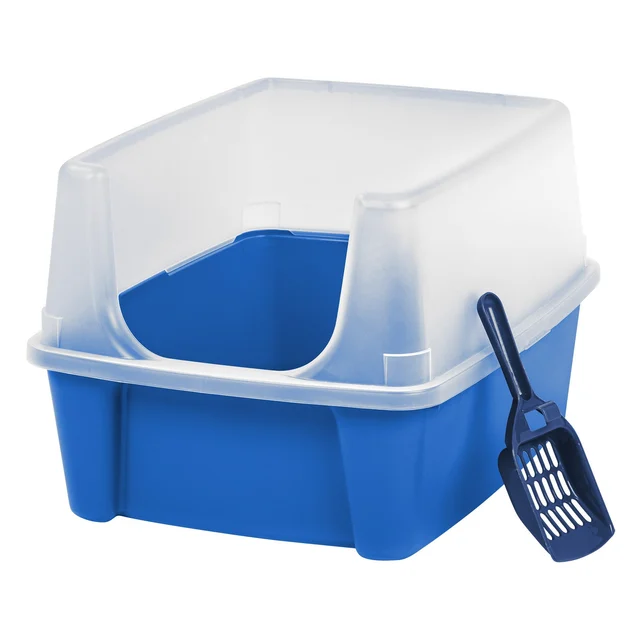
- Buy IRIS USA Large Cat Litter Box with Scatter Shield and Scoop (Open Top, High-Sided) A big, tall-walled open pan that stops scatter without ever confusing a cat about how to get in.
- Buy IRIS USA Top Entry Cat Litter Box with Scoop The tracking fix: a top-entry cube that keeps litter in and curious dogs out.
- It depends Petmate Booda Dome Cleanstep Litter Box A covered dome that trades easy scooping and elbow room for privacy and a tidier look.
- Skip Van Ness Framed Sifting Cat Litter Pan A scoop-free promise that only half works and makes a bigger mess than the scoop it replaces.
What actually matters
- Box format - open pan, hooded/covered, top-entry, or sifting each solve containment and odor differently, and each makes a different trade-off in cleaning effort and cat comfort.
- Interior size relative to your cat - a box has to be big enough for your cat to turn around and dig without stepping in waste, not just look big on the shelf.
- Entry height and access - how far a cat has to step up or climb determines whether kittens, seniors, or cats with joint issues will use the box at all.
- Wall height and scatter control - taller sides or a raised lip catch litter kicked during digging before it lands on your floor.
- Odor-control approach - whether the design relies on a lid and carbon filter, an open layout with no trapped smell, or just frequent cleaning.
- Liner and litter compatibility - some boxes are built around a specific litter type or liner setup, and using the wrong one undoes the design.
- Material and cleaning access - smooth, thick plastic that wipes clean and resists scratches lasts longer and holds less odor over time than thin, flexible plastic.
The specs, in plain English
Green flags vs red flags
Green flags
- Interior dimensions are listed separately from the overall box footprint
- Low, wide entry point that doesn't require a cat to climb or squeeze
- Smooth, rigid plastic that doesn't flex or bow when you press on the walls
- Clear guidance on which litter type the design is built for
- A scoop or cleaning tool is included or explicitly compatible
- Tall walls or a shield that visibly extends above where a digging cat would kick
Red flags
- Box dimensions are only given as one overall size with no interior measurement
- Entry hole or step is noticeably higher than a low, easy walk-in front
- Thin plastic that flexes noticeably when picked up or scooped
- Odor control claims rest entirely on scent or fragrance rather than airflow, filtering, or open design
- Liners are marketed as compatible but the box has no rim or clip to hold them in place
- Multi-piece systems (sifting screens, snap-together frames) with several thin parts that must align to work
Who's who: the brands
- IRIS USA - Known for straightforward open pans and top-entry cubes with a focus on containment and simple, budget-friendly molded plastic.
- Petmate - A long-running pet products maker whose Booda line covers hooded and dome-style boxes aimed at odor control and a tidier look.
- Van Ness - Makes basic, inexpensive pans and sifting systems; a reliable low-cost option for straightforward, no-frills boxes.
- PetFusion - Focuses on higher-sided open and semi-enclosed pans with an emphasis on scatter control and easier cleaning.
- Nature's Miracle - Better known for odor-control litter and cleaning products, but also makes covered and high-sided boxes built around that same odor focus.
How to read a listing without getting fooled
On a product listing, skip past the marketing language first and find the interior dimensions, not just the overall box size; a box that looks huge in a photo can still have a cramped usable floor once walls, a hood, or a ramp are factored in. Check the entry description for how a cat gets in: a low open front, a stepped ramp, or a hole to climb through are very different asks of a cat's age and mobility. If odor control is mentioned, see whether it's backed by something structural, an open top, a carbon filter, ventilation gaps, versus just a scented liner or fragrance additive, which mask smell rather than remove it. Finally, look at how the box comes apart for cleaning: a single molded piece or a lid that lifts fully off is faster to keep clean than a box with several interlocking parts.
How much should you spend?
What drives the cost of a litter box is mostly size, plastic thickness, and how many extra parts it has, not any single breakthrough feature. A large, thick-walled open pan is often the best value because there's little to break and nothing to replace. Covered and filtered boxes cost more because of the added lid, hinge, and filter media, and that filter is a recurring cost of its own since it needs periodic replacement to keep working. Sifting systems with multiple nested pans and screens tend to sit in the same price range as a basic box despite having more parts, which is worth noticing since more parts usually means more that can crack or warp over time. Spending more is worth it when it buys genuine interior room for a large cat or noticeably sturdier plastic; it's not worth it for scented additives or cosmetic styling that doesn't change how well the box actually works day to day.
Questions, answered
What's the real difference between open, hooded, and top-entry litter boxes?
Open pans have no lid, so any cat can walk in freely, but nothing hides odor or mess between cleanings. Hooded boxes add a cover that gives a cat privacy and keeps waste out of sight, at the cost of trapping smell inside and making it more awkward to scoop. Top-entry boxes go a step further, sealing the box almost completely and requiring the cat to climb up and drop in through a hole in the lid; this format does the best job of stopping tracked litter but only works for cats that can jump comfortably.
How big should a litter box actually be?
A widely used rule of thumb is that the box should be roughly one and a half times your cat's body length, measured from nose to the base of the tail, so the cat can turn around and dig without stepping outside the box or in its own waste. Go by interior floor space, not the box's outer dimensions, since walls, domes, and ramps all reduce the usable area. When you're unsure which size to pick, sizing up is safer than sizing down.
Do litter box liners actually work?
They work fine for cats that don't dig aggressively, since the liner makes cleanout faster and keeps the plastic underneath cleaner longer. Cats that dig hard or scratch at the walls tend to catch a liner with their claws and tear or pull it loose, which can spill litter and defeats the purpose. If your cat is a digger, a liner is optional at best, and a smooth, easy-to-wipe box without one may be less hassle.
Do I need a carbon filter, or is a covered box enough for odor control?
A cover alone contains the mess visually but can actually concentrate smell inside the box between cleanings. A carbon or activated charcoal filter in the lid genuinely helps by absorbing odor as air moves through it, but it needs to be replaced periodically to keep working, and it's still not a substitute for scooping daily. An open box with no cover at all avoids trapping odor in the first place, which is why some owners prefer it even though it hides nothing.
Are automatic, self-cleaning litter boxes better than manual ones?
That's a separate category with its own mechanics, sensors, and maintenance considerations, and it isn't covered in this guide, which focuses on manual open, hooded, top-entry, and sifting boxes. If a self-cleaning box is what you're after, look for a dedicated guide to that category rather than assuming the sizing and format advice here carries over directly.
My cat stopped using the litter box. What should I check first?
Start with the basics covered in this guide: is the box big enough, is the entry easy for your cat to use, and is it being scooped daily. A box that's too small, too hard to get into, or simply dirty is a common and fixable cause. This is general product information, not veterinary advice; if a cat that was previously using the box well suddenly stops, strains while trying to go, or shows other changes in behavior, consult a veterinarian, since litter box avoidance can also signal a medical issue.
Or jump to the head-to-head: IRIS USA Large Cat Litter Box with Scatter Shield and Scoop (Open Top, High-Sided) vs IRIS USA Top Entry Cat Litter Box with Scoop.