Explained
Aquarium Water Test Kits, Explained
After reading, you'll understand what each parameter on a test kit is telling you, why two kits can report the same water in different units, and how to check a kit's real coverage before you buy it.
In this guide
The thing that trips up first-time buyers is not the chemistry, it is the packaging. A box labeled master test kit sounds complete, so people buy one and assume every number their tank needs is inside. It is not. Bundles are assembled around a use case, freshwater cycling in one case and reef dosing in another, and each leaves out whatever the other one is built around. The second trap is units, because the same measurement gets reported as dKH, meq/L or ppm CaCO3 depending on who made the kit.
The 30-second version
- Coverage beats convenience, because a kit that reads in 60 seconds is useless if it does not read the parameter that is killing your fish.
- Ammonia is the first number that matters, and it is the one most often missing from strip packs and reef bundles alike.
- Units are not interchangeable, so alkalinity in dKH, meq/L and ppm CaCO3 describe the same property on three different scales.
- Resolution is what you are paying for, and the jump from a color card to a colorimeter buys you smaller readable steps, not a different truth.
- Every kit is a consumable, so check tests per parameter and how refills are sold before you compare one box against another.
The products this guide is about
Our verdict on each, with the full reasoning on the companion review.
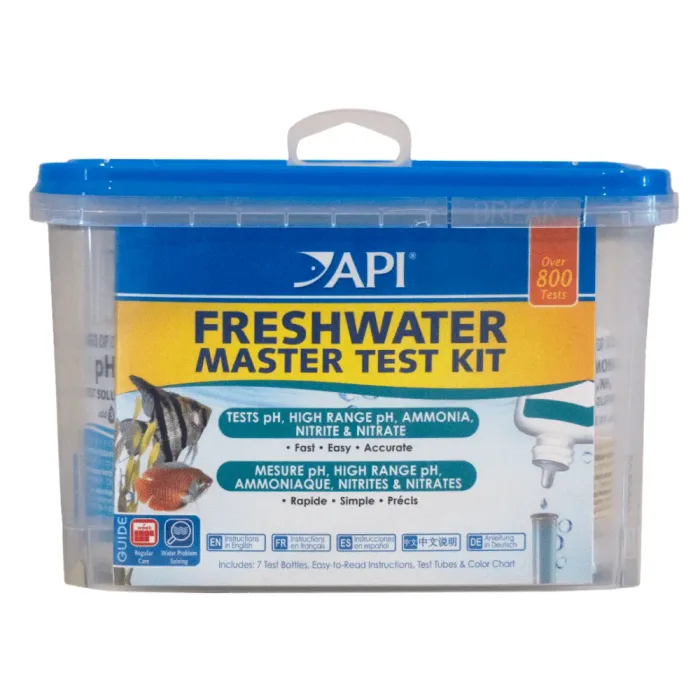
- Buy API Freshwater Master Test Kit Liquid reagents for the five numbers that decide whether a freshwater tank is safe, at a cost per test almost nothing else matches. Amazon
- Buy Salifert Master Reef Testing Combo Kit Six single-parameter reef kits in one box, with the resolution on alkalinity and calcium that coral dosing actually requires. Amazon
- It depends Hanna Instruments HI772 Marine Alkalinity (dKH) Checker HC A pocket colorimeter that removes color matching from alkalinity testing, and does nothing else at all.
- Skip Tetra EasyStrips 6-in-1 Aquarium Test Strips Six pads, 60 seconds, and no ammonia test, which is the one number a new tank cannot do without. Amazon
What actually matters
- Ammonia - it is the first thing to accumulate in a new tank and the first thing to harm fish, and its toxicity rises with pH and temperature. A kit without an ammonia test cannot tell you whether a tank is safe to stock.
- Nitrite - the intermediate step between ammonia and nitrate, and toxic in its own right. It spikes partway through cycling and can reappear later if the biological filter is disturbed by a filter change or medication.
- Nitrate - the end product of the cycle, tolerated at far higher levels than ammonia or nitrite but still worth controlling because it feeds nuisance algae. It is the parameter that tells you whether your water change schedule is keeping up.
- pH and high range pH - two separate tests in most liquid kits, because one reagent cannot cover the whole scale legibly. The high range card exists for tanks that sit above the normal card's ceiling, and reading the wrong one gives a wrong answer.
- KH, carbonate hardness or alkalinity - the buffering capacity that keeps pH from swinging. Low KH is the usual explanation for a pH that will not stay put, and on a reef tank it is also a coral nutrient you deliberately dose.
- GH, general hardness - dissolved calcium and magnesium, which matters for the species you keep rather than for tank safety. It is a common omission from master kits and a common reason people buy a second kit later.
- Phosphate - the other half of the algae fuel pair alongside nitrate, and a growth inhibitor for corals and calcareous algae at elevated levels. Reef bundles usually include it while freshwater bundles usually do not.
The specs, in plain English
Green flags vs red flags
Green flags
- The maker's own page lists every parameter individually rather than only saying master or complete
- The kit states a range and a step size, such as 0 to 160 ppm nitrate or 0.3 dKH increments, instead of only claiming accuracy
- Tests per parameter are published, so you can work out what a year of testing costs you
- Liquid reagents in dropper bottles with glass tubes and a laminated card rather than pads on paper
- Refills or individual replacement kits are sold separately, so one empty bottle does not retire the whole box
Red flags
- A parameter list that quietly omits ammonia on a kit sold for setting up a new tank
- Accuracy claims with no range, no resolution and no units anywhere on the page
- A freshwater tank paired with a marine-labeled kit, or the reverse, because the ranges and units differ
- No lot number or use-by date visible on the packaging
- Strips stored loose, with the tube left open or the drying agent removed, since the pads start degrading immediately
Who's who: the brands
- API - The mainstream freshwater and saltwater liquid kits, best known for the master kits that cover the nitrogen cycle plus pH at a very low cost per test.
- Salifert - Dutch maker of single-parameter reef titration kits, favored for fine step sizes on alkalinity, calcium and magnesium.
- Hanna Instruments - An instrument company rather than an aquarium company, whose Checker colorimeters bring one-parameter digital readings to hobby budgets.
- Red Sea - Reef-focused kits and supplements, usually sold as multi-parameter bundles built around a dosing program.
- Tetra - The mass-market name in fishkeeping, whose EasyStrips are the strips most new owners encounter on a shelf.
How to read a listing without getting fooled
Read a test kit listing backwards. Start with the parameter list and check it item by item against what your tank needs, ignoring the words master, complete or all-in-one entirely. Then find the range and the step size for each parameter, since a range tells you whether the kit can see your water at all and the step size tells you whether it can see a change. Next look for the water type, because freshwater and marine versions of the same test are different products with different color cards or different units. Then find the test count, and check whether it is quoted per parameter or across the whole kit, since a bundle advertising hundreds of tests may have only 50 on the parameter you use weekly. Finally, look at how consumables are sold, because reagent packets in fixed counts and single-parameter replacement boxes are the real long-term cost.
How much should you spend?
Budget tier buys dip strips and single-parameter liquid kits. Strips at this level are best understood as a screening tool, and a single liquid kit here is a sensible way to add one missing parameter, hardness or phosphate, to a bundle you already own. Mid-range is where the category concentrates: the multi-parameter freshwater and saltwater master kits, the bundled reef sets that pack six single-parameter boxes together, and the single-parameter handheld colorimeters all sit here. That tier is where almost every buyer should land, and spending more within it usually buys coverage or resolution rather than build quality. Premium means multi-parameter photometers and automated monitoring hardware that tests on a schedule and logs the results. That equipment is aimed at established reef systems where a parameter is dosed continuously, and it is a poor first purchase for anyone who has not yet worked out which numbers their tank actually moves.
Questions, answered
How often should I test, and which parameters?
During cycling, test ammonia and nitrite frequently and nitrate as it starts to appear, because that is the sequence you are waiting to see complete. Once the tank is established, a weekly check of nitrate and pH plus an occasional ammonia test is enough for most freshwater setups. Reef tanks are different: alkalinity moves fastest and is usually checked several times a week, with calcium and magnesium less often. Test more after anything that disturbs the system, such as a filter change, a medication course or a heavy stocking addition.
Is a digital colorimeter more accurate than a liquid kit?
It is more repeatable, which is not quite the same thing. A colorimeter removes the variability of your eyes and your lighting, so the same sample gives the same number every time and two people will not disagree. The underlying chemistry is still a reagent reaction, so a bad reagent, a dirty cuvette or a mismeasured sample will produce a confidently wrong number. Colorimeters that accept a calibration check set let you verify the instrument itself, which is worth using periodically.
Can I use a freshwater kit on a saltwater tank?
Some tests carry over and some do not. Ammonia, nitrite and nitrate kits are often labeled for both water types and include separate color cards for each. pH is usually not interchangeable, because marine tanks sit higher on the scale and need a high range card. Hardness and alkalinity are the clearest split, since reef testing is done in dKH or meq/L on a marine-specific range while freshwater testing is commonly in ppm CaCO3. Check the label rather than assuming.
What should I do first if a test comes back bad?
Retest before you act, carefully, following the instructions to the letter, because technique errors are more common than genuine emergencies. If ammonia or nitrite is confirmed to be present, a partial water change with dechlorinated water is the standard immediate response, repeated as needed while you find the cause. Do not chase pH with additives on a single reading, since an unstable pH usually points to low buffering capacity that needs addressing at the source. Write readings down with dates, because the trend tells you more than any single number.
Or jump to the head-to-head: API Freshwater Master Test Kit vs Salifert Master Reef Testing Combo Kit.