

Pets
The Best Aquarium Water Test Kits: 4 Compared (and One to Skip)
Four aquarium water test kits compared on which parameters they actually cover, how finely they read, how many tests you get, and whether the number you write down is worth trusting.
The short version
The API Freshwater Master Test Kit is the one most people should own: liquid reagents for pH, high range pH, ammonia, nitrite and nitrate, with enough reagent for many repeat tests. The Salifert Master Reef Testing Combo is the pick for coral keepers, bundling six single-parameter boxes that read alkalinity in roughly 0.3 dKH steps and calcium in 10 mg/L steps. Hanna's HI772 Marine Alkalinity Checker suits one specific buyer, the reef keeper dosing a two part system who needs 0.1 dKH resolution, and it is a poor first purchase because it measures exactly one thing. Tetra EasyStrips 6-in-1 are the ones to skip: the six pads cover nitrate, nitrite, hardness, chlorine, alkalinity and pH, and ammonia is not among them. That is the parameter a new tank most needs. Buy a liquid kit first and add strips later if you want a fast weekly glance. Best for: anyone who wants a number they can act on rather than a number that looks reassuring.
Our picks at a glance
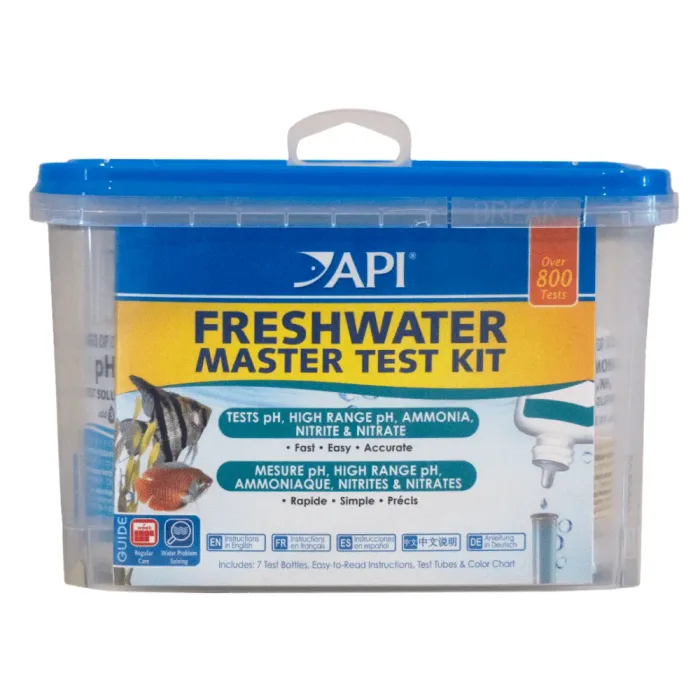
- API Freshwater Master Test Kit - Buy. Liquid reagents for the five numbers that decide whether a freshwater tank is safe, at a cost per test almost nothing else matches.
- Salifert Master Reef Testing Combo Kit - Buy. Six single-parameter reef kits in one box, with the resolution on alkalinity and calcium that coral dosing actually requires.
- Hanna Instruments HI772 Marine Alkalinity (dKH) Checker HC - It depends. A pocket colorimeter that removes color matching from alkalinity testing, and does nothing else at all.
- Tetra EasyStrips 6-in-1 Aquarium Test Strips - Skip. Six pads, 60 seconds, and no ammonia test, which is the one number a new tank cannot do without.
The verdict in 30 seconds
What mattered most
- Test method
- Parameters covered
- Ammonia and nitrite
- Tests per kit, as stated
- Water type
- Smallest step you can read
An aquarium test kit is a measuring instrument, and the useful questions are the ones you would ask of any instrument: what does it measure, how small a change can it resolve, and how many readings do you get before you rebuy. The category splits three ways. Liquid reagent kits drip chemistry into a glass tube and ask you to match a color, digital colorimeters read the color for you and print a number, and dip strips trade both accuracy and coverage for a 60 second answer. We picked four that represent those three approaches honestly, checked every parameter list against the manufacturer's own page, and paid particular attention to what each kit leaves out.
Liquid reagents for the five numbers that decide whether a freshwater tank is safe, at a cost per test almost nothing else matches.
Best for: Anyone cycling or maintaining a freshwater tank who wants one purchase to cover the parameters that actually cause fish loss.
- Covers pH, high range pH, ammonia, nitrite and nitrate, which is the whole nitrogen cycle plus the pH you need to interpret it
- Includes seven test solutions, four test tubes, a holding tray and a laminated color card, enough for many repeat tests
- Liquid reagents in glass tubes give a far more readable color than a pad on a paper strip
- Freshwater only, with no saltwater color card in this kit
- Does not include GH, KH or phosphate, which buyers frequently assume a master kit covers
- The nitrate test is technique sensitive, requiring a hard shake of Solution #2 and careful mixing of the capped tube for the stated time
- Color matching in poor light is the weak link, and two people can read the same tube differently
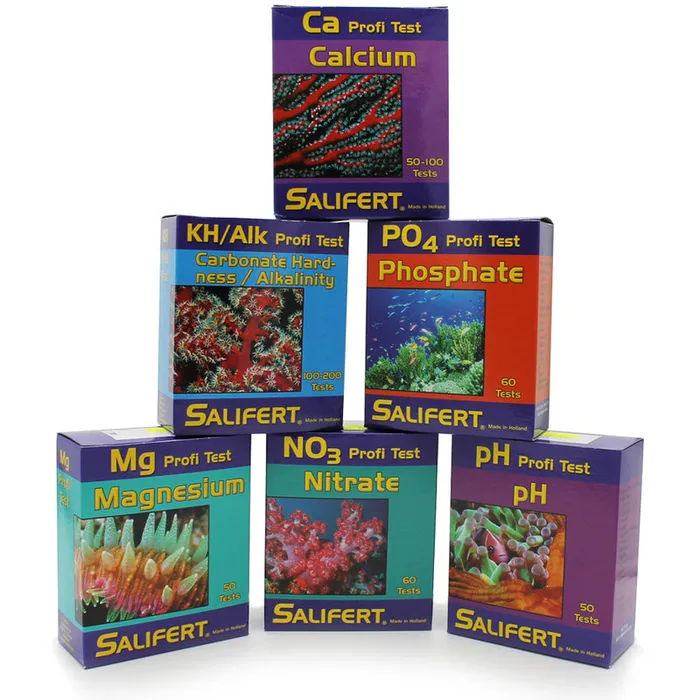
Six single-parameter reef kits in one box, with the resolution on alkalinity and calcium that coral dosing actually requires.
Best for: Reef keepers dosing calcium and alkalinity who want tight readings without buying a meter for every parameter.
- Bundles calcium, KH/alkalinity, magnesium, nitrate, phosphate and pH, which is the working set for a reef tank
- Reads in fine steps: about 0.3 dKH on alkalinity and 10 mg/L on calcium
- Boxes are replaced individually, so you rebuy only the parameter you actually used up
- No ammonia and no nitrite test in the combo, so a cycling tank needs Salifert's separate ammonia kit or another source
- Test counts vary widely by parameter, from about 50 on pH up to 100 to 200 on alkalinity
- Salifert's site centers its Profi-Test line on reef and marine use, so freshwater keepers get little guidance there
- Titration means counting drops and watching for a color break, which takes more attention than a single color match
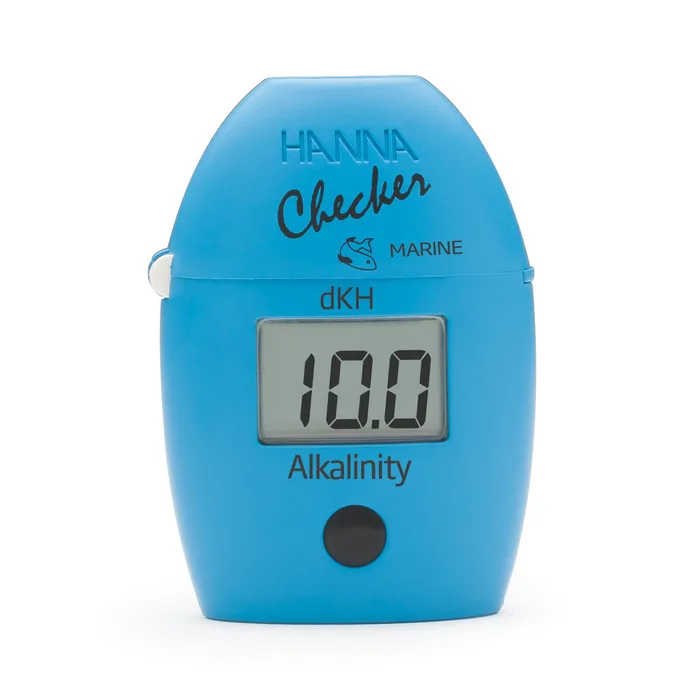
A pocket colorimeter that removes color matching from alkalinity testing, and does nothing else at all.
Best for: Reef keepers running a dosing system who need to see small alkalinity drift before it becomes a coral problem.
- Reads 0.0 to 20.0 dKH at 0.1 dKH resolution, with quoted accuracy of plus or minus 0.3 dKH plus 5 percent of reading
- An LED at 610 nm and a silicon photocell replace your eyes, so two people get the same number
- Ships with two cuvettes, a syringe with tip, a battery and reagent for 25 tests, and a calibration check set is sold separately
- Measures one parameter, so it is an addition to a test kit rather than a replacement for one
- Reagent is a recurring purchase in 25 test boxes
- Marine specific: the freshwater equivalent is a different unit that reads 0 to 500 ppm CaCO3 instead of dKH
- Runs on a single AAA and shuts off after ten minutes of non-use, so it is one more battery to remember

Six pads, 60 seconds, and no ammonia test, which is the one number a new tank cannot do without.
Best for: An owner who already runs a liquid kit and wants a quick weekly glance at hardness and chlorine between real tests.
- Results in about 60 seconds with a quick dip and no tubes or drops to manage
- Covers nitrate, nitrite, general hardness, total chlorine, alkalinity and pH on a single strip
- Sold in several pack sizes, so you can try it without committing to a large tub of strips
- Ammonia is not one of the six parameters, which is disqualifying for cycling a tank
- Tetra notes the hardness pad is not used for saltwater readings, so it is really five parameters on a marine tank
- Tetra also states buffering capacity needs to be high enough before the pH pad reads accurately
- Pads degrade with moisture, so the cap has to stay tight and the drying agent has to stay in the bottle
| Criteria | API Freshwater Master Test Kit Top pick | Salifert Master Reef Testing Combo Kit | Hanna Instruments HI772 Marine Alkalinity (dKH) Checker HC | Tetra EasyStrips 6-in-1 Aquarium Test Strips |
|---|---|---|---|---|
| Verdict | Buy it | Buy it | It depends | Skip it |
| Best for | Anyone cycling or maintaining a freshwater tank who wants one purchase to cover the parameters that actually cause fish loss. | Reef keepers dosing calcium and alkalinity who want tight readings without buying a meter for every parameter. | Reef keepers running a dosing system who need to see small alkalinity drift before it becomes a coral problem. | An owner who already runs a liquid kit and wants a quick weekly glance at hardness and chlorine between real tests. |
| Price tier | $$ · mid-range | $$ · mid-range | $$ · mid-range | $ · budget |
| Test method | Liquid reagent, color card match | Liquid reagent, titration and color match | Digital colorimeter, LED and photocell | Dip strip, color block match |
| Parameters covered | pH, high range pH, ammonia, nitrite, nitrate | Calcium, KH/alkalinity, magnesium, nitrate, phosphate, pH | Marine alkalinity in dKH only | Nitrate, nitrite, GH, total chlorine, KH, pH |
| Ammonia and nitrite | Both included | Neither, both sold as separate Salifert kits | Neither | Nitrite only, no ammonia |
| Tests per kit, as stated | Hundreds of tests, count varies by parameter | About 50 to 200 per parameter box, varies by test | 25 reagent tests in the starter kit | Several pack sizes |
| Water type | Freshwater | Reef and marine | Marine, freshwater is a separate model | Fresh and salt, GH pad freshwater only |
| Smallest step you can read | Color card increments | About 0.3 dKH alkalinity, 10 mg/L calcium | 0.1 dKH | Color blocks printed on the bottle |
| Ongoing consumables | Individual API refill kits | Replace whichever parameter box runs out | Reagent boxes of 25 tests | Another bottle of strips |
| Calibration check available | No | No | Yes, sold separately by Hanna | No |
Which one is right for you?
- Anyone cycling or maintaining a freshwater tank who wants one purchase to cover the parameters that actually cause fish loss. Buy it API Freshwater Master Test Kit
- Reef keepers dosing calcium and alkalinity who want tight readings without buying a meter for every parameter. Buy it Salifert Master Reef Testing Combo Kit
- Reef keepers running a dosing system who need to see small alkalinity drift before it becomes a coral problem. It depends Hanna Instruments HI772 Marine Alkalinity (dKH) Checker HC
- An owner who already runs a liquid kit and wants a quick weekly glance at hardness and chlorine between real tests. Skip it Tetra EasyStrips 6-in-1 Aquarium Test Strips
How we judged the field
Five things decide whether an aquarium test kit is worth owning. First, parameter coverage, because a kit that omits ammonia cannot help you cycle a tank no matter how fast it reads. Second, resolution, meaning the smallest change the kit can actually show you, which is the difference between knowing alkalinity moved and only knowing it is roughly in range. Third, tests per kit, since a kit that reads well but empties in a month is an ongoing purchase rather than a tool. Fourth, how much the result depends on your technique and your eyes, because reagent kits that need precise shaking and good light have a wider spread between careful and careless users. Fifth, whether the kit matches your water, since freshwater and marine versions of the same test use different chemistry, different ranges and different units.
The field splits cleanly into three approaches, and we wanted each represented by something people actually buy. Liquid reagent kits are the mainstream answer and we took two: API’s freshwater master kit, which is the default first purchase for most tanks, and Salifert’s reef combo, which is what the same idea looks like when the target is coral chemistry rather than the nitrogen cycle. Digital colorimeters are the third approach and Hanna’s alkalinity Checker is the most widely owned example, so it stands in for the whole photometer category. Dip strips are the fourth, and Tetra’s EasyStrips are the strips most new owners reach for, which is exactly why they earn the skip rather than a token mention.
API Freshwater Master Test Kit
Buy itAPI’s Freshwater Master Test Kit is the default recommendation for a reason: it covers the five numbers that decide whether a freshwater tank is safe, and it covers them with liquid reagents in glass tubes rather than pads on paper. The kit holds seven test solutions, four test tubes, a holding tray and a laminated color card, which makes for a low cost per reading across pH, high range pH, ammonia, nitrite and nitrate. Two limits are worth knowing before you buy. It is freshwater only, so the color card will not serve a marine tank, and it does not include GH, KH or phosphate even though people routinely assume a master kit does. The nitrate test also punishes sloppy technique: API’s own instructions call for a very vigorous shake of Solution #2, then careful mixing of the capped tube for the stated time. Skip either step and the number is unreliable. For anyone cycling or running a freshwater tank, this is the kit to own first.
Salifert Master Reef Testing Combo Kit
Buy itSalifert sells one parameter per box, and the Master Reef Testing Combo bundles six of them: calcium, KH/alkalinity, magnesium, nitrate, phosphate and pH. The appeal is resolution. Salifert’s alkalinity test reads in steps of roughly 0.3 dKH, and its calcium test resolves 10 mg/L steps, which is the granularity you need when you are dosing a two part system and trying to hold alkalinity flat rather than merely in range. Test counts vary by parameter, from about 50 on pH up to 100 to 200 on alkalinity, so the boxes empty at different rates and you replace them one at a time instead of rebuying a bundle. The gap to plan around is that the combo contains no ammonia and no nitrite test, so a newly filled saltwater tank still needs Salifert’s separate ammonia kit to get through cycling. Buy it if you keep coral and want accuracy without a meter for every parameter.
Hanna Instruments HI772 Marine Alkalinity (dKH) Checker HC
It dependsThe HI772 replaces your eyes with an LED at 610 nm and a silicon photocell. You add reagent to a cuvette, press one button, and it reports alkalinity as a number: 0.0 to 20.0 dKH, 0.1 dKH resolution, quoted accuracy of plus or minus 0.3 dKH plus 5 percent of reading. For a reef keeper chasing alkalinity drift that repeatability is the entire point, because a color card cannot resolve the swing you are trying to prevent, and because two people reading the same tube will not argue with a display. It ships with two cuvettes, a syringe with tip, a battery and reagent for 25 tests, and Hanna sells a calibration check set separately so you can confirm the unit is still honest. The catch is that it does exactly one thing. It measures marine alkalinity and nothing else, the reagent is a recurring 25 test purchase, and it is the wrong model for a freshwater tank, where Hanna’s freshwater Checker reads 0 to 500 ppm CaCO3 instead. Right for a dosing reef, wrong as a first test kit.
Tetra EasyStrips 6-in-1 Aquarium Test Strips
Skip itEasyStrips are the product most new fishkeepers buy first and the one most of them should skip. Tetra’s own page is clear about what is on the strip: a strip reading nitrate, nitrite, general hardness, total chlorine, alkalinity and pH, dipped and read at about 60 seconds against the scale printed on the bottle. Ammonia is not among the six. That single omission is disqualifying for the job people actually buy strips for, which is watching a new tank cycle, because ammonia is the parameter that harms fish first. Tetra also notes that the hardness pad is not used for saltwater readings and that buffering capacity must be high enough before the pH pad reads accurately, which is a lot of conditions on a product sold as one dip. Add the storage rules, cap tight, drying agent left in, no moisture, and the ways to get a wrong answer stack up. As a fast weekly glance alongside a liquid kit, fine. As your only test, no.
Sources
Specs in this review come from these pages.
- API Fishcare: Freshwater Master Test Kit product page (apifishcare.com)
- API Fishcare: Nitrate (NO3) Test Kit product page and instruction sheet (apifishcare.com)
- Salifert: KH/alkalinity Profi-Test technical page (salifert.com)
- Hanna Instruments: HI772 Marine Alkalinity (dKH) Checker HC (hannainst.com)
- Tetra: EasyStrips 6-in-1 Aquarium Test Strips (tetra-fish.com)
- US EPA: Aquatic Life Criteria for Ammonia (epa.gov)
API Freshwater Master Test Kit vs Salifert Master Reef Testing Combo Kit: which should you buy?
These two buys barely compete, which is the useful part. The API master kit is aimed at the nitrogen cycle: ammonia, nitrite, nitrate and the pH you need to interpret them, on a freshwater color card, with enough reagent for many readings. The Salifert combo is aimed at what corals consume: calcium, alkalinity and magnesium, plus the nutrient pair of nitrate and phosphate, at resolutions a freshwater card never attempts. Neither one contains the other’s core parameters. The API kit has no calcium, alkalinity or magnesium test. The Salifert combo has no ammonia and no nitrite test.
So the choice is decided by your tank, not by a quality ranking. Freshwater, planted or community, and the API kit is the purchase, with a separate GH and KH kit added later if you keep species that care about hardness. Saltwater fish only, and you want the API saltwater equivalent for cycling before you spend anything on reef chemistry. Reef with corals, and you want the Salifert combo plus a standalone ammonia test to cover the first six weeks. If you keep both a freshwater tank and a reef, buying both is not redundant, and you will use each of them for different questions.
What to look for
- Check the parameter list, not the word master: manufacturers use master to mean a bundle, and the bundles routinely omit GH, KH, phosphate or ammonia, so read the actual list on the maker’s page before assuming coverage.
- Match the kit to your water: freshwater and marine versions of the same test use different ranges, different reagents and sometimes different units, and a marine alkalinity Checker reading dKH is not interchangeable with a freshwater one reading ppm CaCO3.
- Look at resolution before accuracy: a kit that resolves 0.1 dKH lets you see a trend developing, while a color card with coarse steps only tells you whether you are broadly in range, and for reef dosing the trend is the whole game.
- Count the tests per parameter, not per kit: bundled reef kits often run 50 tests on one parameter and 200 on another, so the box you use most is the box you rebuy most, and the headline number hides that.
- Prefer liquid reagents for anything you will act on: glass tubes and a laminated card read far better than pads on paper, and reagent kits do not degrade the moment a humid room gets to them.
- Budget for consumables from day one: colorimeters need reagent packets in fixed test counts, strips are pure consumable, and even liquid kits sell refill bottles, so the purchase price is only the first payment.
Our final take
Buy the API Freshwater Master Test Kit if you keep freshwater, because it covers the parameters that actually cause fish loss, it reads them with liquid reagents rather than paper, and the kit holds enough reagent for many tests. Buy the Salifert Master Reef Testing Combo if you keep coral, and add a separate ammonia test for the cycling period the combo does not cover. Add Hanna’s HI772 only once you are dosing alkalinity and want to see drift measured rather than estimated. Leave the 6-in-1 strips for the weekly glance they are good at, and never let them stand in for an ammonia test. The kit that shows you the number you need is worth more than the kit that gives you six numbers fast.
Questions, answered
Do I really need a test kit if my fish look fine?
Yes, and the reason is that ammonia and nitrite poison fish long before the damage is visible. In a new tank the bacteria that convert ammonia to nitrite, and nitrite to nitrate, take weeks to establish, and during that window ammonia can climb with no cue in the water at all. By the time behavior changes, the exposure has usually been going on for days. A kit that reads ammonia and nitrite turns that invisible period into a number you can act on with a water change. Once a tank is established the testing gets less frequent, but you still want a baseline you trust.
Are test strips actually inaccurate, or is that just hobbyist folklore?
The bigger and more provable problem with the popular strips is coverage, not precision. Tetra's own page lists the six EasyStrips parameters as nitrate, nitrite, hardness, chlorine, alkalinity and pH, and ammonia is not there. So the single most important reading for a new tank is simply absent. Tetra also states that the hardness pad is not used on saltwater tanks and that buffering capacity has to be high enough before the pH pad reads accurately, both of which narrow the conditions under which the strip is telling you the truth. Add the moisture sensitivity of the pads and the coarse color blocks, and strips are best treated as a rough weekly glance rather than a diagnosis.
Why does my API nitrate reading seem stuck or obviously wrong?
Almost always technique. API's printed instructions call for shaking Nitrate Test Solution #2 very vigorously before you add a single drop, because the reagent settles out in the bottle. Then you cap the tube, mix it for the stated time, and wait for the color to develop. API's own support page adds that bottles get a very vigorous shake while the tube is mixed more gently, by inverting it. Skipping or shortening either step is a common reason a tank that clearly has nitrate reads low. The other classic error is not holding the dropper bottle fully upside down and vertical, which changes the drop size and therefore the result.
Does a master test kit cover everything I need?
No, and this is the most common mistaken assumption in the category. The API Freshwater Master Test Kit covers pH, high range pH, ammonia, nitrite and nitrate. It does not include general hardness, carbonate hardness or phosphate, all of which are sold as separate API kits. On the saltwater side the Salifert Master Reef Testing Combo covers calcium, alkalinity, magnesium, nitrate, phosphate and pH, and includes neither ammonia nor nitrite. Before you buy, write down the parameters your specific setup needs, then check them one by one against the manufacturer's own parameter list rather than the word master on the box.
Do the reagents expire, and how should I store them?
They do. Liquid reagents and strip pads both carry a lot number and a use-by date, and Tetra directs you to the bottom of the strip bottle to find them. Strips are the more fragile format because the pads react to humidity, which is why Tetra tells you to keep the cap tight, store at room temperature and leave the drying agent in the bottle. Liquid reagents are more forgiving but not immortal, and an old bottle of ammonia or nitrate reagent will read low. If a kit has been sitting in a garage through a couple of summers, treat its readings with suspicion and replace the bottle rather than the whole kit.
Deciding between the top two? See our head-to-head: API Freshwater Master Test Kit vs Salifert Master Reef Testing Combo Kit.
More Pets reviews
 The Best Aquarium Thermometers: 4 Compared (and One to Skip)
  Best Automatic Pet Feeders: What Reviewers Actually Recommend (and One to Skip)
  The Best Bird Cages: 4 Compared (and One to Skip)
  The Best Cat Litter Deodorizers: 4 Compared (and One to Skip)
  The Best Cat Litter Mats: 4 Compared (and One to Skip)
  The Best Cat Nail Caps: 4 Compared (and One to Skip)