Explained
Aquarium Substrate, Explained
After reading, you'll understand whether a given substrate will change your water, whether it suits your fish, and whether it is a one-time purchase or a consumable.
In this guide
Most first-time buyers pick substrate the way they pick a rug, by color. The problem is that a substrate sits in contact with your water twenty-four hours a day and some of them are chemically active by design. An aquasoil can drive pH down and release ammonium into a new tank. An aragonite mix will drive pH and hardness up on purpose. A plain quartz sand will do neither. None of that is written on the front of the bag, but almost all of it is written somewhere on the maker's own site.
The 30-second version
- Active soils are not neutral, they release nutrients and shift pH, and ADA's own manual tells you to wait until ammonium and nitrite read zero before adding livestock.
- Carbonate substrates only push one way, so aragonite and crushed coral raise pH and hardness and cannot be used to soften water.
- Grain size is a welfare spec, not a styling one, and fine smooth sand is what husbandry guidance recommends for corydoras and other barbeled fish.
- Depth is decided by your goal, with rooted plants wanting a bed several centimetres thick and a corydoras tank wanting a thin sand layer instead.
- Some substrates are consumables, so check whether the maker will state that the product is good for the life of the aquarium, because many of them will not.
The products this guide is about
Our verdict on each, with the full reasoning on the companion review.
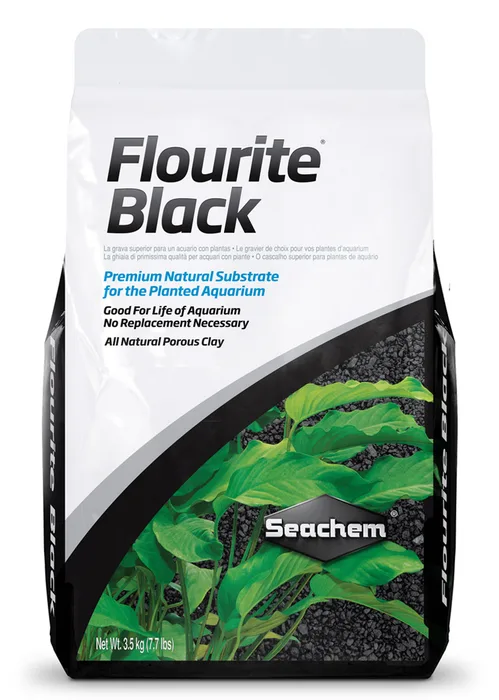
- Buy Seachem Flourite Black A porous clay gravel that feeds plant roots without moving your pH, and that Seachem says you will never have to replace. Amazon
- Buy CaribSea Super Naturals Peace River The smooth 1.0 to 2.0 mm river sand CaribSea itself names when asked what to put under corydoras. Amazon
- It depends ADA (Aqua Design Amano) Aqua Soil Amazonia Ver.2 The best plant growth here, bought at the price of a proper fishless cycle and a water chemistry you do not get to choose. Amazon
- Skip GloFish Aquarium Gravel A best-selling gravel sold entirely on how it looks under a blue LED, with none of the facts you would need to check it. Amazon
What actually matters
- Active versus inert - an active substrate changes water chemistry and feeds plants, an inert one is just a physical bed. This is the first question to answer, because it determines whether you can stock fish immediately or need to cycle the tank empty first.
- Buffering direction - a substrate that buffers can only push one way, up for carbonate materials and down for acidic soils. Match it to the species you want to keep, because fighting your own substrate with chemicals is a losing routine.
- Grain size and shape - published typical sizes let you check a substrate against your fish, and smooth rounded grains matter for anything that sifts or burrows. A maker who does not print a size is telling you the product was not designed around that question.
- Bed depth - rooted plants need enough depth to anchor and to hold nutrients, while a thin layer is safer in a tank where nobody is planting. Buying by weight without converting to depth is how people end up a bag short.
- Rinsing and dust - fine material carries dust that will cloud a tank for days and clog filter floss. The instruction varies by product, and with aquasoils rinsing can actively damage the granules.
- Nutrient content - clay and soil substrates carry minerals for roots, while plain sand carries none and needs root tabs. Neither is wrong, but only one of them grows heavy root feeders unaided.
- Lifespan - inert gravels and sands are effectively permanent, while nutrient-loaded soils are spent at some point and buffering capacity is finite. If a maker will not state an interval, treat the eventual replacement as an unknown cost of ownership.
The specs, in plain English
Green flags vs red flags
Green flags
- The maker publishes a typical grain size in millimetres rather than just a color name.
- The product page states plainly what the substrate does to pH, even if the answer is nothing.
- There is a rinsing instruction specific to that product, not generic advice.
- The maker gives a fill quantity tied to a tank size or a coverage formula you can check.
- The maker is willing to say the substrate is good for the life of the aquarium and need not be replaced.
Red flags
- The description is entirely about how it looks under a light and says nothing about the water.
- No composition is given, so you cannot tell whether it is carbonate, quartz, clay or soil.
- Buffering is claimed but no direction or magnitude is stated anywhere.
- Coverage is quoted by weight per gallon only, with no way to convert it to a bed depth.
- A nutrient-rich soil with no guidance at all on cycling, ammonium or when it is safe to add fish.
Who's who: the brands
- Seachem - Known for Flourite, a fracted porous clay gravel the company states will not alter pH and never needs replacing, plus Onyx Sand for people who do want a small upward buffer.
- CaribSea - A long-standing substrate specialist whose lines are split by job, with uncoated Super Naturals sands for general use and separate African Cichlid Mix products built to buffer rift lake tanks.
- ADA (Aqua Design Amano) - The Japanese originator of the Nature Aquarium style, best known for Aqua Soil Amazonia, a nutrient-loaded natural soil substrate sold with its own supplement.
- Tropica - A Danish aquarium plant grower that also sells its own Aquarium Soil and a finer Aquarium Soil Powder for planted setups.
- GloFish (Spectrum Brands Pet) - Best known for fluorescent fish and matching decor, including gravels and sands sold on their appearance under blue LED lighting.
How to read a listing without getting fooled
Start on the maker's own site rather than a retail listing, because retail pages routinely drop the numbers that matter. Look for four things in order: what the material is, what it does to pH, the typical grain size in millimetres, and the rinsing instruction. If any of those is missing, that absence is itself information about what the product was designed for. Then convert the packaging to something useful: bags are sold by weight or volume, so use the maker's coverage formula or its stated tank size to work out how deep your bed will actually be. CaribSea publishes both a rough rule and a full calculation with per-product densities, and ADA states a tank size that one bag suits. Finally, check whether the page ever mentions replacement. Silence on that point usually means the substrate is a consumable and nobody wants to say so.
How much should you spend?
Plain inert sands and gravels sit in the budget tier and are sold in large bags, which makes them the cheapest way to fill a big tank properly. Mineral-rich plant gravels such as fracted clay sit in the mid-range, and the argument for paying more is that the maker will state the product never needs replacing, so it is a one-time purchase. Imported aquasoils sit firmly in the premium tier and carry a hidden ongoing element, because a nutrient-loaded soil is a consumable even when the maker declines to say how long it lasts. Decorative colored gravels are usually budget tier, but they are budget for a small quantity, which is a different thing from being cheap to fill a tank with. The cheapest genuinely defensible option in this whole category is plain pool filter sand, which a published Corydoras husbandry protocol recommends by name as inert, widely available and cost effective.
Questions, answered
What is the actual difference between an active soil and an inert substrate?
An inert substrate is a physical bed and nothing more, so it leaves pH, KH and GH untouched. An active soil is chemically involved: it holds nutrients for roots, tends to pull pH toward the acidic side, and in a new tank it can release ammonium. Seachem states its Flourite range will not alter pH, while ADA's manual for Amazonia Ver.2 warns of ammonium and nitrite immediately after setup. Neither approach is better in the abstract, but they suit completely different setup timelines.
Does crushed coral or aragonite permanently fix soft water?
It raises pH and hardness for as long as there is carbonate left to dissolve, which is why CaribSea describes its cichlid substrates as buffering for the life of the aquarium and resisting the downward pH drift seen in crowded tanks. It is not instant and it is not adjustable, so it suits fish that want hard alkaline water permanently rather than a tank you want to fine-tune. It also cannot work in reverse. If your goal is softer, more acidic water, a carbonate substrate is the wrong tool entirely.
Can I mix substrates, or put sand on top of a soil?
Mixing is usually fine within limits, and capping is more restricted. CaribSea says you can mix other substrates with its Eco-Planted line but suggests no more than fifty percent, and that you can layer another substrate on top only in a brand new setup. In an established tank it advises against capping an existing bed and says to mix new material in gently instead. The reason is biological: the substrate is part of your filtration, and burying or replacing it in bulk disturbs that.
Do I need root tabs if I use plain sand or gravel?
For rooted plants, generally yes. Plain quartz sand carries no nutrients at all, so heavy root feeders like swords and crypts will need tabs pushed into the bed. Mineral-rich clay gravels are different: Seachem says gravel modifiers such as laterite are not necessary with Flourite, and that supplementary feeding is useful but not a requirement. Water-column feeders and epiphytes such as anubias and java fern do not care about the substrate either way, since they are not rooted in it.
Or jump to the head-to-head: Seachem Flourite Black vs CaribSea Super Naturals Peace River.