Explained
Aquarium Gravel Vacuums, Explained
After reading this you will know exactly which type of gravel vacuum suits your tank size and substrate, and which specs on the box are worth paying for.
In this guide
A gravel vacuum is a tube and a hose that uses gravity to lift fish waste and uneaten food out of your substrate while you drain water for a water change. Almost every model cleans about equally well, because gravity does the work, so the real differences are how the siphon starts, how finely you can slow the flow down, and whether the dirty water ends up in a bucket or straight down your sink. First-time buyers usually pick on price or on cleaning claims, then discover the thing that actually decides whether they keep up with maintenance is bucket trips.
The 30-second version
- Tank size picks the type for you. On a small tank a cheap hand-primed bucket siphon is usually all you need; above that, a faucet-driven system that drains to the sink is what stops you skipping water changes.
- Flow control matters more than suction power. Most siphons have plenty of suction. A valve or clamp that lets you dial it down is what keeps sand, aquasoil, and carpet plants from disappearing up the tube.
- Tube diameter should match your substrate. Wide tubes let coarse gravel tumble and fall back while waste rises; narrow tubes are gentler on fine sand but drain slowly, and no single tube is right for both.
- Priming is the feature that decides if you keep using it. A pump handle or squeeze bulb starts the siphon quickly; anything that needs mouth suction or repeated shaking tends to get abandoned.
- Powered gravel cleaners solve a problem you do not have. They add a pump and a power adapter to a job gravity already handles, and many still leave you moving the water somewhere.
The products this guide is about
Our verdict on each, with the full reasoning on the companion review.
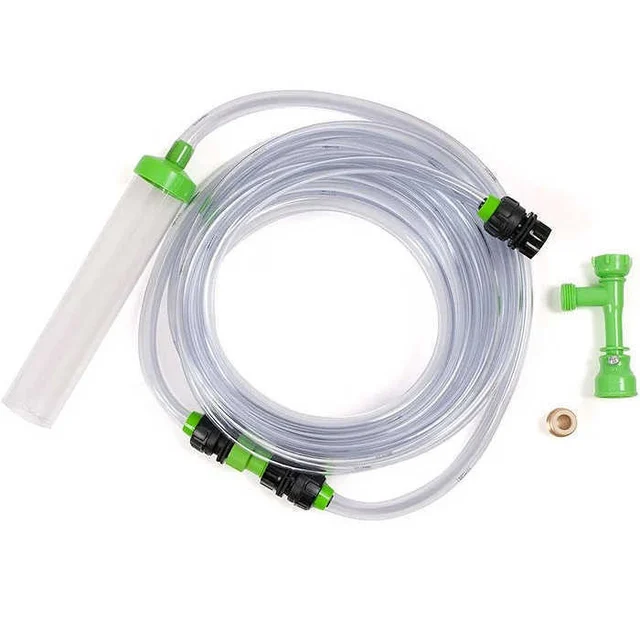
- Buy Python Products Python No Spill Clean and Fill (25 ft) Threads onto your faucet, drains to the sink, and refills the tank, so the bucket disappears entirely. Amazon
- Buy hygger Hand Operated 3-in-1 Water Changer A hand pump starts the siphon, and the extension tubes let one tool fit several tank depths.
- It depends Qanvee Aquarium Gravel Vacuum Deliberately gentle flow built for planted tanks, which is a feature in aquasoil and a liability everywhere else. Amazon
- Skip hygger 5-in-1 Electric Aquarium Gravel Cleaner (HG-955) A submersible pump, a mains cord, and five nozzles bolted onto a job that gravity already handles. Amazon
What actually matters
- Where the dirty water goes. This is the single biggest quality-of-life factor. A bucket siphon is cheap and fits in a drawer but gets tiring after a few bucket trips. A faucet-driven system drains straight to the sink and refills from the same hose, which is what makes weekly maintenance on a big tank sustainable.
- Priming method. Squeeze bulbs, pistol-grip pump handles, and faucet venturi suction all start a siphon without your mouth on the tube. Bulbs are cheapest and can crack, pump handles are sturdier, and venturi systems depend entirely on your tap.
- Adjustable flow. An inline clamp, a valve, or simply how far you open the tap. Coarse gravel tolerates full suction; sand, aquasoil, and planted carpets do not. On a planted tank this is the difference between cleaning it and rebuilding it.
- Intake tube diameter versus your substrate. Wide bore for pebble and coarse gravel so it tumbles and drops back. Narrow bore for fine sand so it does not vanish down the hose. Buy for the substrate you actually have.
- Rigid tube length. The stiff intake tube needs to reach your bottom glass without you submerging your shoulder. Extension tubes are what let one tool cover tanks of different depths.
- Hose length with slack. Measure from the tank to the sink or the bucket, then add a few feet. A hose stretched taut is a hose that pops off the tap or whips out of the bucket.
- Serviceable parts and fish safety. Replacement tubes, washers, and hoses sold separately mean the tool outlives its first failure. A pre-filter sponge or fine mesh over the intake is worth it in shrimp or breeding tanks, where fry are small enough to vanish before you notice.
The specs, in plain English
Green flags vs red flags
Green flags
- An inline flow clamp or valve is included in the box rather than sold as an upgrade.
- The rigid intake telescopes, or the model is sold in tube lengths matched to tank depth.
- Replacement tubes, hoses, washers, and adapters are available separately from the same maker.
- The priming mechanism is a pump handle or a well-reviewed bulb, and the listing shows it clearly rather than burying it.
- The listing states the substrate the tube is designed for, and that matches the sand, gravel, or aquasoil you actually keep.
- For a faucet system, the kit ships with an adapter and lists which tap thread sizes it fits.
Red flags
- No flow control anywhere in the kit, especially on a model marketed for sand or planted tanks.
- Product photos that show the siphon started by mouth, or instructions that involve repeated shaking to get flow going.
- A battery or electric unit described as a 'cleaner' that returns filtered water to the tank, since that is not a water change.
- Repeated reports of the same failure, typically a cracked bulb, a kinked hose, or a pump that stops working.
- A powered model whose pump must stay submerged, so check the minimum water depth it works in.
- Thin, short hose on a model aimed at large tanks, which turns a big water change into a long wait.
Who's who: the brands
- Python Products - American maker of faucet-driven no-spill water changers, described by the maker as needing no buckets or siphons.
- hygger - Budget-to-mid aquarium brand with a broad lineup, from hand-pump gravity siphons to powered gravel cleaners.
- Aqueon - Mainstream US aquarium brand with siphon kits and water-change tools.
- Fluval - Hobby brand best known for filters, with a gravel cleaner range.
- Qanvee - Aquascaping-focused maker whose vacuums are built deliberately gentle for aquasoil, shrimp tanks, and planted carpets rather than for speed.
- Marina - Value-oriented line of basic aquarium accessories, including siphon kits.
How to read a listing without getting fooled
Start by ignoring the cleaning claims, because every siphon lifts waste out of gravel and none of them lift it dramatically better. Instead, find four things in the listing. First, how the siphon starts: look for the words bulb, pump, or faucet adapter, and treat any listing that is vague here as a listing that expects you to use your mouth. Second, whether flow control is included, named as a clamp, valve, or adjustable tap; if the word does not appear, assume there is none. Third, the rigid tube length and whether it telescopes, then compare it to the height of your tank rather than to the picture. Fourth, hose length, measured against the real distance from your tank to your sink or your bucket, with a few feet of slack added. For faucet systems, check the tap thread requirement before anything else, because a beautiful pull-out sprayer with no removable aerator is the one thing that makes the whole category a non-starter for you. Photos are useful for one specific thing: comparing the intake tube's width to the gravel in the shot, which tells you more about substrate fit than the description will.
How much should you spend?
This is a category where the cheap option is genuinely good. A hand-primed bucket siphon costs about as much as a couple of bags of fish food, and a decent one with a pump handle, a flow clamp, and extension tubes does the job on a small to mid size tank. Paying a little more than rock bottom buys you the pump handle instead of a soft bulb, the clamp instead of your thumb, and a rigid tube that reaches, and that small step up is the best value in the category. The genuinely bigger spend is a faucet-driven system, and it is worth it for exactly one reason: it removes bucket trips. If your tank is large, if you keep several tanks, or if hauling water is the reason you skip water changes, that jump pays for itself in maintenance you actually do. If your tank is small and one bucket finishes the job, the extra money buys you nothing you will feel. Where spending more clearly does not pay is powered gravel cleaners, which sit in the same bracket as a faucet system, add a pump and a power adapter, and still leave you moving water somewhere. If you are torn, buy the cheap hand siphon first; it costs so little that upgrading later barely stings, and most people keep it as a spot-cleaning tool anyway.
Questions, answered
Do I need a faucet-driven system, or is a bucket siphon enough?
It comes down to tank volume. A twenty percent change on a small tank is one bucket, which nobody minds. The same change on a large tank is several bucket trips each way, and that is the point where people quietly start skipping weeks. On a large tank, or with several tanks, a faucet system pays for itself in consistency. Below that, a good hand-primed siphon is all you need.
How often should I vacuum the gravel?
Most keepers vacuum during their regular water change, weekly or every other week, taking out twenty to thirty percent of the volume. You do not need to cover the whole substrate each time. Working through about a third of the tank floor per session is common practice and avoids stripping too much beneficial bacteria at once. Heavily stocked or messy-fish tanks need more; lightly stocked planted tanks need much less.
Will a gravel vacuum work with sand?
Yes, but the technique changes. With sand you hover the tube an inch or two above the surface rather than plunging it in, so the lighter waste lifts off while the sand stays put. Flow control matters far more here, because a vacuum with no valve will happily send half your substrate down the hose. A narrower tube, a flow clamp, or a partly closed tap all work.
Can a gravel vacuum suck up fish or shrimp?
It can, and it usually is not fatal. Wide gravel tubes can pull in small fish, which can often be returned to the tank if you catch them quickly. The real risk is fry and shrimplets, which are small enough to vanish before you notice. In a shrimp or breeding tank, stretch fine mesh or a pre-filter sponge over the intake.
Are electric or battery-powered gravel vacuums worth it?
Usually not. They solve the priming problem, which a squeeze bulb already solves for far less, and they introduce new ones: pumps that must stay submerged, filter chambers to disassemble, and a power adapter near water. Battery models that filter and return water to the tank are not performing a water change at all. If the thing you actually want is to stop carrying buckets, a faucet-driven system addresses that directly.
Should I clean the whole substrate at once?
No. Beneficial bacteria live in and around the substrate, and stripping all of it in one session disturbs more of that colony than necessary. Rotating through sections of the tank floor over several water changes keeps the substrate from building up sludge while leaving the biological filter intact. In a heavily planted tank, many keepers skip deep vacuuming entirely and only lift loose detritus from the surface, since roots and plant uptake handle a lot of the waste.
Or jump to the head-to-head: Python Products Python No Spill Clean and Fill (25 ft) vs hygger Hand Operated 3-in-1 Water Changer.