Explained
Aquarium Lights, Explained
After reading this you'll know what PAR, full spectrum, CRI and IP ratings actually mean, and how to pick a fixture that grows your plants without feeding algae.
In this guide
Aquarium lighting is the one piece of tank gear where buying the brightest option can make your tank worse. Listings lead with lumens, watts and color temperature, none of which tell you how much usable light reaches a plant sitting at the bottom of the tank. This guide decodes the specs, explains why light has to be balanced against nutrients and CO2, and shows you how to check a fixture will actually fit the tank you own.
The 30-second version
- PAR is what plants use, lumens are what your eye sees. A fixture can look dazzling and still deliver very little of the light plants photosynthesize with, so treat lumens and watts as within-family size comparisons only.
- Light intensity drops sharply with water depth, so a number measured at the surface can be a fraction of that by the time it reaches a carpeting plant on the substrate of a tall tank.
- Too much light for too long is the most common cause of algae, because light only grows plants when nutrients and CO2 can keep up; past that point the surplus feeds algae instead.
- Control matters more than peak output. A built-in timer with sunrise and sunset ramping and real dimming lets you run a strong fixture gently, which is the single most useful lever you have.
- Fit and sealing are the boring specs that cause returns. Check the bracket extension range against your tank width and the IP rating against how wet the fixture will get.
The products this guide is about
Our verdict on each, with the full reasoning on the companion review.
- Buy Chihiros WRGB II Pro LED Light The output and color rendering serious planted tanks need, with app control that lets you dial the intensity back down.
- Buy Fluval Plant 4.0 LED The best all-round balance of plant-usable output, scheduling and build for a normal home aquarium.
- It depends hygger HG-957 Full Spectrum Aquarium Light A lot of programmable light for very little money, if you can live with a controller panel instead of an app.
- Skip NICREW ClassicLED Plus A tidy viewing light that costs about the same as fixtures which actually grow plants.
What actually matters
- Usable light for your plant list, not the biggest number. Anubias, java fern and cryptocoryne want low light. Carpets and red stem plants want high light plus CO2. Buying above your plan means dimming a fixture you overpaid for, or growing algae.
- PAR or PPFD figures over lumens and watts. Lumens describe brightness as a human eye perceives it and watts describe electricity used. Neither predicts what reaches your substrate, especially in a deep tank.
- Full spectrum with real red and green emitters. White and blue diodes grow easy plants but flatten color. Separate red, green and blue channels improve penetration through dense growth and make red plants and fish look like themselves.
- A built-in timer with ramping. Gradual sunrise and sunset transitions reduce stress on fish and let you run a shorter, gentler photoperiod without babysitting a wall timer. Per-channel dimming is what lets you correct an algae problem without buying a new light.
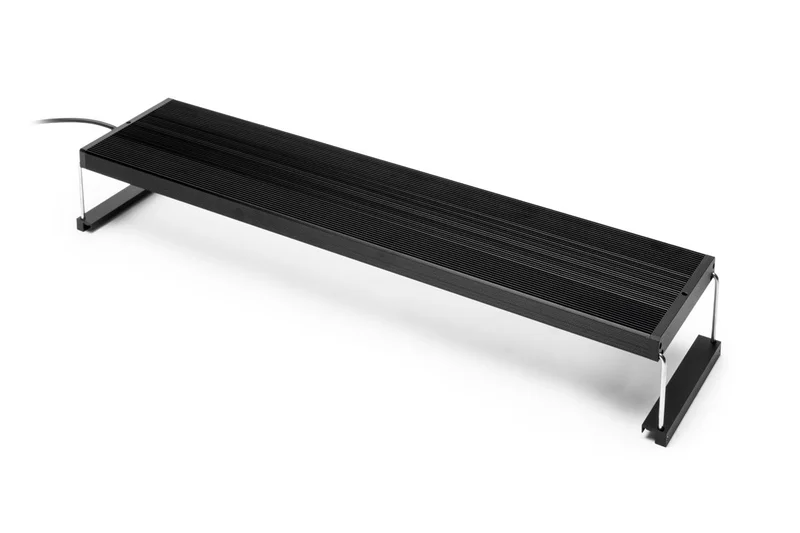
- Brackets that match your tank width and rim style. Measure front to back and the outside width, then check the bracket extension range. Rimless tanks need mounts that clamp bare glass. Getting this wrong is the most common reason these fixtures go back.
- An IP rating you have actually looked up. Splash tolerance is fine above an open-top tank. Stronger sealing matters if you run a lid that drips condensation or a spray bar near the surface.
- A fixture length matched to the tank, not just the bracket span. A light noticeably shorter than the tank leaves dark corners where plants thin out and algae settles in.
The specs, in plain English
Green flags vs red flags
Green flags
- Publishes PAR or PPFD figures at stated depths, or at least describes what the fixture will grow instead of leading with a headline lumen number
- Separate white, red, green and blue emitters, or a published CRI in the high 80s or better
- Built-in timer or app scheduling with genuine sunrise and sunset ramping, plus dimming in real steps
- Extendable brackets with a stated width range, and riser or hanging options for both rimmed and rimless tanks
- A published IP rating you can check, and a warranty measured in years rather than months
- Owner reports over a full year describing what actually grew, not just how bright it looked out of the box
Red flags
- Lumens or watts as the only output claim, with no spectrum detail and no mention of what it will grow
- No dimming and no timer, so the only control you have is a wall plug and the on-off switch
- Vague 'full spectrum' wording with no channel breakdown and no CRI figure
- Fixed-length body with no bracket range stated, or brackets sold separately without saying so up front
- No IP rating published anywhere in the listing while the fixture is marketed for use under a lid
- Marketing that treats maximum brightness as the selling point, with nothing about running it at reduced power
Who's who: the brands
- Fluval - Mainstream aquarium brand whose planted-tank LEDs pair full spectrum output with app scheduling and strong sealing, aimed at everyday freshwater keepers.
- Chihiros - Aquascaping specialist known for high-output WRGB fixtures with per-channel app control, favored by CO2-injected planted tanks.
- hygger - Budget-focused maker that puts programmable on-unit timers and broader spectrum into inexpensive fixtures, with modest output ceilings.
- NICREW - High-volume budget brand whose slim strips are widely sold as starter and viewing lights rather than serious plant-growing fixtures.
- Finnex - Long-running planted-tank brand with programmable fixtures aimed at hobbyists who want scheduling and spectrum control without aquascaping prices.
- Current USA - Known for controller-driven LED systems with color mixing and effects, common on both freshwater planted tanks and reef setups.
How to read a listing without getting fooled
Work through a listing in this order. First, ignore the headline lumen and watt figures until you have found something about spectrum: a channel breakdown such as white, red, green and blue, or a published CRI. That tells you whether the fixture can grow plants and render color, or only make water look bright. Second, look for any PAR or PPFD figure and note the depth it was measured at, because intensity falls off sharply through water and a strong surface number can be modest at the substrate of a tall tank. Where no PAR figure exists, fall back on consistent owner reports of what actually grew, and treat lumen claims as valid only for comparing sizes within one product family. Third, check control: a built-in timer with ramping and real dimming steps is worth more than raw output, because it is how you avoid an algae problem rather than fix one later. Fourth, do the physical homework. Measure your tank front to back and across the outside, then compare that against both the fixture length and the bracket extension range, and confirm whether legs, risers or a hanging kit are included or sold separately. Finally, find the IP rating and match it to your setup: splash tolerance is enough for an open-top tank with the light sitting clear of the water, while a lid that drips condensation calls for stronger sealing. If a listing will not tell you the spectrum, the mounting range or the IP rating, that silence is itself information.
How much should you spend?
Cost in this category tracks three things: how much plant-usable output the fixture produces, how granular the control is, and how well it is built and sealed. The value sweet spot for most freshwater keepers sits in the middle, where you get a genuine full spectrum, app or on-unit scheduling with ramping, brackets that fit a range of tank widths, and sealing that survives a wet lid. That combination covers a planted community tank with easy and medium plants, which is what most tanks actually are. Spending more is worth it in one specific case: a high-tech scape with CO2, a carpet to fill in, or red stem plants where color rendition is the point. Those tanks need real output and per-channel control, and the premium buys both. Spending more is not worth it if your plant list stays easy, because the extra output becomes something you spend the first six months dimming. At the bottom of the market, be careful about what looks cheap. A basic strip with no timer and no dimming often costs about what a programmable fixture with meaningfully more output costs, and you end up buying a plug-in timer on top and replacing the light the moment you add a demanding plant. Factor the timer and the likely upgrade into what a budget fixture really costs.
Lighting is the third piece of a tank setup, alongside filtration and heating. RBE covers the other two in Aquarium Filters, Explained and Aquarium Heaters, Explained, and the three interact: a heater sets the temperature plants and fish live at, a filter supplies the flow that carries nutrients and CO2 around the tank, and the light sets how fast everything grows. Get the light wrong and the other two cannot save you from algae.
Questions, answered
Why do experienced keepers talk about PAR instead of lumens or watts?
Lumens measure brightness the way a human eye perceives it, and the eye is most sensitive to green and least sensitive to the deep reds and blues plants rely on. Watts measure electricity consumed, not light delivered. PAR measures photons in the roughly 400 to 700 nanometer band that plants actually photosynthesize with, which is why it predicts growth and the other two do not. A fixture can look brilliant and still deliver little usable light, and a higher-wattage strip can lose to a better-designed fixture with good optics. Use lumens and watts to compare sizes within one product family, and treat independent PAR measurements or consistent owner accounts of what grew as the more useful signal across brands.
Does tank depth really change how much light my plants get?
Yes, and more than most first-time buyers expect. Light spreads out and is absorbed as it travels through water, so intensity at the substrate is a fraction of what it is at the surface, and the drop steepens the deeper you go. Tannins, suspended particles and floating plants cut it further. That is why a fixture rated at the surface can be plenty for a shallow nano tank and not nearly enough to keep a carpeting plant compact at the bottom of a tall one. When you compare fixtures, look for output figures quoted at a stated depth, and if you have a deep tank assume you need more headroom than the raw surface number suggests. Raising a light on legs or a hanging kit lowers intensity at the substrate, which is a useful way to dial a strong fixture down.
How long should I run the light each day, and why does algae keep appearing?
Six to eight hours is a sensible band for most freshwater tanks, and new setups do better at the lower end with reduced intensity while plants settle in. Algae is driven by total light dose, meaning intensity multiplied by duration, relative to the nutrients and CO2 available. Plants can only use light up to the point where the other two inputs keep pace; beyond that the surplus feeds algae instead. That is why running too much light for too long is the most common cause of algae in a planted tank, and why the fix is almost always to cut duration or intensity first, then wait two to three weeks before changing anything else. Splitting the photoperiod with a midday break is a fine-tuning trick, not a remedy for too much light.
What do full spectrum, Kelvin and CRI actually mean?
They describe three different things that get muddled together. Full spectrum means the fixture emits across the visible range rather than only white and blue, usually by combining white diodes with dedicated red, green and blue ones. Red and blue drive photosynthesis most strongly while green penetrates deeper into dense growth, so a real mix helps both growth and appearance. Kelvin is color temperature, meaning how warm or cool the light looks, with something around 6500K to 7500K reading as natural daylight. CRI is how faithfully colors appear under the light on a 100-point scale, so a high figure means red plants and orange fish look like themselves rather than brown. Kelvin and CRI describe how the tank looks to you. Full spectrum is the one that also affects what grows.
Will the fixture fit my tank, and do I still need a plug-in timer?
Check two things rather than one. The fixture length should roughly match the tank width so you are not leaving dark corners, and the bracket extension range has to cover your tank measured front to back and across the outside, including any trim. Extendable or sliding brackets cover a span rather than a fixed size, rimless tanks need mounts that clamp bare glass, and legs, risers and hanging kits are sometimes sold separately, so confirm what is in the box. On timers, any fixture with built-in scheduling or app control does not need a plug-in timer. A basic light with only an on-off switch does, and that extra purchase belongs in your reckoning of what a cheap fixture really costs.
What IP rating do I need above an aquarium?
IP ratings are two digits describing protection against solids and then against water, and the second digit is the one that matters over a tank. A low water digit means splash and condensation tolerance only, which is fine on an open-top tank where the fixture sits clear of the water. Higher figures add real resistance to jets or immersion, which is what you want if you run a lid that drips condensation, a spray bar near the surface, or a busy household where the tank gets bumped. Whatever the rating, keep a drip loop in the power cord so water running down the cable falls off before it reaches the outlet, and never rely on a rating to excuse a fixture sitting in the splash zone. This is general product information to help you shop, not veterinary advice; if your fish look unwell, consult a qualified aquatic veterinarian rather than changing lighting and hoping.
Or jump to the head-to-head: Fluval Plant 4.0 LED vs Chihiros WRGB II Pro LED Light.