Explained
Pressure Canners, Explained
After reading, you'll understand why low-acid food needs pressure rather than boiling, what dial and weighted gauges each ask of you, how elevation changes the required pressure, and how to tell a real canner from an appliance with a canning button.
In this guide
First-time buyers get tripped up by two things. One is the word 'canner' appearing on appliances that were never validated for the job, because nothing stops a manufacturer from printing it. The other is assuming that pressure is the point, when the pressure is only a means of reaching a temperature: 240 to 250 degrees F, which is what actually destroys Clostridium botulinum spores in low-acid food. Once you see the temperature as the target and the psi as the dial that gets you there, the spec sheets start to make sense, and the altitude adjustments stop looking arbitrary.
The 30-second version
- Pressure is a means, not the goal, because the thing that makes low-acid food safe is holding 240 to 250 degrees F, which 10 to 15 PSIG happens to produce.
- Boiling water is not enough, since botulinum spores are very hard to destroy at 212 degrees F, so boiling alone cannot make low-acid food safe.
- Four quart jars is the dividing line, because NCHFP only treats a vessel as a pressure canner for USDA processes if it holds that many standing upright with the lid on.
- A dial gauge is a yearly commitment, as it should be checked for accuracy yearly and replaced if it reads more than 2 pounds off.
- Look for tested processes, not approval badges, since USDA and NCHFP publish tested processes, so a 'USDA approved' claim on an appliance deserves skepticism.
The products this guide is about
Our verdict on each, with the full reasoning on the companion review.
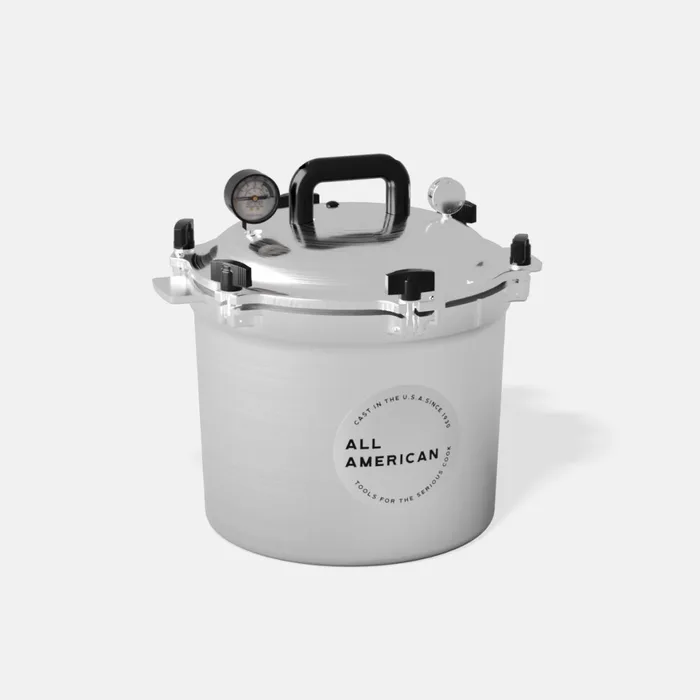
- Buy All American 1930 All American 921 Pressure Canner A cast aluminum stovetop canner with a machined metal to metal seal and a 5, 10, and 15 psi regulator weight, so there is no gasket to replace and no reliance on a dial gauge for pressure. Amazon
- Buy Presto 23-Quart Pressure Canner and Cooker The default full-size stovetop canner: a cover-mounted dial gauge, 23 quarts of liquid capacity, and room for 7 quart jars or 20 pints in a single load. Amazon
- It depends Presto Precise 12-Quart Digital Pressure Canner A countertop electric canner that senses temperature rather than pressure, holds 240 degrees F, the temperature Presto cites for safe home pressure canning, on its own, and needs no elevation adjustment. Amazon
- Skip Nesco Smart Canner and Cooker NPC-9 A 9.5-quart electric multi-cooker with canning buttons on the front panel, which is precisely the appliance class NCHFP says it does not support for USDA low-acid processes. Amazon
What actually matters
- Low-acid versus acid food - Low-acid foods have pH values above 4.6 and include red meats, seafood, poultry, milk, and all fresh vegetables except most tomatoes. Those are the foods that require pressure canning rather than a boiling water bath.
- Processing temperature - NCHFP states that all low-acid foods should be sterilized at 240 to 250 degrees F, which pressure canners reach at 10 to 15 PSIG. Everything else on the spec sheet is in service of hitting and holding that number.
- Jar capacity, not liquid capacity - A 23-quart canner and a 12-quart canner might both be legitimate, but what matters is how many quart jars stand upright inside. Four is the published floor and seven is a comfortable full-size load.
- Gauge type - A weighted regulator controls pressure mechanically and tells you when you are right by rocking, needing no accuracy check. A dial gauge shows the whole pressure range but needs annual testing and constant burner attention.
- Elevation - Water boils cooler as you climb, so the required pressure rises. Weighted gauges move from 10 psi at sea level to 15 psi above 1,000 feet, while dial gauges step 11, 12, 13, and 14 psi across the elevation bands.
- Come-up and cool-down time - The heating and cooling periods are part of the total lethal heat that USDA process times were built on. That is precisely why small or fast-cycling appliances cannot borrow those times safely.
- Cooktop compatibility - Aluminum canners will not heat on induction because they are not magnetic. Glass and ceramic tops bring weight limits, overhang concerns, and sensors that can cut a burner mid-process and ruin the load.
The specs, in plain English
Green flags vs red flags
Green flags
- The manufacturer states a jar capacity of at least four quart jars standing upright on the rack.
- The unit is described as a pressure canner throughout, not a pressure cooker that also cans.
- Documentation gives explicit psi settings and points you to published USDA or Extension process tables rather than its own invented times.
- Replacement sealing rings, regulators, and overpressure plugs are available from the maker.
- The maker publishes what it did to validate the appliance, such as thermocouple testing inside jars, rather than just asserting compliance.
Red flags
- A canning or steam canning button on a multi-function countertop appliance that also browns, slow cooks, and makes yoghurt.
- Any claim that the appliance itself is USDA approved or certified, since USDA and NCHFP publish processes rather than appliance approvals.
- Recipes or process times supplied by the manufacturer that do not match published USDA times for the same food and jar size.
- No mention of altitude adjustment anywhere in the instructions.
- A small total capacity, which may not hold four quart jars upright with the lid closed.
Who's who: the brands
- All American 1930 - Cast aluminum stovetop canners built by Wisconsin Aluminum Foundry, known for a machined metal to metal seal with no gasket and a 5, 10, and 15 psi regulator weight.
- Presto - The volume brand in home canning, with dial gauge stovetop canners at 16 and 23 quarts, an induction-compatible stainless-clad model, and the Precise digital electric canners.
- Nesco - Countertop appliance brand whose Smart Canner sits in the electric multi-cooker category that NCHFP does not support for low-acid canning.
- Ball - Best known for jars and lids, and for an electric automatic home canner intended for acid foods, which is a different job from low-acid pressure canning.
How to read a listing without getting fooled
Start at the jar capacity line rather than the headline quart number, because 23 quarts of water and seven quart jars are two different facts and only the second one tells you whether the published processes apply. Next find the gauge type, since that single word decides whether you owe the canner an accuracy test every year or nothing at all. Then look for an explicit statement of the pressure settings available, ideally 5, 10, and 15 psi or a dial covering the full range, and for altitude guidance; a listing that never mentions elevation is a listing written by someone who has not thought about the process. Check the cooktop line carefully, because 'smooth top' and 'induction' are not synonyms and most aluminum canners handle the first but not the second. Finally, treat any certification language sceptically. The useful signals are available parts, published process references, and a clear description of what the maker actually tested.
How much should you spend?
Budget tier gets you a small stovetop canner, typically 16 quarts with a dial gauge, which holds seven quarts but only 13 half pints and works fine if your batches are modest. Mid-range is where the full-size 23-quart dial gauge canners sit, and this is the sweet spot for most households: full-batch capacity, a dial fine enough for high elevations, and a boiling water mode included. Premium covers two very different things. One is the cast aluminum metal to metal canner, where the money buys the absence of gaskets and gauge tests. The other is the dedicated digital electric canner, where the money buys automatic temperature control and altitude handling at the cost of load size. Spending more does not buy more safety at any tier, since all of them follow the same published processes; it buys less maintenance or less attention.
Questions, answered
Why does low-acid food need pressure when acid food does not?
Clostridium botulinum spores grow in the oxygen-free environment inside a sealed jar, and low-acid foods, meaning those above pH 4.6, do not have enough acidity to stop them. NCHFP notes that botulinum spores are very hard to destroy at boiling-water temperatures and that the higher the canner temperature, the more easily they are destroyed. At 240 to 250 degrees F the spores are destroyed far more readily than in a boiling water canner. Acid foods such as fruits, pickles, and most tomatoes with added acid do not support that growth, so a boiling water bath is enough.
Can I just add extra time to make a small pressure cooker safe?
USDA tried exactly that and abandoned it. The idea was to add ten minutes to standard canner times to compensate for the faster heating and cooling of small cookers, and it did not hold up as a blanket rule. Smaller vessels contain less metal, have a smaller diameter, and use less water, so they shed heat quickly and the shortened come-up and cool-down periods no longer contribute the heat the published times assume. That is why USDA published its recommendation against using pressure saucepans for home canning in the late 1980s, and why the four quart jar threshold exists.
Where do I get a dial gauge tested, and what does it cost?
Many county Cooperative Extension offices run gauge testing, and it is worth calling before canning season; ask your canner's maker how they handle gauge testing too. If the gauge is more than 2 pounds off, replace it rather than trying to compensate.
Do weighted gauges need any maintenance at all?
Very little. A machined weight has no mechanism to drift, so it never needs testing or recalibration, and the correct pressure is confirmed by the weight rocking or jiggling at the rate the manufacturer specifies. What it does need is a clear vent pipe, checked before every use, and a clean seating surface. The rest of the canner still needs attention: the overpressure plug, the sealing ring on canners that have one, and the lid seating surface. On metal to metal designs the seal wants a thin film of lubricant and evenly tightened wing nuts.
Or jump to the head-to-head: All American 1930 All American 921 Pressure Canner vs Presto 23-Quart Pressure Canner and Cooker.