

Home & Kitchen · Head-to-head
All American 1930 All American 921 Pressure Canner vs Presto 23-Quart Pressure Canner and Cooker
Which should you buy? Our verdict on both, pulled from our full The Best Pressure Canners: 4 Compared (and One to Skip) comparison.
The All American 921 removes the two recurring maintenance items that trip up home canners, the annual dial gauge test and the perishable sealing ring, by running on a regulator weight and a metal to metal seal. The Presto 23-Quart does the same job for a fraction of the outlay and holds the same 7 quart jars, as long as you are willing to send the dial gauge in for testing once a year.
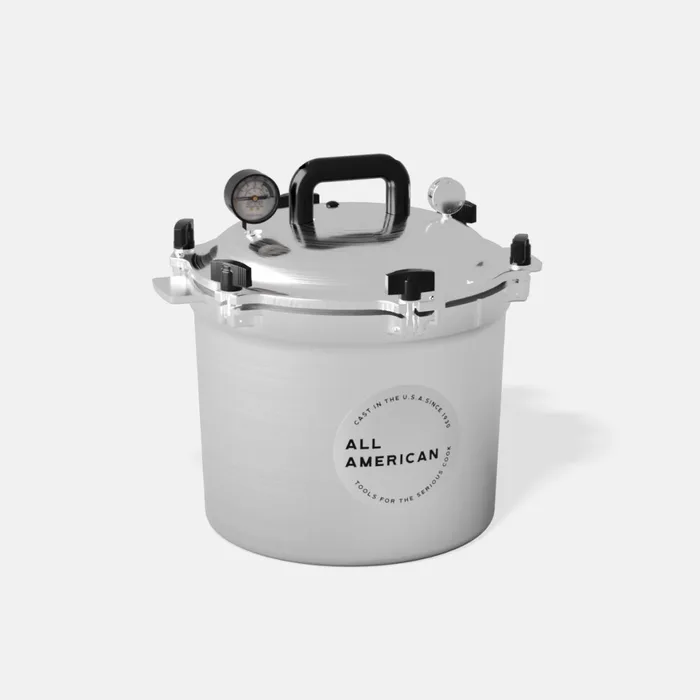
All American 1930 All American 921 Pressure Canner
Buy itA cast aluminum stovetop canner with a machined metal to metal seal and a 5, 10, and 15 psi regulator weight, so there is no gasket to replace and no reliance on a dial gauge for pressure.
- A weighted regulator sets the pressure at 5, 10, or 15 psi, and a weight cannot drift out of calibration the way a dial can, which takes the annual gauge test off your calendar.
- The precision machined metal to metal seal means no rubber sealing ring to dry out, stretch, or go missing between seasons.
- Holds 7 quart jars or 18 pint jars, comfortably above the four quart jar minimum that USDA pressure processes assume.
- Aluminum canners generally do not work on induction cooktops, and the All American retailer page lists gas, electric, and glass-top stoves only, so induction owners should look elsewhere.
- A heavy cast aluminum pot, which is a lot of weight to lift and a lot of load for a glass cooktop even before water and jars.
- Costs several times what a basic dial gauge canner does.
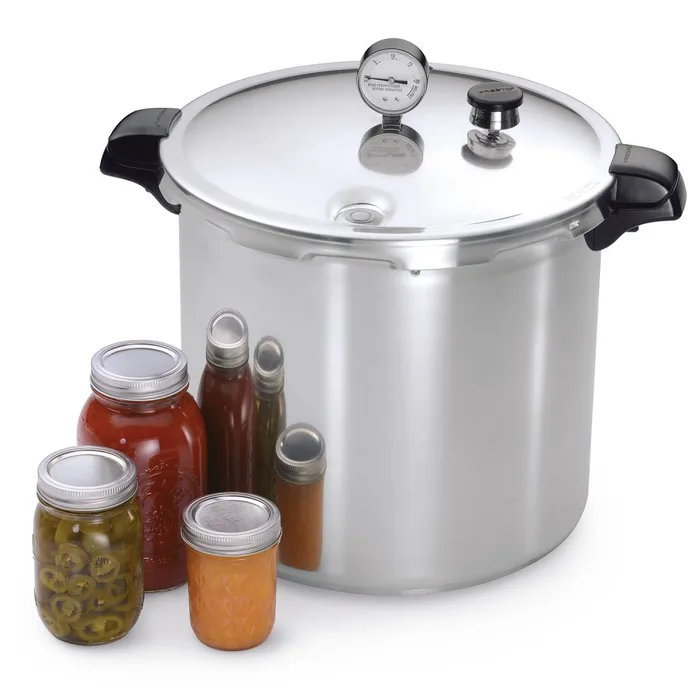
Presto 23-Quart Pressure Canner and Cooker
Buy itThe default full-size stovetop canner: a cover-mounted dial gauge, 23 quarts of liquid capacity, and room for 7 quart jars or 20 pints in a single load.
- Takes 26 half pints, 20 pints, or 7 quart jars, so a full batch of pints goes through in one run.
- The dial gauge lets you hold the exact pressure your elevation calls for, which Presto notes is an advantage above 2,000 feet where incremental pressure adjustment is desirable.
- Doubles as a boiling water canner for jams, jellies, pickles, and salsa, so one pot covers both methods.
- The dial gauge needs testing for accuracy every year, and a gauge reading high causes underprocessing and unsafe food.
- You have to watch and adjust the burner yourself to hold pressure; there is no rocking weight telling you when you are on target.
- The aluminum body will not work on induction, and Presto sells the stainless-clad 01784 as a separate model for that.
Side by side
| All American 1930 All American 921 Pressure Canner | Presto 23-Quart Pressure Canner and Cooker | |
|---|---|---|
| Our verdict | Buy | Buy |
| Best for | The canner who works through a season every year on gas or coil electric and wants equipment with nothing to recalibrate and nothing to re-gasket. | Most first-time canners on gas, coil, or smooth-top electric who want full-batch capacity without a premium outlay. |
| Price tier | $$$ · premium | $$ · mid-range |
The bottom line
Our overall pick is the All American 1930 All American 921 Pressure Canner - A cast aluminum stovetop canner with a machined metal to metal seal and a 5, 10, and 15 psi regulator weight, so there is no gasket to replace and no reliance on a dial gauge for pressure. Choose the Presto 23-Quart Pressure Canner and Cooker instead if most first-time canners on gas, coil, or smooth-top electric who want full-batch capacity without a premium outlay.
Want the full picture, including the other options we compared and the popular one we'd skip? Read the complete The Best Pressure Canners: 4 Compared (and One to Skip).