

Home & Kitchen
The Best Pressure Canners: 4 Compared (and One to Skip)
We compared four pressure canners on the things that decide whether low-acid home canning is safe: whether the appliance fits USDA and NCHFP guidance at all, jar capacity, how pressure is controlled and verified, altitude handling, and cooktop compatibility.
The short version
The All American 921 wins because it is controlled by a 5, 10, and 15 psi regulator weight rather than a dial you have to get tested every year, and because the machined metal to metal seal removes the gasket from the list of things that can fail. The Presto 23-Quart Pressure Canner is the value pick and the one most people should start with: 7 quart jars per load, a dial gauge that lets you dial in the exact pressure your elevation needs, and it doubles as a boiling water canner. The Presto Precise 12-Quart Digital Pressure Canner is the 'depends' pick, right for apartment kitchens, unsuitable cooktops, and high elevations where its automatic altitude handling earns its keep, but it takes 5 quart jars instead of 7 and leans on the maker's own process work rather than published NCHFP testing. Skip the Nesco Smart Canner and Cooker and every other electric multi-cooker with a canning button, because NCHFP states it does not support USDA canning processes in those appliances and Utah State University Extension could not recommend any of the three electric programmable pressure cookers it tested for low-acid canning. Best for: anyone putting up low-acid food at home who wants equipment that matches the published processes rather than marketing copy.
Our picks at a glance
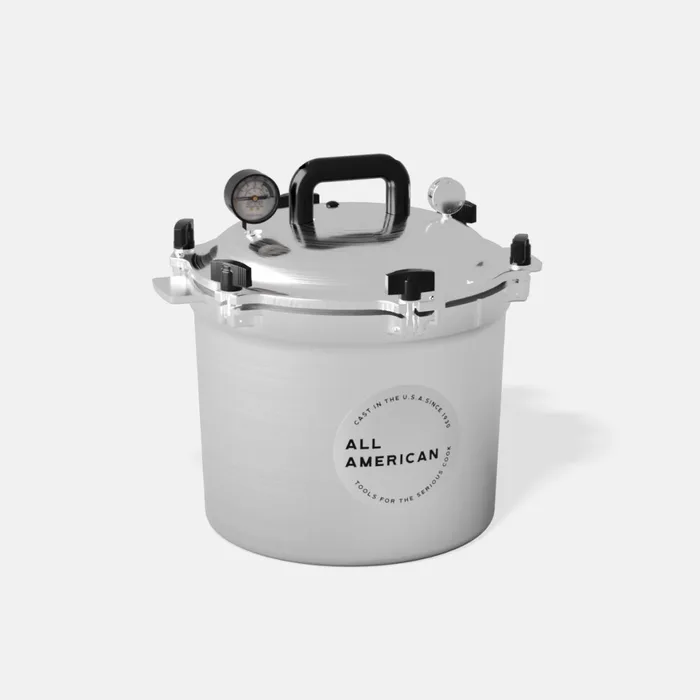
- All American 1930 All American 921 Pressure Canner - Buy. A cast aluminum stovetop canner with a machined metal to metal seal and a 5, 10, and 15 psi regulator weight, so there is no gasket to replace and no reliance on a dial gauge for pressure.
- Presto 23-Quart Pressure Canner and Cooker - Buy. The default full-size stovetop canner: a cover-mounted dial gauge, 23 quarts of liquid capacity, and room for 7 quart jars or 20 pints in a single load.
- Presto Precise 12-Quart Digital Pressure Canner - It depends. A countertop electric canner that senses temperature rather than pressure, holds 240 degrees F, the temperature Presto cites for safe home pressure canning, on its own, and needs no elevation adjustment.
- Nesco Smart Canner and Cooker NPC-9 - Skip. A 9.5-quart electric multi-cooker with canning buttons on the front panel, which is precisely the appliance class NCHFP says it does not support for USDA low-acid processes.
The verdict in 30 seconds
What mattered most
- Type and control
- Liquid capacity
- Quart jars per load
- Fit with USDA and NCHFP guidance
- Annual gauge test
- Altitude handling
Pressure canning is the only home method USDA recommends for low-acid foods such as vegetables, meat, poultry, and seafood, because Clostridium botulinum spores survive boiling water. The National Center for Home Food Preservation puts the requirement plainly: low-acid foods should be sterilized at 240 to 250 degrees F, temperatures reachable only in a pressure canner operated at 10 to 15 PSIG. That single fact rules out a lot of gear that gets sold for the job, including countertop multi-cookers with canning buttons. We picked four units that a home canner can actually buy right now and sorted them by how well they line up with published guidance.
A cast aluminum stovetop canner with a machined metal to metal seal and a 5, 10, and 15 psi regulator weight, so there is no gasket to replace and no reliance on a dial gauge for pressure.
Best for: The canner who works through a season every year on gas or coil electric and wants equipment with nothing to recalibrate and nothing to re-gasket.
- A weighted regulator sets the pressure at 5, 10, or 15 psi, and a weight cannot drift out of calibration the way a dial can, which takes the annual gauge test off your calendar.
- The precision machined metal to metal seal means no rubber sealing ring to dry out, stretch, or go missing between seasons.
- Holds 7 quart jars or 18 pint jars, comfortably above the four quart jar minimum that USDA pressure processes assume.
- Aluminum canners generally do not work on induction cooktops, and the All American retailer page lists gas, electric, and glass-top stoves only, so induction owners should look elsewhere.
- A heavy cast aluminum pot, which is a lot of weight to lift and a lot of load for a glass cooktop even before water and jars.
- Costs several times what a basic dial gauge canner does.
- The wing nuts want lubrication and even crisscross tightening, and new units often need a break-in period before they seal cleanly.
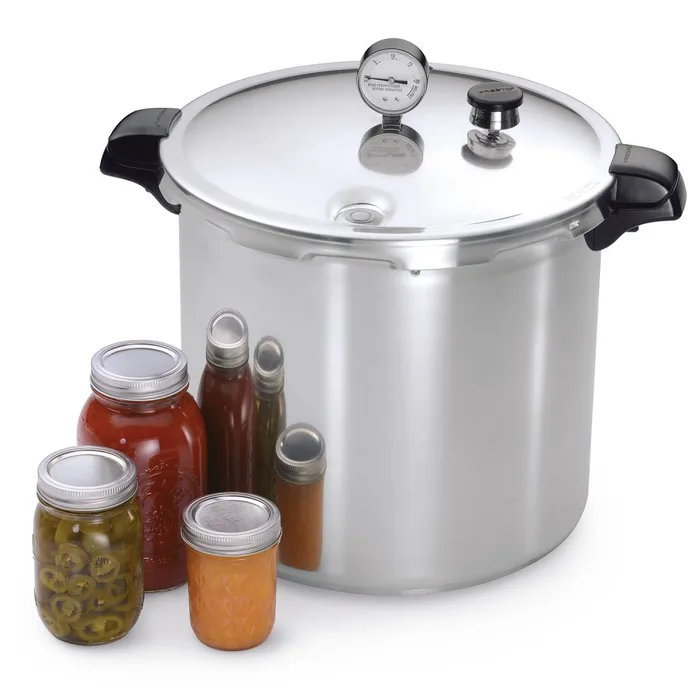
The default full-size stovetop canner: a cover-mounted dial gauge, 23 quarts of liquid capacity, and room for 7 quart jars or 20 pints in a single load.
Best for: Most first-time canners on gas, coil, or smooth-top electric who want full-batch capacity without a premium outlay.
- Takes 26 half pints, 20 pints, or 7 quart jars, so a full batch of pints goes through in one run.
- The dial gauge lets you hold the exact pressure your elevation calls for, which Presto notes is an advantage above 2,000 feet where incremental pressure adjustment is desirable.
- Doubles as a boiling water canner for jams, jellies, pickles, and salsa, so one pot covers both methods.
- The dial gauge needs testing for accuracy every year, and a gauge reading high causes underprocessing and unsafe food.
- You have to watch and adjust the burner yourself to hold pressure; there is no rocking weight telling you when you are on target.
- The aluminum body will not work on induction, and Presto sells the stainless-clad 01784 as a separate model for that.
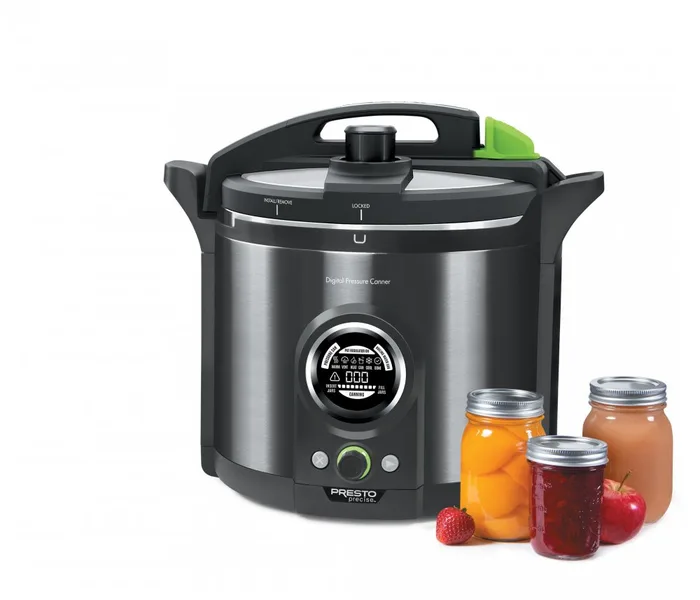
A countertop electric canner that senses temperature rather than pressure, holds 240 degrees F, the temperature Presto cites for safe home pressure canning, on its own, and needs no elevation adjustment.
Best for: Apartment canners, anyone whose cooktop cannot safely take a heavy canner, and people well above sea level who would rather not manage altitude pressure adjustments by hand.
- Presto states it automatically detects and maintains 240 degrees F, the temperature needed for safe home pressure canning, and adjusts for altitude on its own.
- Runs on a countertop near an outlet and needs no burner watching.
- Holds 5 quart jars per load against 7 in a full-size stovetop canner, so big harvests take more runs.
- We found no published NCHFP testing of electric pressure canners, so you are trusting the manufacturer's process development rather than independent work.
- A sealed electronic appliance has failure modes a cast aluminum pot does not.
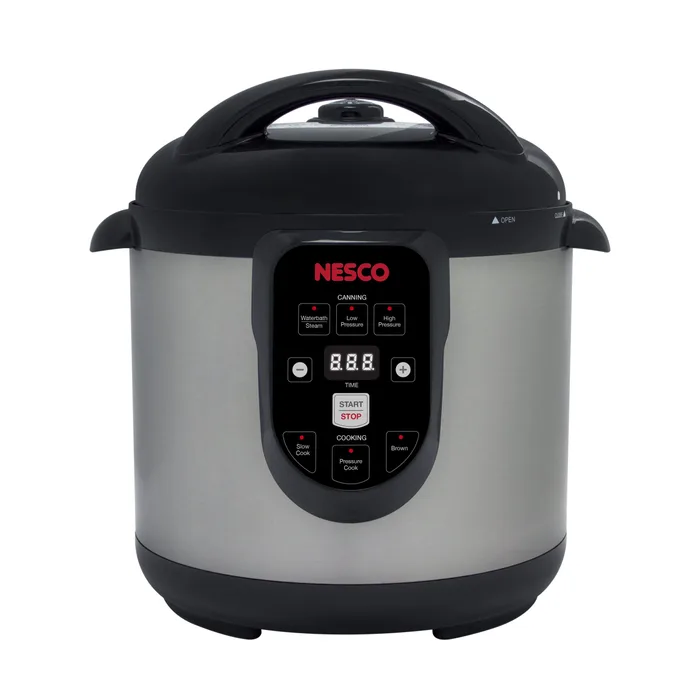
A 9.5-quart electric multi-cooker with canning buttons on the front panel, which is precisely the appliance class NCHFP says it does not support for USDA low-acid processes.
Best for: Nobody who intends to can low-acid food; it is a competent electric pressure cooker, so buy it for that job and can in something the guidance actually covers.
- The control panel is simple and legible, and the unit works as advertised for pressure cooking, slow cooking, and steaming.
- Nesco supplies standard and high-altitude limiting valves at 10 psi and 15 psi.
- The inner pot lifts out and is dishwasher safe, which is more than most stovetop canners offer.
- NCHFP states it does not support the use of USDA canning processes in electric multi-cooker appliances carrying canning or steam canning buttons, because the pressure processes were developed for stovetop canners.
- Utah State University Extension tested three electric programmable pressure cookers, including a Carey Smart Canner, a similar electric canner-cooker, and concluded it could not recommend any of them for pressure canning at Utah altitudes.
- The 9.5-quart pot takes only four wide-mouth quart jars, the bare minimum USDA processes assume, so there is no margin.
- The consequence of underprocessing low-acid food is botulism, not a spoiled batch, which is a bad category of risk to accept for the convenience.
| Criteria | All American 921 Pressure Canner Top pick | Presto 23-Quart Pressure Canner and Cooker | Presto Precise 12-Quart Digital Pressure Canner | Nesco Smart Canner and Cooker NPC-9 |
|---|---|---|---|---|
| Verdict | Buy it | Buy it | It depends | Skip it |
| Best for | The canner who works through a season every year on gas or coil electric and wants equipment with nothing to recalibrate and nothing to re-gasket. | Most first-time canners on gas, coil, or smooth-top electric who want full-batch capacity without a premium outlay. | Apartment canners, anyone whose cooktop cannot safely take a heavy canner, and people well above sea level who would rather not manage altitude pressure adjustments by hand. | Nobody who intends to can low-acid food; it is a competent electric pressure cooker, so buy it for that job and can in something the guidance actually covers. |
| Price tier | $$$ · premium | $$ · mid-range | $$$ · premium | $$ · mid-range |
| Type and control | Stovetop, regulator weight at 5, 10, 15 psi | Stovetop, cover-mounted dial gauge you hold by adjusting the burner | Countertop electric, senses and holds temperature automatically | Countertop electric multi-cooker with limiting valves |
| Liquid capacity | 21.5 quarts | 23 quarts | 12 quarts | 9.5 quarts |
| Quart jars per load | 7 | 7 | 5 | 4 wide-mouth |
| Fit with USDA and NCHFP guidance | Stovetop canner well over the four quart jar minimum | Stovetop canner well over the four quart jar minimum | Dedicated canner; no NCHFP testing found | Electric multi-cooker class NCHFP says it does not support |
| Annual gauge test | Weight is the control; no dial to test | Yes, dial gauge should be checked yearly | No gauge to test | No gauge to test |
| Altitude handling | Swap weights; 10 psi to 1,000 feet, 15 psi above | Fine steps of 11, 12, 13, 14 psi on the dial | Adjusts automatically, no user math | Swap the standard or high-altitude limiting valve |
| Cooktop compatibility | Gas, electric, glass top; not for induction | Gas, electric, smooth top; not induction (01784 is the induction model) | Countertop outlet, no cooktop needed | Countertop outlet, no cooktop needed |
| Seal | Machined metal to metal, no gasket | Replaceable sealing ring | Sealing ring | Lid gasket |
Which one is right for you?
- The canner who works through a season every year on gas or coil electric and wants equipment with nothing to recalibrate and nothing to re-gasket. Buy it All American 1930 All American 921 Pressure Canner
- Most first-time canners on gas, coil, or smooth-top electric who want full-batch capacity without a premium outlay. Buy it Presto 23-Quart Pressure Canner and Cooker
- Apartment canners, anyone whose cooktop cannot safely take a heavy canner, and people well above sea level who would rather not manage altitude pressure adjustments by hand. It depends Presto Precise 12-Quart Digital Pressure Canner
- Nobody who intends to can low-acid food; it is a competent electric pressure cooker, so buy it for that job and can in something the guidance actually covers. Skip it Nesco Smart Canner and Cooker NPC-9
How we judged the field
Five things decide a pressure canner, and only one of them is convenience. First, whether the appliance falls inside published guidance at all: NCHFP requires a canner to hold at least four quart-size jars standing upright with the lid in place, and says it does not support USDA processes in electric multi-cookers with canning buttons. Second, jar capacity, because a canner that takes 7 quarts instead of 5 halves the number of runs on a big harvest. Third, how pressure is controlled and verified, which is really a question about dial gauges, since those need an accuracy check every year and a gauge reading high produces underprocessed food. Fourth, altitude, because the required pressure climbs with elevation and weighted regulators can only step 10 to 15 psi while dials move in single pounds. Fifth, cooktop reality: induction rejects aluminum outright, and glass tops bring weight limits and burner cycling into play.
The field splits cleanly into three groups. Full-size stovetop canners are the reference case; every USDA process time was developed in something like them, and the only real choice within the group is weighted regulator versus dial gauge. Dedicated electric canners are a newer and much smaller group, built for canning rather than adapted to it, with the manufacturer doing the thermal process work in the absence of published NCHFP testing. Then there is the large and growing group of electric multi-cookers that added a canning button, which is where the guidance is unambiguous and unhappy. We took one canner from each of the first two groups, added a second stovetop pick to cover the weighted versus dial split, and used the fourth slot to name the class of appliance that should not be doing this job.
All American 1930 All American 921 Pressure Canner
Buy itThe All American 921 is the one that eliminates the maintenance items rather than managing them. It is cast heavy-duty aluminum with a precision machined metal to metal seal, so there is no sealing ring to perish, and pressure is set by a 5, 10, or 15 psi regulator weight. That combination means the annual dial gauge test that hangs over dial-only canners does not apply to pressure control, and neither does the spring hunt for a replacement gasket. At 21.5 quarts it takes 7 quart jars or 18 pints, so full-batch work is comfortable. The costs are real: it is heavy, it is aluminum so it will not work on induction, and the wing nuts want lubrication and even crisscross tightening. All American’s authorized retailer lists a lifetime limited warranty, and at the time of checking the 921 was out of stock on backorder. This is for the person who cans every year and wants gear that outlives the habit.
Presto 23-Quart Pressure Canner and Cooker
Buy itThe Presto 23-Quart is the canner most people should actually start with, and it is not a compromise pick. Twenty-three quarts of liquid capacity takes 26 half pints, 20 pints, or 7 quart jars, matching the All American on quarts. The cover-mounted dial gauge shows the full range of processing pressures, which is the reason to prefer a dial over a weight at higher elevations: you can step up one pound at a time instead of jumping straight to 15. It doubles as a boiling water canner for jams, pickles, and salsa, so a single pot covers both methods. The trade-off is attention and upkeep. You adjust the burner yourself to hold pressure, and the dial gauge needs an accuracy check every year, because a gauge reading high underprocesses the food. The aluminum body will not work on induction. For gas, coil, or smooth-top electric, it is the sensible default.
Presto Precise 12-Quart Digital Pressure Canner
It dependsThe Presto Precise 12-Quart Digital is the interesting case, and the one where the answer genuinely depends. It is a dedicated canner, not a multi-cooker that grew a canning mode, and it works by sensing temperature rather than pressure: Presto states it detects and holds 240 degrees F automatically and needs no elevation adjustment when pressure canning, which removes the altitude arithmetic. What you do not get is independent validation; we found no published NCHFP testing of electric pressure canners. Capacity is the other cost: it holds 5 quart jars, 8 pints, or 10 half pints per load, and the boiling water mode handles pints and half pints only. If you have no usable cooktop, live high up, or want the altitude arithmetic handled, it earns its place. If you have a good burner, it does not.
Nesco Smart Canner and Cooker NPC-9
Skip itThe Nesco Smart Canner and Cooker is a well-made electric pressure cooker that should not be used for the job its front panel advertises. NCHFP’s position is explicit: it does not support the use of USDA canning processes in electric multi-cooker appliances carrying canning or steam canning buttons, because the pressure processes were developed for stovetop canners holding four or more quart jars, where come-up and cool-down times contribute to the total lethal heat. Utah State University Extension tested three electric programmable pressure cookers at three Utah elevations, including a Carey Smart Canner, a similar electric canner-cooker, and reported that it could not recommend any of them for pressure canning at those altitudes, adding that further work was needed before the Carey could be recommended even where it did hit temperature. The 9.5-quart pot takes four wide-mouth quart jars, exactly the published minimum, with no margin. The downside of getting low-acid canning wrong is botulism. Use it as a pressure cooker and can somewhere else.
Sources
Specs in this review come from these pages.
- National Center for Home Food Preservation, Ensuring Safe Canned Foods (nchfp.uga.edu)
- National Center for Home Food Preservation, Canning in Electric Multi-Cookers (nchfp.uga.edu)
- National Center for Home Food Preservation, Canning in Pressure Cookers (nchfp.uga.edu)
- Utah State University Extension, Food Safety of Low-Acid Pressure Canning in Electric Programmable Pressure Cookers (extension.usu.edu)
- Virginia Cooperative Extension, Pressure Canning (348-585) (pubs.ext.vt.edu)
- National Presto Industries, Canner Comparison Guide (gopresto.com)
All American 1930 All American 921 Pressure Canner vs Presto 23-Quart Pressure Canner and Cooker: which should you buy?
The All American 921 and the Presto 23-Quart hold the same 7 quart jars and follow the same USDA processes, so the decision is not about capacity or safety. It is about how you want pressure controlled and what you are willing to maintain. The All American runs on a regulator weight that rocks when you are at 5, 10, or 15 psi, which means no dial to test, no calibration anxiety, and no gasket to replace. The Presto runs on a dial gauge you watch while adjusting the burner, and that gauge should be checked for accuracy every year, for example through a county Cooperative Extension office.
Elevation tips the balance. Below about 1,000 feet the weighted regulator is the easier life: set the weight, listen for the rock, and stop thinking about it. Above 1,000 feet, a weight can only give you 15 psi while a dial lets you step up one pound at a time, which is less aggressive on the food and easier on a modest burner, so the Presto’s dial becomes a genuine advantage rather than a chore. Budget matters too, and it is not close: the Presto costs less than the All American and does the same work. Buy the All American if you can hard every season, hate recurring maintenance, and cook on gas or coil. Buy the Presto if you are starting out, live high, or want to find out how much canning you actually do before spending more.
What to look for
- Four quart jars, minimum: NCHFP says a vessel only counts as a pressure canner for USDA processes if it holds at least four quart-size jars standing upright on the rack with the lid in place, so check jar capacity, not just the liquid capacity printed on the box.
- No canning button on a multi-cooker: NCHFP states it does not support USDA canning processes in electric multi-cooker appliances with canning or steam canning buttons, and a button on the front panel is not evidence that thermal process work was ever done.
- Dial gauge means an annual errand: dial gauges should be checked for accuracy yearly and replaced if more than 2 pounds off, so plan on a county Extension office visit or a mail-in test before each season.
- Match the gauge type to your elevation: weighted regulators step from 10 psi at sea level straight to 15 psi above 1,000 feet, while a dial lets you run 11, 12, 13, or 14 psi as you climb, which matters if you live in the mountains.
- Check the cooktop before you check the price: aluminum canners will not work on induction at all, and on glass or ceramic tops you have to consider weight, overhang, and thermal sensors that can cut the burner mid-process and ruin the batch.
- Processes, not appliances: USDA and NCHFP develop and publish processes rather than approving equipment, so be skeptical of any ‘USDA approved canner’ claim.
Our final take
Pressure canning is one of the few kitchen tasks where the equipment decision has a fatal failure mode, so start from the guidance and work backwards. A full-size stovetop canner holding at least four quart jars is what every published USDA process was built around, and either of our two buy picks is a sound version of that. The All American 921 costs more and removes the recurring chores; the Presto 23-Quart costs far less, holds the same seven quarts, and asks for a gauge test once a year. The Presto Precise Digital is a legitimate option if your kitchen or your elevation makes a stovetop canner awkward. What is not an option is a multi-cooker with a canning button, no matter how confident the packaging sounds.
Questions, answered
Can I pressure can in an Instant Pot or a multi-cooker with a canning button?
No. The National Center for Home Food Preservation states that it does not support the use of USDA canning processes in the electric, multi-cooker appliances that carry canning or steam canning buttons on their front panels. The reason is not snobbery about brands; it is that USDA process times were developed in stovetop canners holding four or more quart jars upright, and the come-up and cool-down periods in those canners are part of the total lethal heat the process delivers. Utah State University Extension put data behind this, testing three electric programmable pressure cookers at three Utah elevations and finding that two of them never reached the 121.1 degrees C needed, with the conclusion that none of the three could be recommended. A canning button on a front panel is a marketing decision, not evidence that the appliance was validated.
What is the actual difference between a pressure cooker and a pressure canner?
Size and thermal behaviour, and both matter more than they sound. To count as a pressure canner for USDA processes, NCHFP says the vessel must hold at least four quart-size jars standing upright on the rack with the lid in place. Smaller cookers contain less metal, have a smaller diameter, and hold less water, so they heat up and cool down faster. Those come-up and cool-down times are baked into the published process times, and shortening them means the heat delivered at pressure alone may not destroy the target organisms. USDA published its recommendation against using pressure saucepans for home canning in the late 1980s, after finding that simply adding ten minutes to standard times was not a reliable fix.
Do I really need my dial gauge tested every year, and where do I get that done?
Yes, if your canner has a dial gauge. Virginia Cooperative Extension says dial gauges should be checked for accuracy yearly, that a gauge off by more than 2 pounds of pressure should be replaced, and that a dial reading too high can leave food under-processed and risk foodborne illness. Many county Cooperative Extension offices run gauge testing, often free or for a nominal fee, and it is worth calling in spring before the season starts. Presto's support pages explain how to have a Presto gauge tested. Weighted regulators do not need this; a weight cannot drift out of calibration.
Dial gauge or weighted gauge, and does it change what I can can?
It changes the pressures available to you, which matters most at elevation. A weighted regulator is set at 5, 10, or 15 psi and tells you when you are right by rocking or jiggling, so it needs no watching and no accuracy check. The trade-off is that it cannot adjust in fine steps, so above 1,000 feet the standard low-acid process moves straight to 15 psi. A dial gauge shows the whole range, so you can run 11 psi near sea level and 12, 13, or 14 psi as you climb, which is gentler on the food and on your burner. Some canners, including the All American, give you both: a weight for control and a dial to watch.
Will a pressure canner work on my glass top or induction range?
Induction is the harder constraint. Most canners are aluminum, which is not magnetic and will not heat on induction at all; Presto's standard 23-quart is aluminum too. Presto makes the 01784, a 23-quart canner with a stainless-clad base, specifically for induction, gas, electric, and smooth-top ranges. On glass and ceramic tops the issues are weight, overhang, and burner cycling: if a burner cuts out mid-process the food may be underprocessed. Check your range manual before you commit, and never slide a loaded canner across the glass.
Deciding between the top two? See our head-to-head: All American 1930 All American 921 Pressure Canner vs Presto 23-Quart Pressure Canner and Cooker.
More Home & Kitchen reviews
 The Best Electric Pressure Washers for Home Use: 4 Compared (and One to Skip)
  The Best Range Hoods: 4 Compared (and One to Skip)
  The Best Reusable Food Storage Bags: 4 Compared (and One to Skip)
  The Best Reverse Osmosis Systems: 4 Compared (and One to Skip)
  The Best Rice Cookers of 2026: Fuzzy Logic, Pressure, and One to Skip
  The Best Roasting Pans: 4 Compared (and One to Skip)