

Home & Kitchen
The Best Reverse Osmosis Systems: 4 Compared (and One to Skip)
We compared four under-sink reverse osmosis systems on published daily capacity, certification, wastewater ratio and how much of their own specification each maker prints.
The short version
The Waterdrop G3P600 is the one to buy for most households: 600 gallons a day from a tankless unit that frees the whole cupboard, a 2:1 pure-to-drain ratio, NSF/ANSI 42, 58 and 372 certification, and a faucet that displays TDS and filter life so you know when something needs changing. The APEC ROES-50 Essence is the value pick and the one to choose if you would rather have no electronics at all, running on line pressure alone with a four gallon tank, a FILMTEC membrane and the most completely published operating envelope here, down to the feed pH range. The AquaTru Under Sink is the answer for a small cupboard or a rental, at 54 gallons a day from an eleven by eleven by four inch manifold, with built-in leak detection and certification against 84 contaminants. The Express Water Alkaline and Ultraviolet system is the one to skip, because its page sells ten stages and a UV lamp without publishing a capacity, a dimension or a drain ratio. Best for: anyone whose tap water is technically fine and tastes like a swimming pool.
Our picks at a glance
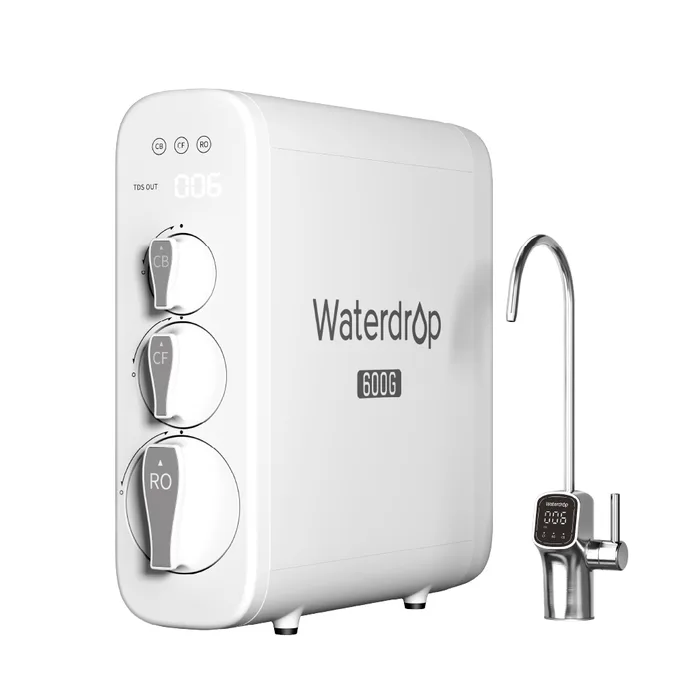
- Waterdrop G3P600 Reverse Osmosis System - Buy. Tankless, 600 gallons a day, and the only system here that reports its own water quality.
- APEC ROES-50 Essence - Buy. No electronics, no power lead, and the most completely published specification in the category.
- AquaTru Under Sink - It depends. The smallest footprint here, with leak detection built in and a contaminant list rather than a stage count.
- Express Water Alkaline and Ultraviolet RO System ROALKUV10D - Skip. Ten stages, a UV lamp and alkaline remineralisation, sold without a capacity figure.
The verdict in 30 seconds
What mattered most
- System type
- Stated daily capacity
- Filter stages
- Certification stated
- Pure-to-drain ratio
- Published dimensions
Reverse osmosis is the most effective water treatment most households can fit under a sink, and the category is sold almost entirely on stage counts. Stage count is close to meaningless: the membrane does the work, and the other stages are pre-filters protecting it and post-filters adjusting taste. The numbers that actually matter are daily capacity, how much water goes down the drain for every gallon produced, what the system is certified against, and whether it needs a tank taking up half the cupboard. Two of the four systems below publish all of that. One publishes a review summary.
Tankless, 600 gallons a day, and the only system here that reports its own water quality.
Best for: A household of three or more that wants the cupboard back and does not mind a power lead.
- 600 GPD tankless output, so there is no pressure tank eating the cupboard and no stale stored water.
- A 2:1 pure-to-drain ratio, against the 3:1 and 4:1 that older tank systems typically run.
- Certified to NSF/ANSI 42, 58 and 372, and the smart faucet displays TDS and remaining filter life.
- It needs mains electricity, so a power cut means no filtered water.
- At 32.4 pounds and 18.11 by 5.67 by 17.73 inches it is the largest single unit here.
- Three filter lives to track, at 6, 12 and 24 months.
- Waterdrop's own G3P800 runs a worse 3:1 drain ratio for its extra output, so more capacity is not automatically better.
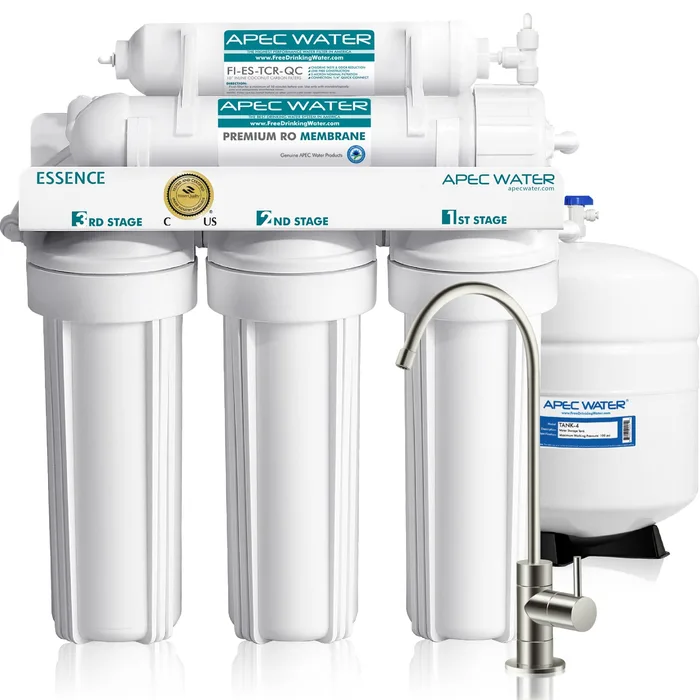
No electronics, no power lead, and the most completely published specification in the category.
Best for: Anyone who wants water treatment with no electronics, and who has cupboard space for a tank.
- Runs on line pressure alone, so there is nothing to plug in and nothing to fail electronically.
- APEC publishes the whole operating envelope: 40 to 85 psi feed pressure, 40 to 100F, maximum 2000 ppm TDS, feed pH 2.0 to 11.0.
- Five stages built around a FILMTEC membrane, with a four gallon pressurised tank and full installation hardware in the box.
- 50 gallons a day at 60 psi, and APEC states that drops to 30 gallons a day at 50 psi.
- The four gallon tank is 11 by 11 by 15 inches and has to live in the cupboard alongside the 15.5 by 5.25 by 17 inch manifold.
- No TDS readout, so you find out a filter is spent by taste.
- APEC does not publish a pure-to-drain ratio for it.
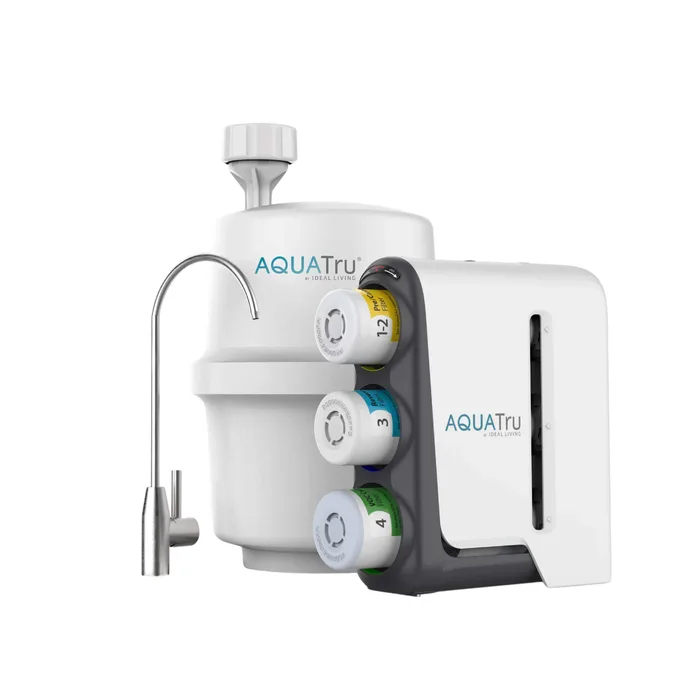
The smallest footprint here, with leak detection built in and a contaminant list rather than a stage count.
Best for: Small kitchens, awkward cupboards and anyone who wants leak detection on a system they will not be looking at.
- The manifold is 11 by 11 by 4 inches, which fits around plumbing that would defeat a full-size system.
- AquaTru states certification to reduce 84 contaminants, naming PFAS including PFOA and PFOS, lead, arsenic, chromium-6, fluoride, nitrates and microplastics.
- Built-in leak detection and filter alerts, which matters for a pressurised system living out of sight.
- 54 gallons per day, close to the APEC and a fraction of the Waterdrop.
- A rated capacity of 360 gallons means filter changes come round faster than on a full-size system.
- There is still a holding tank, 10 inches across and 14 inches tall.
- AquaTru does not publish a pure-to-drain ratio or a system weight.
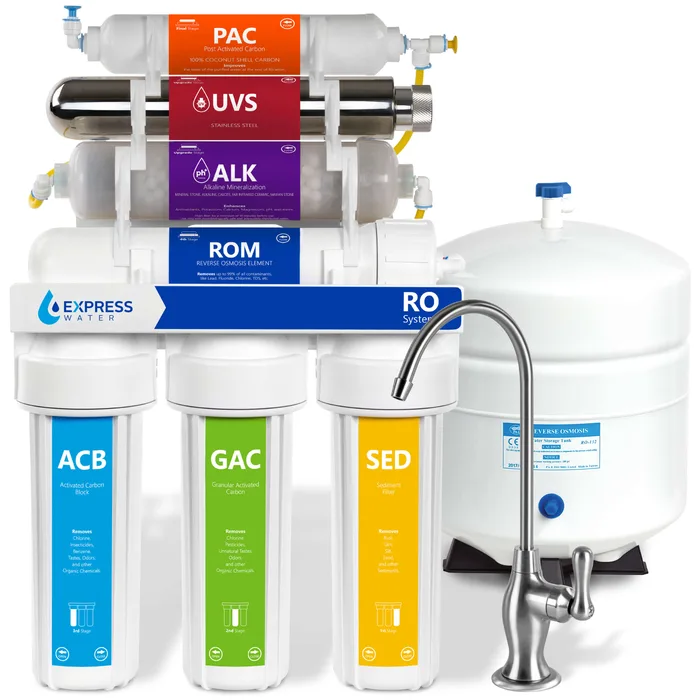
Ten stages, a UV lamp and alkaline remineralisation, sold without a capacity figure.
Best for: Well water with a microbiological concern, and only after asking Express Water for the figures its page omits.
- A UV stage is a genuine addition for well water or any supply with a microbiological risk.
- Alkaline remineralisation puts back minerals that RO strips, which some people prefer on taste.
- Express Water sells the full filter set as a single replacement pack, which simplifies servicing.
- The product page publishes no daily capacity, no dimensions and no pure-to-drain ratio.
- The NSF certification statement on the page is attached to Express Water's RO5DX and RO10DX systems, not to this model.
- Ten stages is a marketing count: the membrane does the separation and the rest are pre-filters and post-filters.
- Most of the page below the fold is an automatically generated summary of customer reviews rather than a specification.
| Criteria | G3P600 Reverse Osmosis System Top pick | ROES-50 Essence | AquaTru Under Sink | Alkaline and Ultraviolet RO System ROALKUV10D |
|---|---|---|---|---|
| Verdict | Buy it | Buy it | It depends | Skip it |
| Best for | A household of three or more that wants the cupboard back and does not mind a power lead. | Anyone who wants water treatment with no electronics, and who has cupboard space for a tank. | Small kitchens, awkward cupboards and anyone who wants leak detection on a system they will not be looking at. | Well water with a microbiological concern, and only after asking Express Water for the figures its page omits. |
| Price tier | $$ · premium | $ · mid-range | $ · mid-range | $ · mid-range |
| System type | Tankless, powered | Tank, line pressure only | Manifold plus holding tank | Tank, with UV lamp |
| Stated daily capacity | 600 GPD | 50 GPD at 60 psi, 30 at 50 psi | 54 GPD | Not published |
| Filter stages | 8 | 5 | 3 plus RO | 10 |
| Certification stated | NSF/ANSI 42, 58 and 372 | WQA certified | 84 contaminants reduced | NSF stated for other models |
| Pure-to-drain ratio | 2:1 | Not published | Not published | Not published |
| Published dimensions | 18.11 x 5.67 x 17.73 in | 15.5 x 5.25 x 17 in plus 11 x 11 x 15 in tank | 11 x 11 x 4 in plus 10 x 14 in tank | Not published |
| Published operating limits | Not published | 40-85 psi, 40-100F, 2000 ppm TDS, pH 2-11 | Not published | Not published |
| Water quality readout | TDS and filter life at the faucet | None | Filter alerts and leak detection | None |
Which one is right for you?
- A household of three or more that wants the cupboard back and does not mind a power lead. Buy it Waterdrop G3P600 Reverse Osmosis System
- Anyone who wants water treatment with no electronics, and who has cupboard space for a tank. Buy it APEC ROES-50 Essence
- Small kitchens, awkward cupboards and anyone who wants leak detection on a system they will not be looking at. It depends AquaTru Under Sink
- Well water with a microbiological concern, and only after asking Express Water for the figures its page omits. Skip it Express Water Alkaline and Ultraviolet RO System ROALKUV10D
How we judged the field
Five things separate one reverse osmosis system from another, and stage count is not among them. The first is daily capacity, which on a tankless system is a genuine flow rate and on a tank system is a refill rate, and the two are not comparable numbers even though both are quoted in gallons per day. The second is the pure-to-drain ratio, which is the running cost: every gallon you drink costs you two, three or four more down the drain, and only some makers will say which. The third is certification, where the standard number and the model it is attached to both matter. The fourth is what physically fits, because a four gallon pressure tank is eleven inches across and cupboards under sinks are full of plumbing. The fifth is whether the system tells you anything about itself, since a filter past its life is invisible until the water tastes wrong.
The category has split. Tankless systems, which Waterdrop pushed into the mainstream, use a pump and electronics to make water on demand at several hundred gallons a day and give the cupboard back. Classic tank systems, which APEC still builds properly, run on line pressure with no power supply and store treated water in a bladder tank. Compact systems aimed at renters and small kitchens shrink the manifold and accept a lower output. And then there is the stage-count end of the market, where ten filters and a UV lamp are the entire pitch. We took one of each.
The G3P600 is the system that makes the strongest case for going tankless. It produces 600 gallons a day on demand, which means no pressure vessel in the cupboard, no bladder holding treated water between uses, and no waiting for a tank to refill after you have filled a jug. Waterdrop states a 2:1 pure-to-drain ratio, which is good for the category and roughly half the waste of older tank systems, and certifies the unit to NSF/ANSI 42, 58 and 372. The smart faucet is more useful than it sounds: it displays TDS and remaining filter life, which turns filter changes from a guess into a reading. The published detail is complete, down to 18.11 by 5.67 by 17.73 inches and 32.4 pounds. The costs are a power lead, three separate filter lives at 6, 12 and 24 months, and the fact that it is the biggest single object here. One useful warning from Waterdrop’s own comparison table: the higher-output G3P800 runs a worse 3:1 ratio, so buying more capacity buys more waste.
The ROES-50 Essence is the opposite philosophy and it is the better buy for a particular kind of owner. There is no pump, no power supply and no electronics; line pressure drives the membrane and a four gallon pressurised tank stores what it makes. Five stages, built around a FILMTEC membrane, with a polypropylene sediment pre-filter, two carbon blocks and a coconut-shell refining carbon post-filter. What sets it apart is that APEC publishes the whole operating envelope rather than a headline: 50 gallons a day at 60 psi and 30 at 50 psi, feed pressure 40 to 85 psi, feed temperature 40 to 100F, a maximum of 2000 ppm total dissolved solids and a feed pH range of 2.0 to 11.0. That is enough to check the system against your own water report before buying, which almost nothing else in this comparison allows. The costs are space, since the tank is 11 by 11 by 15 inches on top of the manifold, and no readout of any kind.
AquaTru’s under-sink system is the one that fits where the others will not. The manifold is 11 by 11 by 4 inches, flat enough to mount on a cupboard wall alongside a waste trap, with a 10 by 14 inch holding tank as the only bulky part. Output is 54 gallons a day, which is in the same territory as the APEC. Rather than a stage count, AquaTru leads with what it is certified to reduce: 84 contaminants, naming PFAS including PFOA and PFOS, lead, arsenic, chromium-6, chlorine, chloramine, fluoride, nitrates and microplastics. For anyone buying RO because of a specific contaminant rather than for taste, that framing is more useful than any number of stages. Built-in leak detection and filter alerts are a real feature on a pressurised device you install and then never look at. The reasons this is a depends are capacity and consumables: 54 gallons a day and a 360 gallon rated capacity mean filter changes arrive faster than on a full-size system.
The Express Water Alkaline and Ultraviolet system is built to be impressive on a listing page. Ten stages, a UV lamp and alkaline remineralisation is a long feature list, and the UV element in particular is a real capability if you are on a well or any supply with a microbiological question. The problem is everything the page does not contain. There is no daily capacity, which is the first number anyone needs. There are no dimensions, on a product that has to fit under a sink. There is no pure-to-drain ratio. The certification statement on the page says that Express Water’s RO5DX and RO10DX systems are NSF certified, which is a claim about two other model families rather than about this one, and it is easy to read as though it covers what you are buying. Below the specification area sits an automatically generated summary of customer reviews. Ten stages is not ten times better than five: the membrane does the separation and everything else is preparation and polish.
Waterdrop G3P600 Reverse Osmosis System vs APEC ROES-50 Essence: which should you buy?
The Waterdrop and the APEC are the two to choose between, and the decision is whether you want electronics in your plumbing. The G3P600 wins on everything that depends on the pump: 600 gallons a day against 50, water on demand rather than a tank that empties, half the cupboard freed, a published 2:1 drain ratio and a faucet that tells you the TDS and when the filters are done. If you have a family, fill bottles, or run a coffee machine off the filtered line, it is not close.
The ROES-50 wins on simplicity and on what it lets you verify. Nothing plugs in, so there is nothing to fail in a way you cannot fix with a spanner, and the published operating envelope means you can check your own water pressure, temperature, TDS and pH against what the system is designed for before spending anything. That is genuinely rare. If your household is one or two people, if the tank will fit, and if you would rather own a mechanical device than an electronic one, the APEC is the better long-term purchase. Check your feed pressure first: at 50 psi its output drops from 50 gallons a day to 30, and that is the difference between adequate and annoying.
What to look for
- A pure-to-drain ratio: it is the running cost of the system, and a maker that publishes 2:1 has something to be proud of while silence usually means 3:1 or worse.
- Which model the certification names: a statement that a company’s systems are NSF certified is not the same as this system being certified, and the model numbers are the tell.
- Capacity in the right units: a tankless gallons-per-day figure is a flow rate and a tank system’s is a refill rate, so 600 GPD and 50 GPD are not six hundred against fifty in practice.
- Published dimensions for every part: the manifold and the pressure tank both have to fit, and the tank is usually the problem at around 11 inches across.
- An operating envelope: APEC’s 40 to 85 psi, 40 to 100F, 2000 ppm and pH 2 to 11 lets you check the system against your own water report, which no stage count can.
- Whether the system reports anything: a TDS and filter-life readout turns maintenance from a guess into a number, and leak detection matters on something you never look at.
Our final take
Reverse osmosis is the most effective thing most households can do to their drinking water, and the buying decision comes down to capacity, waste and what the maker will put in writing. The Waterdrop G3P600 is the one to buy: 600 gallons a day with no tank, a published 2:1 drain ratio, three NSF standards named, and a faucet that tells you when to service it. The APEC ROES-50 Essence is the better answer for a smaller household that wants nothing electronic, and it is the only system here whose full operating envelope you can check against your own water. The AquaTru fits where neither will. And a system sold on ten stages and a UV lamp, with no capacity, no dimensions and a certification claim pointing at other model numbers, is asking you to buy a feature list.
Questions, answered
How much water does reverse osmosis waste?
It is the question the category avoids, and only one maker here answers it. Waterdrop states a 2:1 pure-to-drain ratio for the G3P600, meaning two gallons go down the drain for every gallon produced, and a worse 3:1 for its higher-output G3P800. Older tank-based systems commonly run 3:1 or 4:1. If your water is metered, that ratio is the running cost of the system and it is worth asking for before you buy. It is also the reason capacity and efficiency do not move together: more gallons per day often means a worse ratio.
Do I need a tank, or is tankless better?
Tankless is more convenient and needs power; a tank is simpler and needs space. A tankless system like the G3P600 makes water on demand at 600 gallons a day, so there is no four gallon pressure vessel in the cupboard and no water sitting in a bladder between uses. The trade is that it plugs in, so a power cut stops it. A tank system like the APEC ROES-50 runs on line pressure alone with nothing to fail electronically, but its 50 gallons a day is a refill rate rather than a flow rate, and if you empty the tank you wait.
Does the number of stages matter?
Far less than the listings suggest. Reverse osmosis happens at one semi-permeable membrane; everything before it is sediment and carbon pre-filtration protecting that membrane from chlorine and grit, and everything after it is polishing or remineralisation. A five stage system built around a good membrane, like the APEC, is not worse than a ten stage one. What a higher stage count does reliably increase is the number of cartridges you buy. Look at the certification and the membrane rather than the count.
What does NSF certification actually cover?
Different standards cover different things, so the number after the slash matters. NSF/ANSI 58 is the standard for reverse osmosis drinking water systems. NSF/ANSI 42 covers aesthetic effects such as chlorine taste and odour. NSF/ANSI 372 covers lead content in the materials themselves rather than the water. Waterdrop states all three for the G3P600. Read the model number the certification is attached to as carefully as the standard: a maker can accurately state that some of its systems are certified without that covering the one in front of you.
Will RO strip minerals out of my water, and does that matter?
Yes to the first part. A reverse osmosis membrane removes dissolved minerals along with contaminants, which is why the water tastes flat to some people and why remineralisation or alkaline stages exist. Nutritionally the minerals in drinking water are a small contribution for most diets, so the health argument is weaker than the marketing suggests. The taste argument is real, though, and if you have tried RO water and disliked it, a system with a remineralisation stage is the fix rather than a reason to avoid RO.
Deciding between the top two? See our head-to-head: Waterdrop G3P600 Reverse Osmosis System vs APEC ROES-50 Essence.
More Home & Kitchen reviews
 The Best Rice Cookers of 2026: Fuzzy Logic, Pressure, and One to Skip
  The Best Robot Vacuums Under $500 in 2026 (and the One to Skip)
  The Best Santoku Knives: 4 Compared (and One to Skip)
  The Best Sewing Machines for Beginners: 4 Compared (and One to Skip)
  The Best Shower Filters: 4 Compared (and One to Skip)
  The Best Shower Heads: 4 Compared (and One to Skip)