Explained
Reverse Osmosis Systems, Explained
After reading, you'll understand how to size an RO system, what it costs you in wasted water, and how to check a certification claim.
In this guide
Reverse osmosis listings compete on stage count because stage count is easy to photograph. The membrane does the actual work, and the numbers that predict whether you will be happy are daily capacity, drain ratio, physical size and what the thing is certified against. Three of those are routinely omitted. Knowing which ones to demand makes the shortlist obvious.
The 30-second version
- Stage count is marketing, because one membrane does the separation and the rest are pre-filters and polish.
- The pure-to-drain ratio is the running cost, and at 3:1 you are sending three gallons away for every one you drink.
- Tankless gives the cupboard back, at the cost of needing mains power to make any water at all.
- Read which model a certification names, because a claim about a company's systems is not a claim about yours.
- Check your feed pressure, since a 50 GPD system makes 30 GPD at 50 psi.
The products this guide is about
Our verdict on each, with the full reasoning on the companion review.
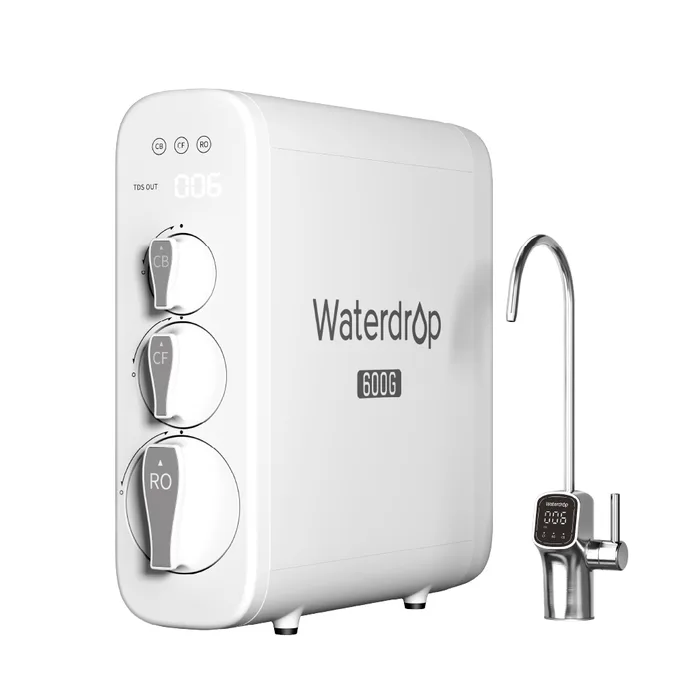
- Buy Waterdrop G3P600 Reverse Osmosis System Tankless, 600 gallons a day, and the only system here that reports its own water quality.
- Buy APEC ROES-50 Essence No electronics, no power lead, and the most completely published specification in the category.
- It depends AquaTru Under Sink The smallest footprint here, with leak detection built in and a contaminant list rather than a stage count.
- Skip Express Water Alkaline and Ultraviolet RO System ROALKUV10D Ten stages, a UV lamp and alkaline remineralisation, sold without a capacity figure.
What actually matters
- Daily capacity (GPD) - gallons per day the system can produce. On a tankless unit it is close to a real flow rate; on a tank system it is how fast the tank refills, so the same number means different things.
- Pure-to-drain ratio - how many gallons go to waste per gallon produced. Waterdrop states 2:1 on the G3P600 and 3:1 on the higher-output G3P800, which shows the trade directly.
- Certification and standard - NSF/ANSI 58 covers reverse osmosis systems, 42 covers taste and odour, and 372 covers lead content in the materials. Check the standard and the model it names.
- Physical footprint - the manifold and, on tank systems, the pressure vessel. A four gallon tank is typically 11 inches across and 15 inches tall, and that is what usually decides whether a system fits.
- Operating envelope - the feed pressure, temperature, TDS and pH the system is designed for. APEC publishes all four, which lets you check it against a water report.
- Filter life and cost - how long each cartridge lasts. A higher stage count means more cartridges to replace, and rated capacity in gallons is a more honest measure than months.
- Monitoring - whether the system reports TDS, filter life or leaks. A spent filter is otherwise invisible until the water tastes wrong.
The specs, in plain English
Green flags vs red flags
Green flags
- A pure-to-drain ratio is stated as a number.
- Capacity is quoted with the pressure and temperature it was measured at.
- The certification names a standard and the specific model.
- Dimensions are given for the manifold and for the tank separately.
- The feed pressure, temperature, TDS and pH limits are published.
Red flags
- Stage count is the headline and there is no capacity figure.
- A certification statement that names different model numbers from the one on sale.
- No dimensions on a product designed to fit inside a cupboard.
- Contaminant reduction claimed as a percentage with no standard attached.
- A specification area that turns out to be a summary of customer reviews.
Who's who: the brands
- Waterdrop - Pushed tankless RO into the mainstream, and publishes drain ratios and NSF standards across its G and X series.
- APEC - California maker of classic tank-based systems built around FILMTEC membranes, with unusually complete published operating limits.
- AquaTru - Known for countertop RO and now a compact under-sink manifold, sold on a named contaminant list rather than a stage count.
- Express Water - High-stage-count systems with alkaline and UV options, sold largely on feature lists.
- iSpring - Long-running value brand in under-sink RO and whole-house filtration, widely stocked in hardware retail.
How to read a listing without getting fooled
Ignore the stage count entirely on the first pass. Find the daily capacity and the conditions it was measured at, then find the pure-to-drain ratio; if either is missing, that absence is the most informative thing on the page. Next check the certification, reading both the standard number and the model it is attached to, because companies with a broad catalogue often state a certification that covers only part of it. Then measure your cupboard and compare it against the published dimensions for both the manifold and the tank, remembering that the waste trap and the shut-off valves are already in there. If the maker publishes an operating envelope, check your own feed pressure against it, because pressure has a large effect on output. Last, look for a readout or an alert, since it is the difference between changing filters on a schedule and changing them when you notice.
How much should you spend?
Under-sink RO spans mid-range to premium, and the price maps fairly well onto capacity and electronics. The mid-range buys a classic tank system with a good membrane and no power supply, which is genuinely enough for one or two people, or a compact manifold designed for small cupboards. The premium tier buys tankless operation, several hundred gallons a day, a better drain ratio and a faucet that reports TDS and filter life, and for a family that fills bottles and runs a coffee machine it pays for itself in convenience. What you should not pay a premium for is stage count, since the additional cartridges mostly add to the replacement bill. Budget for filters as a recurring cost from the start: a system with three cartridges on 6, 12 and 24 month cycles costs more to own than the headline suggests.
Questions, answered
Can I install an RO system myself?
Most people can, with a caveat. The connections are push-fit or compression on quarter or three-eighths inch tubing, and systems ship with the feed valve, drain saddle and faucet hardware. The two jobs that stop people are drilling the sink or worktop for the dedicated faucet, which is straightforward in stainless and risky in granite or composite, and cutting into the drain line. If your worktop is stone, get the faucet hole drilled professionally and do the rest yourself.
Why does my RO water taste flat?
Because the membrane has removed the dissolved minerals that give water its flavour, along with the contaminants. It is working as designed. If you dislike it, the fix is a remineralisation or alkaline post-filter, which several makers including Waterdrop and APEC offer as alternative versions of the same system. It is worth deciding this before you buy, since retrofitting a stage is more awkward than choosing the right model.
How often do the filters need changing?
It depends on the stage and on your water. Pre-filters doing sediment and carbon work typically run 6 to 12 months, and the membrane itself commonly lasts 24 months, which is the pattern Waterdrop publishes for the G3P600. Hard or sediment-heavy water shortens all of them. A rated capacity in gallons, like AquaTru's 360, is a more honest guide than a month count if your household uses a lot or a little.
Does an RO system reduce water pressure at the tap?
At the dedicated RO faucet, yes, noticeably, and that is normal. A tank system delivers at whatever the tank's air charge provides, which is well below mains pressure, and a tankless system delivers at whatever its pump produces. Neither affects the pressure at your ordinary kitchen tap, because the RO system is plumbed to its own outlet. If flow at the RO faucet drops off over time, the usual causes are a spent filter or a tank that has lost its air charge.
Or jump to the head-to-head: Waterdrop G3P600 Reverse Osmosis System vs APEC ROES-50 Essence.