Explained
Roasting Pans, Explained
After reading, you'll understand how to read a roasting pan listing and pick one that matches your oven, cooktop and cooking style.
In this guide
Most people buy a roasting pan once, often the week before a holiday, and judge it by size alone. The things that cause trouble later are less obvious: a rack with a low temperature rating, a pan that will not work on an induction hob, or a lid that steams instead of browning. Listings also mix terms like clad, heavy-gauge and 18/10 that sound similar but mean different things. This guide sorts out what each term tells you.
The 30-second version
- Clad construction matters on the stove, not much in the oven, so it is worth paying for only if you make gravy in the pan.
- The rack can be the weak link, since a nonstick coating may carry a lower temperature limit than the pan.
- Check your cooktop against the maker's list, because some roasters exclude induction or glass tops.
- Measure the oven before you buy, using the pan's full length including handles.
- A lid steams rather than roasts, so covered roasters suit braises and hams more than crisp-skinned birds.
The products this guide is about
Our verdict on each, with the full reasoning on the companion review.
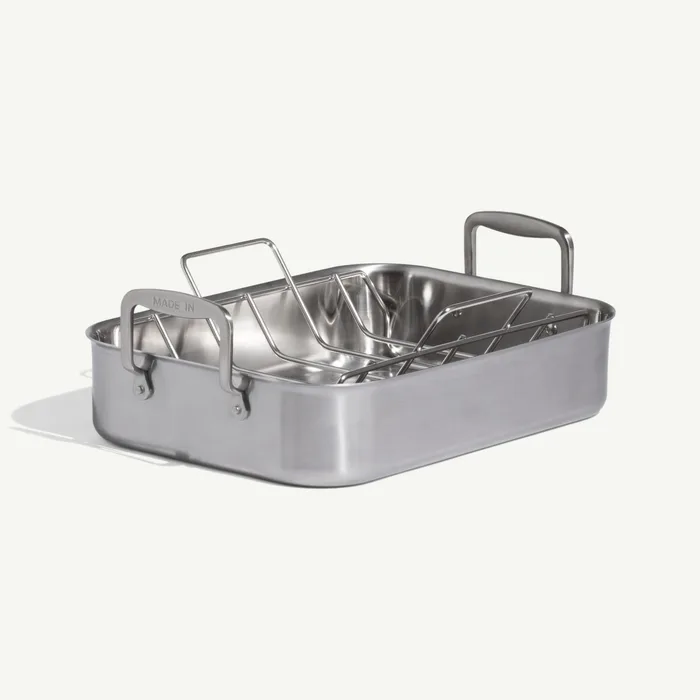
- Buy Made In Stainless Clad Roasting Pan A fully clad 3-ply roaster with a stainless rack, rated to 600°F and sized by Made In for a 24 lb turkey.
- Buy Tramontina Prima 16.5 in Stainless Steel Deep Roasting Pan with Basting Grill and V-Rack A deep 18/10 stainless roaster with a V-rack and a basting grill, oven-safe to 500°F and dishwasher-safe.
- It depends All-Clad Large Stainless Steel Roaster with Rack, 13 x 16 inch A polished stainless roaster with a nonstick V-rack that goes in the dishwasher, but the rack is rated only to 375°F.
- Skip Graniteware Covered Oval Roaster 19 in The classic speckled enamel roaster: cheap and familiar, but it steams more than it roasts and its enamel is not covered for chips.
What actually matters
- Construction - Clad pans bond aluminum between stainless layers so heat spreads across the base. That evenness shows up mostly on the burner, when you deglaze and make gravy.
- Rack type - A V-rack cradles poultry and lifts it off the drippings. A flat rack or basting grill suits roasts, pork loins and vegetables.
- Rack material - Stainless racks tolerate high heat and scrubbing. Nonstick racks release skin easily but can carry a lower temperature limit.
- Oven rating - The listed figure tells you the hottest setting the maker allows. Check it against the recipes you use, especially high-heat finishes.
- Cooktop compatibility - Induction needs a magnetic base and some pans are not rated for it. Glass tops can be scratched or damaged by some pans.
- Size and weight - The pan should fit your oven with space around it for air flow. A heavy pan full of turkey is hard to lift safely.
- Cleanup - Some roasters are dishwasher safe and some are handwash preferred. That small detail decides how often the pan gets used.
The specs, in plain English
Green flags vs red flags
Green flags
- The maker states the construction plainly, such as 3-ply clad or 18/10 stainless.
- A rack is included and its material or temperature rating is listed.
- The oven rating covers the hottest step of your favorite recipes.
- Cooktop compatibility is spelled out, including induction.
- Overall dimensions and weight are published so you can check fit.
Red flags
- A coated rack rated well below the pan's oven limit.
- No cooktop list at all when you plan to make gravy in the pan.
- A lid sold as a feature for roasting poultry with crisp skin.
- Warranty terms that exclude chips, scratches and normal wear on a coated surface.
- Only a nominal size like 16 in with no full dimensions.
Who's who: the brands
- Made In - Direct-to-consumer cookware brand known for clad stainless and carbon steel pans aimed at serious home cooks.
- Tramontina - Brazilian cookware maker known for solid stainless and tri-ply pieces at moderate prices.
- All-Clad - Pennsylvania brand known for bonded clad cookware, though some specialty pieces like its large roaster are not described as clad and are made in China.
- Graniteware - Long-running maker of speckled enameled steel roasters, canners and stock pots, now produced by Cinsa in Mexico.
How to read a listing without getting fooled
Start with construction and look for a specific term: 3-ply clad tells you something useful, while heavy-gauge alone does not. Next, find the oven rating and check whether the rack has its own figure; if they differ, the lower number is your ceiling. Look for a cooktop list if you plan stovetop gravy, and treat a missing list as unknown rather than yes. Compare the full dimensions with handles against your oven interior, and note the weight. Finally, read the care line: dishwasher safe, handwash preferred or hand wash only tells you how the pan will fit your routine.
How much should you spend?
Budget roasters are usually enameled steel or thin aluminum, often with a lid and no rack; they handle braises and covered cooking but do not brown well. Mid-range pans step up to solid stainless with a rack, which covers most home roasting. Premium pans add clad construction, better racks and higher heat ratings, and the extra cost pays off mainly if you make gravy on the stove in the pan. A well-known brand name alone does not guarantee clad construction, so read the spec line before paying a premium.
Questions, answered
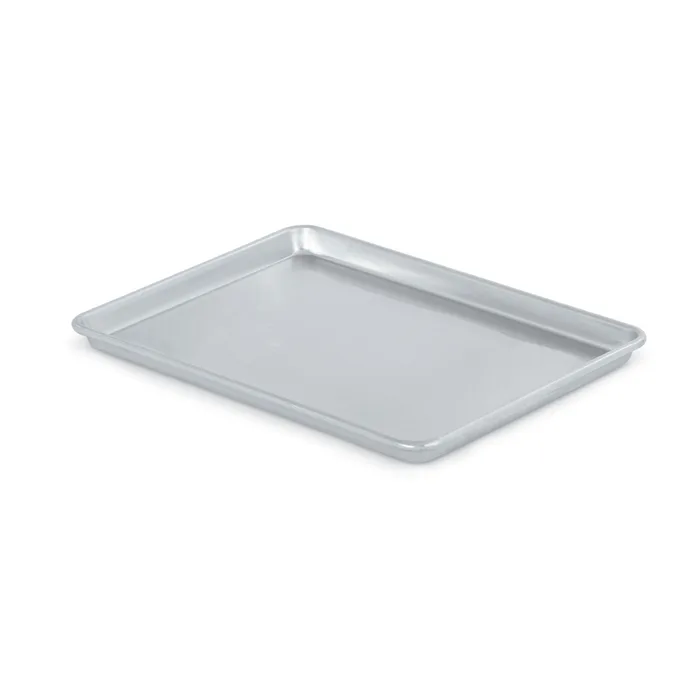
Can I use a sheet pan instead of a roasting pan?
For chicken pieces, vegetables or a small roast, a rimmed sheet pan works well and browns nicely because of its low sides. For a whole turkey or a large roast, the shallow rim cannot hold the drippings safely and there is nowhere to fit a rack. A roasting pan's taller walls are what make it safe to carry a heavy bird out of the oven.
Is a disposable foil roaster good enough?
It can work for a one-off, but foil roasters flex when lifted with a heavy bird, which is a spill and burn risk. Set it on a sheet pan for support when moving it. You also cannot make gravy in it on the burner.
Does a dark or light pan change browning?
Dark surfaces absorb more radiant heat, so they can brown the bottoms of vegetables faster than bright stainless. With a rack holding the meat up, the difference matters less for the roast itself. Pan color mostly affects the drippings and anything sitting directly on the pan.
How do I clean burnt-on residue from stainless?
Soak the pan in warm soapy water, then use a nonabrasive cleanser made for stainless steel. For stubborn spots, simmering water with a little baking soda helps loosen the residue. Avoid steel wool on polished finishes, and follow the maker's care guide on dishwasher use.
Or jump to the head-to-head: Made In Stainless Clad Roasting Pan vs Tramontina Prima 16.5 in Stainless Steel Deep Roasting Pan with Basting Grill and V-Rack.