Explained
Sheet Pans, Explained
After reading, you'll understand which sheet pan specs predict warping, sticking and coating wear, and how to read a maker's use and care rules before you buy.
In this guide
Sheet pans all look alike in photos, so first-time buyers tend to choose on color or price. The specs that matter are buried lower on the page: the metal, its gauge, how the rim is built and the maximum temperature. Coated pans add a second layer of fine print in their care instructions and warranty. Reading those before you buy saves you from a pan that warps or a coating that wears out in a year.
The 30-second version
- Half sheet is the home standard, roughly 18 by 13 inches, and racks and mats are sized for it.
- Thicker metal and a reinforced rim are what stop a pan from twisting in a hot oven.
- Bare aluminum is the low-maintenance choice, as long as you use parchment or oil for sticky foods.
- Coated pans trade easy release for lower temperature limits and stricter care rules.
- Check the maker's maximum temperature before you put any pan under the broiler.
The products this guide is about
Our verdict on each, with the full reasoning on the companion review.
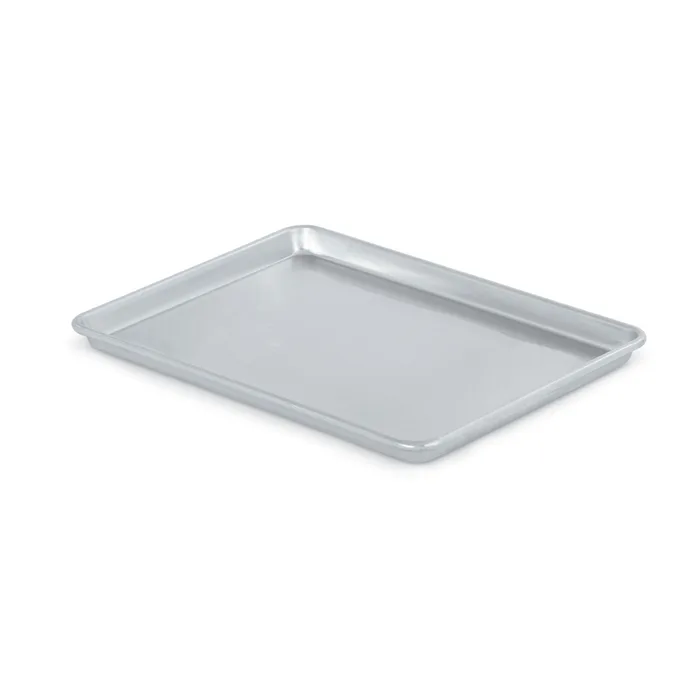
- Buy Vollrath Wear-Ever Half-Size Sheet Pan (5303) An 18-gauge bare aluminum half sheet from a foodservice maker, with a wire-reinforced rim and a base designed to flatten as it heats.
- Buy USA Pan Half Sheet Pan, Nonstick (1050HS) A fluted aluminized steel half sheet with a silicone nonstick coating, made in the USA and backed by a limited lifetime warranty.
- It depends Hestan OvenBond Tri-ply Half Sheet Pan & Rack A tri-ply clad stainless half sheet with handles and a stainless rack, rated to 600°F and broiler safe.
- Skip Caraway Large Baking Sheet A ceramic coated aluminized steel sheet with handles that costs far more than better-backed coated pans.
What actually matters
- Metal - Aluminum, aluminized steel and clad stainless behave differently in the oven. The metal decides how evenly food browns and how much heat the pan tolerates.
- Gauge - Gauge is a thickness number where lower means thicker. Thicker pans resist warping and dents.
- Rim construction - A rolled or beaded rim stiffens the edge. A wire inside the bead adds more resistance to twisting.
- Surface - Bare metal takes any utensil, while a coating releases food more easily. Coatings are the part that wears out.
- Temperature rating - Makers publish a maximum for coated pans and some clad pans. If you broil, this number decides whether the pan qualifies.
- Overall size - Handles add length beyond the cooking surface. Measure your oven, especially compact or wall ovens.
- Warranty - A lifetime warranty on a coated pan says more than a one-year one. Read whether normal wear is excluded.
The specs, in plain English
Green flags vs red flags
Green flags
- A published gauge or thickness figure
- A rolled or wire-reinforced rim
- A clear maximum oven temperature on the product page
- A limited lifetime warranty on coated pans
- Standard half sheet dimensions that fit common racks and mats
Red flags
- No material or thickness listed beyond a marketing name
- A coated pan with a one-year warranty that excludes normal wear
- Care rules that require oil just to protect the coating
- Handles that push the overall length past what your oven fits
- Broiler use pictured or implied without a matching temperature rating
Who's who: the brands
- Vollrath - A Wisconsin foodservice maker whose Wear-Ever aluminum sheet pans are built for commercial kitchens.
- USA Pan - Makes coated aluminized steel bakeware in the USA with its Americoat silicone nonstick and a limited lifetime warranty.
- Hestan - Known for premium clad cookware; its OvenBond line brings tri-ply stainless to sheet pans and bakers.
- Made In - Sells an 18-gauge 3004 aluminum sheet pan made in the USA, in bare and ceramic nonstick styles.
- Caraway - Known for colorful ceramic coated cookware and bakeware marketed as free of PTFE, PFOA and PFAS.
How to read a listing without getting fooled
Start with the material line and ignore the marketing name: you want to see aluminum, aluminized steel or clad stainless spelled out, and ideally a gauge. Then find the dimensions and check whether they include handles, because a pan sold as 18 by 13 can measure 20 or 21 inches overall. Next, look for a maximum oven temperature and any broiler statement; if a coated pan shows broiled food but lists 450°F, trust the number. Finally, read the use and care section and the warranty together. A coated pan that requires hand washing, no spray and soft utensils, and covers the coating for only a year, is telling you how long it expects that coating to last.
How much should you spend?
Bare aluminum commercial half sheets and good coated pans from makers like USA Pan sit in the budget tier, and they are the best value in the category. Designer coated pans and branded aluminum pans move into the mid-range tier, often without any extra thickness or warranty to show for it. Clad stainless sheet pans sit firmly in the premium tier; they earn it only if you broil, roast at very high heat or need induction. For most kitchens, two budget half sheets do more than one premium pan.
Questions, answered
Should I buy a half sheet or a quarter sheet?
Start with a half sheet, because it fits most home ovens and holds a full tray of cookies or a sheet pan dinner. A quarter sheet is handy for toasting nuts, roasting a small batch or as a tray under a cooling rack. Many cooks end up with two half sheets and one or two quarters. Check that a quarter sheet fits your toaster oven if you plan to use it there.
Why did my aluminum pan turn dark?
Bare aluminum discolors from heat, oils and some foods over time. It does not usually affect how the pan cooks. You can scrub it if appearance matters, which is one advantage of a pan with no coating. Lining it with parchment keeps it cleaner.
Can I use cooking spray on a nonstick sheet pan?
Check the maker first. USA Pan says cooking spray is not recommended on its coated bakeware, and Caraway asks for a little oil or butter instead. Spray residue can build up on coatings and make them sticky over time. Grease and flour as the recipe directs, or use parchment.
Do I need a rack that fits my sheet pan?
A rack set inside a sheet pan lets air reach the underside of roasted food and catches drippings. Half sheet racks are sized for standard half sheet pans, so a pan with an unusual cooking surface may not take one cleanly. Hestan sells its OvenBond half sheet with a matching stainless rack. For bare aluminum pans, any standard half sheet rack should fit inside the rim.
Or jump to the head-to-head: Vollrath Wear-Ever Half-Size Sheet Pan (5303) vs USA Pan Half Sheet Pan, Nonstick (1050HS).