Explained
Slow Cookers, Explained
After reading, you'll understand every spec on a slow cooker box and know exactly which features matter for the way you actually cook.
In this guide
A slow cooker has one job: hold a low, steady heat for hours so tough, cheap cuts turn meltingly tender while you get on with your day. The category looks simple, but the labels trip people up, because a plain three-dial pot, a probe-equipped programmable model, and a do-everything multi-cooker all get shelved together as slow cookers. This guide untangles the sizes, settings, and insert types so you can match the machine to your kitchen instead of the marketing.
The 30-second version
- Steady heat beats a long feature list. The whole point is a low, even temperature that renders connective tissue without scorching, so consistency matters far more than a busy control panel.
- A meat probe is the one upgrade worth chasing. It cooks large cuts to a target internal temperature and then holds warm, which removes the guesswork that timers alone can't solve for roasts.
- Size to how full you cook, not how big your family is. Many makers recommend filling a slow cooker at least about half full, so a too-large crock run mostly empty can cook worse than a right-sized one.
- The insert decides whether you can sear. Stoneware is forgiving but shouldn't go on a burner; a metal insert lets you brown first, then simmer in the same pot.
- A dedicated slow cooker usually beats a multi-cooker for this job. If slow cooking is truly all you want, you'll pay less and fiddle with fewer settings than a multi-function machine that treats slow cook as one mode among many.
The products this guide is about
Our verdict on each, with the full reasoning on the companion review.
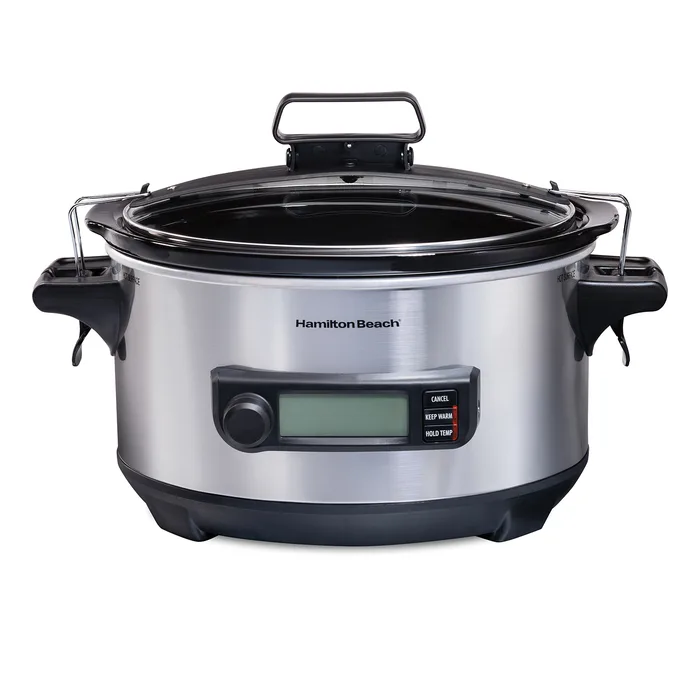
- Buy Hamilton Beach Advanced Temp Tracker 6-Quart Slow Cooker (33867) A temperature probe that holds the food at the temperature you set makes this the slow cooker most people should buy.
- Buy All-Clad Gourmet Plus Stainless Steel 7-Quart Slow Cooker The premium pick, with a built-in sear mode, buffet keep-warm, and a ceramic-coated cast-aluminum insert. Amazon
- It depends Crock-Pot Programmable 7-Quart Cook & Carry Slow Cooker The classic large-batch carrier is affordable and dependable, but basic on control. Amazon
- Skip Ninja Foodi PossibleCooker PRO (MC1001) A capable multi-function cooker, but overbuilt and overpriced if you only want to slow cook. Amazon
What actually matters
- Temperature consistency - a slow cooker earns its keep by holding a stable low simmer for hours; uneven or too-hot units scorch the bottom and dry out lean cuts, which is the single most common complaint.
- Control and doneness - a programmable timer that automatically shifts to warm is the baseline for hands-off cooking, while a meat probe that stops at a target internal temperature is a real step up for roasts and whole birds.
- Capacity and shape - quarts determine how many people you can feed, and an oval crock fits roasts and racks of ribs better than a round one; remember to follow the maker's fill guidance.
- Insert type - stoneware crocks are cheap to replace and easy to clean, while cast-aluminum or nonstick metal inserts let you sear on the stovetop before slow cooking, cutting down on dishes.
- Lid seal and portability - a gasket or locking lid plus sturdy, full-grip handles matter a lot if you carry a full pot to potlucks; a loose lid spills and lets heat escape.
- Simplicity vs. versatility - decide honestly whether you want a purpose-built slow cooker or a multi-cooker; extra modes add cost and complexity you may never use for a single task.
The specs, in plain English
Green flags vs red flags
Green flags
- A programmable timer that automatically shifts to warm when the cycle ends
- A built-in meat probe if you cook roasts or whole poultry regularly
- A tight gasket or locking lid with full-grip handles for spill-free carrying
- A removable crock and lid for easy cleanup
- A capacity that matches how full you'll actually cook, with an oval crock for roasts
- Consistent owner reports of even, reliable heat over long cooks
Red flags
- Only a plain on/off or a single dial with no auto-warm, so food overcooks if you're delayed
- Repeated owner reports of scorching, hot spots, or running too hot on low
- A loose or ill-fitting lid, or flimsy handles, if you plan to transport meals
- Paying a premium for multi-cooker modes you won't use when you only want to slow cook
- Complaints about latch or seal durability on carry-style models
- A crock so large you'd routinely run it under half full
Who's who: the brands
- Crock-Pot - The name that defined the category; known for affordable, dependable large-batch and Cook & Carry models with locking lids.
- Hamilton Beach - Value-focused kitchen brand; its Advanced Temp Tracker uses a probe that displays and holds the food's temperature.
- All-Clad - Premium cookware maker; its slow cookers pair a programmable timer with a ceramic-coated cast-aluminum insert and a built-in sear mode.
- Ninja - Known for versatile multi-cookers that slow cook among other modes, rather than dedicated slow cookers.
- Cuisinart - Mainstream housewares brand offering programmable slow cookers, some with brownable metal inserts.
How to read a listing without getting fooled
Start by separating true dedicated slow cookers from multi-cookers, because the two get listed side by side and answer different needs. Read the capacity in quarts against how full you actually cook, and prefer an oval crock if roasts are on the menu. Then look at control: the phrase you want is a programmable timer with automatic keep-warm, and a genuine meat probe is a clear bonus, not just a temperature display. Check the insert material, since 'stoneware' means no stovetop searing while 'cast-aluminum' or 'nonstick metal' means you can brown first. Terms like 'Cook & Carry' or 'locking lid' signal portability. Treat long multi-cooker feature lists skeptically if slow cooking is your only goal, and weigh recent owner reports on heat consistency and lid or latch durability over glossy feature bullets.
How much should you spend?
Slow cookers span a wide range, and more money tends to buy better build quality, smarter controls, and searable metal inserts rather than a fundamentally different result. The value sweet spot sits with a mid-range programmable model that adds a meat probe and auto-warm, because those features remove real guesswork for a modest step up over the most basic dials. Spending toward the top is worth it only if you cook often and specifically want extras like a sear mode and one-pot sear-then-simmer convenience; for occasional soups and stews it's overkill. At the bottom, an inexpensive programmable carrier is perfectly sensible if you mainly want big-batch capacity and easy transport and can live without a probe. Paying premium prices for a multi-cooker you'll only ever use on the slow-cook setting is the one place most buyers overspend.
Questions, answered
What is the real difference between low and high?
Both settings drive the crock toward a similar simmering temperature; high just gets there faster. Low is gentler and more forgiving over a long, unattended day, while high is handy when you started late. As a rough rule, many recipes that take eight hours on low finish in about four on high.
Do I actually need a meat probe?
Only if you regularly cook large cuts like roasts, pork shoulder, or whole poultry. A probe stops cooking at a target internal temperature and holds warm, which timers can't guarantee. For soups, stews, and chili, a programmable timer with auto-warm is plenty.
Can I sear or brown meat in the slow cooker itself?
Only if the cooker has a metal insert designed for stovetop use or a built-in sear mode; check the maker's instructions. Stoneware crocks should not go on a burner, so with those you brown in a separate pan first. Searing before slow cooking adds flavor but isn't mandatory.
What size should I buy?
Match it to how full you'll cook, not just family size, because many makers recommend filling a slow cooker at least about half full. Around 6 quarts suits most households; go to 7 quarts or more only if you routinely feed a crowd or cook big roasts, and consider an oval crock for long cuts.
Is a multi-cooker a good substitute for a dedicated slow cooker?
It can slow cook, but slow cooking is one mode among many, so you pay more and manage extra settings for a single task. If you genuinely want a do-everything pot, a multi-cooker makes sense; if slow cooking is truly all you're after, a purpose-built model is usually the better value.
Is it safe to leave a slow cooker running while I'm out?
Slow cookers are designed for long, unattended cooking, and an automatic keep-warm setting helps prevent overcooking. As general guidance, place it on a heat-safe surface away from walls and cords, don't overfill it, and follow the manufacturer's instructions and standard food-safety practices. This is general product information, not food-safety advice; consult a qualified source for specific concerns.
Or jump to the head-to-head: Hamilton Beach Advanced Temp Tracker 6-Quart Slow Cooker (33867) vs All-Clad Gourmet Plus Stainless Steel 7-Quart Slow Cooker.