Explained
Stainless Steel Cookware Sets, Explained
After reading this, you'll be able to look at any stainless cookware listing and know within a minute whether it's a genuine buy-for-life set or a disc-bottom pretender in shiny packaging.
In this guide
Stainless steel cookware is the closest thing the kitchen has to a buy-it-for-life purchase: no coating to wear out, no fear of metal utensils, and searing power nonstick can't touch. The catch is that the category is drowning in near-identical shiny sets, and the one spec that actually separates them - how the aluminum core is built into the pan - is buried under marketing words like 'professional', 'tri-ply base', and 'surgical grade'. This guide decodes the jargon so you can tell the real thing from the lookalike.
The 30-second version
- Full cladding is the whole game. A pan whose aluminum core runs from rim to rim heats evenly up the sidewalls; a disc welded to the bottom scorches in a ring. This one spec matters more than brand, piece count, or finish.
- Budget and flagship sets can share the same technology. A well-made budget tri-ply set performs remarkably close to the most expensive one in everyday cooking - the extra money buys refinement, metal lids, and longevity pedigree, not a different physics.
- Stainless doesn't mean nonstick, and that's fine. Food releases cleanly from stainless once you preheat properly and add a little fat; sticking is usually technique, not a defect.
- Handles and lids are where sets actually differ. Since every good set is fully clad, the livable differences are handle comfort (you'll hold these for decades) and lid material (metal lids survive the broiler, glass lids don't).
- Count useful pieces, not total pieces. A '12-piece set' counts every lid. Ten essentials you'll use daily beat fourteen pieces padded with tiny saucepans and plastic tools.
The products this guide is about
Our verdict on each, with the full reasoning on the companion review.
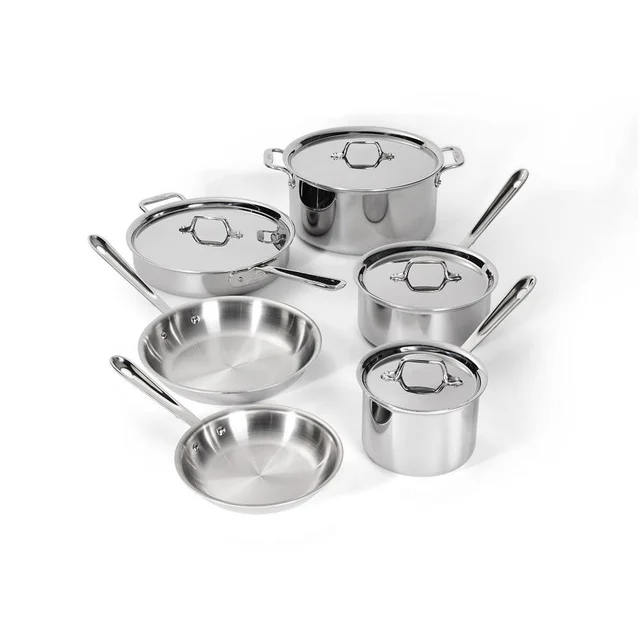
- Buy All-Clad D3 Stainless 10-Piece Cookware Set The original fully bonded tri-ply set is still the benchmark everything else is measured against. Amazon
- Buy Tramontina Tri-Ply Clad 10-Piece Cookware Set Fully clad tri-ply performance within striking distance of the flagship, at a fraction of the price. Amazon
- It depends Made In 10-Piece Stainless Clad Cookware Set Excellent five-ply pans favored by restaurant kitchens - but you pay near-flagship money for them. Amazon
- Skip Cuisinart MultiClad Pro 12-Piece Cookware Set (MCP-12N) A once-great value pick that Tramontina now beats on comfort and price at the same performance level. Amazon
What actually matters
- Full cladding - the aluminum layer must be bonded through the entire pan body, floor and sidewalls, not just a disc stuck on the bottom. This is the single spec that determines whether the pan heats evenly or develops a scorching ring.
- Ply count (tri-ply vs five-ply) - tri-ply is lighter and responds faster to burner changes; five-ply adds mass that smooths hot spots and holds heat for slow cooking. Neither is strictly better; well-made tri-ply handles most everyday tasks just as well.
- Lid material - all-metal lids mean the whole set can go under a broiler; tempered glass lids let you watch food cook but cap the oven-safe temperature well below metal. Decide based on whether you finish dishes in a hot oven.
- Handle design - clad pans last decades, so an uncomfortable handle is a decades-long problem. Handle shape is genuinely divisive between brands; check owner reports specifically for handle complaints before you commit.
- Steel grade (18/10 interior) - the cooking surface should be 18/10 stainless for corrosion resistance and easy cleanup; the exterior needs a magnetic stainless layer for induction to work.
- Set composition - look at the actual pieces: two fry pans, two saucepans, a sauté or saucier, and a stockpot cover almost everything. Sets padded with utensils, small lids, or a third tiny saucepan are inflating the count, not the value.
- Warranty with a track record - many brands promise 'lifetime', but the promise only matters if owner reports show the company actually honoring claims years later.
The specs, in plain English
Green flags vs red flags
Green flags
- The words 'fully clad' or 'full tri-ply' describing the whole pan body, not just the base
- All-metal lids and a high stated oven-safe temperature for the complete set
- An 18/10 interior with a magnetic induction-ready exterior
- Open-stock availability - you can buy or replace individual pieces later
- Owner reports spanning many years that mention pans still in daily use
- A sensible piece list: two fry pans, two saucepans, a sauté or saucier, a stockpot
Red flags
- 'Tri-ply base' or 'impact-bonded base' - that's a disc bottom wearing clad vocabulary
- Piece counts inflated with lids, plastic utensils, or duplicate tiny saucepans
- 'Surgical grade' or 'professional' with no actual steel grade or cladding spec listed
- No stated oven-safe temperature, or a suspiciously low one hinting at glass lids or plastic handle parts
- Recurring owner complaints about warping on high heat or handles loosening
- Nonstick coating inside a 'stainless' set - you're buying a coating's lifespan, not steel's
Who's who: the brands
- All-Clad - The Pennsylvania-based originator of bonded clad cookware; its tri-ply line is the benchmark the whole category is measured against, at a flagship price.
- Tramontina - Brazilian maker whose fully clad tri-ply sets get remarkably close to flagship performance at a fraction of the cost - the category's value story.
- Made In - Direct-to-consumer brand crafting five-ply pans in Italy; favored by restaurant kitchens, sold mostly online at a premium tier.
- Cuisinart - Mainstream kitchen brand whose long-running clad line performs genuinely well, though owner reports flag rougher finishing and sharp handle edges versus rivals.
- Calphalon - Broad mainstream cookware maker offering both clad stainless and nonstick lines - read the specific product's construction carefully, since the range is mixed.
How to read a listing without getting fooled
Start with the construction sentence and ignore the adjectives. You're looking for 'fully clad', 'full tri-ply', or 'bonded from rim to rim' - if the listing says 'tri-ply base', 'encapsulated base', or 'impact-bonded bottom', it's a disc-bottom pan no matter how professional it looks. Next, check the stated oven-safe temperature: a high number with metal lids means true stovetop-to-broiler versatility, while a low number usually betrays glass lids or plastic handle parts. Then audit the piece list one item at a time, counting only pans you'd actually cook in - lids and utensils pad the number. Finally, skim long-term owner reviews for three specific words: handles, warping, and spots. Those surface the problems a glossy product photo never will.
How much should you spend?
Because budget and flagship sets can share the same fundamental fully clad construction, this is a category where spending more buys refinement rather than a different technology. The value sweet spot is a genuinely fully clad tri-ply set from a reputable maker at the lower end of the market - it delivers much of the flagship cooking experience, with compromises like glass lids and a spot-prone finish that most kitchens can live with. Spending flagship money makes sense if you use the oven and broiler hard, want top build consistency, and intend to keep the set for decades - the premium buys metal lids, refined finishing, and a proven longevity record, and on a per-decade basis it's cheap. The tier to be wary of is the murky middle: sets priced well above the value leaders without clearly beating them on comfort, lids, or build. And at any price, walk away from a set that isn't fully clad - no amount of savings fixes a disc bottom.
Questions, answered
Why does food stick to stainless steel, and is that a defect?
It's technique, not a defect. Stainless needs a proper preheat - a couple of minutes on medium - and a little oil or butter before food goes in. Done right, food releases much more easily. If you want zero-effort release for delicate foods, keep one inexpensive nonstick skillet alongside your stainless set instead of buying a whole nonstick set whose coating will wear out.
Is five-ply worth it over tri-ply?
It's a different tool rather than a strictly better one. Five-ply's extra mass smooths hot spots and holds temperature beautifully for braises and slow cooking, but the pans are heavier and slower to respond when you adjust the burner. Well-made tri-ply is generally considered comparable for most everyday cooking, so choose five-ply only if low-and-slow stability is your priority.
Can I put a stainless set in the dishwasher?
Many fully clad sets are listed as dishwasher safe, but owners report that dishwashers can dull the finish and leave white mineral spotting over time; check your maker's care guide. Hand washing, with an occasional scrub using a stainless paste cleaner for heat tint and stuck-on marks, keeps clad pans looking their best for years.
Do all stainless sets work on induction?
No - the pan needs a magnetic exterior layer. Quality fully clad sets almost always include one, but confirm the listing says induction compatible, or test the base with a fridge magnet. Bare aluminum-core pans without a magnetic outer layer simply won't heat on an induction cooktop.
Are glass lids a dealbreaker?
They cut both ways. Glass lets you monitor food without releasing heat, which beginners love, but tempered glass caps the whole set's oven-safe temperature well below all-metal lids. If you regularly finish covered dishes in a hot oven or under the broiler, choose metal lids; if you mostly cook on the stovetop, glass is a livable trade.
How long should a good clad stainless set last?
Decades is realistic for a well-made set. With no coating to degrade, the failure points are physical: warping from thermal shock (don't rinse a screaming-hot pan in cold water), loosening handles, and cosmetic staining. Owner reports on the best sets describe decades of daily use, which is why handle comfort and warranty track record matter so much up front.
Or jump to the head-to-head: All-Clad D3 Stainless 10-Piece Cookware Set vs Tramontina Tri-Ply Clad 10-Piece Cookware Set.