Explained
Stockpots, Explained
After reading, you'll understand how to read a stockpot listing and pick the right size and construction for the way you cook.
In this guide
Stockpots look alike on a shelf, which is why buyers often pick by price or size alone. The differences that show up later are construction, handle material and cooktop ratings: one pot scorches chili, another cannot go in a hot oven, a third will not work on induction. Listings also use terms like tri-ply, 5-ply and encapsulated base that are rarely explained. This guide covers what each means for real cooking.
The 30-second version
- Clad construction matters for thick foods, not for boiling water, so match the build to what you cook.
- Eight quarts covers most families, while 12 quarts is for whole-bird stock and batch cooking.
- Handle material sets the oven limit, since phenolic handles usually allow less heat than stainless.
- Induction needs a stated listing, so do not assume a stainless pot works on it.
- More plies cost more, and the benefit shrinks when the pot mostly holds liquid.
The products this guide is about
Our verdict on each, with the full reasoning on the companion review.
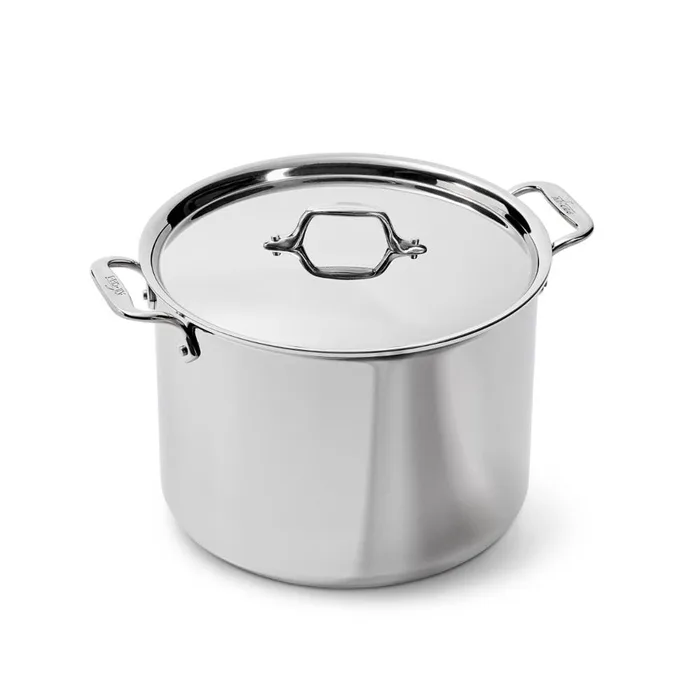
- Buy All-Clad D3 12-Quart Stock Pot Bonded tri-ply, made in the USA, induction compatible and oven safe to 600°F, in a big 12-quart size.
- Buy Tramontina Signature 8 Quart Tri-Ply Clad Stainless Steel Covered Stock Pot An aluminum-core tri-ply 8-quart pot that works on induction, goes in the oven to 500°F and in the dishwasher.
- It depends Made In 5-Ply Stainless Clad Stock Pot A 5-ply clad pot made in Italy, rated to 800°F and sold in 6, 8 and 12 quart sizes.
- Skip Farberware Classic Series Stainless Steel Stockpot with Lid, 8-Quart A familiar budget stockpot that works on induction, but its phenolic handles cap oven use at 350°F and no clad construction is published.
What actually matters
- Construction - Clad pots bond aluminum between stainless layers up the walls. That spreads heat and cuts scorching when you brown or simmer thick foods.
- Capacity - Size decides whether stock fits without boiling over. A pot that is too big is hard to lift full and may not fit your sink.
- Shape - Tall, narrow pots reduce evaporation for long simmers. Wider, shorter pots brown more meat at once and reduce faster.
- Cooktop compatibility - Induction needs a magnetic base and the maker should list it. Glass tops reward a flat, smooth base.
- Oven rating - The listed temperature tells you if you can finish braises in the oven. Handles are often the limiting part.
- Lid - A well-fitting lid speeds boiling and limits evaporation. Stainless lids handle oven heat; glass lids let you see inside but may have lower limits.
- Care - Dishwasher-safe pots are easier to live with. Handwash-only pots need more effort but often keep their finish longer.
The specs, in plain English
Green flags vs red flags
Green flags
- Construction is stated plainly, such as tri-ply clad with an aluminum core.
- Induction compatibility is listed by the maker.
- The oven rating is 500°F or higher with stainless handles.
- Capacity and full dimensions are published.
- A clear warranty and care instructions are on the product page.
Red flags
- No construction details at all on a stainless pot.
- Plastic or phenolic handles with a low oven limit when you want to braise.
- No dimensions, so you cannot check fit against your sink or shelf.
- A large capacity paired with a thin build, which invites scorching.
- Induction not mentioned when you cook on induction.
Who's who: the brands
- All-Clad - Pennsylvania brand that popularized bonded clad cookware, with its D3 line still bonded in the USA.
- Tramontina - Brazilian maker known for tri-ply clad stainless cookware at moderate prices.
- Made In - Direct-to-consumer brand known for heavy clad stainless and carbon steel cookware.
- Farberware - Long-running budget cookware brand whose Classic Series stainless pots are common starter pieces.
How to read a listing without getting fooled
Start with the construction line and look for a specific claim, such as tri-ply clad with an aluminum core, or 5-ply from base to walls. If the listing only says stainless steel, assume a basic build. Next, check capacity in quarts and, if published, height and diameter, so you know it fits your sink and storage. Read the cooktop list and treat a missing induction mention as a no. Look at the oven rating and the handle material together, since phenolic handles usually set a lower limit. Finish with care instructions and the warranty terms.
How much should you spend?
Budget stockpots are usually single-layer stainless, sometimes with a base disc, and often with plastic handles; they boil water well but scorch thick foods more easily. Mid-range pots bring tri-ply clad construction, stainless handles and induction compatibility, which covers almost every home cooking job. Premium pots add more plies, made-in-USA or made-in-Italy production and larger sizes, and the extra spend pays off mainly if you sear and reduce in the pot or cook in large batches. For boiling pasta alone, a premium pot is hard to justify.
Questions, answered
What is the difference between a stockpot and a Dutch oven?
A stockpot is tall and fairly light, made for liquids such as stock, pasta water and soup. A Dutch oven is heavier, usually cast iron, shorter and wider, and holds heat for braises and bread. You can make soup in either, but a stockpot is easier to lift when full of liquid.
Is a pasta insert worth it?
A pasta or steamer insert lets you lift pasta or vegetables out without pouring a heavy pot into a colander. It is handy if you cook pasta often or steam seafood. Check that the insert is made for your exact pot size.
Can I use a stockpot for canning?
A tall stockpot can work for water bath canning of high-acid foods if jars sit on a rack and are covered by enough water. Low-acid foods like vegetables and meat need a pressure canner, not a stockpot. Follow tested guidance for processing times.
How do I stop soup from scorching on the bottom?
Use moderate heat once the pot is up to a simmer, stir thick soups regularly, and scrape the bottom with a flat spatula. A clad pot spreads heat better and reduces scorching. Adding thick ingredients like beans or puréed vegetables later in cooking also helps.
Or jump to the head-to-head: All-Clad D3 12-Quart Stock Pot vs Tramontina Signature 8 Quart Tri-Ply Clad Stainless Steel Covered Stock Pot.