Explained
Towel Warmers, Explained
After reading, you'll understand the difference between a heated towel rack and a towel warmer bucket, what the wattage, timer and safety specs mean, and how to spot a listing that leaves out the important parts.
In this guide
Most first-time buyers assume all towel warmers do the same thing, then find that a wall rack leaves towels pleasantly warm rather than hot, or that a bucket cannot dry a damp towel. The two types are built for different jobs. Spec sheets add confusion by mixing liters, towel counts, watts and BTUs, and many cheaper listings never name a safety mark at all. Knowing which numbers to look for makes the choice quick.
The 30-second version
- Racks and buckets do different jobs, with racks drying and warming towels over hours and buckets heating dry towels quickly on a timer.
- Wattage tells you the type more than the quality, since racks often draw around 150 W and buckets around 450 W or more.
- A named safety listing matters for a heater near water, so look for cETLus, ETL or UL rather than an FCC statement.
- A delay timer is the bucket feature that changes daily use, because it lets you wake up to a towel that is already hot.
- Hardwired racks need planning, including an electrician and, per at least one maker's guide, a GFCI-protected circuit.
The products this guide is about
Our verdict on each, with the full reasoning on the companion review.
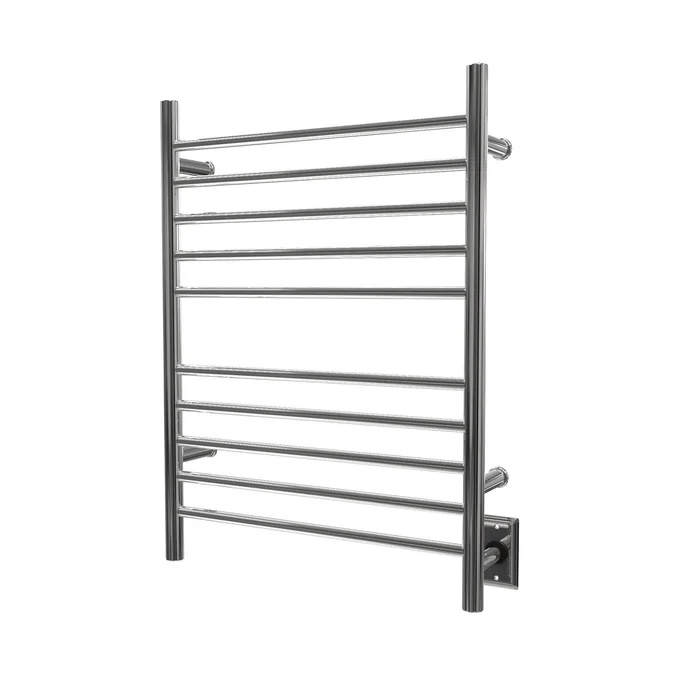
- Buy Amba Radiant Hardwired + Plug-in Combo Straight 10 Bar Heated Towel Rack A 10-bar stainless wall rack that plugs in or hardwires, is cETLus listed and is designed to run continuously.
- Buy Keenray Towel Warmer CL1 PLUS A 20 L bucket for two 40 x 70 inch bath towels with a delay timer of up to 24 hours, three heat settings and a child lock.
- It depends Zadro Large Towel Warmer Bucket (20L) A plain 20 L bucket with a steel tub, a 15 to 60 minute timer, an 83 inch cord and a complete spec sheet.
- Skip Sharper Image Luxury Towel Warmer A two-towel bucket with a 60-minute maximum timer whose manual names no safety listing and tells you to unplug it after every use.
What actually matters
- Form factor - Wall racks are permanent fixtures that dry towels as well as warm them. Buckets are portable and only warm dry items.
- Safety listing - A cETLus, ETL or UL mark means an independent lab tested the product to a safety standard. If a listing or manual does not name one, treat that as missing information.
- Power draw - Wattage tells you how much electricity the unit uses while heating. A low-watt rack can run for hours, while a higher-watt bucket runs in short timed bursts.
- Timer and delay start - A shut-off timer limits how long a bucket heats. A delay start lets you schedule heating so a towel is ready at a set time.
- Installation type - Plug-in racks need a nearby grounded outlet and visible cord. Hardwired racks hide the wiring but need an electrician and wall work.
- Capacity - Buckets are usually rated by how many 40 x 70 inch bath towels fit. Racks list a towel count based on bar spacing and width.
- Warranty - The warranty is the maker's own estimate of how long the heating element should last. Look for a stated term on the product page or manual.
The specs, in plain English
Green flags vs red flags
Green flags
- A named safety listing such as cETLus, ETL or UL on the page or in the manual
- A full spec sheet with watts, volts, dimensions and cord length
- A stated warranty term, ideally two years or more for a wall rack
- Clear installation instructions, including circuit requirements for hardwired racks
- Capacity given in towel sizes, not just liters
Red flags
- No safety listing named anywhere, or only an FCC Part 15 statement
- Product page and manual that disagree on dimensions or timer settings
- Instructions to unplug after every use on a product sold as an automatic appliance
- Aromatherapy or spa extras used to fill a short spec list
- No warranty term on the product page
Who's who: the brands
- Amba - A towel-warmer specialist with wall racks in many finishes, plug-in/hardwire combo models and detailed spec pages.
- Keenray - Known for feature-rich bucket warmers with delay timers and multiple heat settings.
- Zadro - Long-running bathroom accessory maker, better known for lighted mirrors, with a towel bucket backed by a full spec sheet.
- Sharper Image - A gift-catalog brand whose towel warmer is sold mainly as a spa-at-home gift.
How to read a listing without getting fooled
Start with the type, because a rack and a bucket are not comparable on most numbers. For a rack, check watts and amps, the surface temperature range if given, the number of bars and towels, the installation type, and whether a timer is built in or sold separately. Then open the installation guide, which often holds the real requirements such as an electrician, a GFCI circuit or a grounded outlet. For a bucket, check capacity in bath-towel terms, maximum wattage, the timer settings and whether there is a delay start. On both, look for a named safety listing and a warranty term, and if the product page and manual disagree, trust the manual and treat the gap as a warning.
How much should you spend?
Buckets sit mostly in the mid-range, and the extra money between them buys controls such as a delay timer and heat settings rather than more capacity, since most hold two bath towels. Plug-in wall racks start in the budget-to-mid range for small units and climb into premium territory for larger stainless racks in special finishes. Hardwiring adds the cost of an electrician and any wall controls. Paying more for a rack is worth it when it brings a named safety listing, a longer warranty and the option to hardwire.
Questions, answered
Will a heated towel rack heat my bathroom?
Not in any meaningful way. A 150 W rack puts out about 512 BTU, a small fraction of what a space heater does. It will take the chill off the towels and the air right around them. If the room itself is cold, you need a separate heat source.
How long does a towel warmer take to heat up?
Amba lists 10 to 15 minutes for its Radiant rack without towels, and its guide says to allow 10 to 20 minutes. Buckets heat folded towels inside a closed tub, and most let you choose 15 to 60 minutes. Thick bath sheets take longer than thin towels in either type.
Why do my towels have marks after using a heated rack?
Amba's guide notes that towels with soap or detergent residue may show what look like scorch marks. It describes this as discoloration of the residue in the towel, not damage from the rack. Rinsing towels well and not overloading the rack helps.
Can I use an extension cord with a towel warmer?
The makers we checked say no. Amba's guide says never to use an extension cord with its plug-in racks, and Sharper Image's manual says the same for its bucket. Plan placement around an existing outlet, and note that the bucket cords we checked run from 72 to 83 inches.
Or jump to the head-to-head: Amba Radiant Hardwired + Plug-in Combo Straight 10 Bar Heated Towel Rack vs Keenray Towel Warmer CL1 PLUS.