Explained
Tower Fans, Explained
After reading this, you'll be able to look at any tower fan listing and know whether it will actually be quiet, actually cool your room, and actually last past one summer.
In this guide
A tower fan is the tall, slim fan that fits where a pedestal fan won't - beside a bed, in a corner, next to a desk. The category looks simple, but listings are full of vague promises like 'whisper quiet' and 'whole room' that often don't survive contact with reality. The trick is knowing which two or three specs actually predict how a fan performs, and which are marketing filler.
The 30-second version
- The motor type matters most. A DC motor generally points to a quieter, more efficient fan with finer speed control; AC-motor fans tend to hum more and jump more coarsely between speeds.
- Fans don't cool air - they cool you. A fan creates a wind-chill effect on your skin; it does not lower the room temperature, so 'cooling power' claims are really about how much air reaches you.
- Oscillation quality is the hidden failure point. Grinding or clicking during the sweep is one of the most common tower-fan complaints, and it's invisible on a spec sheet - only owner reports reveal it.
- Judge noise at the speeds you'll actually use. Most fans are quiet on minimum; what matters is the sound at the middle speeds that genuinely move air, especially overnight.
- Year-two reports tell the durability story. Cheap fans often feel fine in week one; rattles, dying oscillation gears, and failed motors show up in the second summer of owner reports.
The products this guide is about
Our verdict on each, with the full reasoning on the companion review.
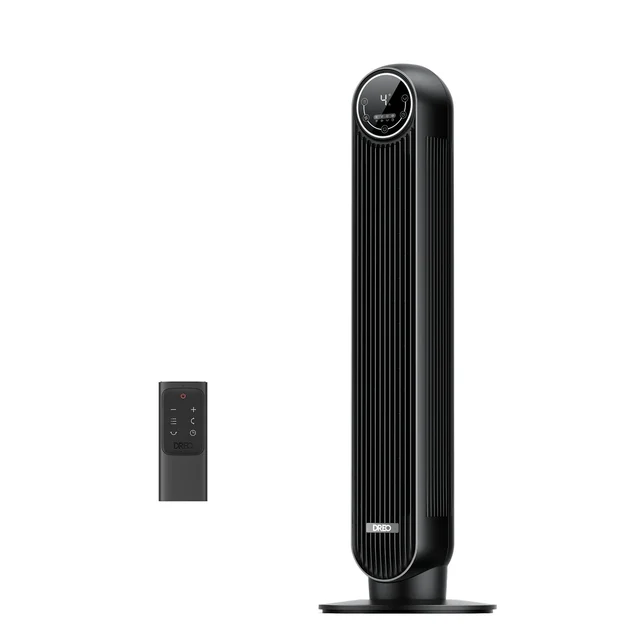
- Buy Dreo Nomad One Tower Fan The quiet default that most bedrooms and offices should buy.
- Buy Vornado OSCR37 Oscillating Tower Circulator The whole-room circulator that actually moves air to the far corners, not just past your chair. Amazon
- It depends Lasko Wind Curve T42951 Tower Fan A lot of raw airflow for very little money, if you can live with three speeds and some fan hum. Amazon
- Skip Honeywell QuietSet Whole Room Tower Fan (HYF290B) A best-seller whose 'quiet' branding writes checks its oscillation gears and airflow can't cash. Amazon
What actually matters
- Motor type - DC motors generally run quieter at low speeds, use less electricity, and allow more finely graded speeds; AC motors are generally cheaper and tend to hum more and offer fewer, coarser settings.
- Real-world airflow - how far and wide the fan actually pushes air across a room, not the peak number on the box; a fan that's strong at close range can still feel weak from across a living room.
- Noise character - not just how loud, but what kind of sound: a smooth whoosh is easy to sleep through, while motor hum, plastic rattle, or oscillation clicking is not, even at the same volume.
- Oscillation quality - a smooth, quiet sweep spreads air evenly; a cheap oscillation gearbox grinds, clicks, or dies early, and it's a top complaint in owner reports across the category.
- Sleep features - a display that dims or turns off, a gradual step-down night mode, and a timer matter more in nightly use than an extra speed setting or two.
- Room match - a standard tower blows a narrow ribbon of air suited to a bedroom or desk; a large open space needs a circulator-style design engineered to move air around the whole room.
- Build and warranty - heavier bases wobble less and rattle less over time, and a long warranty from a responsive brand is a real signal of confidence in the oscillation gears and motor.
The specs, in plain English
Green flags vs red flags
Green flags
- A DC motor, if the maker states it, with four or more speeds plus sleep and timer modes
- Owner reports that specifically praise smooth, quiet oscillation after months of use
- A display that dims or turns off completely, with silenceable button beeps
- A warranty of two years or more from a brand with responsive support
- Independent testing that confirms the airflow reaches across a real room, not just a wind-tunnel number
Red flags
- 'Whisper quiet' or 'whole room' claims with no motor type mentioned anywhere in the listing
- Repeated owner complaints of grinding or clicking when the fan oscillates
- Only three speeds with big jumps between them - often a sign of an older design
- Reports of rattling, wobbling, or fans dying shortly after the first year
- A dB rating quoted only for the lowest speed, with no information about mid or high speeds
- Review volume doing the selling - tens of thousands of ratings can still hide consistent mechanical complaints underneath
Who's who: the brands
- Dreo - A newer brand with strong owner satisfaction and thoughtful controls at mid-range prices.
- Vornado - The air-circulator specialist - premium-priced fans engineered to move air around an entire room, with a 5-year satisfaction guarantee on the OSCR37.
- Lasko - The American budget stalwart; lots of raw airflow per dollar from simple designs, with noise and longevity as the trade-offs.
- Honeywell - A huge-selling household name whose tower fans are popular but draw consistent owner complaints about oscillation noise and modest airflow.
- Dyson - The luxury end - bladeless styling, app control, and some models with heating or purifying built in, at prices several times a conventional tower fan.
How to read a listing without getting fooled
Start with the motor: if the listing doesn't say 'DC motor' or 'brushless,' you can't assume it's quiet, so lean on owner reports. Next, ignore adjectives like 'turbo' and 'whisper' and look for hard numbers - speed count, oscillation angle, timer length - then cross-check the quiet claims against owner reports filtered to mentions of 'grinding,' 'clicking,' or 'rattle,' which is where oscillation problems hide. Be suspicious of dB figures with no speed attached; they are often measured on minimum. Finally, sort owner reports to the oldest and read what people say after a full summer - that's where durability, wobble, and dying oscillation gears show up, long after the honeymoon reviews were written.
How much should you spend?
Cost in this category is driven mostly by the motor and the engineering around it: budget towers tend to use simple motors and oscillation gears, mid-range models often add DC motors with more speeds and better sleep features, and the premium tier buys room-scale circulation engineering, longer warranties, or designer styling. The value sweet spot for most people is the mid-range DC-motor tier - the jump in nighttime quietness and speed control over budget fans can be large, while the jump from mid-range to premium mostly buys whole-room reach you only need in large spaces. Spending more is worth it when the fan must cool a big open living area or run silently beside your bed every night; it isn't worth it for a garage, workshop, or occasional-use spare room, where a budget fan's raw breeze is all you need.
Questions, answered
Do tower fans actually cool a room?
No fan lowers air temperature - fans cool you through wind-chill on your skin and by keeping air moving. That's why airflow reach matters more than any 'cooling' claim: a fan only helps where its air actually arrives. If you need the room itself cooler, that's a job for an air conditioner, with a fan helping to spread the cool air.
Is a DC-motor tower fan really worth the extra money?
If the fan will run in a bedroom or office, usually yes. DC motors are generally quieter at low speeds, offer finer speed steps, and use less electricity over a summer of nightly use. If the fan lives in a garage or a spare room where noise doesn't matter, a cheaper fan delivers plenty of breeze.
Tower fan or pedestal fan - which should I get?
Tower fans win on footprint: they slot into corners and beside beds where a pedestal fan won't fit, and modern towers close much of the airflow gap while running quieter. If you have open floor space and want maximum raw air, a pedestal fan still moves more. Pick by the room, not the category.
Why do so many tower fans start clicking or grinding when they oscillate?
The oscillation mechanism is a small plastic gearbox at the base, and it's a common weak point in the category. Cheap gears wear, misalign, and start grinding - sometimes within months. It rarely shows on a spec sheet, so the only defense is reading owner reports for oscillation complaints and favoring brands whose sweep is specifically praised.
How do I keep a tower fan quiet and working for more than one summer?
Dust is the main enemy: vacuum the intake grilles every few weeks during heavy use, since buildup makes the motor work harder and louder. Keep the fan on a level, hard surface, and avoid tipping it over - impact is a common cause of new rattles. Fans with sturdy bases tend to age more gracefully.
Are bladeless tower fans better than regular ones?
They're often considered safer around curious kids and pets, easier to wipe clean, and stylish, but you pay a large premium for it. Conventional tower fans typically match or beat bladeless models on airflow per dollar. Buy bladeless for the safety and design if those matter to you - not expecting more breeze.
Or jump to the head-to-head: Dreo Nomad One Tower Fan vs Vornado OSCR37 Oscillating Tower Circulator.