Explained
Water Softeners, Explained
After reading, you'll understand how to size a softener from a hardness figure, why the regeneration trigger matters, and when a salt-free system is the right answer.
In this guide
Water softener listings are full of grain numbers with no context, and half the category is not selling softeners at all. Two pieces of arithmetic and one distinction cover almost everything: how to turn your water hardness into a grain capacity, what a regeneration cycle costs you, and the difference between removing hardness and inhibiting scale.
The 30-second version
- Grain capacity is arithmetic, hardness times daily gallons times days between regenerations.
- Flow rate and capacity are both needed, because one sets how long it lasts and the other whether it keeps up.
- Metered beats timed regeneration, since a timer fires whether you used the capacity or not.
- Salt-free conditioners do not soften, they keep minerals from sticking, which is a different and narrower job.
- Softening adds sodium, in proportion to how hard the water was, which is why a potassium substitute exists.
The products this guide is about
Our verdict on each, with the full reasoning on the companion review.
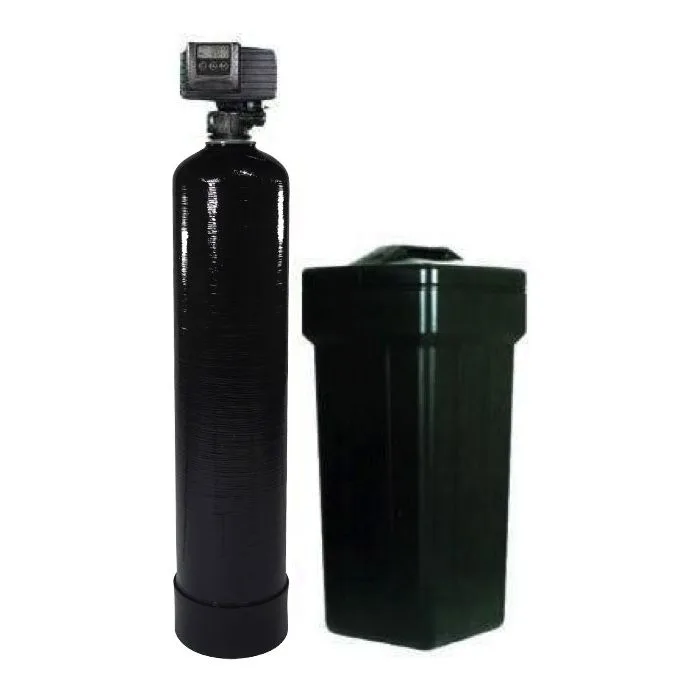
- Buy Fleck 5600 SXT Metered Water Softener The metered control valve that has been the default recommendation for years, in four honest sizes.
- Buy Waterdrop WHR01 Water Softener System Up-flow regeneration and a pre-assembled install, in three grain capacities.
- It depends APEC Hydro Express Water Softener 45 A pre-programmed softener for moderate hardness, with an LED display and no flow rate published.
- Skip GreenWave Salt-Free Water Softener Alternative A scale inhibitor sold in the softener aisle, and the vendor says plainly that it does not remove hardness.
What actually matters
- Hardness in grains per gallon - the input to every other decision. Municipal suppliers publish it in an annual report, usually in parts per million, and dividing ppm by 17.1 converts it to grains per gallon.
- Grain capacity - how much hardness the resin bed can remove before it needs regenerating. Fleck publishes 26,000 to 70,000 across the 5600 SXT range and Waterdrop offers 32,000, 48,000 and 64,000.
- Service flow rate - gallons per minute the softener can deliver without a pressure drop. Two bathrooms running at once wants more than a single bathroom, and a system with the right capacity can still be the wrong flow rate.
- Regeneration trigger - metered systems count gallons treated and regenerate on demand; timer systems fire on a schedule. The difference shows up in salt and water used per year.
- Up-flow against down-flow regeneration - the direction brine travels through the resin. Waterdrop states its up-flow cycle uses less salt for the same softening.
- Salt type - sodium chloride is standard and potassium chloride is the substitute for sodium-restricted households, at higher cost.
- Installation requirements - a drain for the regeneration discharge, a power supply, a bypass valve, and floor space for the brine tank. APEC also states its unit should not be installed outside the home.
The specs, in plain English
Green flags vs red flags
Green flags
- Both grain capacity and service flow rate are published for each size.
- The regeneration trigger is stated as metered or timed.
- Installation requirements including the drain line are described plainly.
- Several sizes are offered so the system can be matched to a hardness figure.
- Any sodium or salt consumption claim is explained rather than just asserted.
Red flags
- A salt-free system described as a softener without saying it does not remove hardness.
- Grain capacity given with no flow rate anywhere on the page.
- No mention of a drain line on a system that regenerates.
- Hardness removal claimed as a percentage with no grain figure.
- A single capacity offered for every household size.
Who's who: the brands
- Fleck - Control valve maker, now part of Pentair, whose 5600 SXT metered head is the long-standing default in enthusiast and trade installations.
- Waterdrop - Consumer water treatment brand whose WHR01 softeners use up-flow regeneration and arrive largely pre-assembled.
- APEC - California maker better known for reverse osmosis, with the pre-programmed Hydro Express softeners and the FUTURA salt-free conditioners.
- GreenWave - Salt-free TAC conditioner sold as a softener alternative, with no salt, no drain and no hardness removal.
- Aquasure - Value brand offering digital metered softeners and combination softener and filtration systems.
How to read a listing without getting fooled
Get your hardness figure first and treat every listing as unreadable without it. Then look for two numbers together: grain capacity and service flow rate. A page that gives capacity alone is telling you how long the system lasts between regenerations and nothing about whether it can keep up with two showers. Next find the word metered or timed, because that determines the running cost more than anything else on the page. Then read the installation notes properly, since a drain line, a power outlet and a location that will not freeze are genuine constraints and makers who state them are doing you a favour. Finally, check whether the product removes hardness or inhibits scale. Salt-free systems are often sold under softener-adjacent names, and the honest ones will say what they do if you look at the questions section.
How much should you spend?
Water softeners sit in the mid-range to premium tiers, and the money buys control and capacity rather than better softening. The mid-range covers consumer-brand ion exchange systems with pre-programmed valves and simplified installation, which is genuinely enough for a household with known, moderate hardness. The premium tier buys a proper metered control head, a wider range of sizes and a system that a plumber can service in a decade, which is what you want if your hardness is high or your usage varies. Salt-free conditioners are priced alongside real softeners and do less, so they are only good value for the specific case where salt is not an option. Factor in salt as a running cost from the start, and remember that an oversized softener regenerating rarely is cheaper to run than an undersized one regenerating constantly.
Questions, answered
How long does a water softener last?
The resin bed typically lasts ten to fifteen years on municipal water, and the control valve is usually the part that fails first. That is the argument for a widely used control head like the Fleck 5600 SXT, since a replacement or a rebuild kit is easy to find years later. Chlorinated municipal water slowly degrades resin, and a carbon pre-filter extends its life. On well water, iron and sediment are the usual killers and should be treated ahead of the softener.
Will softened water damage my plumbing or my plants?
Not your plumbing, in normal use. Softened water is not aggressive to copper or plastic at household hardness levels. Plants are a different matter, because the sodium added during ion exchange accumulates in soil. The standard arrangement is to leave outside taps and one cold kitchen tap on the unsoftened line, which also gives you drinking water without the added sodium.
Do I need a softener if I already have a reverse osmosis system?
They solve different problems. Reverse osmosis treats drinking water at one tap; a softener treats everything in the house. Hard water damages the water heater, the dishwasher, the kettle and the shower screen, none of which the RO system touches. There is a useful interaction the other way round: softening ahead of an RO system extends the membrane's life considerably, which is why combined packages exist.
Why does my softened water feel slippery?
Because it is doing its job. Hard water reacts with soap to form the scum that makes skin feel squeaky, and without calcium and magnesium the soap rinses cleanly and you feel your own skin's natural oils. It is not residue. Most people adjust within a fortnight, and the practical consequence is that you need considerably less soap and detergent than you did before.
Or jump to the head-to-head: Fleck 5600 SXT Metered Water Softener vs Waterdrop WHR01 Water Softener System.