

Home & Kitchen
The Best Water Softeners: 4 Compared (and One to Skip)
We compared four whole-house water treatment systems on published grain capacity, flow rate, how regeneration is triggered and whether they remove hardness at all.
The short version
The Fleck 5600 SXT is the one to buy: a metered valve that regenerates on water used rather than on a clock, four sizes from 7 GPM and 26,000 grains up to 20 GPM and 70,000 grains, and a control head that has been the enthusiast default long enough for parts and documentation to be everywhere. The Waterdrop WHR01 is the value pick and the easier install, in 32,000, 48,000 and 64,000 grain versions with up-flow regeneration that Waterdrop states uses less salt for the same softening. The APEC Hydro Express 45 is the one for moderate hardness and a simple life, rated up to 45,000 grains with a pre-programmed electronic valve and an LED display, though APEC does not publish a flow rate for it. The GreenWave salt-free system is the one to skip if what you want is soft water, and the vendor says so in its own Q&A: it uses TAC media to keep minerals from sticking and it does not remove hardness. Best for: anyone descaling a kettle more than once a year.
Our picks at a glance
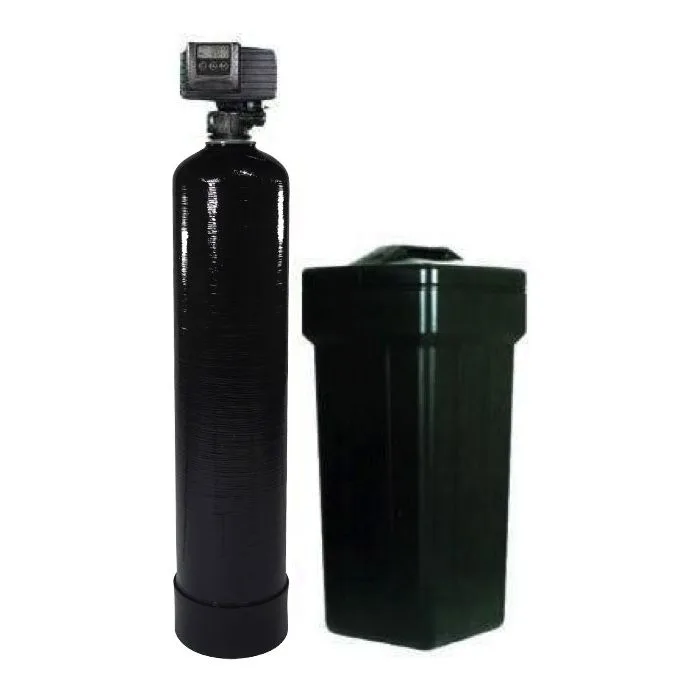
- Fleck 5600 SXT Metered Water Softener - Buy. The metered control valve that has been the default recommendation for years, in four honest sizes.
- Waterdrop WHR01 Water Softener System - Buy. Up-flow regeneration and a pre-assembled install, in three grain capacities.
- APEC Hydro Express Water Softener 45 - It depends. A pre-programmed softener for moderate hardness, with an LED display and no flow rate published.
- GreenWave Salt-Free Water Softener Alternative - Skip. A scale inhibitor sold in the softener aisle, and the vendor says plainly that it does not remove hardness.
The verdict in 30 seconds
What mattered most
- Does it remove hardness
- Grain capacities offered
- Published service flow rate
- Regeneration trigger
- Salt required
- Drain line required
A water softener is one of the few appliances that pays for itself in other appliances, because scale is what kills water heaters, kettles and dishwashers early. It is also a category with a genuine category error in it: a large share of what gets sold as a softener does not soften water. Ion exchange systems remove calcium and magnesium; salt-free conditioners leave the minerals in place and try to stop them sticking. Both have a use, and only one of them is a softener. The numbers that matter are grain capacity, flow rate and what triggers a regeneration cycle.
The metered control valve that has been the default recommendation for years, in four honest sizes.
Best for: Anyone sizing a softener properly for a household with genuinely hard water, who wants a system that is serviceable for a decade.
- Metered regeneration, so the system counts gallons and regenerates on demand rather than on a timer.
- Four sizes with both figures published: 7 GPM and 26,000 grains, 10 and 35,000, 15 and 53,000, 20 and 70,000.
- Multiple regeneration modes and a control head common enough that parts, manuals and help are easy to find.
- It is the most expensive option here at every size.
- It is a two-tank installation with a brine tank, so it needs floor space and a drain.
- The SXT head is capable but its interface is dated compared with the LED and app-driven controls elsewhere.
- You still have to buy and carry salt, which is true of every real softener.
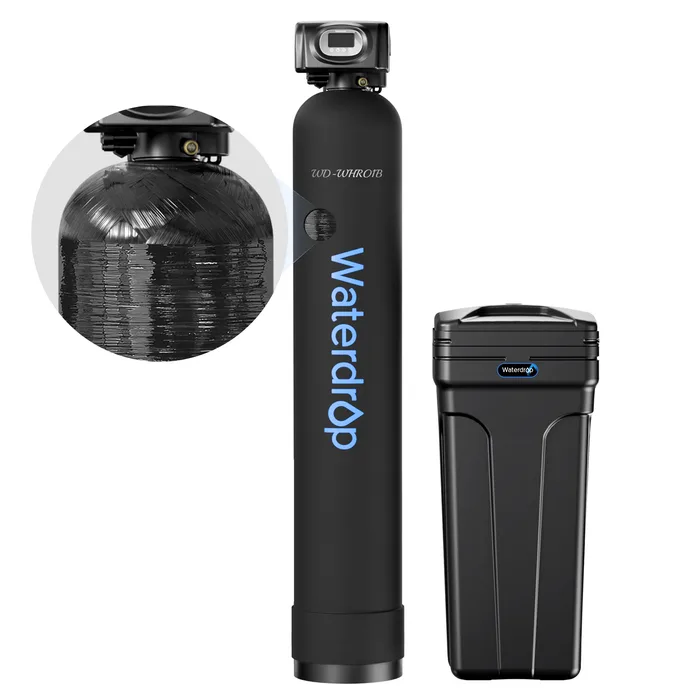
Up-flow regeneration and a pre-assembled install, in three grain capacities.
Best for: A household that wants real softening with the least installation effort and the lowest salt bill.
- Three sizes covering 32,000, 48,000 and 64,000 grains, which brackets most household hardness levels.
- Waterdrop states its up-flow regeneration uses less salt to deliver the same softening than a conventional down-flow cycle.
- Core components arrive pre-assembled, which is the difference between an afternoon and a weekend on a DIY install.
- Waterdrop does not publish a service flow rate in gallons per minute for any size.
- There is no published regeneration mode detail, so whether it meters or times is not stated on the page.
- It is a newer product than the Fleck, without the same decade of field documentation behind it.
- As with any ion exchange softener, it adds sodium to the treated water.
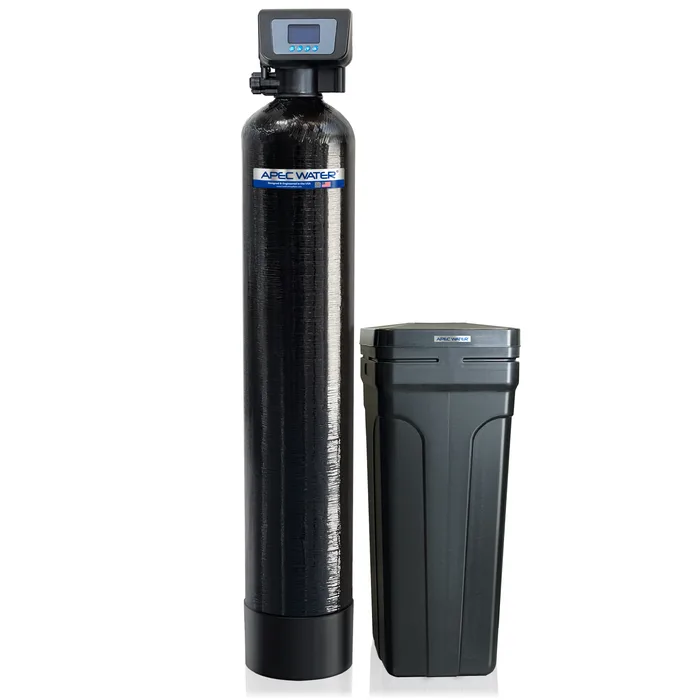
A pre-programmed softener for moderate hardness, with an LED display and no flow rate published.
Best for: A household with moderate hardness that wants a softener it does not have to program.
- Rated up to 45,000 grains, which APEC positions for homes with moderate hardness.
- A solid state microprocessor with an LED display and a fully automatic pre-programmed electronic control valve, so setup is minimal.
- APEC states its high efficiency regeneration saves both water and salt.
- APEC publishes no service flow rate, which is the second number you need to size a softener correctly.
- One size only, so if your hardness or household falls outside 45,000 grains there is no adjustment.
- APEC states it is not recommended for installation outside the home, which rules out a garage in a cold climate.
- A drain line is required, and APEC says so plainly, which some buyers discover late.
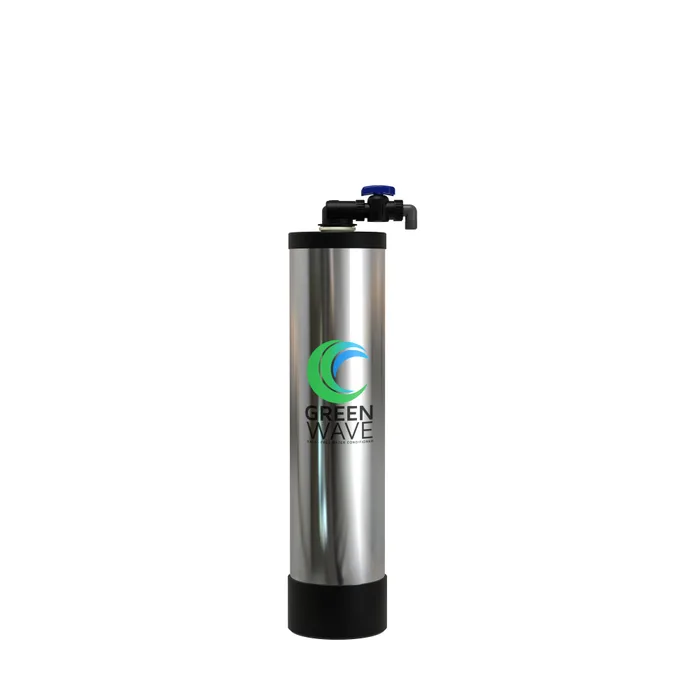
A scale inhibitor sold in the softener aisle, and the vendor says plainly that it does not remove hardness.
Best for: Someone whose only problem is scale in a water heater, who cannot use salt, and who understands they are not buying soft water.
- It adds no sodium to the water, which matters if someone in the house is on a restricted-sodium diet.
- There is no salt to buy, no brine tank and no drain line, so installation is far simpler.
- TAC media genuinely does reduce scale sticking to heaters and fixtures, which is a real benefit if scale is your only complaint.
- It does not remove hardness minerals, which the vendor states directly in its own product Q&A.
- Water treated this way still feels hard: no slippery soap feel, no reduction in detergent use, no end to spotting.
- On well water, iron, manganese and sulfur have to be treated ahead of it or the media fouls.
- It is priced alongside real softeners while doing a narrower job.
| Criteria | 5600 SXT Metered Water Softener Top pick | WHR01 Water Softener System | Hydro Express Water Softener 45 | GreenWave Salt-Free Water Softener Alternative |
|---|---|---|---|---|
| Verdict | Buy it | Buy it | It depends | Skip it |
| Best for | Anyone sizing a softener properly for a household with genuinely hard water, who wants a system that is serviceable for a decade. | A household that wants real softening with the least installation effort and the lowest salt bill. | A household with moderate hardness that wants a softener it does not have to program. | Someone whose only problem is scale in a water heater, who cannot use salt, and who understands they are not buying soft water. |
| Price tier | $$$ · premium | $$ · mid-range | $$ · mid-range | $$$ · premium |
| Does it remove hardness | Yes, ion exchange | Yes, ion exchange | Yes, ion exchange | No, TAC scale inhibition |
| Grain capacities offered | 26,000 / 35,000 / 53,000 / 70,000 | 32,000 / 48,000 / 64,000 | Up to 45,000 | Not applicable |
| Published service flow rate | 7 / 10 / 15 / 20 GPM | Not published | Not published | 10 / 15 / 20 GPM |
| Regeneration trigger | Metered, on gallons used | Not published | Pre-programmed automatic | None, no regeneration |
| Salt required | Yes | Yes, reduced by up-flow cycle | Yes | No |
| Drain line required | Yes | Yes | Yes, stated | No |
| Adds sodium to water | Yes | Yes | Yes | No |
| Outdoor installation | Not published | Not published | Not recommended, stated | Not published |
Which one is right for you?
- Anyone sizing a softener properly for a household with genuinely hard water, who wants a system that is serviceable for a decade. Buy it Fleck 5600 SXT Metered Water Softener
- A household that wants real softening with the least installation effort and the lowest salt bill. Buy it Waterdrop WHR01 Water Softener System
- A household with moderate hardness that wants a softener it does not have to program. It depends APEC Hydro Express Water Softener 45
- Someone whose only problem is scale in a water heater, who cannot use salt, and who understands they are not buying soft water. Skip it GreenWave Salt-Free Water Softener Alternative
How we judged the field
Five things decide whether a water softener is the right one, and the first is whether it is a softener at all. Ion exchange systems swap calcium and magnesium for sodium on a resin bed and genuinely remove hardness; salt-free conditioners leave the minerals in place and inhibit scale. Both are sold in the same aisle under similar names. The second is grain capacity, which has to be matched to your hardness and your household size or the system either exhausts constantly or regenerates for no reason. The third is service flow rate in gallons per minute, which determines whether the shower still works while the dishwasher runs. The fourth is what triggers regeneration, where metering on actual gallons beats a timer on both salt and water. The fifth is the install: a drain line, a power outlet and floor space for a brine tank are requirements, not options.
The field splits three ways. The traditional two-tank softener with a proper control valve, of which the Fleck 5600 SXT is the reference, is what a plumber would fit. A newer group of consumer-brand softeners simplifies the install and the interface and often publishes less. And the salt-free conditioners occupy a category of their own while marketing themselves as alternatives. We took one from each of the first two groups, a second consumer softener, and the clearest example of the third, because the difference between them is the single most expensive misunderstanding in this category.
The Fleck 5600 SXT is the softener people recommend when someone asks what a plumber would fit. The reason is the control head. It meters the water actually used and regenerates when the resin is close to exhausted, rather than firing on a clock whether you were home or not, and it offers several regeneration modes for different situations. It is sold in four sizes and, usefully, both numbers are published for each: 7 GPM at 26,000 grains, 10 GPM at 35,000, 15 GPM at 53,000 and 20 GPM at 70,000. Having flow rate and capacity together is what lets you size a system properly, and it is the thing most consumer softeners leave out. The costs are straightforward. It is the most expensive option at every size, it is a two-tank installation needing floor space and a drain, and the SXT interface is functional rather than modern. What you get for that is a system that is documented, serviceable and understood, which on a device with a ten to fifteen year life matters more than a nicer display.
The WHR01 is Waterdrop taking the same ion exchange principle and aiming it at someone who wants to fit it themselves. It comes in three sizes covering 32,000, 48,000 and 64,000 grains, which spans most domestic hardness levels, and the core components arrive pre-assembled so a great deal of the fiddly work is done. The interesting technical claim is up-flow regeneration: brine is pushed up through the resin bed rather than down, and Waterdrop states this uses less salt to achieve the same softening. That is a genuine efficiency difference and it shows up in the salt bill rather than in the water. What Waterdrop does not publish is a service flow rate in gallons per minute for any size, which makes it hard to check against a household with two bathrooms, and it does not state how regeneration is triggered. Neither omission is disqualifying at this price, and for a straightforward house with known hardness this is the sensible buy.
The Hydro Express 45 is APEC’s answer for a household that does not want to think about the machine. It is rated up to 45,000 grains, which APEC positions specifically for moderate hardness, and it runs a fully automatic pre-programmed electronic control valve with a solid state microprocessor and an LED display, so there is nothing to configure beyond installation. APEC states its high efficiency regeneration saves both water and salt. Two things hold it back from a buy. There is no published service flow rate, which is half of what you need to size a softener, and there is only one capacity, so a household outside the moderate band has nowhere to go within the model. APEC is also refreshingly direct about two installation constraints that catch people: a drain line is required, and the unit is not recommended for installation outside the home, which rules out an unheated garage in a cold climate.
The GreenWave is the clearest example of the category confusion at the heart of this market, and to the vendor’s credit the honest answer is on its own page. Asked directly whether it would help with 135 ppm well water, the reply states that it is a salt-free conditioner, that it does not remove hardness minerals like a traditional water softener, that it instead changes how those minerals behave so they are less likely to stick as scale, and that if your main goal is true soft water and complete hardness removal a conventional softener would be the better option. That is exactly right, and it is the whole review. The media is template assisted crystallisation, there is no salt, no brine tank, no drain line and no sodium added, and it comes in 10, 15 and 20 GPM sizes. If scale in a water heater is your only complaint and you cannot use salt, this is a reasonable purchase. If you bought it expecting soap to lather and spots to stop, you bought the wrong thing at a softener price.
Fleck 5600 SXT Metered Water Softener vs Waterdrop WHR01 Water Softener System: which should you buy?
The Fleck and the Waterdrop are both real softeners and they separate on control and on effort. The Fleck gives you metered regeneration, which is the single feature that keeps running costs down, and it publishes a flow rate alongside every grain capacity so you can size it against a two-bathroom house with confidence. It is a plumber’s component with a long documented life, and in ten years the head will still be serviceable with parts anyone stocks. The Waterdrop gives you a much easier installation, three sensible capacities and an up-flow regeneration cycle that the company states uses less salt for the same result.
Choose the Fleck if your hardness is high, if your household has more than one bathroom running at once, or if you want to size the system properly rather than by grain capacity alone. Choose the Waterdrop if you are fitting it yourself, if your hardness is known and moderate, and if the salt saving over years appeals more than a configurable control head. Before either, get a hardness number: from the utility’s annual water quality report if you are on municipal supply, or a test kit if you are on a well. Every other decision in this category depends on that one figure, and it is the one most people skip.
What to look for
- Whether it removes hardness at all: ion exchange softens, and salt-free TAC conditioning inhibits scale without softening, which the GreenWave’s own Q&A states directly.
- Grain capacity matched to your hardness: multiply grains per gallon by daily gallons by days between regenerations, and get the hardness figure from a report rather than a guess.
- A published service flow rate: capacity tells you how long it lasts and GPM tells you whether the shower survives the dishwasher, and you need both.
- Metered against timed regeneration: a metered valve counts gallons and regenerates when needed; a timer regenerates whether you were home or not.
- The installation requirements in writing: a drain line, a power outlet and floor space for a brine tank are all needed, and APEC states its unit should not be installed outside the home.
- Salt type and consumption: up-flow regeneration uses less salt than down-flow, and potassium chloride is the substitute if sodium is a concern.
Our final take
Water softeners are worth buying if you have hard water, and the first job is making sure you are buying one. The Fleck 5600 SXT is the pick: metered regeneration keeps the salt and water bills down, four sizes with both flow rate and grain capacity published let you size it properly, and the control head is documented and serviceable for as long as the tanks last. The Waterdrop WHR01 is the value answer and the easiest install, with up-flow regeneration cutting the salt further. The APEC Hydro Express 45 suits a household with moderate hardness that wants nothing to configure. And the salt-free system in the same aisle is not a softener, which its own vendor will tell you if you ask.
Questions, answered
How do I work out what grain capacity I need?
Multiply your water hardness in grains per gallon by the number of gallons your household uses in a day, then multiply by the number of days you want between regenerations, usually seven. A family of four using around 300 gallons a day with water at 15 grains per gallon needs roughly 4,500 grains a day, so a 32,000 grain unit regenerates about weekly. Get your hardness from your water utility's annual report or a test kit, since guessing is the single most common sizing error. Oversizing slightly is better than undersizing, because a softener that regenerates constantly burns salt and water.
What is the difference between a softener and a salt-free conditioner?
A softener removes calcium and magnesium by exchanging them for sodium on a resin bed, which is why the water feels different, why soap lathers more and why spotting stops. A salt-free conditioner leaves the minerals in the water and uses a media, usually template assisted crystallisation, to convert them into microscopic crystals that are less likely to stick to surfaces. The vendor of the GreenWave system states this plainly in its own Q&A: it does not remove hardness minerals, and if your goal is true soft water a conventional softener is the better option. Both reduce scale. Only one softens.
Does a metered softener actually save money?
Yes, and it is the main reason to prefer one. A timer-based softener regenerates on a schedule whether you used the capacity or not, so a week away from home still costs you a full cycle of salt and several hundred gallons of rinse water. A metered valve like the Fleck 5600 SXT counts actual gallons treated and regenerates only when the resin is nearly exhausted. Over a year the salt and water savings are real, and they matter more the more your usage varies week to week.
Will a softener add too much sodium to my drinking water?
The amount is small but not zero, and it scales with your hardness. Ion exchange releases roughly 8 milligrams of sodium per litre for every grain per gallon of hardness removed, so very hard water produces more. For most people that is a minor contribution against dietary sodium from food. If someone in the household is on a medically restricted sodium intake, the usual solutions are a potassium chloride substitute in the brine tank, or leaving one cold tap unsoftened for drinking and cooking, which is also better for houseplants.
Can I install a water softener myself?
It is a plumbing job rather than an appliance swap, so be honest about your skill level. You need to tee into the main line after the meter and before the water heater, fit a bypass valve, run a drain line for the regeneration discharge, and provide a power outlet. APEC states outright that a drain line is required and that its unit is not recommended for installation outside the home, and those two constraints decide a lot of installations. If your main is copper and you are comfortable with push-fit or soldered joints, it is a weekend. If not, this is worth paying for.
Deciding between the top two? See our head-to-head: Fleck 5600 SXT Metered Water Softener vs Waterdrop WHR01 Water Softener System.
More Home & Kitchen reviews
 The Best Wet/Dry Shop Vacuums for Garages: 4 Compared (and One to Skip)
  The Best Whetstones: 4 Compared (and One to Skip)
  The Best Window Air Conditioners: 4 Compared (and One to Skip)
  The Best Window Vacuums: 4 Compared (and One to Skip)
  The Best Wine Fridges: 4 Compared (and One to Skip)
  The Best Woks: 4 Compared (and One to Skip)