

Home & Kitchen
The Best Window Air Conditioners: 4 Compared (and One to Skip)
We compared four window air conditioners on cooling power, noise, efficiency, installation, and long-term reliability from independent testing and owner reports.
The short version
After synthesizing independent testing and owner reports across the 2026 window AC market, the Midea U 8,000 BTU Smart Inverter (MAW08V1QWT) is our clear top pick - its U-shaped design puts the compressor outside a closed sash for whisper-quiet running, and its inverter compressor keeps electric bills low. The LG 8,500 BTU Dual Inverter (LW8024IVSM) is the runner-up: nearly as quiet and efficient, noticeably easier to install, with a bit more cooling muscle. The GE Profile ClearView is a genuinely clever premium option that preserves your window view, but its weight, fit restrictions, and scattered reliability complaints make it a measure-twice purchase. The bargain Frigidaire FFRA051WAE is the one to skip - its loud, fixed-speed compressor and bare-bones controls belong to a previous era. Best for: the Midea U if you want the quietest, cheapest-to-run window AC; the LG if you want inverter performance with a simple, conventional install.
Our picks at a glance
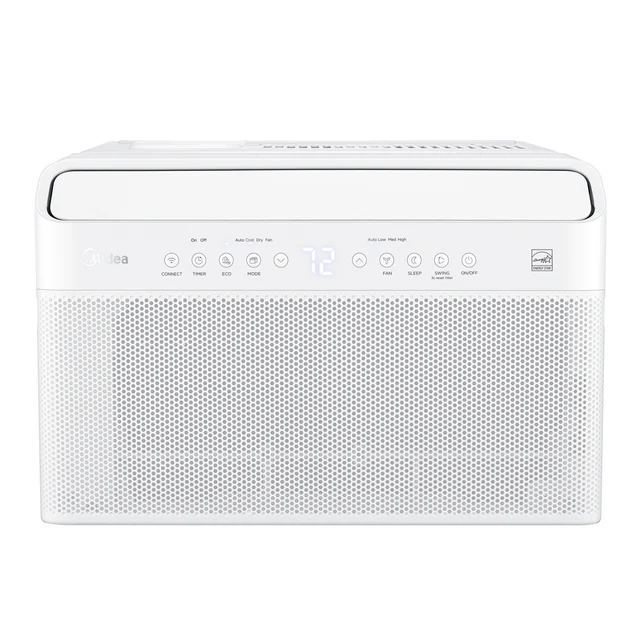
- Midea U 8,000 BTU Smart Inverter Window Air Conditioner (MAW08V1QWT) - Buy. The U-shaped inverter design that made every other window AC sound loud - still the one to beat.
- LG 8,500 BTU Dual Inverter Smart Window Air Conditioner (LW8024IVSM) - Buy. A conventional-shaped inverter unit that's nearly as quiet and efficient, with a far simpler install.
- GE Profile ClearView 8,300 BTU Ultra Quiet Window Air Conditioner (AHTT08BC) - It depends. A clever below-the-sill design that keeps your view and daylight - if your window and wall cooperate.
- Frigidaire 5,000 BTU Window Air Conditioner (FFRA051WAE) - Skip. The classic cheap mechanical box - light, simple, and thoroughly outclassed in 2026.
The verdict in 30 seconds
What mattered most
- Cooling capacity
- Compressor type
- Noise character
- Window after install
- Smart features
- Installation
Window air conditioners have quietly gone through a revolution: variable-speed inverter compressors have turned what used to be a loud, cycling box into something you can sleep next to. We synthesized independent testing and thousands of owner reports to compare four current units - a U-shaped inverter standout, a conventional dual-inverter workhorse, a view-preserving premium design, and the classic budget box. Two earn a clear buy, one depends on your window, and one is genuinely hard to recommend in 2026.
The U-shaped inverter design that made every other window AC sound loud - still the one to beat.
Best for: Bedrooms and anyone who prioritizes near-silent cooling and low running costs
- Independent testing consistently ranks it among the quietest window units ever made - the compressor hangs outside the closed sash
- Inverter compressor holds temperature steadily and sips power
- U-shape lets you still open the window, and Wi-Fi, voice control, and scheduling all work reliably in the app
- Installation is more involved than a conventional unit - the support bracket must be assembled and leveled first
- The U-channel can collect debris and water, so it needs occasional cleaning to stay fresh
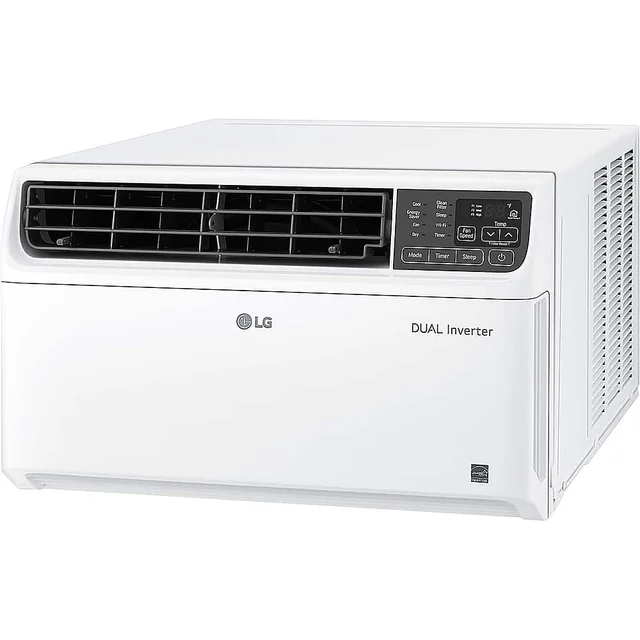
A conventional-shaped inverter unit that's nearly as quiet and efficient, with a far simpler install.
Best for: Living rooms and anyone who wants inverter quiet and efficiency without the U-shaped installation gymnastics
- Dual inverter compressor modulates smoothly - reviewers report very quiet, steady operation with no jarring on/off cycling
- Standard chassis installs like any traditional window AC, with a slide-out design that keeps the heavy lifting manageable
- Strong airflow and slightly higher cooling output than rivals in its size class, plus Wi-Fi and voice control
- It's a heavy unit, and the lower window sash stays blocked - no opening the window afterward
- Owners report the companion app works but can be fussy about setup and occasional disconnects
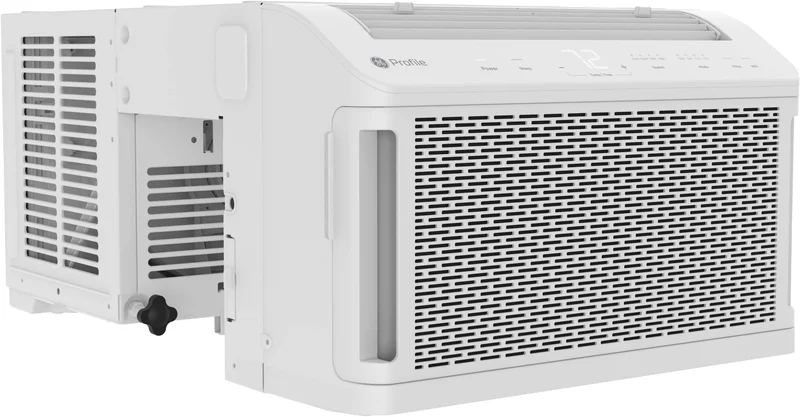
A clever below-the-sill design that keeps your view and daylight - if your window and wall cooperate.
Best for: Design-conscious buyers with compatible windows who value an unobstructed view over the lowest price
- Saddle-style design sits below the sill, so the window closes above it and you keep your view and natural light
- Independent testing and owners agree it runs impressively quiet, with smart controls and voice assistant support
- The window can be fully closed and locked over the unit - better security than a raised sash
- Heavy, awkward two-person installation, and it simply won't fit some wall depths and sill configurations - measure carefully
- Costs meaningfully more than the inverter picks, and some owners report pump faults and error codes that require service
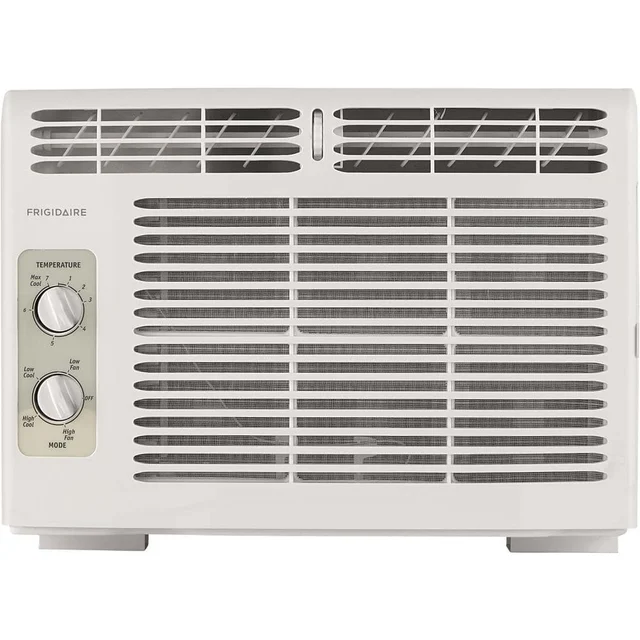
The classic cheap mechanical box - light, simple, and thoroughly outclassed in 2026.
Best for: Only the tightest budgets cooling a tiny, rarely used room - most people should stretch to an inverter unit
- Genuinely inexpensive and light enough for one person to install in minutes
- Simple mechanical dials with nothing to break, pair, or update
- Fixed-speed compressor cycles on and off loudly - independent testing consistently flags it as one of the noisiest ways to cool a room
- Basic mechanical controls, and it only handles a small bedroom-sized space
| Criteria | Midea U 8,000 BTU Smart Inverter Window Air Conditioner (MAW08V1QWT) Top pick Buy it Buy | LG 8,500 BTU Dual Inverter Smart Window Air Conditioner (LW8024IVSM) Buy it Buy | GE Profile ClearView 8,300 BTU Ultra Quiet Window Air Conditioner (AHTT08BC) It depends Buy | Frigidaire 5,000 BTU Window Air Conditioner (FFRA051WAE) Skip it Buy |
|---|---|---|---|---|
| Best for | Bedrooms and anyone who prioritizes near-silent cooling and low running costs | Living rooms and anyone who wants inverter quiet and efficiency without the U-shaped installation gymnastics | Design-conscious buyers with compatible windows who value an unobstructed view over the lowest price | Only the tightest budgets cooling a tiny, rarely used room - most people should stretch to an inverter unit |
| Price tier | $$ · mid-range | $$ · mid-range | $$$ · premium | $ · budget |
| Cooling capacity | 8,000 BTU | 8,500 BTU (up to 380 sq ft per LG) | 8,300 BTU | 5,000 BTU (small room) |
| Compressor type | Variable-speed inverter | Dual inverter (variable) | Variable-speed inverter | Fixed-speed (cycles on/off) |
| Noise character | Whisper-quiet, compressor outside the sash | Very quiet, smooth modulation | Very quiet, below-sill placement | Loud, abrupt cycling |
| Window after install | Can still open through the U | Lower sash blocked | Closes and locks above the unit - view preserved | Lower sash blocked |
| Smart features | Wi-Fi, app, voice control | Wi-Fi, app, voice control | Wi-Fi, app, voice control | None - mechanical dials |
| Installation | Bracket-first, more steps | Conventional, straightforward | Heavy two-person saddle fit; not all windows compatible | Light and easy |
| Energy efficiency | Inverter, efficient | ENERGY STAR listed by LG | Inverter | Fixed-speed, basic |
| Price tier | $$ · mid-range | $$ · mid-range | $$$ · premium | $ · budget |
Which one is right for you?
- Bedrooms and anyone who prioritizes near-silent cooling and low running costs Buy it Midea U 8,000 BTU Smart Inverter Window Air Conditioner (MAW08V1QWT)
- Living rooms and anyone who wants inverter quiet and efficiency without the U-shaped installation gymnastics Buy it LG 8,500 BTU Dual Inverter Smart Window Air Conditioner (LW8024IVSM)
- Design-conscious buyers with compatible windows who value an unobstructed view over the lowest price It depends GE Profile ClearView 8,300 BTU Ultra Quiet Window Air Conditioner (AHTT08BC)
- Only the tightest budgets cooling a tiny, rarely used room - most people should stretch to an inverter unit Skip it Frigidaire 5,000 BTU Window Air Conditioner (FFRA051WAE)
How we judged the field
We don’t run a lab. What we do is synthesize what independent testing has measured and what thousands of owners report after living with these machines through real summers - then weigh it all against what actually matters in a window air conditioner. Four criteria dominated: noise (you will hear this machine every day), energy efficiency (a window AC can run eight hours a day for months), installation and window compatibility (the best unit is worthless if it doesn’t fit or you can’t lift it), and long-term reliability as reported by owners two and three seasons in. We kept this comparison strictly to window units - portable air conditioners are a different tool with different trade-offs, and we cover them separately.
The 2026 field splits cleanly into two eras: variable-speed inverter units that hum along quietly, and fixed-speed boxes that blast, stop, and blast again. That split shaped every verdict below.
Midea U 8,000 BTU Smart Inverter Window Air Conditioner (MAW08V1QWT)
Buy itThe Midea U’s party trick is structural: the unit is shaped like a U, so your window sash closes into the gap, putting the glass between you and the compressor. Combined with a variable-speed inverter compressor, the result is a machine that independent testing consistently ranks among the quietest window units ever sold - on low, reviewers describe it as barely audible over ambient room noise. Owners echo it: this is the window AC people buy for bedrooms and then buy again for the rest of the house.
Efficiency is the other half of the story. The inverter design ramps output up and down instead of cycling, which holds temperature within a narrow band and helps keep running costs low. The app and voice control are among the better implementations owners report in this category, and because the sash closes into the U, you can still open your window on mild days - something no conventional unit allows.
The honest caveats: installation is bracket-first and more involved than dropping in a traditional unit, and the U-channel can collect leaves and water if you never look at it. A minority of long-term owners report fan rattle developing after several seasons. None of that changes the verdict - this is the best window air conditioner for most people.
LG 8,500 BTU Dual Inverter Smart Window Air Conditioner (LW8024IVSM)
Buy itIf the Midea U’s installation or window compatibility gives you pause, LG’s dual inverter is the answer. It’s a conventional-shaped unit that installs the way window ACs always have - slide-out chassis, side curtains, done - but carries a variable-speed dual inverter compressor that reviewers report runs smoothly and quietly, with none of the shuddering starts of old-school units.
It actually edges out the Midea slightly on cooling output for the same class, moves a lot of air, and LG lists it as ENERGY STAR. Wi-Fi and voice control round it out. Owners’ main gripes are weight - it’s a dense machine that wants two people for an upper-floor install - and an app that works but occasionally needs re-pairing. The lower window sash also stays blocked, as with any conventional unit.
Reviewers and owners converge on the same conclusion we reached: this is the no-drama inverter pick, and for many rooms the smarter buy.
GE Profile ClearView 8,300 BTU Ultra Quiet Window Air Conditioner (AHTT08BC)
It dependsThe ClearView solves the problem nobody else even attempts: it sits below the window sill in a saddle over the wall, so your window closes and locks above it and you keep your entire view and all your daylight. It runs impressively quiet - the compressor hardware sits outside and low - and the smart features work as advertised. For a street-facing window or a room where light matters, nothing else in this comparison comes close aesthetically, and the closed-and-locked window is a genuine security upgrade over a raised sash.
So why not a straight buy? Three reasons. First, fit: the saddle design has real limits on wall depth and sill configuration, and a meaningful share of frustrated owner reports trace back to windows it was never going to fit. Measure everything before ordering. Second, the install is heavy and awkward - owners consistently describe it as a committed two-person job, and removal is worse. Third, reliability reports are more mixed than the category leaders: a visible minority of owners report condensate pump faults and error codes, sometimes early in the unit’s life. At a premium price, that’s a real gamble.
If your window measures out, you value the view, and you’re comfortable with the install, the ClearView is a lovely machine. That’s a lot of ifs - hence, it depends.
Frigidaire 5,000 BTU Window Air Conditioner (FFRA051WAE)
Skip itThis is the best-selling shape of window AC in America: a light, cheap, mechanical box with two dials and a fixed-speed compressor. It cools a small room, it costs very little, and installation takes minutes. Owners who just need cold air in a tiny space are often perfectly satisfied, and we won’t pretend otherwise.
But judged as a purchase in 2026, it’s hard to defend. Independent testing consistently flags fixed-speed budget units like this as loud - not white-noise loud, but on-off-on-off loud, with the compressor thudding in and out all night. It has basic mechanical controls rather than a precise thermostat, so what you save up front you may hand back to the utility company across a couple of summers. It is a 5,000 BTU unit, suited only to a small room.
The inverter revolution reset this category’s baseline. When quiet, efficient, app-controlled units cost only moderately more and pay the difference back in electricity, the classic budget box has become a false economy. Skip it unless the absolute lowest upfront cost is the only criterion that matters.
Midea U 8,000 BTU Smart Inverter Window Air Conditioner (MAW08V1QWT) vs LG 8,500 BTU Dual Inverter Smart Window Air Conditioner (LW8024IVSM): which should you buy?
These two are closer than their designs suggest - both are variable-speed inverter units with strong efficiency, real smart features, and noise levels that would have seemed impossible in this category a decade ago. The decision comes down to your window and your priorities.
Buy the Midea U if quiet is the whole point. Putting the compressor outside a closed pane of glass is a structural advantage no conventional unit can match, and for a bedroom it’s decisive. You also keep the ability to open your window, and running costs are as low as this category gets. The price you pay is a fussier bracket-first installation and a design that wants occasional cleaning of the U-channel.
Buy the LG if you want most of the experience with none of the installation drama. It fits any window a normal AC fits, slides in the way you already know, pushes slightly more cold air, and its dual inverter is quiet enough that most people in a living room will never think about it. It blocks the sash and weighs plenty - but it’s the pick that never asks you to think about your window type.
Bedroom and light sleeper: Midea. Living room, rental, or tricky window: LG. Neither choice is a mistake.
What to look for
- Inverter compressor, non-negotiable in 2026. Variable-speed units are dramatically quieter and cheaper to run than fixed-speed boxes. This one spec predicts satisfaction better than any other.
- Size to the room, not the price tag. Roughly 20 BTU per square foot; add a little for sun and ceilings. Oversized fixed-speed units short-cycle and leave rooms clammy.
- Check your window before you order. Sash type, sill depth, and (for U-shaped and saddle designs) bracket clearance determine what you can actually install. The most-returned units are the ones that never fit.
- Weigh the install honestly. Anything above the ground floor deserves two people. Slide-out chassis designs make this far safer.
- Efficiency certification pays you back. A certified inverter unit running all summer can offset its price premium over a couple of seasons.
- Filter access matters. You should be able to rinse the filter monthly without tools; it’s the difference between year-five performance and a wheezing box.
Our final take
The window AC category has a clear before-and-after, and the inverter compressor is the dividing line. The Midea U 8,000 BTU Smart Inverter is our pick because it stacks that technology on a structural design no rival matches - the quietest, cheapest-to-run window air conditioner most people can buy, with the small tax of a more involved install. The LG 8,500 BTU Dual Inverter is the runner-up and the easier recommendation for anyone who wants a conventional install: nearly as quiet, just as efficient, slightly stronger. The GE Profile ClearView is the category’s most interesting idea - a window AC that gives you your window back - but its fit restrictions, bulk, and mixed reliability reports make it a conditional purchase at a premium price. And the Frigidaire FFRA051WAE, honest as it is about what it costs, is the one to skip: the era it was built for is over, and your ears and your electric bill both know it.
Questions, answered
How many BTUs do I need for my room?
As a rule of thumb, roughly 20 BTU per square foot: about 5,000-6,000 BTU for a small bedroom (up to ~250 sq ft), 8,000 BTU for a mid-size room, and 10,000-12,000 BTU for large open spaces. Size up modestly for sunny rooms, high ceilings, or kitchens - but don't massively oversize a fixed-speed unit, or it will short-cycle and dehumidify poorly. Inverter models are more forgiving because they throttle output to match the load.
What's the difference between an inverter and a regular window AC?
A traditional window AC runs its compressor at full blast, then shuts it off, then slams it back on - that cycling is loud and wastes energy. An inverter compressor varies its speed continuously, holding your set temperature with a low, steady hum. Independent testing and owner reports agree the difference is dramatic: inverter units like the Midea U and LG dual inverter run far quieter and cost meaningfully less to operate over a summer.
Is the Midea U hard to install?
It's more involved than a conventional unit, not harder physically. You assemble and level a support bracket on the sill first, then seat the unit so the window sash closes into the U-channel. Most owners report the process takes under an hour with the included quick-install kit, and the payoff is that the heavy, noisy part of the machine hangs outside your closed window. Renters should check that their window type and building rules allow a bracket.
Are window air conditioners better than portable ones?
For raw cooling per watt, yes - a window unit rejects heat directly outside, while a single-hose portable fights itself by pulling conditioned air out of the room. If your building allows a window unit and your window is compatible, it will almost always cool better, quieter, and cheaper to run than a portable of the same rating. We cover portable air conditioners separately for situations where a window install isn't possible.
Should I remove my window AC in winter?
If you get real winters, ideally yes - removing and storing the unit prevents drafts, ice damage, and grime buildup. If removal isn't practical (the Midea U's bracket and the GE ClearView's saddle design make seasonal removal a chore), use an insulated cover and seal gaps with foam. Either way, clean or rinse the filter monthly during cooling season; it's the single best thing you can do for performance and air quality.
Deciding between the top two? See our head-to-head: Midea U 8,000 BTU Smart Inverter Window Air Conditioner (MAW08V1QWT) vs LG 8,500 BTU Dual Inverter Smart Window Air Conditioner (LW8024IVSM).
More in Home & Kitchen
Window Air Conditioners, Explained Plain-English guide → Midea U 8,000 BTU Smart Inverter Window Air Conditioner (MAW08V1QWT) vs LG 8,500 BTU Dual Inverter Smart Window Air Conditioner (LW8024IVSM) Head-to-head →  The Best Window Insulation Kits: 4 Compared (and One to Skip)
  The Best Window Vacuums: 4 Compared (and One to Skip)
  The Best Wine Decanters: 4 Compared (and One to Skip)
  The Best Wine Fridges: 4 Compared (and One to Skip)