Explained
Window Air Conditioners, Explained
After reading this, you'll be able to size a window AC to your room, tell an inverter unit from a fixed-speed box at a glance, and know before ordering whether a unit will actually fit your window.
In this guide
A window air conditioner looks like the simplest appliance you can buy - a box that makes cold air. But the category quietly split into two eras: old-style fixed-speed units that blast, stop, and blast again, and modern inverter units that hum along almost silently and cost far less to run. What trips most buyers up isn't the cooling - it's noise they didn't expect, a unit that doesn't fit their window, or an electric bill that erases the savings of buying cheap.
The 30-second version
- The compressor type is the single most important spec. A variable-speed inverter compressor runs quietly and efficiently; a fixed-speed compressor cycles on and off loudly. This one line on the spec sheet predicts your satisfaction better than anything else.
- Size to the room, not the sale price. Roughly 20 BTU per square foot is the rule of thumb - an undersized unit runs flat-out forever, and an oversized fixed-speed unit short-cycles and leaves the room clammy.
- Measure your window before you fall in love with a design. U-shaped and saddle-style units have real requirements for sash type, sill depth, and bracket clearance - the most-returned units are the ones that never fit.
- Efficiency certification pays you back. A window AC can run eight hours a day for months, so a certified efficient inverter unit can recover part of its price premium in electricity over several summers.
- Noise is a design outcome, not a mystery. Where the compressor sits and how it modulates determine what you hear. Designs that put the compressor outside a closed pane of glass are dramatically quieter than anything conventional.
The products this guide is about
Our verdict on each, with the full reasoning on the companion review.
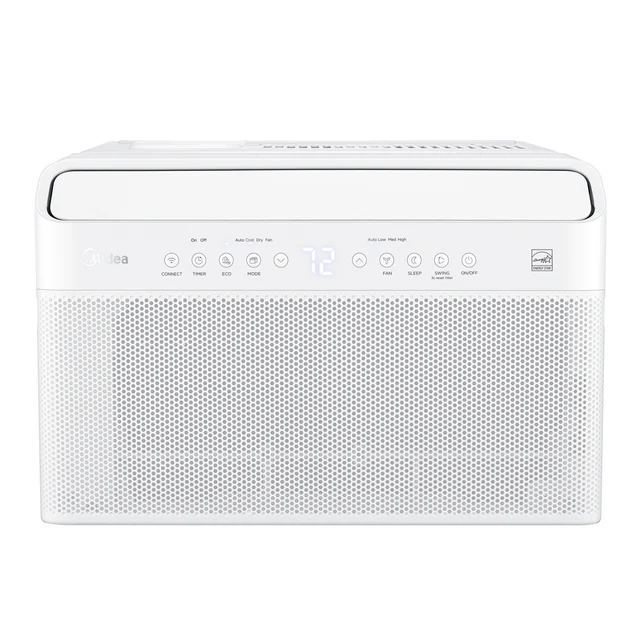
- Buy Midea U 8,000 BTU Smart Inverter Window Air Conditioner (MAW08V1QWT) The U-shaped inverter design that made every other window AC sound loud - still the one to beat. Amazon
- Buy LG 8,500 BTU Dual Inverter Smart Window Air Conditioner (LW8024IVSM) A conventional-shaped inverter unit that's nearly as quiet and efficient, with a far simpler install.
- It depends GE Profile ClearView 8,300 BTU Ultra Quiet Window Air Conditioner (AHTT08BC) A clever below-the-sill design that keeps your view and daylight - if your window and wall cooperate.
- Skip Frigidaire 5,000 BTU Window Air Conditioner (FFRA051WAE) The classic cheap mechanical box - light, simple, and thoroughly outclassed in 2026. Amazon
What actually matters
- Compressor type - inverter (variable-speed) vs fixed-speed is the great divide in this category. Inverter units modulate output smoothly to hold your set temperature; fixed-speed units slam on at full blast and shut off, over and over, all night.
- Cooling capacity (BTU) - this is the unit's output, and it must match your room's size. Too little and it never catches up on a hot day; too much (in a fixed-speed unit) and it cools the air fast but leaves the humidity behind.
- Noise level and character - you will hear this machine every single day. Steady low hum is easy to live with; abrupt compressor cycling is not. Independent testing and owner reports consistently separate inverter units from fixed-speed boxes on exactly this point.
- Window compatibility - sash type (double-hung vs slider vs casement), window width, sill depth, and wall thickness determine what you can physically install. U-shaped and saddle designs are pickier than conventional boxes.
- Energy efficiency (CEER rating and certification) - window ACs run long hours through the hottest months, so efficiency differences compound into real money on your electric bill.
- Installation weight and method - anything above the ground floor deserves two people. Slide-out chassis and bracket-first designs each change how hard (and how safe) the install is.
- Filter access and maintenance - a filter you can rinse monthly without tools is the difference between year-five performance and a wheezing, musty box.
The specs, in plain English
Green flags vs red flags
Green flags
- The listing says "inverter" or "variable-speed compressor" prominently - the maker knows it's the headline feature
- An efficiency certification badge and a high CEER number, stated plainly with the wattage
- Clear published window requirements: minimum/maximum width, sash type, sill depth, and included install kit contents
- Owner reviews specifically praise how quiet it is at night, seasons after purchase - not just on day one
- A washable filter you can reach and rinse without tools, mentioned in the manual or listing
- The brand sells the same unit year after year with incremental model updates - a sign the design is proven, not churned
Red flags
- No compressor type mentioned anywhere - in 2026 that silence almost always means fixed-speed
- No efficiency certification and no CEER figure on a unit that will run all summer
- A very low price on a unit with mechanical dials, no remote, and no thermostat precision - the savings go straight to your utility company
- Owner reviews clustered around "louder than expected," "cycles constantly," or "kept me up" - noise complaints are the most honest reviews in this category
- A clever form factor (U-shaped, saddle) with vague or missing fit specifications - that's how units end up returned
- Repeated owner reports of error codes, pump faults, or early failures on a premium-priced unit
Who's who: the brands
- Midea - The Chinese appliance giant whose U-shaped inverter design reset the category's noise expectations - the current benchmark for quiet, efficient window cooling.
- LG - Maker of the dual inverter line - conventional-looking units with variable-speed compressors that deliver near-benchmark quiet and efficiency with a simple, traditional install.
- GE / GE Profile - Long-standing American appliance brand; its Profile ClearView saddle design is the category's boldest idea, preserving your window view at a premium price with pickier fit requirements.
- Frigidaire - The classic name in cheap, simple, mechanical window boxes - light and dead-easy to install, but its budget fixed-speed units belong to the pre-inverter era.
- Windmill - A design-focused newer brand selling inverter units with cleaner looks and friendlier setup, aimed at buyers who want the tech without the appliance-aisle aesthetic.
How to read a listing without getting fooled
Start with the compressor line: if the listing doesn't say "inverter" or "variable-speed," assume it's a fixed-speed unit and price it accordingly. Next, check the BTU rating against your actual room size using the 20-BTU-per-square-foot rule - ignore vague claims like "cools large rooms." Then find the fit specifications: minimum and maximum window width, sash type, and (for U-shaped or saddle designs) bracket and sill requirements - if these are missing or vague, that's your cue to walk away. Treat decibel claims as marketing until confirmed by owner reports, which are ruthlessly honest about noise. Finally, look for an efficiency certification and a CEER number; a listing that hides its efficiency figures on an appliance that runs eight hours a day is telling you something.
How much should you spend?
Window AC pricing tracks three things: compressor technology, cooling capacity, and design cleverness. The cheapest tier buys you a fixed-speed mechanical box - a genuine false economy for any room you use daily, because the noise and electricity costs hand back some of the savings over a few summers. The value sweet spot for most people is a mid-range inverter unit from a major brand: this is where near-silent operation, strong efficiency, and smart controls all arrive at once, and where the running-cost math starts working in your favor. Spending beyond that buys form factor rather than cooling - view-preserving saddle designs and premium finishes - which is worth it only if your window suits them and the aesthetics genuinely matter to you. Spend more for a bedroom you sleep in every night; spend less only for a space you rarely occupy.
Questions, answered
How many BTUs do I actually need?
Use roughly 20 BTU per square foot: about 5,000-6,000 BTU for a small bedroom, around 8,000 BTU for a 350-square-foot room, and 10,000-12,000 BTU for large open spaces. Add a modest margin for strong sun, high ceilings, or a kitchen. Don't dramatically oversize a fixed-speed unit - it will cool in short blasts and leave the room humid. Inverter units are forgiving of sizing because they throttle down to match the load.
Is an inverter window AC really worth the extra cost?
For any room you occupy regularly, yes. Independent testing and owner reports agree the difference is dramatic, not subtle: a steady quiet hum instead of loud on-off cycling, tighter temperature control, better dehumidification, and meaningfully lower electricity use over a summer. The price gap between fixed-speed and inverter units can pay itself back over time on the utility bill, depending on how many hours you run it.
Will a window AC fit my window?
Check four things before ordering: window type (most units need a double-hung sash; sliders and casements need special units or adapters), width (compare your opening to the unit's stated min-max range), sill depth and condition (the sill carries real weight), and - for U-shaped or saddle designs - bracket clearance and wall depth. Renters should also confirm their building allows window units and exterior brackets. Mis-measured windows are a common cause of returns in this category.
Window AC or portable AC - which is better?
If your window and building allow it, a window unit wins on nearly every count: it rejects heat directly outdoors, so it cools better, runs quieter, and uses less electricity than a portable of the same rating. A single-hose portable partially fights itself by pushing conditioned air out of the room. Portables earn their place only where a window install is impossible - casement windows, strict building rules, or the need to move the unit between rooms.
How much maintenance does a window AC need?
Very little, but the little matters: rinse the washable filter monthly during cooling season - it's the single best thing you can do for performance, efficiency, and air quality. Check that the unit still tilts slightly toward the outside so condensate drains properly, and clear leaves or debris from any exterior channels (U-shaped designs especially). If you get real winters, remove and store the unit, or fit an insulated cover and seal the gaps.
Why is my window AC loud, and could a new one really be quieter?
Older and budget units are loud for a structural reason: a fixed-speed compressor bolted inside the same box that sits in your room, switching between full blast and silence all night. Modern inverter units attack both halves of that problem - the compressor modulates smoothly instead of cycling, and the quietest designs physically place it outside a closed pane of glass. Owners upgrading from an old box to a current inverter unit routinely describe the difference as not believing the new unit is running.
Or jump to the head-to-head: Midea U 8,000 BTU Smart Inverter Window Air Conditioner (MAW08V1QWT) vs LG 8,500 BTU Dual Inverter Smart Window Air Conditioner (LW8024IVSM).