Explained
Woks, Explained
After reading, you'll know which wok material and shape fit your stove, what wok hei really means, and how to spot a wok that will actually stir-fry well.
In this guide
A wok looks simple, but the spec sheet hides the choices that decide whether you get smoky, restaurant-style stir-fries or a sad steamed pile of vegetables. The two things that trip people up most are picking the wrong material (a heavy cast iron wok looks rugged but cooks badly) and the wrong bottom shape for their stove. This guide decodes the terms so you can match a wok to your kitchen instead of guessing.
The 30-second version
- Material decides everything. Carbon steel is the traditional stir-fry choice because it heats fast and recovers heat quickly; nonstick trades that performance for convenience; cast iron is the wrong tool for stir-frying.
- Flat bottom for home stoves. Round-bottom woks are built for high-output round burners and barely touch a flat cooktop, so on a Western gas, electric, or induction stove you want a flat-bottom wok.
- Heat response beats raw heat. The best woks bounce back to temperature the instant cold food hits them, and that recovery is what builds char instead of steam.
- Seasoning is a feature, not a chore forever. Bare carbon steel and cast iron build a natural nonstick patina over time; nonstick needs none but wears out over time.
- Weight and handling matter. You should be able to toss a wok one-handed, so a lighter body plus a helper handle beats a heavy pan you can't flip.
The products this guide is about
Our verdict on each, with the full reasoning on the companion review.
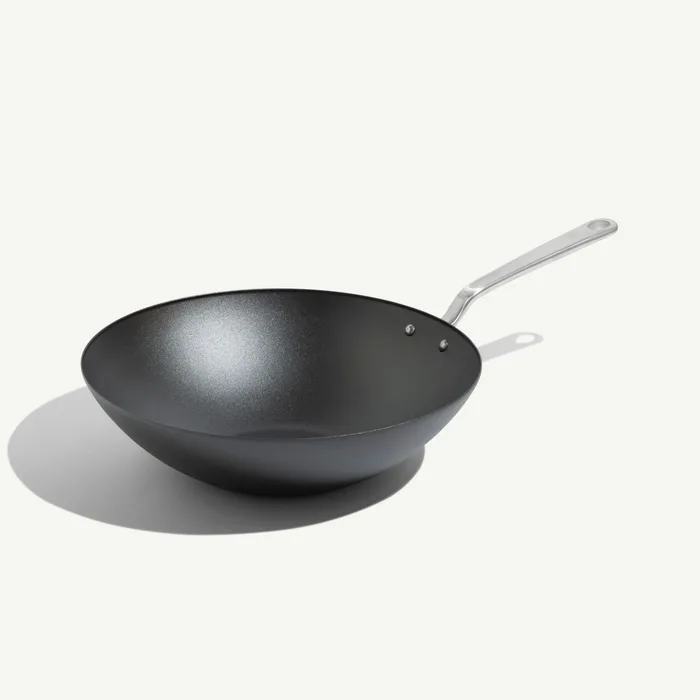
- Buy Made In Seasoned Carbon Steel Wok A pre-seasoned carbon steel wok with a flat bottom made for all home stovetops. Amazon
- Buy Yosukata Black Carbon Steel Wok (Flat Bottom, 13.5") A pre-seasoned, flat-bottom carbon steel wok at a lower price tier. Amazon
- It depends GreenPan Lima Ceramic Nonstick Wok (12.5") A PFAS-free ceramic nonstick wok that's great for easy cleanup and low-fat cooking, but can't chase true wok hei. Amazon
- Skip Lodge 14-Inch Cast Iron Wok A beloved brand making the wrong tool for the job: cast iron is heavy and slow to stir-fry with.
What actually matters
- Material - carbon steel gives the best all-round stir-fry performance and can last for decades with care; ceramic or PTFE nonstick is easy but temporary; cast iron holds heat but is too heavy and slow for a wok.
- Bottom shape - a flat bottom makes real contact with a flat home cooktop; a round bottom needs a wok ring and a high, round burner to work well.
- Heat responsiveness - how quickly the wok recovers temperature when cold food lands is what separates searing from steaming.
- Wok hei potential - only a wok that tolerates very high, direct heat can develop that smoky, charred flavor; nonstick coatings generally can't get there.
- Weight and balance - a wok you can lift and toss one-handed is the whole point; excess weight kills the technique.
- Handle design - a stay-cool or long handle plus an optional helper handle makes tossing and pouring safe and easy.
- Size - a 13-to-14-inch wok suits most home cooks and burners; anything bigger overhangs the flame and heats unevenly.
The specs, in plain English
Green flags vs red flags
Green flags
- Flat bottom explicitly rated for gas, electric, and induction
- Carbon steel construction if stir-frying is your goal
- A helper handle or loop opposite the main handle for two-handed tossing
- A size in the 13-to-14-inch range that fits your burner
- Owner reports mentioning fast, even heating and a patina that builds quickly
- Clear seasoning and care instructions from the maker
Red flags
- Cast iron marketed as a stir-fry wok - too heavy and too slow to respond
- A round bottom sold for a flat Western cooktop with no wok ring plan
- Ceramic or PTFE nonstick pitched for high-heat stir-frying and wok hei
- A very heavy pan you can't comfortably lift and toss one-handed
- Vague or missing material description (just 'metal' or 'steel-look')
- Wooden or plastic handles described as oven- or open-flame-safe
Who's who: the brands
- Made In - Premium cookware brand; its pre-seasoned carbon steel wok is a flat-bottom design for home stoves.
- Yosukata - Specialist carbon steel wok maker offering pre-seasoned and bare, flat-bottom and round-bottom woks at value prices.
- GreenPan - Popular ceramic nonstick brand; its coatings, marketed as PFAS-free, prioritize easy cleanup and low-oil cooking over high-heat searing.
- Lodge - American cast iron maker; excellent at what cast iron does, but cast iron is the wrong material for a stir-fry wok.
- Joyce Chen - Wok brand known for flat-bottom carbon steel woks for Western home kitchens.
How to read a listing without getting fooled
Start with two words on the listing: the material and the bottom shape. If it doesn't clearly say 'carbon steel' (or, for convenience, 'ceramic nonstick') and 'flat bottom,' treat the listing as incomplete. Ignore vague marketing like 'restaurant-grade' or 'heats evenly' and look instead for concrete facts - steel gauge or weight, whether it ships pre-seasoned, whether there's a helper handle, and whether the base is induction-rated if you need that. Be skeptical of any nonstick wok that promises true wok hei or 'high-heat searing'; the coating generally can't survive the heat that flavor requires. And read a handful of owner reports specifically for how the wok behaves after a few months, since seasoning and coating wear only show up with time.
How much should you spend?
You don't have to spend big to stir-fry well. A mid-tier, pre-seasoned flat-bottom carbon steel wok can deliver much of the cooking experience of a premium one, which is where the value sweet spot sits for most home cooks. What drives cost up is thicker steel (faster, more even heat recovery), a name brand, and extras like a helper handle. Spending more is genuinely worth it if you stir-fry constantly and want an premium pan that recovers heat a bit faster; it's not worth it if you cook stir-fries occasionally. Be wary of paying mid-range money for a ceramic nonstick wok you may need to replace sooner, and don't assume a heavy, pricey cast iron wok is an upgrade, since for stir-frying it is usually a downgrade.
Questions, answered
Which wok material should a beginner buy?
For real stir-frying, carbon steel - ideally one that ships pre-seasoned so you can start sooner. It heats and recovers fast, becomes naturally nonstick as it seasons, and can last for years. If you mostly cook eggs, noodles, and low-oil everyday dishes at moderate heat and want zero maintenance, a ceramic nonstick wok is a reasonable pick, just don't expect charred, smoky results from it.
Do I need a flat-bottom or round-bottom wok?
For any Western home stove, get a flat-bottom wok. Round-bottom woks are made for the high, round burners in commercial and traditional kitchens; on a flat cooktop they only touch the heat at a tiny point and need a wok ring to stay stable. A flat bottom makes direct contact with gas, electric, and induction elements.
What exactly is wok hei and can I get it at home?
Wok hei is the smoky, slightly charred aroma that comes from searing food in a very hot wok. You can get a good version of it at home with a carbon steel wok, a hot burner, small batches so the pan doesn't cool down, and constant tossing. A powerful gas burner helps most, but a well-preheated carbon steel wok can produce char on electric and induction too.
How do I season and care for a carbon steel wok?
Wash off the factory coating, dry it, then heat the wok and wipe on a very thin layer of high-smoke-point oil, repeating until the surface darkens. After each use, rinse with hot water (little or no soap once seasoned), dry it on the burner, and wipe on a light film of oil to prevent rust. Skip the dishwasher and long soaks. Cast iron is treated the same way; ceramic nonstick needs none of this, just gentle hand washing.
Is a cast iron wok ever worth it?
Rarely for stir-frying. Cast iron holds heat beautifully, but a wok's job is fast, responsive, high-heat cooking with lots of tossing, and cast iron is heavy and slow to change temperature, so it fights you on both counts. If you already own one, use it for braising or deep-frying; for genuine stir-fry, a carbon steel wok is lighter, quicker, and far easier to handle.
Will a wok work on my induction or electric stove?
Yes, with the right pick. Carbon steel and cast iron are magnetic, so they work on induction as well as gas and electric; nonstick woks work on induction only if they have an induction-rated base. On electric coil or smooth-top stoves a flat bottom matters even more because it maximizes contact, and you'll want to preheat the wok well before adding oil.
Or jump to the head-to-head: Made In Seasoned Carbon Steel Wok vs Yosukata Black Carbon Steel Wok (Flat Bottom, 13.5").