Explained
Air Fryers, Explained: What to Look For
Understand air fryer specs in plain English, so you can pick the right size and skip the marketing noise.
In this guide
An air fryer is really a small, powerful convection oven that circulates hot air to crisp food with little or no oil. This guide explains the specs that actually change how one cooks and fits your kitchen.
The 30-second version
- Capacity is measured in quarts, and it runs small. Advertised quarts describe the whole basket, not usable cooking space. Food needs room around it to crisp, so a stated capacity feeds fewer people than the number suggests.
- The three body styles suit different needs. Basket units are compact and simple, oven-style units hold more and often toast or bake, and dual-zone units run two baskets so two foods finish together.
- Most presets are marketing. A preset just sets a time and temperature you could dial in yourself. A machine with a clear manual temperature and time control does everything the fancy button menu does.
- Footprint matters more than people expect. These are bulky appliances that need clearance above and behind for hot air to vent. Measure your counter and cabinet gap before you fall for a big-capacity model.
- You will still have to shake or flip food. No air fryer cooks a full basket evenly on its own. Plan to pause and toss things partway through; a good basket and a viewing window make that easier.
The products this guide is about
Our verdict on each, with the full reasoning on the companion review.
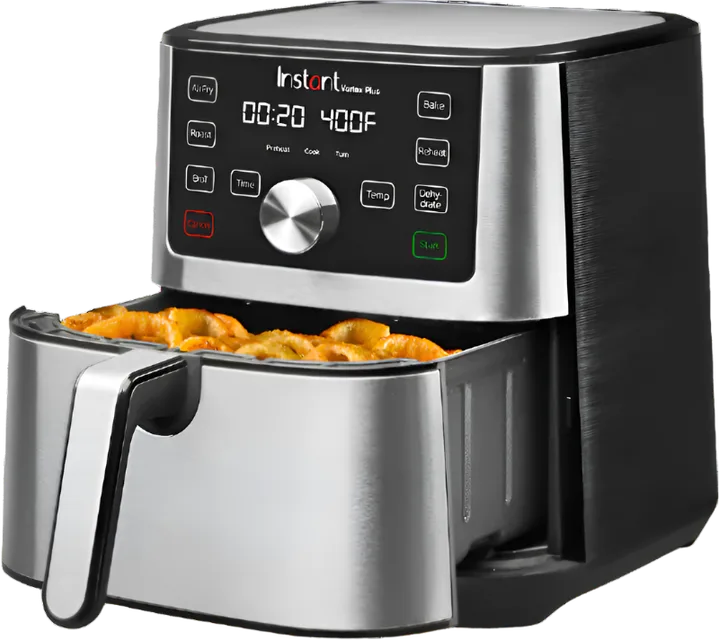
- Buy Instant Vortex Plus 6QT The boring-in-a-good-way pick: even crisping, accurate temps, no learning curve. Amazon
- Buy Cosori TurboBlaze 6.0-Quart The quiet, non-toxic-coating choice that also happens to be fast. Amazon
- It depends Ninja Air Fryer Pro XL (AF181) Big capacity and aggressive crisping, but it runs hot and the controls are coarse. Amazon
- Skip Gourmia 6-Qt Digital Air Fryer (GAF686) The cheap Walmart/Costco bestseller everyone grabs - but it's built to be disposable. Amazon
What actually matters
- Usable capacity, not the quart label - figure out how many portions actually fit in a single layer, because crowding is the main reason food steams instead of crisps.
- Body style (basket, oven, or dual-zone) - this decides how much you can cook at once, whether two foods can finish together, and how much counter and cabinet space it eats.
- Temperature range and consistency - a wider range and steady heat let you do more than reheat fries; look for a top end high enough to properly roast and crisp.
- Footprint and venting clearance - the counter space it occupies plus the gap it needs above and behind to exhaust hot air safely, which the box rarely mentions.
- Basket material and cleanup - a nonstick, dishwasher-safe basket with a removable crisper plate is the difference between a quick rinse and a nightly scrub.
- Controls you can actually read - a plain temperature and time display beats a wall of preset icons, because you end up overriding presets anyway.
The specs, in plain English
Green flags vs red flags
Green flags
- Clear manual controls for temperature and time, not just a menu of presets
- Removable, nonstick, dishwasher-safe basket and crisper plate
- A published temperature range with a genuinely high top end for crisping
- Honest capacity guidance that mentions single-layer or portion limits
- A viewing window or interior light so you can check without opening
- Stated clearance requirements for venting in the manual or specs
Red flags
- Capacity claims that sound huge but describe total volume, not usable space
- Dozens of presets standing in for a simple temperature dial
- No mention of whether the basket is dishwasher-safe or how it cleans
- A sealed or fixed crisper plate that traps grease and is hard to clean
- Vague or missing temperature range on the spec sheet
- A bulky body with no note about the clearance it needs to vent safely
Who's who: the brands
- Instant - Known for basket and dual-zone units; generally straightforward controls.
- Cosori - Popular for mid-size basket models with app and preset ecosystems.
- Ninja - Wide lineup including dual-zone and oven-style multi-cookers.
- Philips - One of the original air fryer makers; leans premium and simple.
- Cuisinart - Often oven-style and toaster-oven hybrids for larger loads.
- Breville - Higher-end convection ovens with air-fry modes and fine control.
- Dash - Compact, budget-friendly single-basket units for small kitchens.
- Chefman - Budget to mid-range baskets and ovens across many sizes.
How to read a listing without getting fooled
Start with how many people you feed and what your counter can spare, then work backward. Decide on a body style first, because a basket, an oven, and a dual-zone unit solve different problems. Treat the quart number as approximate and check the actual basket dimensions if you can. From there, weigh temperature range, cleanup, and controls, and let the marketing presets be a tiebreaker at most, never the reason you buy.
How much should you spend?
Entry-level air fryers are simple single-basket units that crisp fine but skimp on capacity, build, and even heating. The middle tier is where most people are well served: larger or dual-zone baskets, sturdier coatings, and clearer controls. Premium models are usually oven-style or convection hybrids that add baking, toasting, and finer temperature control, which matters only if you will actually use those modes. Paying more mostly buys size, versatility, and durability, not dramatically crispier fries, so match the tier to how you cook rather than chasing the top of the range.
Questions, answered
How many quarts do I need?
Match quarts to portions, but expect less usable space than the label implies. A small basket suits one or two people, a mid-size handles a family side dish, and larger or dual-zone units are for full meals. Food crisps best in a single layer, so size up if you cook for a crowd.
Is an air fryer just a small convection oven?
Essentially, yes. It circulates hot air around food to crisp it, the same principle as a convection oven's fan. The difference is a compact, enclosed basket that concentrates airflow and heats fast, which is why small batches cook quickly and get crisp.
Do I really need all those presets?
No. Every preset simply loads a time and temperature you can set yourself. They save a few taps, nothing more. A unit with clear manual temperature and time controls does everything a preset menu does, and you will usually end up adjusting them anyway.
Do I have to shake or flip the food?
Usually, yes. Air fryers cook fastest where airflow hits directly, so a full basket browns unevenly without a mid-cook shake or flip. Fries and small pieces especially benefit. Plan to pause once or twice; a viewing window makes checking progress easier.
Basket, oven, or dual-zone style?
Basket units are compact and simple for one or two people. Oven-style units hold more and often bake or toast, but eat counter space. Dual-zone units run two baskets so different foods finish together. Choose by how much you cook and how much room you have.
How much space does an air fryer need?
More than the footprint suggests. Beyond counter space for the body, these appliances vent hot air and need clearance above and behind them. Measure your counter depth and the gap under any cabinets before buying, since large-capacity models are often taller and deeper than expected.
Or jump to the head-to-head: Instant Vortex Plus 6QT vs Cosori TurboBlaze 6.0-Quart.