Explained
Air Mattresses, Explained
After reading, you'll know which air mattress specs actually predict a comfortable, long-lasting bed and which are just marketing.
In this guide
An air mattress looks simple, but the label is full of terms like 'neverFLAT,' 'Fiber-Tech,' and 'raised profile' that hide what really matters: whether it inflates easily, stays firm all night, and survives more than a season. First-time buyers usually fixate on plushness and price, then get burned by a bed that sags by 3 a.m. or springs a slow leak. This guide decodes the jargon so you can match a bed to how and where you'll actually sleep on it.
The 30-second version
- The pump decides everything. An AC pump is fine for a guest room near an outlet, but only a rechargeable or battery pump works for real off-grid camping.
- Overnight sag is normal physics, not always a defect. Cooling air and tiny seam losses soften any airbed by morning; a secondary auto-refirming pump is built to counter it.
- Height is a use-case choice, not a quality score. Raised beds are easier to climb into at home, while low-profile beds pack down and travel better.
- Durability lives in long-term owner reports. First-night comfort tells you little; look for beds people still trust months and years in, with thicker reinforced PVC.
- Cheap can be expensive. A budget bed that leaks within a season costs more than a mid-range bed you keep for years.
The products this guide is about
Our verdict on each, with the full reasoning on the companion review.
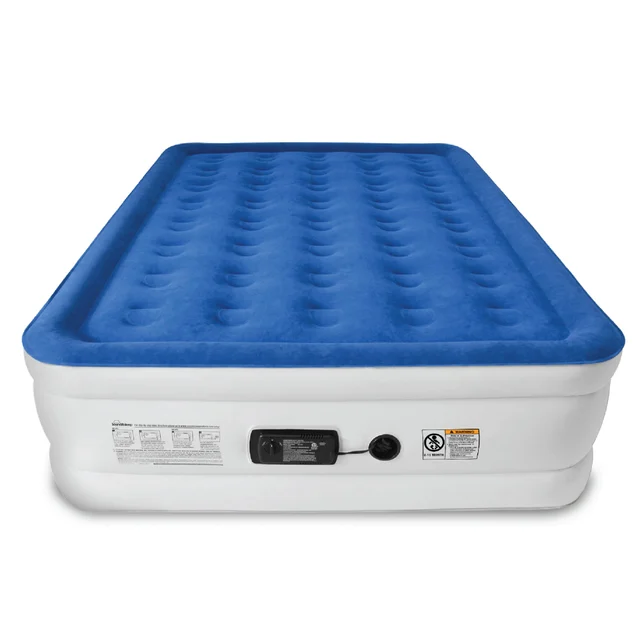
- Buy SoundAsleep Dream Series Air Mattress (Queen) The reliable, no-drama guest bed that inflates in minutes and stays comfortable night after night. Amazon
- Buy Insta-Bed Raised Air Mattress with neverFLAT Pump (Queen) A dual-pump bed that quietly re-inflates itself all night so you never wake up sagging.
- It depends Etekcity Camping Air Mattress with Rechargeable Pump (Queen) The one that actually works in a tent, thanks to a cordless rechargeable pump that needs no outlet.
- Skip Intex Dura-Beam Deluxe Comfort-Plush Elevated Airbed (22-inch Queen) Cheap, plush, and everywhere, but too many owners report slow leaks and sagging within a season. Amazon
What actually matters
- Pump type and power source - this dictates where you can use the bed. AC pumps need a wall outlet; rechargeable or battery pumps free you to camp or use it anywhere, but must be charged first.
- Overnight firmness retention - whether the bed holds pressure until morning. A secondary auto-refirming pump is designed to fix the classic morning sag; without one, expect an occasional top-off.
- Height (raised vs. low-profile) - raised beds (roughly 18–22 inches) feel more like a real bed and are easier to get in and out of; low-profile beds (around 9 inches) are lighter, colder near the floor, and better for travel.
- Internal support structure - coil or beam construction keeps the sleeping surface flat and resists the edge-sinking that makes cheaper beds feel like a taco.
- Material durability - thicker, reinforced, flocked PVC resists punctures and slow leaks far better than thin vinyl, and tends to help a bed last longer.
- Deflation and storage - a pump that also deflates, plus a carry bag, turns pack-away from a wrestling match into a two-minute job.
- Weight capacity and grip - a generous, honest weight rating plus a non-slip base keeps the bed stable and stops it wandering across the floor.
The specs, in plain English
Green flags vs red flags
Green flags
- A pump that both inflates and deflates, ideally with selectable firmness levels
- A secondary auto-refirming pump if you hate the morning sag and will sleep near an outlet
- Thick, reinforced, flocked PVC and internal coil or beam support
- Consistent long-term owner reports of holding air over months and years, not just night one
- A non-slip base and an included carry bag for easy storage
- A rechargeable or battery pump if you actually plan to camp away from power
Red flags
- Reviews describing slow leaks, edge sinking, or lost firmness after only occasional use
- Thin vinyl with no flocked top and no mention of internal support structure
- An AC-only pump when you're buying it specifically for camping
- A high headline weight capacity paired with complaints that it sags under normal weight
- No deflation function or carry bag, making storage a chore
- Marketing that leans entirely on first-night plushness and price with nothing about durability
Who's who: the brands
- SoundAsleep - Known for dependable raised guest beds with strong long-term reliability records; a common safe default.
- Insta-Bed - Best known for the neverFLAT dual-pump system that auto-refirms the bed overnight for set-and-forget firmness.
- Etekcity - Makes camping-oriented beds with cordless rechargeable pumps that work away from any outlet.
- Intex - Ubiquitous budget brand (Dura-Beam, Fiber-Tech); cheap and comfortable on night one but more prone to leaks over time.
How to read a listing without getting fooled
Start with the pump line: is it AC-only, or rechargeable/battery? That one detail tells you whether the bed can leave the house. Next, separate 'inflation speed' claims (many beds inflate in a few minutes, so this often differs little) from overnight firmness features, which are what actually protect your sleep. Read 'raised' and 'plush' as use-case and feel descriptors, not quality grades. When you see internal-structure branding like Dura-Beam, Fiber-Tech, or coil support, that's a genuine plus for a flat surface. Then go straight to the long-term reviews and filter for people who've owned the bed for months: a wall of five-star first-night reactions matters far less than a handful of owners saying it still holds air a year later. Finally, sanity-check the weight capacity against real complaints rather than the printed number.
How much should you spend?
Think in tiers rather than dollars. The cheapest beds are genuinely fine for a bed you'll pull out once or twice a year and don't mind replacing; their weakness is longevity, so spending the least makes sense only when durability truly doesn't matter. The mid-range is the value sweet spot for most households: it buys reinforced materials, a raised height, and a reliability track record without paying for extras you won't use. Stepping up to premium is worth it for one specific reason, an automatic overnight re-firming pump, which is a real quality-of-sleep upgrade for guests staying several nights; if you'll never notice the morning sag, that premium is money you can keep. A rechargeable camping pump also commands a small premium, and it's worth every bit of it if you sleep away from outlets and pointless if you don't.
Questions, answered
Why does my air mattress feel softer in the morning?
Two things cause it: tiny air losses through the seams and valve, and cooler overnight air contracting and slightly lowering the pressure. It happens on many airbeds. A quick top-off fixes it, or a bed with an automatic re-firming secondary pump handles it for you. If the bed goes noticeably flat fast, that's a real leak, not normal cooling.
Can I use any air mattress for camping?
Only if its pump doesn't need a wall outlet. Beds with AC-only pumps are meant for guest rooms or campsites with power hookups. For off-grid camping, choose a bed with a cordless rechargeable or battery pump, and charge it before you leave, or plan to bring a separate battery or manual pump.
How long should a good air mattress last?
With occasional guest-room use and careful handling, the better beds can last several years. The budget ones more often develop leaks or sagging sooner. Keeping pets and shoes off, avoiding over-inflation, and storing it clean and dry all meaningfully extend an airbed's life.
Is a taller, raised air mattress always better?
No, it's a trade-off. Taller beds (about 18–22 inches) are easier to get in and out of and feel more like a real bed, which suits older guests and longer stays. But they're bulkier and heavier and do nothing for camping, where a low, packable bed is more practical. Match the height to the use: raised for guests at home, low-profile for travel.
Do built-in pumps deflate the bed too?
Many electric built-in pumps both inflate and deflate at the flip of a switch, which makes pack-away much easier. Many rechargeable camping pumps do as well. Only some beds add a second pump that re-inflates automatically overnight; that feature is about holding firmness, not about deflating for storage.
Or jump to the head-to-head: SoundAsleep Dream Series Air Mattress (Queen) vs Insta-Bed Raised Air Mattress with neverFLAT Pump (Queen).