Explained
Bidet Toilet Seats, Explained
After reading, you'll understand the tankless and tank difference, what to measure before ordering, and why an attachment is not a seat.
In this guide
Bidet seat listings are long lists of named features, most of which are variations on three things: how the water is heated, what sprays it, and how the seat sits on the bowl. There is also a category boundary hidden in the search results, because attachments and seats look similar in photographs and cannot do the same job. A short vocabulary sorts all of it out.
The 30-second version
- Tankless heating is the feature that matters, because a tank gives you about half a minute of warm water.
- An attachment has no power, so it cannot heat water, heat the seat, or dry, whatever else it does well.
- Stainless nozzles beat plastic, and how many there are decides whether washes share hardware.
- Measure before you order, roughly 16.5 inches for round and 18.5 for elongated, taken from the seat bolts.
- You need a socket by the toilet, and in an older bathroom adding one is the real cost of the upgrade.
The products this guide is about
Our verdict on each, with the full reasoning on the companion review.
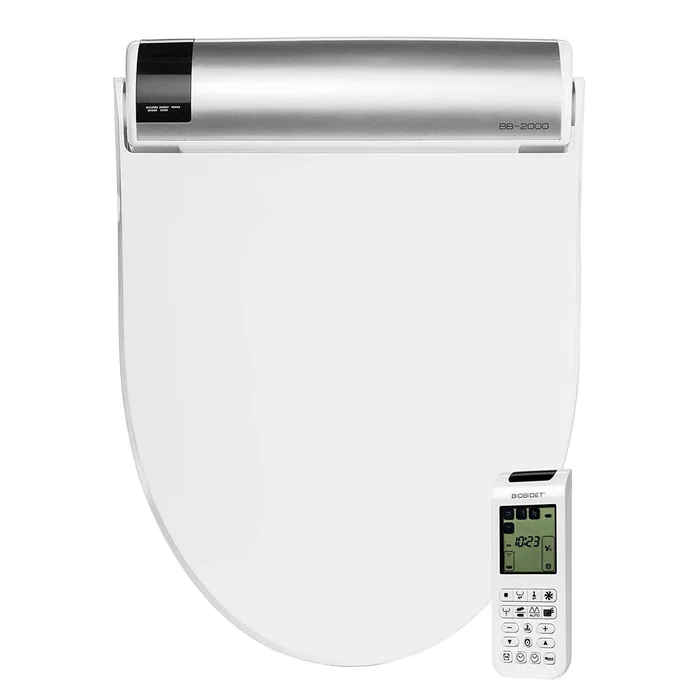
- Buy Bio Bidet BB-2000 Bidet Toilet Seat The most completely featured seat here, and one Bio Bidet designed for you to fit yourself.
- Buy Alpha Bidet iX Pure Bidet Seat Tankless warm water and a slim 4.5 inch profile, with the simplest remote in the category.
- It depends Brondell Swash 1400 Two independent stainless nozzles and a self-cleaning system, at a published weight.
- Skip TUSHY Classic 4.0 A genuinely good product, and not a bidet seat, which is what makes it the wrong purchase here.
What actually matters
- Water heating type - tankless heats on demand and does not run out; a tank heats a reservoir that lasts around thirty seconds. Alpha states tankless on the iX Pure and Bio Bidet describes unlimited warm water on the BB-2000.
- Nozzle material and count - stainless steel resists biofilm in a way plastic does not, and a dual-nozzle design gives the rear and feminine washes separate hardware rather than one shared spray head.
- Nozzle cleaning - every electric seat rinses its nozzle, and some go further. Brondell's NozzleClean+ and, on premium models, electrolysed water sterilisation are the escalations.
- Seat profile - how tall the seat sits at the rear, which determines how much higher you are sitting and how the toilet looks. Alpha publishes 4.5 inches on the iX Pure; most makers publish nothing.
- Comfort features - heated seat, warm air dryer and deodoriser. All three require power, and the deodoriser is the one most often left off mid-range seats.
- Seat shape - round or elongated, matched to the bowl. It is a checkout selection with no adjustment afterwards, so it has to be measured.
- Power requirement - a GFCI outlet within reach of the toilet. It is the one part of the installation you cannot do with a screwdriver and a T-valve.
The specs, in plain English
Green flags vs red flags
Green flags
- The page says explicitly whether heating is tankless or tank-based.
- The nozzle material is named as stainless steel.
- A rear height or seat thickness is published.
- Both round and elongated versions are offered.
- The install is described including the T-valve and the power requirement.
Red flags
- Warm water promised with no statement of how it is heated.
- No dimensions of any kind on a product that sits under you.
- An attachment photographed to look like a seat.
- Nozzle described as self-cleaning with no material given.
- No mention that an electrical outlet is required.
Who's who: the brands
- Bio Bidet - Broad range from the non-electric BB-300 to the BB-2000 flagship, with a reputation for feature-complete seats and DIY installation.
- Alpha Bidet - Known for slim profiles and tankless heating, from the iX Pure up to the JX Elite with electrolysed water sterilisation.
- Brondell - Long-running American brand whose Swash line uses dual stainless nozzles and the NozzleClean+ system.
- TUSHY - Direct-to-consumer brand built on non-electric attachments, now also selling seats and a smart toilet.
- TOTO - The Japanese company that created the Washlet and effectively invented the modern bidet seat category.
How to read a listing without getting fooled
Look for the heating method first, and treat its absence as a red flag rather than an oversight, because tankless is a selling point and companies that have it say so. Then check the nozzle: stainless steel, how many, and whether position and pressure adjust. After that, look for any physical dimension at all. Rear height or seat thickness is what tells you how much the toilet will change, and finding a figure is rare enough that publishing one says something about the maker. Check that your bowl shape is offered and measure before ordering rather than guessing. Finally, confirm you are looking at a seat rather than an attachment: if the copy mentions that no electricity is needed, that is an attachment, and it cannot heat water no matter how good the rest of it is.
How much should you spend?
Bidet seats run from budget to premium and the tiers are unusually honest. The budget tier is non-electric attachments, which work, need no power, and cannot heat anything. The mid-range is where tankless electric seats start, and it is the best value in the category: endless warm water, a heated seat, a dryer and a stainless nozzle for considerably less than the flagship models. The premium tier adds a deodoriser, more wash modes, a seat sensor and sometimes nozzle sterilisation, all of which are real but none of which change the fundamental experience the way tankless heating does. If your budget forces a choice, buy tankless heating over any feature on the list. Remember to budget for an outlet if your bathroom does not have one near the toilet, since that can cost as much as the seat.
Questions, answered
Will a bidet seat fit my toilet?
Almost certainly, if you match the bowl shape. Standard two-piece and most one-piece toilets take a bidet seat using the existing seat bolt holes, and the seats ship with a mounting plate and a T-valve for the fill line. The exceptions are toilets with unusual tank shapes that foul the seat's control panel at the rear, and French-curve or skirted designs where the bolt spacing differs. Measure from the bolts to the front of the bowl, and check the tank does not overhang where the seat's body sits.
How much electricity does a bidet seat use?
Less than people expect, and the heating type is the main variable. A tank system keeps a small reservoir warm continuously, which is a steady low draw all day. A tankless system uses nothing between uses and a larger burst while washing. Most seats also have a power saving mode that lets the seat and water heating idle cooler when the bathroom is not in use, which is worth turning on.
Is the warm air dryer actually useful?
Opinions divide sharply, and it depends how patient you are. A bidet seat's dryer moves a modest volume of warm air and takes considerably longer than a towel or paper, so people who expect a hand dryer are disappointed. Used as intended, as a finishing step after patting dry, it works well. If you are choosing between two seats on price and one lacks a dryer, it is not the feature to pay a large premium for.
Does a bidet seat need its own water filter?
Not usually, but it helps in hard water. The nozzle and the internal water path are narrow, and scale builds up in them the same way it does in a kettle. Several makers sell an inline filter for the bidet's supply line, and Brondell offers one on subscription. If you already have a softener or a whole-house filter, you do not need it. If your water is hard and untreated, a small inline filter is cheap insurance on a seat that costs several hundred.
Or jump to the head-to-head: Bio Bidet BB-2000 Bidet Toilet Seat vs Alpha Bidet iX Pure Bidet Seat.