Explained
Carving Knives, Explained
After reading, you'll understand which carving knife specs change your results at the table and which are just marketing.
In this guide
Carving knives get bought rarely, often as gifts, so the listing is all most buyers go on. The common mistakes are buying a blade too short for the roast, choosing a fragile edge for bone-in meat, and paying for a boxed set when only the knife matters. Terms like granton, HRC and forged also sound impressive without saying what they change. This guide explains the specs so you can match the knife to what you actually carve.
The 30-second version
- Length matters most, because a blade that crosses the meat in one stroke gives clean slices.
- Match the tip to the job, pointed for bone-in carving and rounded for long boneless slicing.
- Scalloped edges reduce sticking, but they do not replace a sharp, honed edge.
- Harder and thinner is not always better, since fine Japanese edges can be restricted from contact with bones.
- Sets cost extra, and the carving fork is the part most cooks can do without.
The products this guide is about
Our verdict on each, with the full reasoning on the companion review.
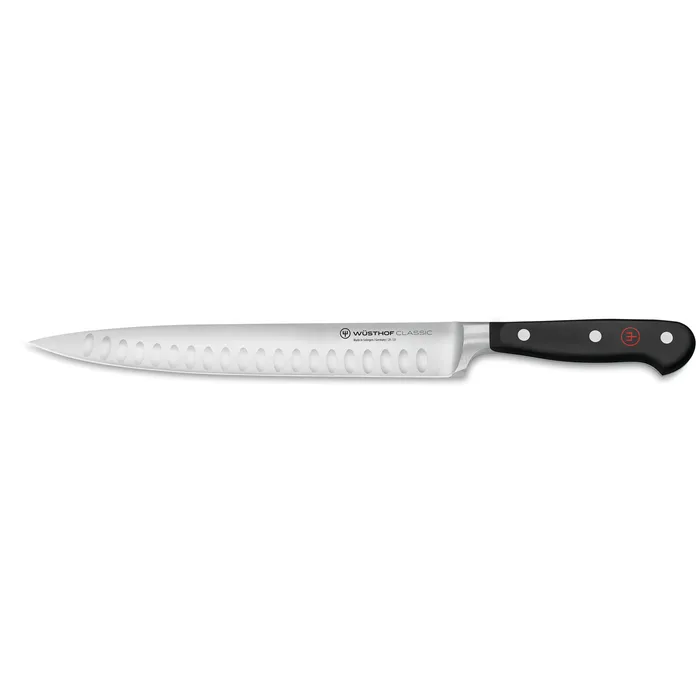
- Buy Wüsthof Classic 9" Hollow Edge Carving Knife A forged 9 in carving knife at 58 HRC with a hollow edge and a pointed tip for working around bone.
- Buy Victorinox Fibrox Slicing Knife Granton Blade, 12 in (5.4723.30) An 11.8 in fluted slicer with a non-slip handle that goes in the dishwasher, for long, even slices of big roasts.
- It depends Shun Classic 9" Hollow Ground Slicing Knife (DM0720) A beautiful, very sharp Japanese slicer with a 16° VG-MAX edge, for careful carvers who keep it off bones.
- Skip Zwilling Four Star 2-pc Slicing/Carving Knife and Fork Set (35037-000) A well-made forged gift set whose knife is short for carving, sold at a premium price with a fork most cooks do not need.
What actually matters
- Blade length - A blade that crosses the roast in one stroke avoids sawing and torn slices. Around 9 inches suits poultry; 11 to 12 inches suits brisket and big roasts.
- Tip shape - A pointed tip follows bones and joints on a bird or ham. A rounded tip adds safety and suits long strokes through boneless meat.
- Edge type - Hollow, granton or fluted scallops create air pockets so slices release. A plain edge works too but sticks more on moist meat.
- Hardness (HRC) - Higher numbers usually hold an edge longer but can be more brittle. Lower numbers are tougher and easier to hone.
- Edge angle - A smaller angle per side cuts more finely but is less robust. Makers that publish it make sharpening easier.
- Construction - Forged knives are shaped from a single heated piece of steel and usually have a bolster. Stamped or laser-cut knives are lighter and cheaper to make.
- Care rules - Some makers allow the dishwasher; others insist on hand washing. Warranty limits, such as no use on bones, matter for carving.
The specs, in plain English
Green flags vs red flags
Green flags
- Blade length stated clearly on the product page
- A published HRC hardness and edge angle
- A hollow, granton or fluted edge for moist meats
- A tip shape that matches what you carve
- A lifetime or limited lifetime warranty from the maker
Red flags
- No blade length listed, especially on boxed sets
- A short blade sold as a carving knife
- Warranty terms that forbid contact with bones when you carve bone-in meat
- Vague claims like razor-sharp with no hardness or angle
- A premium price driven by a fork or presentation box
Who's who: the brands
- Wüsthof - A Solingen maker known for forged German knives such as the Classic line.
- Victorinox - The Swiss Army knife maker, known for practical, affordable Fibrox kitchen knives with non-slip handles.
- Shun - Kai's Japanese brand, known for hard, thin, Damascus-clad blades with fine edges.
- Zwilling - A Solingen maker known for forged knives such as the Four Star and Pro lines.
How to read a listing without getting fooled
Find the blade length first, and make sure it is the blade, not the overall length including the handle. Then look for the edge type, any scallops, and the tip shape in the photos and description. Check whether the maker publishes a hardness figure in HRC and an edge angle; both help you understand edge life and sharpening. Read the care section for dishwasher rules and the warranty page for any limits on bones or frozen food. For sets, look up what each piece is and how long each blade is before comparing the price with buying a single knife.
How much should you spend?
Budget carving knives are usually stamped blades with plastic handles and few published specs; they can cut well but dull sooner. Mid-range is where long stamped slicers with good edges and grippy handles sit, and this tier is the best value for most cooks. Premium knives add forged construction, harder or specialty steels, finer edge angles and nicer handles. Boxed carving sets often land in the premium tier because of the fork and presentation, so compare the knife alone against a single premium carving knife before you pay for the set.
Questions, answered
How should I store a long carving knife?
Keep the edge from knocking against other utensils. A blade guard or sheath works in a drawer, and a magnetic strip or a block with a long slot also works. Very long slicers may not fit standard block slots, so check the overall length. Avoid tossing it loose in a drawer, which dulls and chips the edge.
How often should I sharpen a carving knife?
Hone it before each use with a honing steel or rod to straighten the edge. Sharpen it when honing no longer brings the edge back, which for a knife used a few times a year might be once a year or less. Match the sharpening angle to the maker's published angle if there is one. A whetstone or a quality pull-through sharpener both work.
What board should I carve on?
Use a wood or plastic board, never glass, stone or metal, which dull the edge quickly. A board with a juice groove keeps drippings off the counter when carving roasts. Put a damp towel underneath so the board does not slide. A large board gives room to move the meat and the slices apart.
Is an electric knife better for carving?
An electric knife can slice soft roasts and bread with little effort, and some people with weak grip find it easier. It tends to give a rougher cut than a sharp manual knife and is noisy and bulky to store. A sharp, long manual slicer usually gives cleaner slices. If grip strength is the issue, a lighter knife with a non-slip handle is worth trying first.
Or jump to the head-to-head: Wüsthof Classic 9" Hollow Edge Carving Knife vs Victorinox Fibrox Slicing Knife Granton Blade, 12 in (5.4723.30).