Explained
Chainmail Scrubbers, Explained
After reading, you'll understand what a chainmail scrubber can and cannot remove, why the ring joint matters more than the brand, and which of the cast iron rules you were taught are actually true.
In this guide
Most people buy a chainmail scrubber after ruining a skillet's seasoning with a green scouring pad, or after giving up on a pan they let soak. Both of those are solvable, but the fixes are different, and a lot of the advice attached to cast iron is decades out of date. The listings do not help: two pads that look identical can be different alloys with differently closed rings, and neither page will necessarily say. Here is what the words on the box mean.
The 30-second version
- The rings abrade the food, not the pan, which is why a chainmail pad lifts stuck-on residue while leaving hardened seasoning in place.
- Welded beats butted, because a ring that is only bent shut can spring open under pressure and start unravelling the mail around it.
- Name the steel or walk away, since 304, 304L and 316 are all normal choices and a page that just says stainless steel is telling you nothing.
- Soap is not the enemy, and the makers say so themselves, because modern dish detergent is not the harsh lye soap that the old rule was written about.
- Nothing here is for enamel, because enamel is glass bonded to iron and metal scratches it permanently, as the makers of enameled cookware say directly.
The products this guide is about
Our verdict on each, with the full reasoning on the companion review.
- Buy Stargazer Cast Iron Chain Mail Scrubber The only pad here whose maker states the rings are welded, in 304 stainless, made in the USA.
- Buy Field Company Chain Mail Scrubber A finer USA-made 304L mesh with no hooks or hardware woven in, aimed at smooth machined pans. Amazon
- It depends Lodge Cast Iron Chainmail Scrubbing Pad 304 mail wrapped on a silicone core, which is much easier to hold and much harder to rinse out between the rings. Amazon
- Skip Smithey Ironware Chainmail Scrubber A good-looking pad from a good brand that publishes less about its own construction than anything else here.
What actually matters
- Alloy grade - 304 and 304L are the standard kitchen stainless grades and hold up fine in a wet sink environment. 316 adds molybdenum for more corrosion resistance, which is a nice extra rather than a requirement for a scrubber.
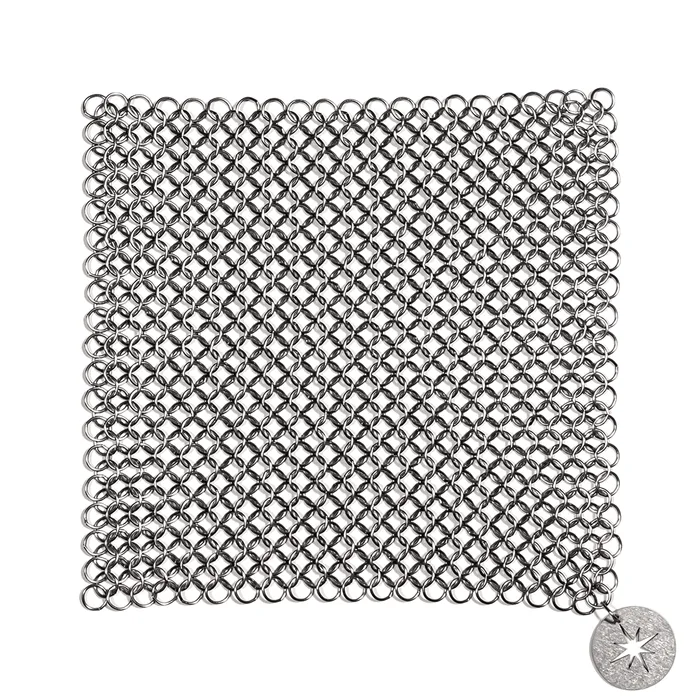
- Ring joint - a welded or soldered ring is fused closed and a butted ring is just bent shut. The butted kind is the one that opens up mid-scrub and starts a run in the mail, so a stated weld is the strongest durability signal you can get.
- Ring opening and wire diameter - together these set how fine the mesh is and how aggressively it bites. Very few makers publish either number, so descriptions like finer mesh are usually all you get.
- Pad size - around five inches square is the sweet spot, big enough to fold over your fingers for reach into a pan wall and still small enough to control. Smaller pads make you press with your palm, which is where blisters come from.
- Core or no core - bare mail rinses out completely and stores flat; a silicone core gives you grip and something rigid to push against but traps water and food where the mail meets the pad.
- Stated cookware - makers scope these pads to bare cast iron and carbon steel. That scope is doing real work, because it is quietly telling you not to use one on enameled cookware or on non-stick.
- Cleaning guidance for the pad itself - most makers say dishwasher, which is the easy answer. What matters more is drying it open rather than dropping it wet into a drawer with food still caught between rings.
The specs, in plain English
Green flags vs red flags
Green flags
- The page names a specific alloy, such as 304, 304L or 316, rather than just stainless steel.
- The maker states that the rings are welded, soldered or machine soldered.
- Published dimensions of around five inches square or larger for a bare pad.
- A stated cleaning method for the scrubber itself, most often dishwasher safe.
- The listing names the cookware it is for, and stops at bare cast iron and carbon steel rather than claiming everything.
Red flags
- Material listed only as stainless steel with no grade anywhere on the page.
- No mention of how the rings are closed, or the phrase manually closed rings, which means butted.
- Claims that it is safe for enameled cookware, non-stick, or every pan in your kitchen.
- Hooks, tags or stamped badges sitting proud of the mail, which are the parts that can drag on seasoning.
- No published dimensions, so you cannot tell whether you are getting a pad you can fold or a coaster.
Who's who: the brands
- Stargazer Cast Iron - A US maker of machined skillets whose scrubber page states 304 stainless with welded rings, which is unusually complete disclosure for this category.
- Field Company - Known for lightweight machined cast iron, and builds its USA-made 304L pad with a finer mesh and deliberately no hooks or hardware.
- Lodge Cast Iron - The mass-market name in American cast iron, and the maker of the widely stocked 304 chainmail pad built around an ergonomic silicone core.
- Smithey Ironware - A premium polished cast iron and carbon steel brand whose chainmail scrubber is dishwasher safe but is listed only as stainless steel with no grade.
- Amagabeli - A budget chainmail specialist that, unusually, distinguishes its machine soldered models from its manually closed ring models.
How to read a listing without getting fooled
Read a chainmail listing backwards, starting with the specification block rather than the headline. You are looking for three things in order: a named alloy, a statement about how the rings are joined, and the pad's dimensions. If all three are there, the rest of the copy is decoration. If the alloy is missing, assume the cheapest grade the factory had; if the ring joint is missing, assume butted, because a maker that welds its rings has every reason to say so. Then check the sentence that names which cookware the pad is for, because that scope line is the only place most brands will tell you not to take it near enamel. Finally, look for a care instruction aimed at the scrubber itself rather than at your pan. A brand that has thought about how you clean food out from between its rings has usually thought about the rest of it too.
How much should you spend?
This is a category where the spread from cheapest to dearest is narrow, so paying up is easy to justify and easy to overdo. At the budget tier you get perfectly good pads, including USA-made ones with a published alloy, and also the anonymous mail where the grade is unstated. The mid tier buys you the most disclosure, the largest bare pads, and the silicone-core designs. The premium tier in this category is mostly brand: a smaller pad from a boutique cookware name, made to the same stated alloy as a cheaper one. The sensible move is to spend at the low end of mid-range on a pad whose maker names the alloy and the ring joint, and put the difference toward seasoning oil or a pan scraper, which is the tool that actually handles anything the mail cannot.
Questions, answered
Does a chainmail scrubber replace a pan scraper?
Not quite, and the makers sell both for a reason. The mail is for residue that has stuck but not carbonised, and it works by tumbling over the surface so the ring edges catch food. A hard polymer scraper is better for a solid crust or the ring of burnt sugar around the edge of a pan, because you can put a straight edge against it. Most people end up using the scraper for ten seconds and the mail for the rest.
Can I use one on carbon steel, stainless pans, or a griddle?
Carbon steel is explicitly fine, and two of the makers here list their pads for it alongside cast iron. Bare stainless and cast iron griddles are also in the same family of hard, unseasoned or seasoned metal surfaces that mail handles well. What you should keep it away from is anything with a coating: non-stick, ceramic, and enamel are all surfaces where the ring edges will leave marks. When a maker lists the cookware its pad is for, take the omissions seriously.
How long should one last?
A well-made pad with fused rings should outlast several pans, because there is nothing on it to wear out except the steel itself. The realistic failure mode is a ring pulling open on a butted pad, which starts a run that spreads with every scrub. If the mail is still intact and just looks grubby, it is not worn out, it needs a proper clean. Replace it when rings start separating, not when it stops looking new.
Is it worth getting a bigger pad?
Usually yes, up to a point. A larger square can be folded over your fingers, which gives you a thicker working face and better reach up a pan wall, and it can be opened out flat for a griddle. A much larger pad can become a handful to control in a sink and awkward to store. Around five inches square is where most of the well-specified pads sit, and it is a good default.
Or jump to the head-to-head: Stargazer Cast Iron Chain Mail Scrubber vs Field Company Chain Mail Scrubber.