Explained
Chest Freezers, Explained
You will know exactly what size to buy, whether your garage will kill a non-rated freezer, and which of the handful of features actually earn their keep.
In this guide
A chest freezer is a deliberately low-tech appliance: an insulated box with a compressor, a lid that seals, and a dial. That simplicity is why it is cheap to run and lasts a decade, and also why the buying decision comes down to just a few things. The two mistakes people make are buying too small and putting a non-garage-rated freezer in an unheated garage.
The 30-second version
- Size in cubic feet, and size up. A rough rule of thumb is 1.5 to 2 cubic feet per person for everyday overflow. That covers normal use, but it collapses the moment you buy a bulk meat order or bring in a garden haul, so if you are between sizes and have the floor space, take the bigger one.
- Chest beats upright on efficiency, upright beats chest on access. Cold air sinks, so a top-opening lid spills far less cold than a front-opening door. Chest freezers hold temperature longer, run cheaper, and cost less per cubic foot. The price you pay is digging: the bottom layer is genuinely hard to reach.
- Nearly every chest freezer is manual defrost, and that is on purpose. Frost-free systems use a heater that periodically warms the coils, which costs energy and gently thaws the surface of your food. Chest freezers skip it, which is why they run so efficiently and freezer-burn less. You defrost once or twice a year instead.
- "Garage ready" is a temperature rating, not a marketing word. It means the unit is rated to keep food frozen across a wide ambient range. A freezer without that rating can stop cycling correctly in a cold garage in winter and struggle in a hot one in summer.
- Three extras matter most. A temperature alarm, a defrost drain, and an interior light. Most else on a chest freezer spec sheet is either standard or noise.
The products this guide is about
Our verdict on each, with the full reasoning on the companion review.
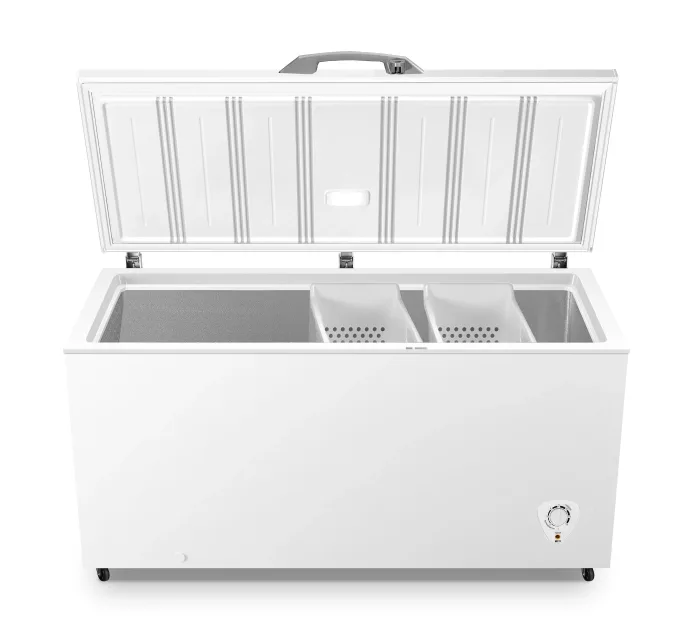
- Buy Hisense 17.7 cu. ft. Garage Ready Chest Freezer (CFC177M6AWD) A very large, garage-rated chest freezer with a stated temperature range, an interior light, and a lock.
- Buy Frigidaire 7.0 cu. ft. Garage-Ready Chest Freezer (FFCS0762AW) The sweet-spot size: garage-rated, easy to organize, and priced for most families.
- It depends Midea 5.0 cu. ft. Chest Freezer (MRC050S0AWW) A tidy, quiet compact freezer that makes sense only if space and needs are modest.
- Skip Insignia 5.0 cu. ft. Garage-Ready Chest Freezer (NS-CZ50WH26L) A fine-on-paper house-brand unit that offers no real edge and a rockier delivery record. Amazon
What actually matters
- Capacity in cubic feet - the single most regretted spec, because people underestimate. Roughly 1.5 to 2 cubic feet per person handles everyday overflow, but a genuine bulk buy (a quarter-cow, a hunting season, a garden year) wants a large unit on its own. As a mental yardstick, one cubic foot holds somewhere around 30 to 35 pounds of packed frozen food.
- Ambient temperature rating (garage ready) - if the freezer will live anywhere unconditioned, this is the spec that decides whether it works. Look for a stated operating range, not just the phrase on the box.
- Footprint and lid clearance - a chest freezer needs floor space plus vertical room to open the lid fully, and air gaps around the sides and back so the compressor can shed heat. Measure the swing, not just the box.
- Lid seal (gasket) quality - the gasket is the part most likely to cause trouble over years. A tired or crushed seal lets warm air in, which means frost buildup, higher running cost, and food that ices over.
- Temperature alarm - a cheap feature that catches the expensive failure. It warns you when the lid was left ajar or the interior is warming, which is the difference between closing a lid and throwing out a freezer full of food.
- Defrost drain - a small plug near the base that lets meltwater run out during defrosting. Without it, defrost day means towels and a wet-vac. Most decent units have one, but confirm.
- Baskets and organization - a chest freezer is a deep hole. Sliding or hanging baskets keep the things you use weekly at the top so you are not unloading half the freezer to find a bag of peas.
The specs, in plain English
Green flags vs red flags
Green flags
- A published ambient operating range, not just the words "garage ready" on the box
- A temperature alarm, especially on a large unit you will not open daily
- A built-in defrost drain with an accessible plug
- At least one removable or sliding basket, and more on larger capacities
- A capacity that fits how you actually shop, with a little headroom left over
- A major brand with real parts availability, since the gasket and compressor are what eventually need service
Red flags
- No stated ambient temperature range when you plan to put it in a garage
- A capacity chosen to fit the space rather than the amount of food you buy
- No defrost drain, which turns an annual chore into a mopping job
- A single flimsy basket in a large cabinet, guaranteeing you dig for everything
- A listing that is vague about the lid seal or shows a lid with visible gaps
- House-brand units with a pattern of owner reports about arrival damage or thin support
Who's who: the brands
- Hisense - Large-capacity chest freezers with a published garage temperature range on the spec sheet, though features such as a door-open alarm vary by model.
- Frigidaire - Mainstream sizes with garage-ready models; steady, unremarkable owner reports in the best way.
- Whirlpool - Long-running appliance maker with a solid dealer and parts network behind its freezers.
- Midea - Value-focused compacts that owners describe as quiet and efficient, though not always extreme-temperature rated.
- Danby - Specializes in compact and apartment-scale appliances, useful when floor space is the binding constraint.
- Insignia - Retailer house brand; competitive on paper, but support and parts depth are thinner than the major names.
How to read a listing without getting fooled
Work in this order: placement, then capacity, then features. If the freezer is going in a garage, basement, porch, or shed, filter first for a stated ambient temperature range and ignore anything that only says "garage ready" without numbers. Next, size it against how you shop rather than the room: use 1.5 to 2 cubic feet per person as a floor, then add real headroom if you buy in bulk, hunt, or garden. Listings inflate impressions by quoting total volume, so check the interior dimensions if they are given and remember baskets eat some of it. After that, the feature list is short. Confirm there is a defrost drain, prefer a temperature alarm, take an interior light and extra baskets if offered, and treat everything else as filler. Manual defrost is not a downgrade to be talked out of; it is the reason the appliance is cheap to run.
How much should you spend?
Chest freezers are one of the few categories where the entry tier is genuinely usable, because the technology is simple and the compressor is the same idea at every price. Budget compacts get you a working freezer with a dial, a drain, and one basket, which is enough for an apartment or light overflow in a heated room. The middle tier is where most households should land: it buys the real garage temperature rating, better insulation and gasket quality, and a size that will not be outgrown in a year. Stepping to the top of the range mostly buys capacity plus the two convenience features (alarm and interior light), and on a large unit those are worth it, since a big freezer represents a lot of food to lose. What extra money does not buy is dramatically better freezing. Spend on the right size and the right temperature rating first, and treat everything above that as optional comfort. Running cost is low across the board, so a slightly more efficient model pays back slowly; buy the correct freezer, not the marginally cheaper one to operate.
Questions, answered
What size chest freezer do I actually need?
Start at roughly 1.5 to 2 cubic feet per person in the household for everyday overflow, so a family of four lands around 7 cubic feet. That rule breaks down for bulk buying: a quarter-cow, a hunting season, or a full garden year each want serious dedicated space, which pushes you toward 15 cubic feet or more. Underestimating is the most common regret, so when you are between sizes and the floor space exists, go bigger.
Chest or upright freezer?
Chest wins on efficiency, temperature stability, capacity per dollar, and how long food stays frozen in an outage, because cold air sinks and does not pour out of a top-opening lid. Upright wins on access and floor space: shelves and drawers mean you can see everything, and a tall narrow body fits where a wide box will not. If the freezer is going in a garage and you mostly do long-term storage, chest is the better appliance. If you will open it daily and want to find things fast, upright earns its penalty.
Why is manual defrost so common on chest freezers, and is it a problem?
It is a deliberate design choice. Frost-free systems periodically run a heater to melt frost off the coils, which uses electricity and slightly warms your food each cycle, which over months causes freezer burn. Chest freezers skip that, so they run cheaper and preserve food better long-term. In exchange you defrost once or twice a year: unplug, let the frost melt, drain it through the drain plug, dry it, and restart. Plan it for when stock is low and it takes an afternoon.
Can I really put any chest freezer in the garage?
No, and this is the mistake that costs people a freezer full of food. A standard freezer assumes it lives in a room-temperature house. In an unheated garage in winter, the thermostat can read the cold ambient air and stop calling for cooling, and the interior slowly rises above freezing. In a hot garage in summer, the compressor may not keep up. A garage-ready unit is rated across a wide ambient span, and is the safer choice for an unconditioned space.
How long will food stay frozen in a power outage?
A full chest freezer that stays closed generally holds food frozen for about 48 hours, and a half-full one for roughly 24. The frozen contents act as the cold reservoir, so a fuller freezer buys you more time. Keep the lid shut, and keep an appliance thermometer inside so you can judge whether food stayed at a safe temperature when power returns rather than guessing.
How do I keep it organized without unloading the whole thing?
Treat it as layers, not a pile. Put long-term storage on the bottom, use the baskets for what you reach for weekly, and group items in labeled bins or reusable bags by category (meat, vegetables, prepared meals). Date everything, because a chest freezer is where food goes to be forgotten. Keeping a simple inventory list taped to the lid saves more digging than any feature you can buy.
How do I take care of the lid seal?
Wipe the gasket with mild soapy water a few times a year and dry it, since crumbs and spills break the seal. Do not overfill so that packages or a basket hold the lid open even slightly. If frost starts building up unusually fast, check the seal first: close the lid on a sheet of paper and see whether it pulls out easily, which means the gasket is not gripping at that spot.
Or jump to the head-to-head: Hisense 17.7 cu. ft. Garage Ready Chest Freezer (CFC177M6AWD) vs Frigidaire 7.0 cu. ft. Garage-Ready Chest Freezer (FFCS0762AW).