

Home & Kitchen
The Best Chest Freezers: 4 Compared (and One to Skip)
We compared four current chest freezers from compact 5 cu ft to a 15+ cu ft garage unit on capacity, garage tolerance, defrost, and real ownership.
The short version
Chest freezers are simple, and the ones worth buying get the fundamentals right: a genuine garage temperature rating, a lid seal and compressor that hold up, and enough room for how you actually shop. The Hisense 17.7 cu ft is our overall pick for stock-up households because it pairs the largest capacity here with a stated garage temperature range and an interior light. The garage-ready Frigidaire 7.0 is the better call for most families who want meaningful overflow without an oversized box. The compact Midea 5.0 is a reasonable budget option, but only in a climate-controlled room rather than a punishing garage. We would skip the Insignia, which brings no advantage and a shakier delivery record. Best for: buy the Hisense if you stock up in bulk and have garage space, or the Frigidaire 7.0 if you want the right-sized, garage-ready everyday choice.
Our picks at a glance
- Hisense 17.7 cu. ft. Garage Ready Chest Freezer (CFC177M6AWD) - Buy. A very large, garage-rated chest freezer with a stated temperature range, an interior light, and a lock.
- Frigidaire 7.0 cu. ft. Garage-Ready Chest Freezer (FFCS0762AW) - Buy. The sweet-spot size: garage-rated, easy to organize, and priced for most families.
- Midea 5.0 cu. ft. Chest Freezer (MRC050S0AWW) - It depends. A tidy, quiet compact freezer that makes sense only if space and needs are modest.
- Insignia 5.0 cu. ft. Garage-Ready Chest Freezer (NS-CZ50WH26L) - Skip. A fine-on-paper house-brand unit that offers no real edge and a rockier delivery record.
The verdict in 30 seconds
What mattered most
- Capacity
- Best placement
- Garage temp rating
- Defrost
- Extra features
- Energy
A chest freezer is one of the highest-value appliances you can buy: it turns bulk sales, garden hauls, and batch cooking into months of storage for pennies of electricity. But they are also gloriously low-tech, which means almost all of them are manual-defrost, most live in a garage or basement, and the differences that matter are size, temperature rating, and how well the lid seal and compressor hold up. We looked at four you can actually buy right now and landed on two clear buys, one that depends entirely on your space, and one we would pass over.
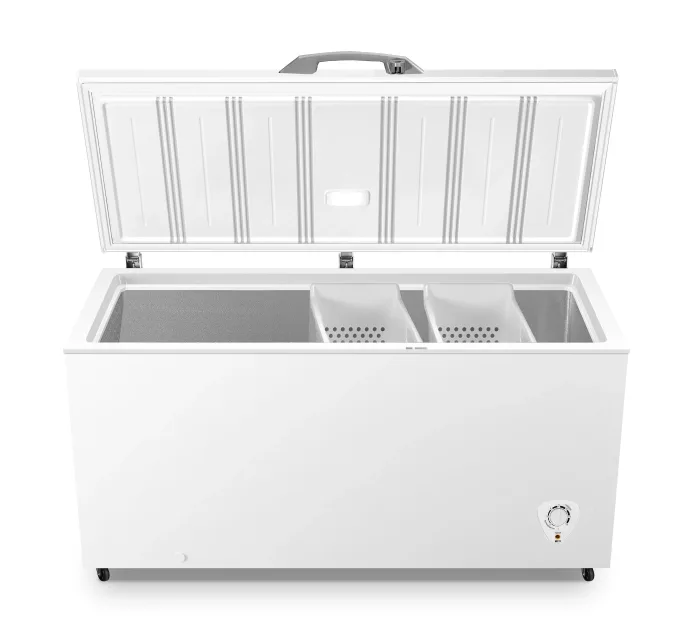
A very large, garage-rated chest freezer with a stated temperature range, an interior light, and a lock.
Best for: Households buying in bulk, hunters, gardeners, or anyone who wants one very large freezer for the garage.
- The maker states it is garage ready in freezer mode, designed to perform in ambient temperatures from 0°F to 110°F
- 17.7 cu ft swallows a bulk meat order or a season of garden produce with room to spare
- Interior LED light, two removable sliding baskets, and a lock and key
- Can switch between freezer and fridge modes with a knob
- Large footprint (about 65 inches wide) needs a dedicated wall in a garage or basement, not a kitchen corner
- The maker spec sheet lists no door-open alarm
- Manual defrost is a bigger chore at this capacity
- The garage rating applies in freezer mode only
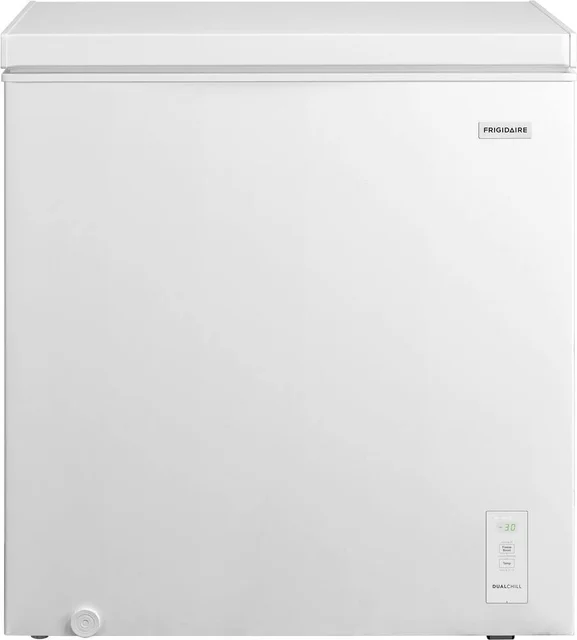
The sweet-spot size: garage-rated, easy to organize, and priced for most families.
Best for: The typical family that wants meaningful extra storage in a garage or utility room without going oversized.
- Garage-ready temperature rating means it holds temp in an unconditioned space year-round
- 7 cu ft is enough for a family's overflow without dominating the room
- Removable basket and a front defrost drain make organizing and defrosting simpler
- Frigidaire's chest freezers draw consistently steady owner-satisfaction reports
- External dial control is basic, with no temperature alarm or light
- Manual defrost once or twice a year is still on you
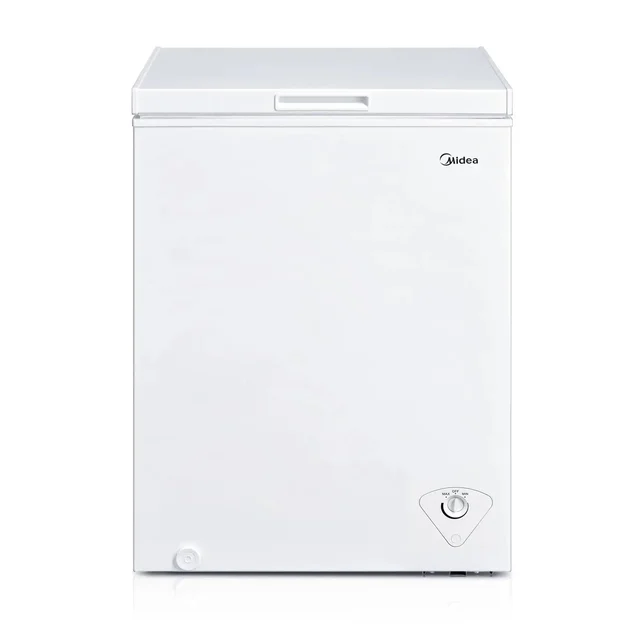
A tidy, quiet compact freezer that makes sense only if space and needs are modest.
Best for: Apartment dwellers or small households who want a little overflow in a climate-controlled space, not a garage anchor.
- Small 5 cu ft footprint fits an apartment, spare room, or tight garage corner
- Runs quietly and sips power, per owner reports
- Includes a hanging storage basket and an easy-access defrost drain
- Budget price makes it an easy first freezer
- Not marketed with the extreme-temperature garage rating the Hisense and Frigidaire carry, so a very hot or freezing garage is a gamble
- 5 cu ft fills up fast once you start batch-buying
- Basic dial control, no alarm or light
Amazon had no buyable listing for this when we last checked. The link still works if it returns.
Check price on Amazon Read our detailed assessment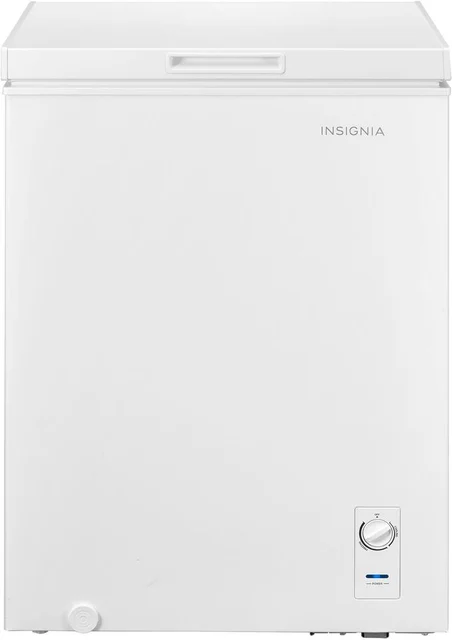
A fine-on-paper house-brand unit that offers no real edge and a rockier delivery record.
Best for: Really only worth it if it is deeply discounted and you can inspect it in person before taking it home.
- Garage-ready rating in a compact 5 cu ft size
- Quiet in normal use and simple to operate
- Defrost drain included
- Recurring owner reports of dents and shipping damage on arrival
- House-brand support and parts availability are thinner than the major brands
- No feature or price advantage over the Midea or a small Frigidaire at the same size
| Criteria | Hisense 17.7 cu. ft. Garage Ready Chest Freezer (CFC177M6AWD) Top pick | Frigidaire 7.0 cu. ft. Garage-Ready Chest Freezer (FFCS0762AW) | Midea 5.0 cu. ft. Chest Freezer (MRC050S0AWW) | Insignia 5.0 cu. ft. Garage-Ready Chest Freezer (NS-CZ50WH26L) |
|---|---|---|---|---|
| Verdict | Buy it | Buy it | It depends | Skip it |
| Best for | Households buying in bulk, hunters, gardeners, or anyone who wants one very large freezer for the garage. | The typical family that wants meaningful extra storage in a garage or utility room without going oversized. | Apartment dwellers or small households who want a little overflow in a climate-controlled space, not a garage anchor. | Really only worth it if it is deeply discounted and you can inspect it in person before taking it home. |
| Price tier | $$$ · premium | $$ · mid-range | $ · budget | $ · budget |
| Capacity | 17.7 cu ft | 7.0 cu ft | 5.0 cu ft | 5.0 cu ft |
| Best placement | Garage or basement | Garage or utility room | Conditioned space | Garage (with caveats) |
| Garage temp rating | Garage ready in freezer mode (0°F to 110°F) | Garage-ready | Not extreme-temp rated | Rated for garage use |
| Defrost | Manual defrost | Manual, with drain | Manual, with drain | Manual, with drain |
| Extra features | LED light, 2 sliding baskets, lock | Removable basket | Hanging basket | Defrost drain only |
| Energy | Not listed as ENERGY STAR on the maker page | Efficient for size | Low draw | Low draw |
| Support / track record | Major global brand | Major brand, steady | Budget brand, decent | House brand, mixed delivery |
| Price tier | $$$ · premium | $$ · mid-range | $ · budget | $ · budget |
Which one is right for you?
- Households buying in bulk, hunters, gardeners, or anyone who wants one very large freezer for the garage. Buy it Hisense 17.7 cu. ft. Garage Ready Chest Freezer (CFC177M6AWD)
- The typical family that wants meaningful extra storage in a garage or utility room without going oversized. Buy it Frigidaire 7.0 cu. ft. Garage-Ready Chest Freezer (FFCS0762AW)
- Apartment dwellers or small households who want a little overflow in a climate-controlled space, not a garage anchor. It depends Midea 5.0 cu. ft. Chest Freezer (MRC050S0AWW)
- Really only worth it if it is deeply discounted and you can inspect it in person before taking it home. Skip it Insignia 5.0 cu. ft. Garage-Ready Chest Freezer (NS-CZ50WH26L)
How we judged the field
We do not run our own appliance lab. Instead we synthesize independent testing, manufacturer specifications, and the pattern of owner reports across thousands of reviews, then weight the things that genuinely separate a good chest freezer from a mediocre one.
For a category this simple, four criteria did most of the work. Temperature rating came first: a chest freezer usually lives in a garage or basement, so whether it is rated to run in extreme heat or cold is the single most important spec. Capacity and footprint came next, because the most common regret owners voice is buying too small. Then defrost and drainage, since every unit here is manual-defrost and a built-in drain turns a wet chore into a quick one. Finally we weighed track record and support, favoring brands whose owners consistently report units that arrive intact and keep cycling for years.
We deliberately did not chase gimmicks. Chest freezers reward boring reliability, so a temperature alarm and an interior light are the only extras we treated as meaningful, and we note which units have them.
Hisense 17.7 cu. ft. Garage Ready Chest Freezer (CFC177M6AWD)
Buy itIf you actually stock up, this is the one to beat. The 17.7 cu ft interior handles a bulk meat order, a hunting season, or a summer of garden produce without forcing you to play freezer Tetris. It is also sold as garage ready: the maker says it is designed and tested to perform in ambient temperatures from 0°F to 110°F in freezer mode, which is a published range rather than just a phrase on the box. Note that the garage rating applies in freezer mode, because this model can also be switched to fridge duty with the knob.
Inside you get an LED light, two removable sliding baskets, and a lock and key. The maker spec sheet lists a mechanical control and manual defrost, and it does not list a door-open alarm, so you give that up compared with some rivals. It also does not list ENERGY STAR certification. The trade-offs are the obvious ones for a big chest unit: at about 65 inches wide it needs a dedicated wall, and manual defrost is a larger job at this size. Neither is a dealbreaker if you have the space.
Frigidaire 7.0 cu. ft. Garage-Ready Chest Freezer (FFCS0762AW)
Buy itFor most families, this is the smarter buy. At 7 cu ft it holds a serious amount of overflow, roughly a couple hundred pounds of frozen food, yet it does not dominate a garage or utility room the way a 15 cu ft box does. It carries the same garage-ready rating that matters most, so it keeps temperature in an unconditioned space through summer and winter.
Inside, a removable basket keeps small items reachable, and a front defrost drain makes the once-or-twice-a-year defrost quick. Owner reports on Frigidaire’s chest freezers are steady and unremarkable in the best way, which is exactly what you want from an appliance that should quietly work for a decade. You give up the interior light of the Hisense, and the control is a simple external dial, but for the size-to-value ratio this is the everyday pick.
Midea 5.0 cu. ft. Chest Freezer (MRC050S0AWW)
It dependsThe Midea is a genuinely likable little freezer, and whether it is right for you comes down to one question: where will it live? At 5 cu ft it slips into an apartment, a spare room, or a tight corner, and owners describe it as quiet and easy on electricity. It ships with a hanging basket and a defrost drain, and at a budget price it is an easy first freezer.
The catch is that it is not marketed with the extreme-temperature garage rating the Hisense and Frigidaire carry. In a climate-controlled space that is a non-issue, but in a garage that swings from freezing to sweltering it is a gamble. And 5 cu ft fills up faster than people expect once they start buying in bulk. If you have a conditioned spot and modest needs, it is a fine buy; if you were planning to park it in a harsh garage or stock up heavily, size and rate up instead.
Insignia 5.0 cu. ft. Garage-Ready Chest Freezer (NS-CZ50WH26L)
Skip itOn paper the Insignia looks competitive: a garage-ready rating in a compact 5 cu ft size, quiet operation, and a defrost drain. In practice it does not give you a reason to choose it. Owner reports include a recurring thread of dents and shipping damage on arrival, and as a retailer house brand its long-term parts and support picture is thinner than the major names.
Most tellingly, it has no feature or price edge over the alternatives. At the same size and price you can get the Midea for a conditioned space, or step to a small garage-ready Frigidaire for a garage. Unless you find it deeply discounted and can inspect it in person before buying, there is no compelling case here.
Hisense 17.7 cu ft vs Frigidaire 7.0 cu ft: which should you buy?
This is really a question about how you shop and how much room you have. Both are garage-ready and both are manual-defrost, so the basic approach is the same. The Hisense wins on capacity and features: 17.7 cu ft, plus an interior light, two sliding baskets, and a lock that make daily use nicer. If you buy meat by the quarter-cow, hunt, garden, or simply hate running out of freezer space, it is worth the premium and the wall it occupies.
The Frigidaire wins on fit and value. Seven cubic feet is plenty for a family’s overflow, it costs meaningfully less, and it tucks into a garage or utility room without taking over. You lose the light and the extra capacity, but you gain a right-sized box that most households will never outgrow. Short version: buy the Hisense if you stock up in bulk and have the space; buy the Frigidaire if you want the sensible, garage-ready everyday freezer.
What to look for
- A genuine garage rating if the freezer will live anywhere unconditioned. This is the spec that most often makes or breaks real-world performance.
- The right capacity for how you shop. Five cubic feet suits apartments and light overflow, seven covers most families, and fifteen-plus is for bulk buyers, hunters, and gardeners. When in doubt, size up.
- A built-in defrost drain. The Frigidaire, Midea, and Insignia are described as having one, while the Hisense spec sheet does not list it; it turns manual defrosting from a mopping job into a quick task.
- A temperature alarm and interior light if you can get them. They are the only extras that genuinely earn their keep on a chest freezer.
- A solid brand track record, because the parts that fail on these, the lid seal and the compressor, are exactly where reputation matters.
Our final take
Chest freezers are one of the few appliance categories where boring is the whole point, and the winners here win by nailing the basics. The Hisense 17.7 cu ft is our overall pick for anyone who truly stocks up: a stated garage temperature range, a big honest interior, and an interior light that makes a large freezer pleasant to live with. If that is more than you need, the garage-ready Frigidaire 7.0 is the value pick for most families, offering the same core reliability in a size that fits real homes. The compact Midea earns a conditional recommendation for climate-controlled spaces and tight budgets, while the Insignia is the one we would pass on, since it asks the same money for less confidence. Decide on placement and size first, and the right freezer on this list picks itself.
Questions, answered
Are chest freezers really more efficient than upright freezers?
Generally yes. Cold air sinks, so when you open a chest freezer's top lid, less of it spills out than when you open an upright's front door. That, plus thicker insulation on many models, is why chest freezers tend to hold temperature well and run efficiently, especially in a garage.
What does 'garage-ready' actually mean?
It means the freezer is rated to keep food frozen even when the surrounding air is very hot or very cold, across a wide range. A freezer that is not garage-rated can struggle or stop cycling correctly in an unheated garage in winter or a sweltering one in summer, which is exactly where most people want to put a chest freezer.
Do I have to defrost these manually?
Almost certainly, yes. Nearly all chest freezers, including all four here, are manual-defrost. In exchange for that occasional chore you get simpler, more reliable cooling and usually lower running cost. A built-in defrost drain, which most of these models are reported to have, makes the job much less messy.
What size chest freezer should I buy?
Match it to how you shop. A 5 cu ft unit suits an apartment or light overflow; 7 cu ft covers most families; and 15 cu ft or more makes sense if you buy meat in bulk, hunt, or garden. It is easy to underestimate, so if you are between sizes and have the floor space, sizing up usually pays off.
How long will food stay frozen if the power goes out?
A full chest freezer that stays closed typically keeps food frozen for a couple of days, and a half-full one for about a day, because the frozen mass itself acts as a cold reservoir. Keep the lid shut, and consider a simple appliance thermometer so you can judge food safety when power returns.
Deciding between the top two? See our head-to-head: Hisense 17.7 cu. ft. Garage Ready Chest Freezer (CFC177M6AWD) vs Frigidaire 7.0 cu. ft. Garage-Ready Chest Freezer (FFCS0762AW).
More Home & Kitchen reviews
 The Best Clothes Drying Racks: 4 Compared (and One to Skip)
  The Best Mini Fridges: 4 Compared (and One to Skip)
  The Best Panini Press: 4 Compared (and One to Skip)
  The Best Portable Induction Cooktops: 4 Compared (and One to Skip)
  The Best Portable Washing Machines: 4 Compared (and One to Skip)
  The Best Soda Makers: 4 Compared (and One to Skip)