Explained
Cocktail Shakers, Explained
After reading, you'll understand why bar shakers have no lid, and how to size a shaker for the drinks you actually make.
In this guide
Cocktail shakers are one of the few kitchen tools where the professional version is simpler and often cheaper than the consumer one. Bars use two plain metal tins and strain with a separate tool. Home shakers add a cap, a strainer and sometimes a measure, and every one of those additions is a place where things stick, clog or leak. Understanding the three shaker types and how capacity works once ice is in the tin tells you most of what you need.
The 30-second version
- Capacity is about ice, so an 18 oz shaker is a one-drink tool and 28 oz is where two drinks live.
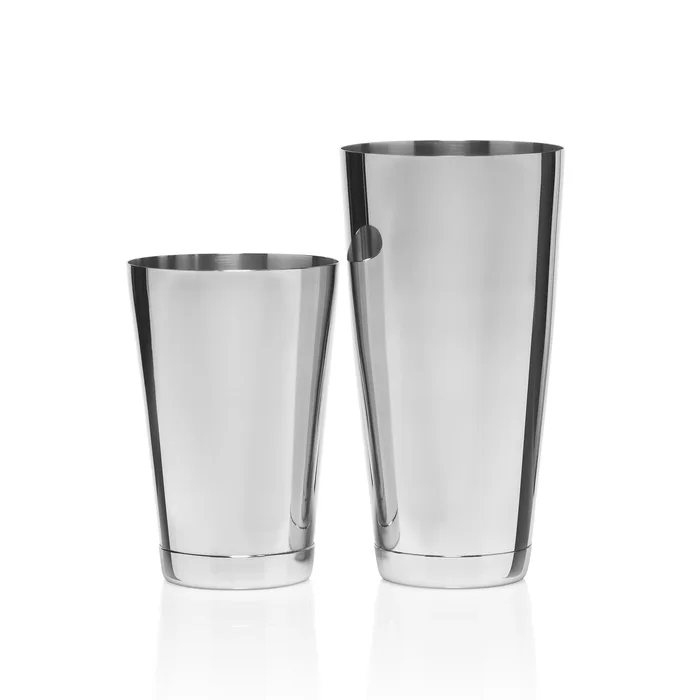
- Boston means two tins, with straining and measuring handled by separate tools.
- Cobbler means a built-in strainer, which is convenient until pulp or mint blocks it.
- Cold makes lids stick, because air inside contracts and pulls a friction-fit cap tight.
- Weighted bases steady the pour, and laser-welded ballast is sealed in rather than attached to the outside.
The products this guide is about
Our verdict on each, with the full reasoning on the companion review.
- Buy Cocktail Kingdom Koriko Weighted Shaking Tins, Set Two weighted stainless tins with no gasket, thread or built-in strainer, which is why bars have used this design for decades.
- Buy Uber Bar Tools Boston & Toby Tin Shaker Set, Chrome The same two-tin design with every number published and a lifetime guarantee, which is rare anywhere in this category.
- It depends Elevated Craft The Original Hybrid Cocktail Shaker A threaded, vacuum-insulated shaker with a built-in strainer and a measuring top, which replaces three tools if you can twist it open.
- Skip Viski Alchemi Vacuum Insulated Cocktail Shaker An 18 oz all-in-one cobbler that runs out of room the moment you add ice, with no dimensions, weight or warranty published.
What actually matters
- Total capacity - the number that decides how many drinks you can make at once. Because a proper shake fills the vessel with ice, the usable liquid space is a fraction of the stated volume, and 28 ounces is the working standard for a large tin.
- Seal type - friction-fit, tin-on-tin or threaded. Friction-fit caps on cobbler shakers are the ones that seize when cold, tin-on-tin is struck apart deliberately, and threads with a gasket avoid the problem at the cost of more cleaning.
- Part count - each additional component is another surface that touches the drink and another thing to dry. A two-tin set has two parts; an integrated shaker can have four or five including a gasket.
- Built-in versus separate strainer - a built-in strainer is one less tool to own and cannot be replaced or swapped for a finer mesh. A separate Hawthorne can be cleaned properly and changed.
- Weighted base - ballast in the bottom of a tin lowers the centre of gravity, which makes pouring steadier and the tin feel more solid. Sealed or welded ballast is more durable than an attached base.
- Material and finish - 304 stainless is the standard and will not transfer flavour. Plated finishes in chrome, gold or copper look good and mark more easily than bare steel over years of washing.
- Insulation - double-wall vacuum construction slows dilution and protects your hands, and it removes the external frost that many people use as their signal that a drink is ready.
The specs, in plain English
Green flags vs red flags
Green flags
- Capacity stated for each vessel in both ounces and millilitres.
- A large tin of roughly 28 oz, which is the working size for two drinks.
- A weighted base described as welded or sealed rather than attached.
- Stainless grade named, ideally 304.
- A published warranty or guarantee you can read in full.
Red flags
- A single total capacity under about 20 oz sold as an all-in-one shaker.
- A silicone seal or gasket with no replacement part offered.
- No dimensions and no weight published anywhere on the page.
- Photographs showing the shaker full of liquid with no ice in it.
- A built-in strainer with no description of the hole pattern or how to clean it.
Who's who: the brands
- Cocktail Kingdom - Supplies working bars worldwide, with Koriko as its house line of tins and Usagi as its cobbler range.
- Uber Bar Tools - British bar tool maker that publishes unusually complete specifications and backs its tins with a lifetime guarantee.
- Elevated Craft - Known for the threaded, vacuum-insulated hybrid shaker with a built-in measuring top, aimed squarely at home use.
- Viski - Home barware brand offering a wide range of gift-oriented shakers, strainers and glassware.
How to read a listing without getting fooled
Find the capacity first and mentally fill the vessel with ice before you judge it, because that is what the number has to accommodate. If a shaker lists one total figure under about twenty ounces, it is a single-drink tool no matter what the photographs suggest. Next identify the type from the description rather than the name: two vessels means Boston, a built-in strainer and cap means cobbler, threads and a gasket means a hybrid. Then count the parts that touch the drink and ask yourself which of them you would have to replace if it perished. Check whether the stainless grade is stated, since 304 is the standard. Finally look for a warranty, which in this category is rare enough to be a real differentiator.
How much should you spend?
Budget gets you a serviceable cobbler shaker, and the compromises are usually capacity, a thin gauge of steel and a cap that sticks. A plain pair of unweighted tins also sits in this tier and is a far better tool than a cheap cobbler. The mid-range is where the good tin sets live, with weighted bases, proper quality control on the flex of the tin, and occasionally a lifetime guarantee, and this is where most people should buy. Premium pricing buys integration rather than better shaking: insulation, built-in measures, threaded lids and stocked replacement parts. That is a reasonable thing to pay for if you want one object on the counter instead of three in a drawer, but it does not make a better drink than two tins and a Hawthorne.
Questions, answered
Do I need a shaker at all, or can I stir?
It depends on the drink. Anything containing citrus, egg white, cream or fruit juice needs shaking, because shaking aerates and emulsifies as well as chilling. Spirit-only drinks are traditionally stirred, since shaking them aerates a drink that is supposed to be silky and clouds the appearance. A mixing glass and a bar spoon cover the stirred half of the repertoire, so a full kit is a shaker, a mixing glass, a strainer and a jigger.
How long should I shake for?
Around ten to fifteen seconds of hard shaking with plenty of fresh ice is the usual guidance for a citrus drink, and the traditional signal is frost forming on the outside of the tin. That signal disappears on an insulated shaker, so if you buy one you will need to count instead. Shaking longer does not make a drink colder past a point; it mostly adds water. Using more ice rather than less actually reduces dilution, because the ice melts more slowly.
What ice should I use in a shaker?
Plenty of it, and as cold and solid as you can get. Filling the tin with ice means each cube warms less, which means less melting and less water in the finished drink. Small, wet ice from a freezer tray melts fast and waters drinks down. If you are serious about it, bigger cubes straight from the freezer are the practical home upgrade, and it matters far more than which shaker you own.
How do I open a stuck tin or cap?
On a tin-on-tin set, hold the seam where the tins meet and strike the larger tin firmly with the heel of your hand at the point where the seal is widest, which flexes the metal and breaks the vacuum. On a cobbler shaker, warm the joint briefly in your hand rather than banging it on the counter, which is how tins get dented and lids get deformed. Threaded shakers avoid the issue, and some makers suggest venting by loosening the small cap before removing the main top.
Or jump to the head-to-head: Cocktail Kingdom Koriko Weighted Shaking Tins, Set vs Uber Bar Tools Boston & Toby Tin Shaker Set, Chrome.