

Home & Kitchen
The Best Chainmail Scrubbers for Cast Iron: 4 Compared (and One to Skip)
We compared four chainmail scrubbers on what their makers actually publish: stainless grade, whether the rings are welded or butted, working size, dishwasher guidance, and which cookware the maker says the pad is for.
The short version
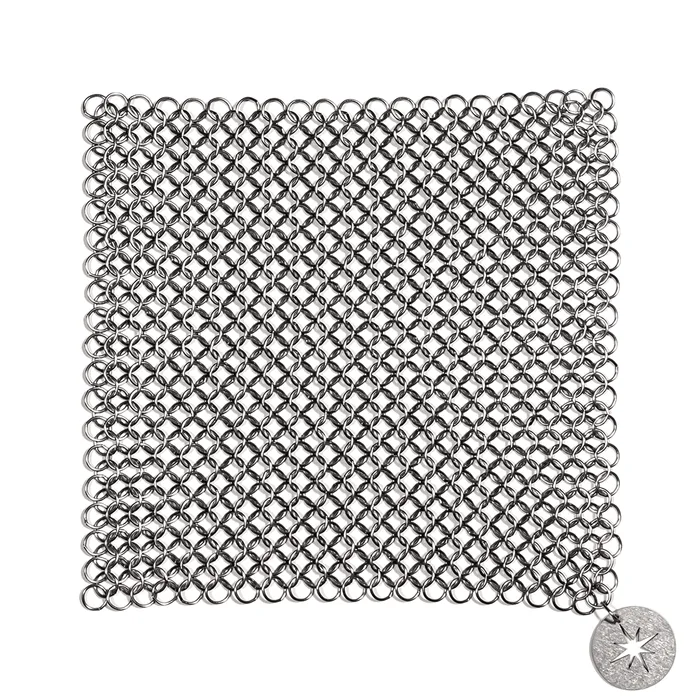
The Stargazer Chain Mail Scrubber wins because it is the only pad here whose maker states both the alloy and the joint: 304 stainless with welded rings, made in the USA, at 5.3 by 5.3 inches. The Field Company Chain Mail Scrubber is the value pick, a USA-made 304L pad with a finer mesh and no hooks or hardware woven into it, which suits smooth machined skillets. The Lodge Chainmail Scrubbing Pad wraps 304 mail around a silicone core, so it is far easier to hold and far harder to rinse clean between the rings, which makes it a grip decision rather than a cleaning one. Skip the Smithey Chainmail Scrubber: it is a fine pad from a good brand, but its page lists the material only as stainless steel with no grade and says nothing about how the rings are joined, at the same tier as pads that tell you. One thing the maker pages point to and many buyers get wrong: none of these belong on enameled cookware, and modern dish soap is not the enemy of seasoning. Best for: anyone who cooks on bare cast iron or carbon steel and wants stuck-on food gone in seconds without a wire brush.
Our picks at a glance
- Stargazer Cast Iron Chain Mail Scrubber - Buy. The only pad here whose maker states the rings are welded, in 304 stainless, made in the USA.
- Field Company Chain Mail Scrubber - Buy. A finer USA-made 304L mesh with no hooks or hardware woven in, aimed at smooth machined pans.
- Lodge Cast Iron Chainmail Scrubbing Pad - It depends. 304 mail wrapped on a silicone core, which is much easier to hold and much harder to rinse out between the rings.
- Smithey Ironware Chainmail Scrubber - Skip. A good-looking pad from a good brand that publishes less about its own construction than anything else here.
The verdict in 30 seconds
What mattered most
- Stainless grade stated
- Ring joint stated
- Size (maker stated)
- Construction
- Dishwasher safe (maker)
- Where made
A chainmail scrubber is a small square of stainless steel rings that lifts stuck food off bare cast iron without stripping the seasoning underneath. It is one of the few kitchen tools where the entire argument comes down to two facts, the alloy and how the rings are closed, and most brands publish neither. So we went through the manufacturer pages rather than the marketing, and ranked the field on disclosure as much as on feel. Four pads made the cut, including one built around a silicone core and one we would not buy.
The only pad here whose maker states the rings are welded, in 304 stainless, made in the USA.
Best for: Anyone buying one scrubber for one bare cast iron skillet who wants the construction detail stated before they pay.
- Stargazer's page states 304 stainless steel with welded rings, which is the joint that helps stop rings pulling open in use.
- At 5.3 by 5.3 inches it is the largest bare mail pad in this group, so you can fold it over your fingers and still cover a pan wall.
- Stargazer tells you to clean the scrubber itself by putting it in the dishwasher, so the maintenance routine is on the record.
- No published ring diameter or wire gauge, so you cannot compare its mesh with another pad on paper.
- Bare mail with no core or handle, which gets slippery once it is coated in grease.
- Stargazer lists it for cast iron and does not extend the claim to enameled cookware.
- Sits above the cheapest pads in the category for a piece of steel mesh.
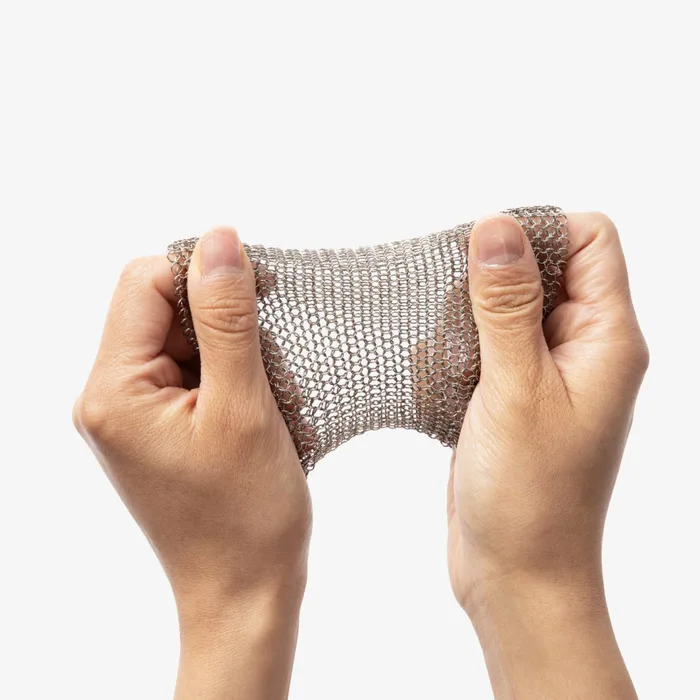
A finer USA-made 304L mesh with no hooks or hardware woven in, aimed at smooth machined pans.
Best for: Owners of smooth, machined skillets who want the plainest possible pad and the lowest tier in the group.
- Field states 304L stainless steel, made in the USA, measuring 4 by 5 inches.
- Field deliberately leaves out hooks and hardware, which it says could scratch your seasoning.
- The mesh is finer than the usual pad, which Field ties specifically to smooth, machined cast iron surfaces.
- Field does not say whether the rings are welded or butted.
- No dishwasher-safe statement on the product page, unlike three of the four pads here.
- The no-hardware build also means no hanging loop, so you need somewhere for it to drain.
- Finer mesh is a relative claim with no published ring size behind it.
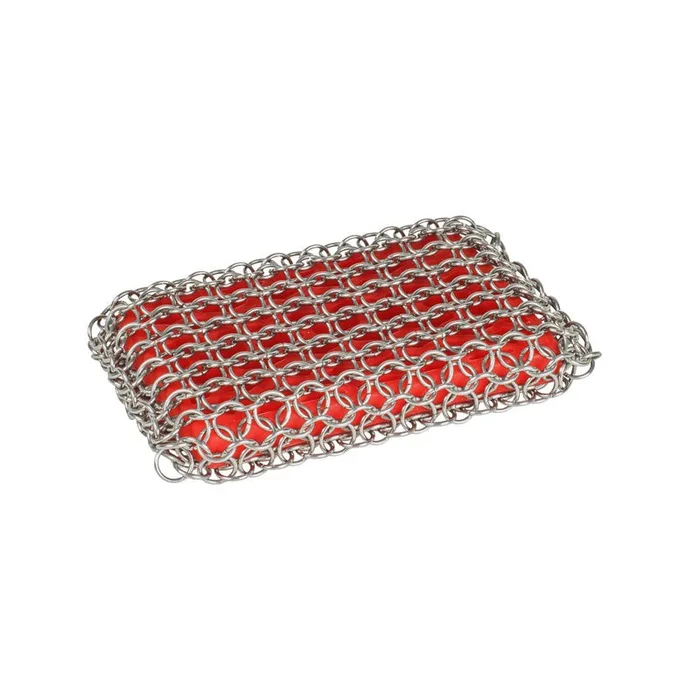
304 mail wrapped on a silicone core, which is much easier to hold and much harder to rinse out between the rings.
Best for: Cooks with weak grip or arthritic hands, and anyone who dislikes wrestling a loose handful of metal over a sink.
- Lodge states durable 304 stainless chainmail with a silicone core, and calls the pad dishwasher safe.
- The ergonomic silicone core gives you something rigid to push against on baked-on food.
- Lodge publishes the pad's dimensions and weight and lists it for both its cast iron and its carbon steel cookware.
- The core traps water and food where the mail meets the silicone, so rinsing is less thorough than with a bare pad.
- At 4.33 by 3 inches it has the smallest working face of the four.
- Lodge's own cast iron cleaning FAQ says it does not recommend steel wool or a metal scrubber for daily cleanup, which sits awkwardly beside this listing.
- Made in China, unlike the two USA-made pads here.
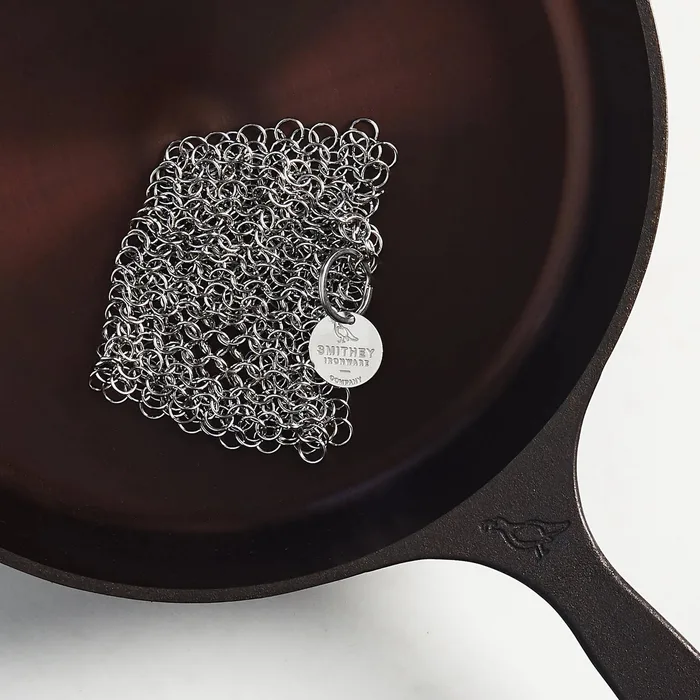
A good-looking pad from a good brand that publishes less about its own construction than anything else here.
Best for: Smithey owners who want the matching accessory and genuinely do not care what the steel is.
- Smithey states the pad is dishwasher safe and answers the seasoning question directly in its product FAQ.
- At 5 by 5 inches it matches the larger pads in this group for coverage.
- Smithey says it is designed for use on both cast iron and carbon steel cookware.
- The material is listed only as stainless steel, with no grade, while pads at the same tier publish 304 or 304L.
- No statement on whether the rings are welded or butted, which is the joint that fails first.
- It is sold with a logo on the mail, while a competing maker builds its pad with no hardware because it says hooks and hardware could scratch seasoning.
- Smithey notes the pad is sourced from China, so you are paying for the badge rather than for disclosed materials.
| Criteria | Chain Mail Scrubber Top pick | Chain Mail Scrubber | Chainmail Scrubbing Pad | Chainmail Scrubber |
|---|---|---|---|---|
| Verdict | Buy it | Buy it | It depends | Skip it |
| Best for | Anyone buying one scrubber for one bare cast iron skillet who wants the construction detail stated before they pay. | Owners of smooth, machined skillets who want the plainest possible pad and the lowest tier in the group. | Cooks with weak grip or arthritic hands, and anyone who dislikes wrestling a loose handful of metal over a sink. | Smithey owners who want the matching accessory and genuinely do not care what the steel is. |
| Price tier | $$ · mid-range | $ · budget | $$ · mid-range | $ · budget |
| Stainless grade stated | 304 | 304L | 304 | Not stated |
| Ring joint stated | Welded rings | Not stated | Not stated | Not stated |
| Size (maker stated) | 5.3 x 5.3 in | 4 x 5 in | 4.33 x 3 in pad | 5 x 5 in |
| Construction | Bare mail | Bare mail, no hardware | Mail on silicone core | Bare mail with logo |
| Dishwasher safe (maker) | Yes | Not stated | Yes | Yes |
| Where made | USA | USA | China | Sourced from China |
| Ring size or wire gauge published | No | No, finer mesh claimed | No | No |
| Cookware the maker lists | Cast iron | Cast iron skillets | Cast iron, carbon steel | Cast iron, carbon steel |
Which one is right for you?
- Anyone buying one scrubber for one bare cast iron skillet who wants the construction detail stated before they pay. Buy it Stargazer Cast Iron Chain Mail Scrubber
- Owners of smooth, machined skillets who want the plainest possible pad and the lowest tier in the group. Buy it Field Company Chain Mail Scrubber
- Cooks with weak grip or arthritic hands, and anyone who dislikes wrestling a loose handful of metal over a sink. It depends Lodge Cast Iron Chainmail Scrubbing Pad
- Smithey owners who want the matching accessory and genuinely do not care what the steel is. Skip it Smithey Ironware Chainmail Scrubber
How we judged the field
Five things decide whether a chainmail scrubber is worth owning. First, the alloy: 304 and 304L stainless are the standard for kitchen tools that live wet, and 316 adds more corrosion resistance, so a listing that just says stainless steel is telling you less than it could. Second, how the rings are closed, because a butted ring that is bent shut can work open under pressure and start unravelling the mail, while a welded or soldered ring is far less likely to. Third, working size, since a pad you can fold over two fingers and still cover the wall of a large skillet beats a small one. Fourth, whether the maker publishes cleaning guidance for the scrubber itself, because the failure mode nobody mentions is food lodged between rings. Fifth, what the maker actually says the pad is for, which is how you find out that none of them intend it for enamel.
The field splits three ways. There are the bare pads from cast iron makers, which is where the disclosure is best and where both of our buy picks come from. There are the silicone-core pads, which trade rinsing access for grip and which Lodge dominates. And there is a long tail of unbranded and lightly branded mail where the alloy is a mystery. We took the two most transparent bare pads, the most widely sold silicone-core pad, and one well-liked pad from a premium cookware brand that tells you noticeably less about its own product than its competitors do.
Stargazer Cast Iron Chain Mail Scrubber
Buy itStargazer is the only maker in this group that puts the joint on the record. Its page states 304 stainless steel with welded rings, made in the USA, at 5.3 by 5.3 inches, and its FAQ tells you to clean the scrubber by running it through the dishwasher. That matters because ring closure is the failure mode for this whole category: rings that are simply bent shut can spring open under load, and once one opens it snags and takes its neighbours with it. Welded rings are far less prone to it. The pad is also the largest bare mail here, which sounds trivial until you are working the wall of a big skillet and want to fold the mail over your fingers for reach. What Stargazer does not publish is ring diameter or wire gauge, so you cannot line its mesh up against a rival’s on paper, and bare mail is genuinely slippery once it is greasy. For most people buying one scrubber for one pan, this is it.
Field Company Chain Mail Scrubber
Buy itField takes a different approach to disclosure. It names the alloy, 304L stainless, and where it is made, the USA, but says nothing about how the rings are joined. What it does publish is a design decision, and an unusually specific one. Field builds the pad with no hooks and no hardware, on the grounds that those are the parts that could scratch your seasoning, and it uses a finer mesh that it ties directly to smooth, machined cast iron of the kind it sells. On a polished pan that difference is real, because coarser mail chatters across a machined surface instead of gliding. The pad measures 4 by 5 inches. The trade-offs are the flip side of the same choices: no hardware means no hanging loop, so you need somewhere for it to drain, there is no dishwasher-safe claim on the product page, and finer mesh is a relative claim with no ring size behind it. It is the pick for a smooth pan and the lowest tier here.
Lodge Cast Iron Chainmail Scrubbing Pad
It dependsLodge’s version is not a bare pad. It is 304 chainmail wrapped around a silicone core, 4.33 by 3 inches, and Lodge calls it dishwasher safe and lists it for both its cast iron and its carbon steel cookware. The core is the whole argument. You get something rigid to push against, which makes short work of baked-on food and matters a great deal if your hands are weak or arthritic, and you are not holding a slippery handful of loose metal over a hot sink. The cost is hygiene. Water and food work into the seam where the mail meets the silicone, and unlike a bare pad you cannot open it out flat and blast it clean. It also has the smallest working face of the four. One honest wrinkle: Lodge’s own cast iron cleaning FAQ says it does not recommend steel wool or a metal scrubber for daily cleanup, and points you to a stiff-bristled brush instead. Buy this one for the grip, not because it cleans better.
Smithey Ironware Chainmail Scrubber
Skip itSmithey makes lovely cookware and this is a perfectly functional scrubber, which is exactly why the skip needs explaining. Its page gives you the size, 5 by 5 inches, says it is dishwasher safe, scopes it to cast iron and carbon steel, and answers the seasoning question directly in the FAQ. What it does not give you is the alloy. The material is listed only as stainless steel, with no grade, while pads at the same tier put 304 or 304L right on the page. There is no word on whether the rings are welded or butted either, which is the one detail that predicts whether the pad survives a year of hard use. The pad is sold with a logo on the mail, at a moment when a competing maker is deliberately building its pad with no hardware because it says hooks and hardware could scratch seasoning. Smithey also notes it is sourced from China. If you want the matching accessory, fine. If you want to know what you are buying, look elsewhere.
Sources
Specs in this review come from these pages.
- Lodge Cast Iron - Chainmail Scrubbing Pad product page (lodgecastiron.com)
- Lodge Cast Iron - How to Clean Cast Iron (lodgecastiron.com)
- Lodge Cast Iron - Cleaning and Care: Enameled Cast Iron (lodgecastiron.com)
- Stargazer Cast Iron - Chain Mail Scrubber product page (stargazercastiron.com)
- Field Company - Chain Mail Scrubber product page (fieldcompany.com)
- Smithey Ironware - Chainmail Scrubber product page (smithey.com)
Stargazer Cast Iron Chain Mail Scrubber vs Field Company Chain Mail Scrubber: which should you buy?
Stargazer and Field are both USA-made pads in the 304 family and both will clean your skillet fine, so choose on two things: your pan’s surface and how much you care about the ring joint. Stargazer is the safer buy on paper, because it is the only one of the four that says welded rings out loud, and it gives you the most mail to work with at 5.3 by 5.3 inches. Field is the finer mesh and the smaller pad at 4 by 5 inches, built with no hooks or hardware anywhere on it, and its pitch is explicitly about smooth, machined cast iron rather than the pebbly texture of a mass-produced skillet.
So: if your pan is a standard sand-cast skillet with a textured cooking surface, or you own several pans and want one pad that handles all of them, take the Stargazer. If your skillet is machined smooth, take the Field, and accept that you are trading a published ring-joint spec for a mesh that suits your surface better and a lower price tier. Neither is a mistake. If you cannot decide, the Stargazer answers more questions about itself, and that is a reasonable tiebreaker in a category where most brands answer none.
What to look for
- Named alloy, not just ‘stainless’: 304 and 304L are the normal kitchen grades and 316 adds corrosion resistance, so a listing that will not name a grade is choosing not to tell you.
- Welded or soldered rings: a butted ring is bent shut and can work open under scrubbing pressure, which is how a pad starts unravelling, so treat a stated weld as the single best signal in the category.
- Enough mail to fold: roughly five inches square lets you fold the pad over two fingers and still reach a pan wall, while a small pad forces you to press with your palm.
- A stated cleaning routine for the scrubber: most makers here say dishwasher, and one says nothing at all, which tells you how much thought went into the food that lodges between rings.
- The cookware list on the page: every maker in this comparison scopes its pad to bare cast iron or carbon steel, and none of them lists enameled cookware, which is your answer about the Dutch oven.
- No hardware on the mail: hooks, tags and stamped badges are the parts that sit proud of the rings, and at least one maker builds its pad without them specifically because they could scratch seasoning.
Our final take
Buy the Stargazer if you want the most information and the most mail: 304 stainless, welded rings, made in the USA, and a maker that tells you to run it through the dishwasher. Buy the Field if your skillet is machined smooth, because the finer mesh and the hardware-free build are aimed at exactly that surface, and it sits at the lowest tier here. Take the Lodge only if grip is the problem you are solving, because the silicone core that makes it comfortable also makes it the hardest of the four to rinse properly. And skip the Smithey, not because it is bad, but because at the same tier you can have the alloy and the ring joint stated on the page.
Questions, answered
Will a chainmail scrubber strip the seasoning off my skillet?
Every maker here says no, and phrases it the same way: the mail lifts stuck food while leaving the seasoning alone. Lodge's listing says it removes stubborn food without removing seasoning, Stargazer says its welded rings scrub off stuck-on food while being gentle on seasoning, and Smithey's FAQ says the rings will not damage the seasoning layer. Worth knowing that none of them draws a technical line between food residue and the hardened seasoning layer underneath, so this is a claim about normal use rather than a guarantee. It is also true that Lodge's general cast iron cleaning FAQ says it does not recommend steel wool or a metal scrubber for daily cleanup, and recommends a stiff-bristled brush or scrubbing pad instead. In practice, scrub with light pressure and let the rings do the work rather than leaning on the pan.
Can I use one on an enameled Dutch oven?
No, and the makers are consistent about this even though none of them says the word chainmail in the warning. Lodge, which sells both enameled cookware and a chainmail pad, lists that pad for its cast iron and carbon steel cookware only, and its enameled cast iron care page tells you to use a sponge, everyday scrub cloth, or scrub brush with a gentle dish soap. The same page warns that metal can scratch the enamel finish. Smithey, Stargazer and Field all scope their pads to bare cast iron or carbon steel too. Enamel is a glass surface bonded to iron, and once it is scratched or chipped there is no repairing it, so keep the mail for bare pans and use a plastic scraper and soak for enamel.
Do I have to avoid dish soap on cast iron?
You do not, and the manufacturers say so plainly. Lodge's cleaning guide answers the question directly: soap is totally okay, because the soap we use for washing dishes today is no longer strong enough to remove seasoning from cast iron, and it is an easy way to prevent build up. Field's care guidance says the same thing in fewer words, telling you to soap up if you want to because your cast iron can handle it. The old advice comes from an era of harsher lye-based soaps, not from modern dish detergent. What genuinely does cause trouble is water left sitting: Lodge warns that soaking, air drying, or the dishwasher can lead to rust.
How do I clean the scrubber itself?
Three of the four say the dishwasher. Stargazer's FAQ is the bluntest, telling you to just put it in the dishwasher. Smithey says the same and adds the sensible warning not to put your skillet in there with it. Lodge calls its pad easy to clean and dishwasher safe. Field does not make a dishwasher claim on its product page, so with that one you are on your own: rinse it under hot water with a squirt of dish soap and work the mail against itself until the water runs clear. Whichever you buy, open the mail out and let it dry properly rather than dropping it wet into a drawer, because trapped food between the rings is the real hygiene problem with this format.
Welded rings or butted rings, does it actually matter?
It is one of the most useful things to look for and few makers publish it. A butted ring is bent closed and left that way; a welded or soldered ring is fused shut. Under scrubbing pressure a butted ring can work open, and once one opens it catches on the pan and starts unravelling the mail around it. Stargazer is the only pad in this comparison whose maker states welded rings on the product page. Others in the wider category advertise the distinction openly, describing some models as machine soldered and others as having manually closed rings, which is butted by another name. If a listing says nothing at all, assume nothing.
Deciding between the top two? See our head-to-head: Stargazer Cast Iron Chain Mail Scrubber vs Field Company Chain Mail Scrubber.
More Home & Kitchen reviews
 The Best Charcoal Grills: 4 Compared (and One to Skip)
  The Best Charcoal Starters: 4 Compared (and One to Skip)
  The Best Charcuterie Boards: 4 Compared (and One to Skip)
  Best 8-Inch Chef's Knives: Our Honest Picks (and One to Skip)
  The Best Cocktail Shakers: 4 Compared (and One to Skip)
  The Best Cocktail Smokers: 4 Compared (and One to Skip)