Explained
Charcoal Starters, Explained
After reading, you'll know which method suits where you grill, how to size a chimney, and how to light charcoal safely without fluid.
In this guide
Charcoal needs to reach ignition temperature and then sustain it, and every product in this category is a different way of delivering that first burst of heat. The differences between them are less about how well they work than about what they need in order to work at all, which is what should decide your choice.
The 30-second version
- A chimney needs nothing but a match, which is why it works anywhere you can grill.
- Hot air and torches are the fast methods, and one of them needs a socket while the other needs gas.
- Capacity is the chimney specification that matters, measured in gallons or pounds of briquettes.
- Only a torch or hot air will light logs, so fire pits and offset smokers narrow the field.
- Everything here stays dangerously hot afterwards, and needs somewhere fireproof to cool down.
The products this guide is about
Our verdict on each, with the full reasoning on the companion review.
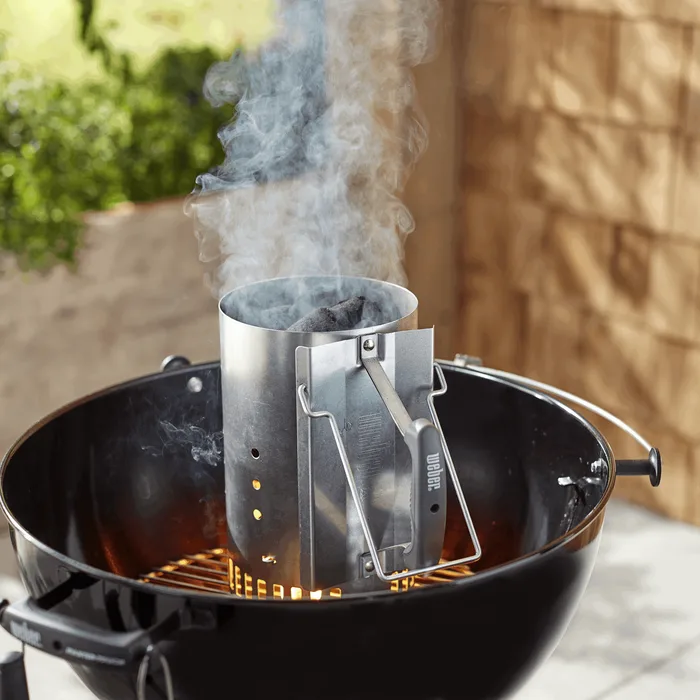
- Buy Weber Rapidfire Chimney Starter 1.6 gallons of aluminized steel that needs nothing but a match and ten minutes.
- Buy Looftlighter Pro Superheated air at 1400 degrees, no flame, no gas, no fluid, and a socket.
- It depends Oklahoma Joe's Charcoal Lighter 2.0 A 20,000 BTU propane torch with a safety trigger, for people who want a flame.
- Skip Char-Broil Electric Charcoal Starter A 550 watt element buried in the pile, which is the slow way to do this.
What actually matters
- Method - chimney convection, superheated air, propane flame or an electric element. Each has a different dependency and a different speed.
- Capacity - for a chimney, the volume in gallons and the weight of briquettes it holds, which determines whether one load fills your grill.
- Output rating - BTU for a gas torch, watts for an electric starter, air temperature for a hot-air lighter. These are not comparable with each other.
- Dependencies - mains power, propane canisters, or a separate ignition source such as newspaper or a paraffin cube.
- Fuel compatibility - whether it lights lump charcoal, briquettes, or logs as well, which matters for fire pits and stick burners.
- Safety design - heat shields, helper handles, safety triggers and whether there is an open flame at all.
- Build and materials - aluminized or stainless steel on a chimney, and whether the heating component is in contact with the fuel.
The specs, in plain English
Green flags vs red flags
Green flags
- A published capacity in gallons or pounds of briquettes.
- An output rating in the appropriate unit for the method.
- Fuel compatibility stated, including whether it lights logs.
- A described heat shield, helper handle or safety trigger.
- Materials named, particularly for anything that will be repeatedly heated.
Red flags
- Speed claimed as a multiple with no baseline stated.
- No capacity on a chimney starter.
- An electrical product with no cable length published.
- A gas product with no canister size or thread standard.
- No mention of how hot the tool gets or where to put it afterwards.
Who's who: the brands
- Weber - Makes the reference chimney starter in aluminized steel with a heat shield and helper handle, in standard and compact sizes.
- Looft - Swedish maker of the Looftlighter range, which ignites fuel with superheated air rather than flame, in corded and portable versions.
- Oklahoma Joe's - Smoker brand whose accessories include a 20,000 BTU propane firelighter and all-natural fire starter cubes.
- Char-Broil - Long-established grill maker offering a simple 550 watt electric element starter alongside its grills.
- Kingsford - The best-known briquette brand, whose charcoal is the usual reference for chimney capacity figures quoted in pounds.
How to read a listing without getting fooled
Decide first where you grill, because that eliminates half the category before you compare anything. No socket means a chimney or a torch. No interest in storing gas canisters means a chimney or a hot-air lighter. If you use a chimney, the only number worth finding is the capacity, in gallons and ideally in pounds of briquettes, because that tells you whether one load fills your grill or whether you will be doing it twice. For the powered and gas options, treat the output figure as a rough indication only, since watts, BTU and air temperature are not comparable with one another and nobody publishes a time to light. Then read the safety features properly, because three of these four leave you holding something hot enough to start a fire. And check fuel compatibility if you burn wood, since only two of the four will light a log.
How much should you spend?
This is a category where the cheapest option is also the one most people should buy. A chimney starter costs very little, lasts for years, needs no power or consumables beyond a lighter cube, and is what most experienced charcoal cooks use. Spending more buys speed and convenience rather than better results: a propane torch at mid-range money lights wood and damp fuel that a chimney struggles with, and a hot-air lighter at premium money removes the flame entirely and works in a couple of minutes, provided you have a socket. Electric coil starters sit at chimney money and deliver neither the independence nor the speed, which makes them hard to justify. If you grill often and the wait genuinely annoys you, the hot-air lighter is the upgrade worth making.
Questions, answered
How long should charcoal take to light?
None of these makers publishes a figure, which is telling. In general terms, a chimney takes somewhere in the region of fifteen to twenty minutes to bring a full load to the stage where the top coals are ashed over and ready to pour. A propane torch or a hot-air lighter gets a section of the pile going in a couple of minutes, though the fire still needs time to spread through the rest. An electric element is the slowest. Judge readiness by appearance rather than a timer: coals should be glowing and covered in grey ash.
Can I use a chimney starter without newspaper?
Yes, and it is usually better. Newspaper works but burns fast, leaves ash flakes that blow around, and sometimes goes out before the coals catch. Paraffin cubes and natural wood-wool starters burn longer and more reliably, which is why almost every grill brand sells them, including Oklahoma Joe's all-natural fire starters. Put one or two under the chimney, light them, and leave it alone. If your chimney repeatedly fails to catch, the usual cause is too little starter rather than too little air.
Is a hot-air lighter safe to use indoors on a fireplace?
It is the safest of these to use near an indoor fire, because there is no flame and no fuel of its own, only hot air, and Looft states the Looftlighter works on logs as well as charcoal. The usual fire safety rules still apply: never leave it running unattended, keep the nozzle away from anything flammable, and remember that the tip stays extremely hot after switching off. It also needs a socket, which in front of a fireplace usually means an extension lead across a floor.
How do I know when the coals are ready to cook on?
When they are glowing underneath and covered with a layer of grey ash, which is the visual signal that the fuel is burning cleanly and the volatile compounds have burned off. Cooking too early is what produces an acrid taste, and it is the main reason lighter fluid got its reputation. Spread the coals once they are ready, and give the grate a few minutes over them before food goes on, so it is hot enough to sear rather than stick.
Or jump to the head-to-head: Weber Rapidfire Chimney Starter vs Looftlighter Pro.