Explained
Yogurt Makers, Explained
After reading, you'll understand which yogurt maker features actually change your results and how to read a listing before you buy.
In this guide
Most yogurt makers look like a warm box with a lid, so buyers tend to pick by price or jar count. The differences show up later: one machine lets you set the temperature, another runs a fixed heat; one switches off on time, another keeps warming until you unplug it. Listings also mix up a timer that stops the machine with a dial that only reminds you. This guide explains what each feature does for the yogurt in your fridge.
The 30-second version
- Temperature control is the biggest difference, because the heat you hold the culture at shapes texture and tang.
- Look for automatic shutoff, since a marker dial does not stop a batch from over-fermenting.
- One big jar suits Greek yogurt, while small cups suit single portions and flavors.
- A multi-cooker can be enough, if you make yogurt occasionally and want one appliance.
- Long-ferment recipes need a long timer, so check that it runs well past 12 hours if you follow them.
The products this guide is about
Our verdict on each, with the full reasoning on the companion review.
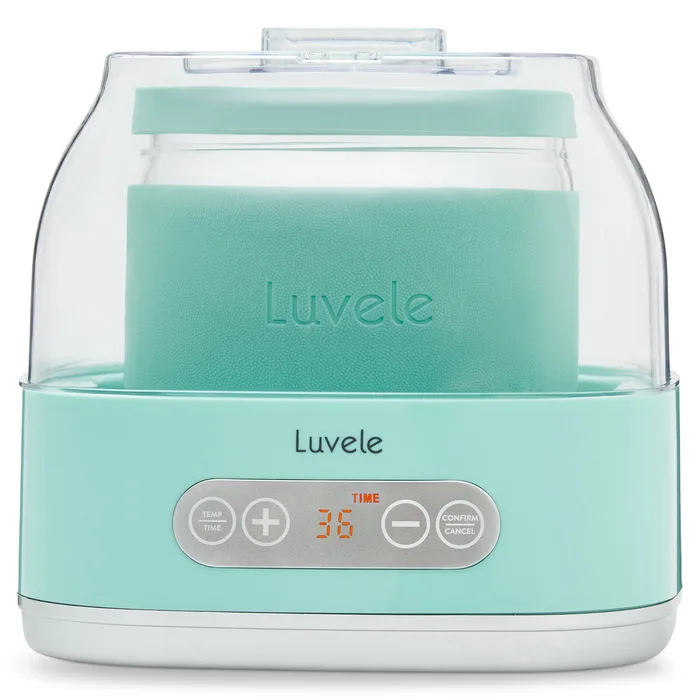
- Buy Luvele Pure Plus Yogurt Maker A dedicated yogurt maker with a settable 78 to 122°F temperature, a 36-hour timer, automatic switch-off and a 2-liter glass container.
- Buy Instant Pot Duo 6QT Multi-Use Pressure Cooker The multi-cooker with a yogurt function, a 6-quart stainless pot and six other cooking modes.
- It depends Brod & Taylor Folding Proofer & Slow Cooker (FP-105) A folding, temperature-controlled box that cultures several quart jars of yogurt, proofs bread and slow cooks.
- Skip Euro Cuisine YM80 Electric Yogurt Maker A long-selling jar maker with seven 6-ounce glass jars, an on/off switch and no temperature or shutoff control.
What actually matters
- Temperature control - Adjustable heat lets you follow a recipe's incubation temperature. Fixed-heat makers leave results more dependent on your kitchen.
- Timer and shutoff - A timer that ends heating stops a batch from going sour while you sleep or work. A dial that only marks time does not.
- Capacity - Batch size decides how often you make yogurt. A family that eats it daily needs a liter or more per batch.
- Container material - Glass and stainless are easy to clean and do not hold odors. Check that lids are listed as food safe and fit well for fridge storage.
- Heating method - A water bath or plate calibrated to food temperature heats more evenly than warm air alone. Even heat means fewer runny edges or overdone centers.
- Versatility - Multi-cookers and proofers handle other jobs. Dedicated makers usually give finer yogurt controls.
- Footprint - Yogurt makers often live on the counter for hours at a time. A compact unit or one that folds away is easier to live with.
The specs, in plain English
Green flags vs red flags
Green flags
- A settable temperature range printed on the listing.
- A timer that runs 24 hours or more with stated automatic shutoff.
- Glass or stainless containers with well-fitting lids.
- A published wattage, model number and warranty term.
- A manual or recipe guide from the maker that explains settings.
Red flags
- Only an on/off switch and indicator light.
- A "timer" that turns out to be a reminder dial.
- No temperature information anywhere on the listing.
- Very small jars if you want to strain for Greek yogurt.
- No model number or warranty details from the maker.
Who's who: the brands
- Luvele - Known for dedicated yogurt makers with water-bath heating, settable temperatures and long timers.
- Instant Pot - Known for multi-cookers that combine pressure cooking, slow cooking and a yogurt function.
- Brod & Taylor - Known for the folding bread proofer that doubles as a yogurt incubator and slow cooker.
- Euro Cuisine - Known for budget jar-style yogurt makers, sold in both manual and automatic versions.
How to read a listing without getting fooled
Start with the controls section of the listing. Look for a stated temperature range and whether you can change it, then check whether the timer ends heating or only marks a time. Next, find the container size and material, and add up jar volumes to get the true batch size. Check the wattage and model number, which tell you the maker is publishing real specs, and the warranty term. If the listing is vague, open the manual: it usually says how the machine heats, whether it shuts off and what temperatures it holds for yogurt.
How much should you spend?
Budget jar makers sit in the lowest tier and usually offer an on/off switch with no temperature setting, which is enough only if you are home to stop each batch. Mid-range dedicated makers add settable temperature, long timers, automatic shutoff and glass containers, which is where most regular yogurt makers should spend. Multi-cookers with a yogurt function sit in the same mid-range tier and make sense if you will use the other modes. Premium proofers cost more because they are built for bread, slow cooking and large jar batches, so they are worth it only if you will use that range.
Questions, answered
How long does homemade yogurt take?
Most makers list several hours to set a batch, and Euro Cuisine says its YM80 takes 6 to 10 hours depending on thickness. Longer incubation usually gives a tangier, thicker result. Some recipes, such as SCD yogurt, run around 24 hours. Your maker's timer should cover the longest recipe you plan to use.
Can a yogurt maker make other foods?
Some can. Brod & Taylor lists its proofer for bread dough, soft cheeses, kefir, tempeh and slow cooking. Multi-cookers like the Instant Pot cook whole meals. Dedicated yogurt makers are usually limited to yogurt and similar cultured foods.
Does a yogurt maker use a lot of electricity?
Usually not much, because it only keeps food warm. Luvele lists 300W maximum but a much lower average draw over an incubation, and Brod & Taylor says its proofer's heater cycles on only part of the time. The Euro Cuisine YM80 is rated at 13 watts. A multi-cooker draws more at full power but uses little to hold yogurt warm.
Should I buy extra jars or containers?
If you want to start a new batch while the last one is still in the fridge, a second container helps. Jar makers usually sell replacement jar sets, and dedicated makers often sell spare large containers. With a proofer you use your own mason jars or pots, so you may already own what you need.
Or jump to the head-to-head: Luvele Pure Plus Yogurt Maker vs Instant Pot Duo 6QT Multi-Use Pressure Cooker.