Explained
Wine Fridges, Explained
After this guide you'll be able to read any wine fridge listing and know instantly whether it can hold a steady temperature, fit your space, and protect your bottles - or whether it's a glorified mini fridge.
In this guide
A wine fridge exists to do one thing a kitchen refrigerator can't: hold bottles at a steady, humid, wine-friendly temperature instead of a bone-dry refrigerator temperature. The catch is that the category is full of look-alike glass-door boxes that differ enormously in the parts you can't see - the cooling system, the venting, and the shelving. Buyers most often get tripped up by cheap thermoelectric units that can't cool a warm room, and by bottle counts that only work for one bottle shape.
The 30-second version
- Compressor cooling is the single most important spec. It holds a set temperature better in warm rooms; thermoelectric units can only cool a fixed amount below room temperature and drift on hot days.
- Venting direction decides where the fridge can live. Front-venting models can be built into cabinetry; rear-venting models should stand free with clearance on all sides or they may overheat and fail early.
- Dual zones only matter if you store reds and whites together. Two independent temperature zones cost more - if you drink mostly one style, or store everything at a cellar-style 55°F, a single zone does the job.
- Advertised bottle counts are best-case numbers. They assume slim standard Bordeaux bottles; a mixed collection with Pinot or Champagne bottles typically loses some of the rated capacity.
- Wood shelves are the quickest quality tell. Sliding wood shelves grip bottles and damp vibration; rattly wire racks are the telltale of cost-cutting, even on famous-name models.
The products this guide is about
Our verdict on each, with the full reasoning on the companion review.
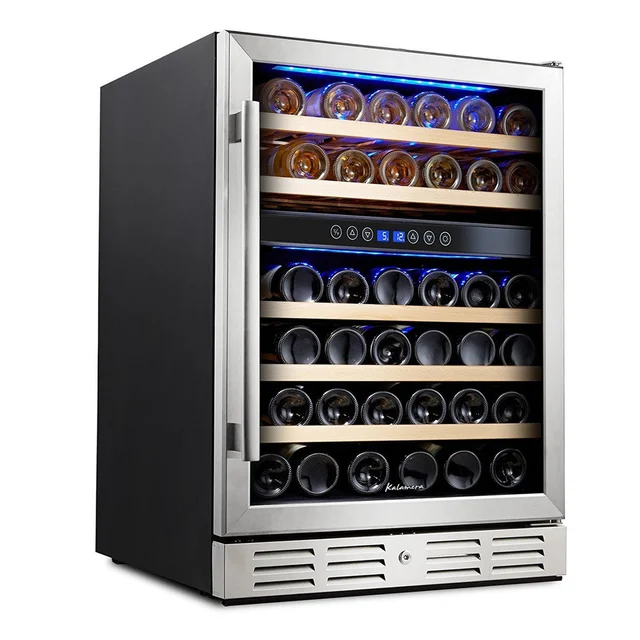
- Buy Kalamera 24-Inch 46-Bottle Dual Zone Wine Cooler (KRC-46DZB) The best value serious wine fridge here: 46 bottles, true dual zones, wood shelves, and built-in flexibility without the luxury-brand markup. Amazon
- Buy Ivation 18-Bottle Compressor Wine Cooler A cheap, narrow, no-frills compressor fridge that keeps 18 bottles properly chilled - the right first wine fridge for most people. Amazon
- It depends NewAir 29-Bottle Dual Zone Wine Fridge (AWR-290DB) A beautifully finished 15-inch dual-zone fridge that only makes sense if a narrow built-in slot is exactly what your kitchen needs. Amazon
- Skip Wine Enthusiast 32-Bottle Dual Zone MAX Compressor Wine Cooler The famous name on the door doesn't change what's behind it: wire racks, freestanding-only venting, and more quality niggles than its rivals.
What actually matters
- Cooling type - compressor units actively refrigerate and hold their set point in warm rooms; thermoelectric units are quieter on paper but can only cool relative to ambient temperature, so your 'chilled' whites drift warm on hot days.
- Temperature stability - the whole point of the appliance. Owner reports over a full summer tell you far more than the spec sheet: a good unit reaches its set point and holds it without drift.
- Venting direction - front-venting fridges exhaust heat through a grille below the door and can slide into a cabinet slot; rear-venting fridges need several inches of clearance and are freestanding only. Box one in and it may fail early.
- Zones - a dual-zone fridge keeps whites around 40-50°F and reds around 50-66°F simultaneously. It's genuinely useful for mixed collections and pure extra cost for everyone else.
- Shelving material and travel - sliding wood shelves tend to protect labels, damp vibration, and pull out smoothly; fixed or wire racks scratch, rattle, and favor one bottle shape.
- Noise and vibration - compressors cycle on and off with an audible hum. For living rooms and bedrooms, look for models owners specifically call quiet; vibration also matters because it can disturb sediment in aging reds.
- Real-world capacity - measure your bottles, not the marketing number. If you're between sizes, buy the bigger fridge; collections only grow.
The specs, in plain English
Green flags vs red flags
Green flags
- Compressor cooling with a stated range that reaches down to roughly 40°F - proof it can hold true white-wine temperatures
- Front venting explicitly stated, if you ever want to build it into cabinetry
- Sliding wood shelves rather than fixed wire racks
- Owner reports specifically praising quietness and temperature stability after months of use, not just on arrival
- Temperature memory after power loss, plus a door lock and UV-tinted glass
- A stated bottle capacity qualified with bottle type - a sign the maker is being honest about real-world fit
Red flags
- Thermoelectric cooling sold for a warm kitchen or living space - it can't hold temperature on hot days
- A rear-venting fridge marketed with built-in or under-counter photos - boxing it in will overheat the compressor
- Wire racks on a mid-range or premium-priced unit - cost-cutting where it matters
- Recurring owner reports of frost, condensation, door misalignment, or shelf rattle - a pattern, not bad luck
- A famous wine brand on the door with entry-level hardware behind it - you're paying for the name
- Bottle counts with no mention of bottle size, especially on tightly spaced racks that only fit standard bottles
Who's who: the brands
- Kalamera - A wine-fridge specialist offering dual zones, wood shelving, and built-in venting at prices below the prestige labels.
- NewAir - A compact-appliance maker whose wine fridges earn praise for quiet running and refined interiors, particularly in narrow built-in widths.
- Ivation - A budget-focused brand whose compressor models bring proper cooling to entry-level prices, with expected trade-offs in shelving and noise.
- Wine Enthusiast - The famous wine-accessories retailer; its house-brand fridges pair strong US-based customer service with hardware that often trails similarly priced rivals.
- EuroCave - The French luxury benchmark for dedicated wine cabinets - superb, but priced in a different league than mainstream fridges.
How to read a listing without getting fooled
Start with the cooling type - if the listing doesn't say 'compressor,' assume thermoelectric and move on unless the fridge will live somewhere cool. Next find the venting direction, because photos lie: plenty of freestanding-only units are shot flush inside beautiful cabinetry they can't actually survive in. Then check the stated temperature range; a unit that bottoms out well above 45°F can't hold true white-wine cold. Read the shelf description literally - 'chrome racks' or 'wire shelving' means wire, and 'sliding wood shelves' is the phrase you want. Finally, discount the bottle count for a mixed collection, and skim recent owner reports for the words 'noise,' 'frost,' and 'stopped cooling' - patterns there tell you more than any spec.
How much should you spend?
What you pay for in a wine fridge is the cooling system first, then capacity, then finish. The cheapest tier is dominated by thermoelectric units that are usually a false economy; the smart budget move is the smallest compressor model from a value brand, accepting a single zone and wire shelves. The value sweet spot sits in the mid-to-upper mainstream range, where dual zones, sliding wood shelving, front venting, and quiet low-vibration running all show up together - often from specialist value brands rather than famous names. Spending more than that mostly buys capacity, cabinetry-grade finish, or a prestige label; it's justified for large collections and serious long-term aging, and rarely justified just for the badge. Wherever you land, a slightly bigger fridge than you need today is usually money better spent than a fancier small one - collections grow.
Questions, answered
Why can't I just use my kitchen refrigerator for wine?
A kitchen fridge runs colder than wine wants - too cold for serving most wine and typically too dry for long-term storage. A wine fridge holds the temperature band wines actually want, with less vibration and gentler humidity. For a bottle you'll drink this week the kitchen fridge is fine; for anything you're keeping, it isn't.
Compressor or thermoelectric - which should I buy?
Compressor, in most cases. Thermoelectric units are silent and cheap but can only cool a fixed amount below room temperature, so they lose control in warm rooms - exactly when you need them. Owner reports generally show compressor models holding steadier temperatures year-round. The only good thermoelectric use case is a small unit in a consistently cool space.
What temperature should I actually set?
For serving: whites and sparkling around 40-50°F, reds around 55-65°F. For storing a mixed collection in a single-zone fridge, a cellar-style 55°F is the classic compromise - reds are ready to pour and whites need only a short chill. Dual-zone fridges let you keep both styles at serving temperature simultaneously.
Can I build any wine fridge into my cabinets?
No - only front-venting models. They exhaust heat through a grille below the door, so air circulates even when the sides and back are enclosed. Rear-venting fridges need a few inches of clearance all around; enclosing one traps heat, can force the compressor to run constantly, and can shorten its life. The listing must explicitly say front-venting or built-in capable.
How loud are wine fridges - can one live in my living room or bedroom?
Compressor models hum when the compressor cycles on, then run near-silent between cycles. Well-built units are often described by owners as fine for open living spaces; budget units tend to have more noticeable cycling. For a bedroom or very quiet room, prioritize models owners specifically praise for low noise and low vibration - vibration matters for aging reds too, since it can disturb sediment.
Is a dual-zone fridge worth the extra money?
Only if you regularly keep both reds and whites and want each at its own serving temperature. If you mostly drink one style, or you're storing everything long-term at 55°F anyway, the second zone is capacity you paid extra to subdivide. First-time buyers are usually better served by a good single-zone compressor unit, upgrading later if the collection diversifies.
Or jump to the head-to-head: Kalamera 24-Inch 46-Bottle Dual Zone Wine Cooler (KRC-46DZB) vs Ivation 18-Bottle Compressor Wine Cooler.