

Home & Kitchen
The Best Whetstones: 4 Compared (and One to Skip)
We compared four sharpening stones on what the makers actually publish: abrasive size in microns rather than a bare grit number, whether the stone has to be soaked, whether it has to be flattened, and how much surface you get.
The short version
The DMT 8 inch Dia-Sharp D8E/F is the pick for most people: two grits on one steel plate, no soaking, no flattening plate to buy, and DMT guarantees the surface not to hollow or groove. The SHARPAL 162N does the same job for less, with a coarser pair of grits, a storage box that doubles as a non-slip base, and an angle guide in the box. The Shapton Kuromaku Professional 1000 is the one to get if you want a real waterstone feel and a finer finish on hard Japanese steel, but Shapton itself tells you to true the face before every session, so budget for a lapping plate. The Sharp Pebble 1000/6000 and 3000/8000 kit is the skip: four grits of soaking stone, no published micron sizes or grit standard, and roughly the same money as a diamond plate that stays flat on its own. Grit numbers only mean something inside one maker's own scale, so compare microns when a maker publishes them. If you sharpen once a month and want the least fuss, buy a diamond plate. Best for: home cooks and tool users who want one stone that works and stays flat, rather than a drawer of stones and a maintenance ritual.
Our picks at a glance
- DMT 8 in Dia-Sharp Double-Sided Bench Stone (D8E/F) - Buy. A double-sided diamond plate that sharpens wet or dry, needs no flattening, and is labelled in microns so you can actually compare it to something.
- SHARPAL 162N Dual-Grit Diamond Whetstone 8 x 3 in - Buy. A wide 8 by 3 inch diamond plate with a coarse and an extra-fine side, a storage box that works as a non-slip base, and an angle guide included.
- Shapton Kuromaku Professional Series 1000 (Orange, K0702) - It depends. The splash-and-go ceramic waterstone that most Japanese knife owners end up on, and the one that will make you buy a flattening plate.
- Sharp Pebble 1000/6000 and 3000/8000 Sharpening System (Sharpen & Hone Set) - Skip. Four grits of soaking corundum sold as a complete system, at money that buys a diamond plate which stays flat by itself.
The verdict in 30 seconds
What mattered most
- Abrasive
- Grits as the maker labels them
- Sharpening surface
- Water, oil or dry
- Flattening plate needed
- What wears out
Sharpening stones are sold on a single number, and that number is close to meaningless on its own. A stone marked 1000 from one maker can carry a coarser abrasive than a plate marked 1200 from another, because Japanese, American and European grading systems are separate scales that were never designed to line up. On top of that, most bonded stones wear hollow in the middle as you use them, and a hollow stone cannot grind a straight bevel, so a flattening plate is part of the purchase whether the listing says so or not. We picked four stones that show the whole spread: two diamond plates that stay flat by construction, one splash-and-go ceramic waterstone, and one multi-grit kit that is easy to buy and hard to justify.
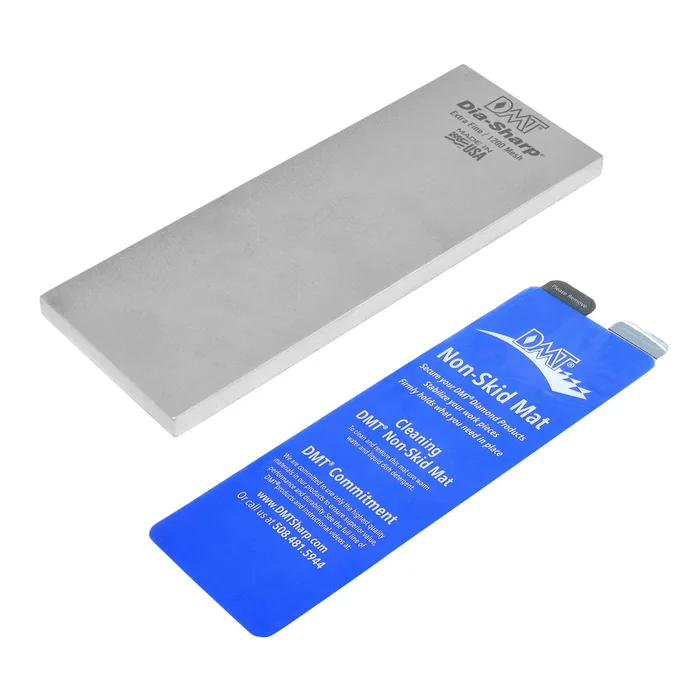
A double-sided diamond plate that sharpens wet or dry, needs no flattening, and is labelled in microns so you can actually compare it to something.
Best for: Someone who wants to buy one plate, keep it in a drawer for a decade, and never think about stone maintenance.
- DMT labels each side in microns as well as mesh: fine is 25 micron (600 mesh), extra-fine is 9 micron (1200 mesh).
- Continuous monocrystalline diamond surface that DMT guarantees not to hollow or groove, so there is no lapping plate to buy.
- Works dry or with water, with no oil and no soaking wait before you start.
- It is the most expensive stone here by a wide margin.
- 9 micron extra-fine is a working edge, not a mirror polish, so it will not match a fine waterstone for finish.
- Neither side is coarse enough to reset a badly chipped edge quickly.
- Diamond plates cut with a distinct grabby feel that some people dislike compared with a waterstone.
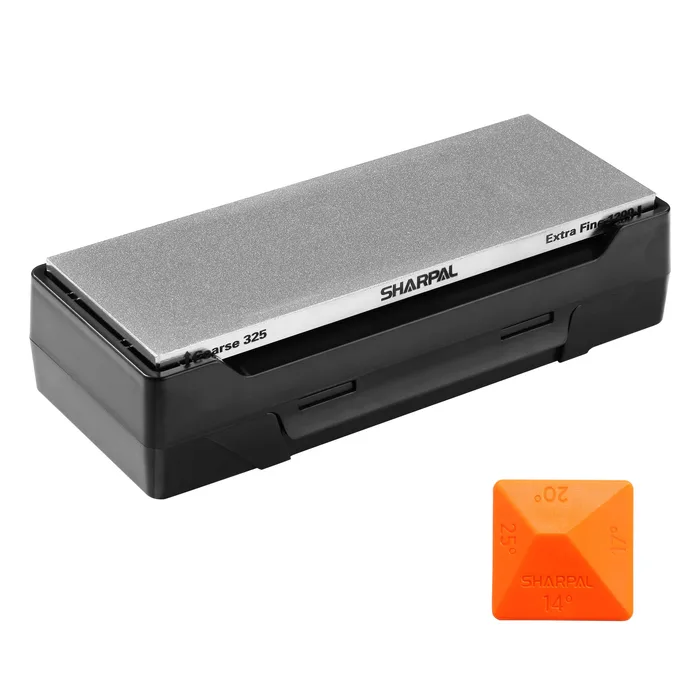
A wide 8 by 3 inch diamond plate with a coarse and an extra-fine side, a storage box that works as a non-slip base, and an angle guide included.
Best for: A first serious sharpener for someone with a drawer of genuinely dull knives who wants the base and angle guide in the box.
- Both grits are published with micron sizes: coarse 325 grit is 45 micron, extra fine 1200 grit is 12 micron.
- Full 8 by 3 inch (203 by 76 mm) face, wide enough to keep a broad chef's knife on the stone through the whole stroke.
- SHARPAL specifies flatness of plus or minus 0.002 in (0.05 mm) and says water or oil is not required.
- The coarse side at 45 micron is aggressive for a kitchen knife and will leave a toothy edge if you stop there.
- 12 micron is the finest grit on the plate, so a mirror finish means buying a separate finishing stone.
- SHARPAL recommends dry sharpening and warns that metal filings left on the surface can oxidise and look like rust.
- The whole thing weighs about 1.38 kg with the box, so it is not a pack-it-along sharpener.
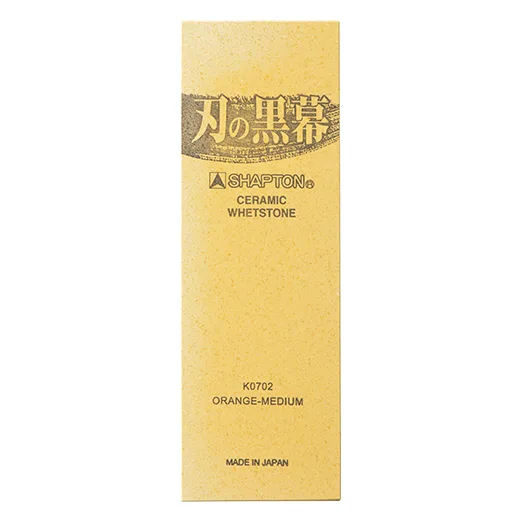
The splash-and-go ceramic waterstone that most Japanese knife owners end up on, and the one that will make you buy a flattening plate.
Best for: Someone sharpening hard Japanese kitchen knives who wants a proper stone finish and accepts the flattening routine that comes with it.
- No soaking wait: Shapton says the stones do not need to be soaked, and suggests only five to six minutes of soaking the very first time you use one.
- 210 by 70 by 15 mm of solid stone with a plastic case that doubles as a sharpening base.
- Shapton says its stones will sharpen any blade material other than ceramic and carbide, and that the stones can be used with oil instead of water if you commit that stone to oil.
- Shapton recommends truing the face of the stone before every sharpening session, which means a lapping plate is a required second purchase.
- One grit only, so a chipped edge or a real reprofile needs a coarser stone as well.
- The grit number is on Shapton's own class scale, which is not what 1000 means on a diamond plate, so do not compare it across brands.
- Sharpening slurry from a coarser stone will scratch the finish if you do not wash your hands and the blade between grits, which Shapton calls out explicitly.
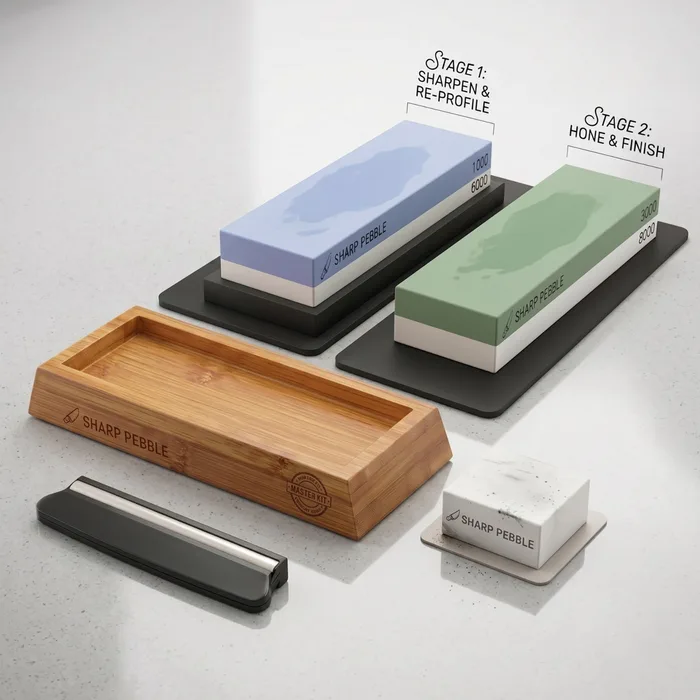
Four grits of soaking corundum sold as a complete system, at money that buys a diamond plate which stays flat by itself.
Best for: Almost nobody, though a woodworker who already owns a flattening plate and wants cheap polishing grits could use the finer stone.
- Four grits in one purchase, from edge setting on 1000 through polishing on 8000.
- An angle guide is included, which genuinely helps a first-timer hold a consistent bevel.
- Water only, with no oil to buy or clean up.
- The product page gives no micron sizes, no grit standard and no stone dimensions, so the numbers cannot be compared to a Shapton, Naniwa or DMT figure.
- These are soaking stones: Sharp Pebble tells you to soak its 1000/6000 stone for 10 to 15 minutes and to rinse and dry it completely before storing.
- Most kitchen knives get nothing useful from a 3000 or 8000 grit pass, so half the kit is decoration for the average buyer.
- Soft bonded stones dish fastest of all, which makes the flattening problem worse rather than better.
Amazon had no buyable listing for this when we last checked. The link still works if it returns.
Check price on Amazon Read our detailed assessment| Criteria | 8 in Dia-Sharp Double-Sided Bench Stone (D8E/F) Top pick | 162N Dual-Grit Diamond Whetstone 8 x 3 in | Kuromaku Professional Series 1000 (Orange, K0702) | 1000/6000 and 3000/8000 Sharpening System (Sharpen & Hone Set) |
|---|---|---|---|---|
| Verdict | Buy it | Buy it | It depends | Skip it |
| Best for | Someone who wants to buy one plate, keep it in a drawer for a decade, and never think about stone maintenance. | A first serious sharpener for someone with a drawer of genuinely dull knives who wants the base and angle guide in the box. | Someone sharpening hard Japanese kitchen knives who wants a proper stone finish and accepts the flattening routine that comes with it. | Almost nobody, though a woodworker who already owns a flattening plate and wants cheap polishing grits could use the finer stone. |
| Price tier | $$$ · premium | $$ · mid-range | $$ · mid-range | $$ · mid-range |
| Abrasive | Monocrystalline diamond on steel | Monocrystalline diamond electroplated in nickel on stainless steel | Bonded ceramic waterstone | Corundum (aluminium oxide) waterstone |
| Grits as the maker labels them | Fine 25 micron (600 mesh) / extra-fine 9 micron (1200 mesh) | Coarse 325 grit (45 micron) / extra fine 1200 grit (12 micron) | 1000 class on Shapton's own scale (medium) | 1000/6000 and 3000/8000, no scale or micron size published |
| Sharpening surface | 8 in length, two sides | 8 x 3 in (203 x 76 mm), two sides | 210 x 70 x 15 mm, one side in use at a time | Two dual-grit stones, dimensions not on the product page |
| Water, oil or dry | Dry or water, no oil needed | Maker recommends dry use | Splash and go; no soak needed, 5 to 6 min for first use | Soak 10 to 15 min per the maker's own instruction |
| Flattening plate needed | No, guaranteed not to hollow or groove | No, held to plus or minus 0.002 in (0.05 mm) | Yes, Shapton advises truing before each session | Yes, and soft stones dish fastest |
| What wears out | The diamond wears, the plate stays flat | The diamond wears, the plate stays flat | The stone wears and dishes | The stone wears and dishes |
| In the box | Non-skid mat | Storage box that doubles as a non-slip base, angle guide | Plastic case usable as a stone holder | Angle guide, per the current product page |
| Price tier | $$$ · premium | $$ · mid-range | $$ · mid-range | $$ · mid-range |
Which one is right for you?
- Someone who wants to buy one plate, keep it in a drawer for a decade, and never think about stone maintenance. Buy it DMT 8 in Dia-Sharp Double-Sided Bench Stone (D8E/F)
- A first serious sharpener for someone with a drawer of genuinely dull knives who wants the base and angle guide in the box. Buy it SHARPAL 162N Dual-Grit Diamond Whetstone 8 x 3 in
- Someone sharpening hard Japanese kitchen knives who wants a proper stone finish and accepts the flattening routine that comes with it. It depends Shapton Kuromaku Professional Series 1000 (Orange, K0702)
- Almost nobody, though a woodworker who already owns a flattening plate and wants cheap polishing grits could use the finer stone. Skip it Sharp Pebble 1000/6000 and 3000/8000 Sharpening System (Sharpen & Hone Set)
How we judged the field
Five things decide whether a stone is worth owning. First, what the abrasive actually is and how big it is, in microns, because a grit number on its own belongs to whichever scale the maker chose and cannot be compared across brands. Second, whether the stone stays flat, since a dished face grinds a curved bevel no matter how careful your technique is. Third, what it takes to get started: a soaking stone needs saturating and drying, a splash-and-go stone needs a rinse, and a diamond plate needs nothing. Fourth, how much surface you get, because a narrow stone forces you to work a wide blade in sections. Fifth, whether the stone suits the steel you own, since hard Japanese blades and soft bonded stones are a poor match.
The field splits into families that behave very differently. Natural stones are inconsistent and expensive and are a specialist purchase. Synthetic waterstones cut fast and feel good but are soft and dish quickly. Oil stones are hard and long lived but slow, and the oil is a nuisance in a kitchen. Ceramic stones sit between the two, cutting fast while wearing slowly. Diamond plates do not wear out of shape at all, because the abrasive is bonded to a steel plate rather than held in a matrix that erodes. We picked one strong example from each end of that spread, one splash-and-go ceramic to represent the waterstone world honestly, and one popular multi-stone kit to show what a bad purchase looks like.
DMT 8 in Dia-Sharp Double-Sided Bench Stone (D8E/F)
Buy itDMT’s D8E/F is the least interesting stone here and the most sensible one. It is an eight inch steel plate with fine diamond on one face and extra-fine on the other, and DMT publishes both in microns as well as in mesh: 25 micron on the fine side, 9 micron on the extra-fine. That matters, because those numbers can be compared to anything, while a bare grit number cannot. You sharpen dry or with water, there is no oil, no soaking and no waiting. The important line is DMT’s guarantee that the surface will not hollow or groove, which quietly deletes the whole flattening problem and the second purchase it usually implies. What you give up is finish. Nine micron leaves a keen working edge rather than a polished one, so if you want a mirror bevel on a single-bevel Japanese knife you will still want a fine waterstone. It also costs noticeably more than everything else here. For a person who wants one plate to handle kitchen knives, chisels and a pocket knife for the next decade, that is a fair trade.
SHARPAL 162N Dual-Grit Diamond Whetstone 8 x 3 in
Buy itThe SHARPAL 162N is the same idea at a lower price with a coarser pair of grits. The two faces are 325 grit at 45 micron and 1200 grit at 12 micron, and the sharpening surface is a full eight by three inches, which is wide enough that a broad chef’s knife stays on the stone through the entire stroke rather than hanging off the edge. The abrasive is monocrystalline diamond electroplated in nickel onto a stainless steel base, held to a stated flatness of plus or minus 0.002 in. SHARPAL recommends using it dry and warns that metal filings left on the surface can oxidise and look like rust, so a wipe after use is part of the deal. The box it ships in doubles as a non-slip base and an angle guide is included, which is genuinely useful if you have never freehanded a bevel. The 45 micron side is aggressive for kitchen work, so treat it as a repair grit rather than a routine one. This is the one to buy if you are starting with genuinely dull knives.
Shapton Kuromaku Professional Series 1000 (Orange, K0702)
It dependsThe Kuromaku Professional 1000 is what a lot of people mean when they say whetstone. It is 210 by 70 by 15 mm of solid ceramic stone in a plastic case that doubles as a base, and Shapton’s whole pitch is that you do not soak it: splash water on and go, with a five or six minute soak suggested only the first time. It cuts fast, it suits hard steel, and Shapton says the only blades it will not sharpen are ceramic and carbide. It will also make you buy a second thing. Shapton’s own advice is to true the stone face before every sharpening session, and their FAQ recommends checking with a pencil grid to confirm the whole face has been touched. That is a real routine, not a once a year chore. It is also one grit, so a chipped edge needs a coarser stone too. If you want the feel and the finish that a stone gives and you will actually do the maintenance, this is the one. If you will not, buy a plate.
Sharp Pebble 1000/6000 and 3000/8000 Sharpening System (Sharpen & Hone Set)
Skip itSharp Pebble’s four grit kit is easy to buy and hard to defend. You get a 1000/6000 stone and a 3000/8000 stone made from corundum, plus an angle guide, and the current product page describes it as a complete four grit system. What the page does not give you is any micron size, any statement of which grit standard those numbers belong to, or even the dimensions of the stones, which makes the headline numbers impossible to compare with a Shapton, Naniwa or DMT figure. These are soaking stones as well; Sharp Pebble’s instruction for its 1000/6000 stone is a 10 to 15 minute soak and a full dry before storing. The deeper problem is the shape of the offer: soft bonded stones dish faster than anything else, so buying four of them multiplies the flattening chore, and a home cook gets almost nothing from a 3000 or 8000 pass on a stainless kitchen knife. At this money a diamond plate that stays flat by itself is the better answer for nearly everyone.
Sources
Specs in this review come from these pages.
- Shapton FAQ (stone care, flattening frequency, class and type definitions) (shapton.co.jp)
- Shapton product overview (Kuromaku and RockStar specifications) (shapton.co.jp)
- DMT Dia-Sharp D8E/F product page and DMT grit table (dmtsharp.com)
- SHARPAL 162N specifications and FAQ (sharpal.com)
- Matsunaga Stone (King whetstones): how to use and maintain a sharpening stone (matsunaga-corp.co.jp)
- Suehiro Toishi: how to use and maintain whetstones (suehiro-toishi.com)
DMT 8 in Dia-Sharp Double-Sided Bench Stone (D8E/F) vs SHARPAL 162N Dual-Grit Diamond Whetstone 8 x 3 in: which should you buy?
Both buys are diamond plates, and the choice between them is really a choice about grits and money. The DMT pairs 25 micron with 9 micron, which is a maintenance and refining pair: it will bring a slightly dull knife back and put a clean edge on it, but it is slow if the edge is properly wrecked. The SHARPAL pairs 45 micron with 12 micron, which is a repair and working pair: it will reshape a neglected edge quickly and finish it well enough for kitchen use, but it stops coarser than the DMT does. If your knives are maintained and you want the better final edge, take the DMT. If your knives are in bad shape and you want the tools to fix them, take the SHARPAL.
The practical differences are smaller than the spec sheets suggest. The SHARPAL is wider at three inches, which is a real advantage on a broad blade, and it arrives with a base and an angle guide, so it is a complete setup out of the box rather than a plate and a mat. The DMT is made in the USA and carries the explicit guarantee against hollowing or grooving, which is the closest thing to a promise anyone in this category makes. Neither needs soaking, neither needs flattening, and neither will be the stone that gives you a mirror polish. If you want that finish later, add a fine waterstone and a lapping plate, and let the diamond plate keep doing the heavy work.
What to look for
- Look for a micron figure, not just a grit number: DMT and SHARPAL publish particle sizes, and micron is the only unit that lets you compare a Japanese stone with an American plate.
- Assume you are buying a flattening plate too: unless you choose diamond, budget for a lapping plate or correcting stone, because Shapton advises truing before every session and Suehiro says to do it before and after use.
- Check whether it soaks or splashes before you buy: a soaking stone means a wait before every sharpening and a wash and dry after, while a splash-and-go stone or a diamond plate is ready in seconds.
- Get at least a 200 mm by 60 mm face if you sharpen kitchen knives: a wide blade on a narrow stone forces you to work in sections, which is where uneven bevels come from.
- Match the stone to the steel: hard Japanese blades cut slowly on soft bonded stones and chew them out of flat, while diamond handles hard and high-wear steels without complaint.
- Be suspicious of multi-stone kits with no published specs: four grits with no micron sizes, no scale and no dimensions is a marketing bundle, not a considered set.
Our final take
Buy fewer stones than you think you need and take the flattening problem seriously, because that is where most home setups die. For the majority of people, a double-sided diamond plate is the honest answer: it starts working immediately, it handles any steel short of ceramic and carbide, and it stays flat without a second purchase and a maintenance habit. The DMT D8E/F is the better plate and the SHARPAL 162N is the better value, and either will out-sharpen a drawer of soft waterstones that nobody ever laps. If you genuinely want the feel and the finish of a stone, the Shapton Kuromaku 1000 is a fine one, but buy the lapping plate at the same time. Skip the four grit kits.
Questions, answered
Is a 1000 grit stone from one brand the same as a 1000 grit stone from another?
No, and this is the single most misleading thing about the category. Japanese JIS grading, American ANSI and CAMI mesh numbers and European FEPA grades are separate systems, so the same number describes different abrasive sizes. You can see it in the makers' own figures: DMT lists its 1200 mesh extra-fine diamond at 9 micron while SHARPAL lists its 1200 grit diamond at 12 micron, so two plates with the same number differ in particle size. Shapton labels its stones by a class number that it describes as the approximate median particle size in micrometers, on its own scale. Compare microns when the maker publishes them, and only compare grit numbers within one maker's range.
Do I really need a flattening plate?
If you buy a bonded stone, yes, treat it as part of the purchase. A stone wears fastest where you press hardest, which is the middle, so the face goes hollow and the bevel you grind on it stops being straight. Shapton's own guidance is to true the stone face before every sharpening session, and Suehiro says to keep the face flat and to use a correcting stone before and after use. Matsunaga, who make King stones, put it plainly: the whetstone gets dented over time and needs maintenance. Diamond plates are the exception, because the abrasive sits on a steel plate rather than in a wearing matrix.
What is the difference between a soaking stone and a splash-and-go stone?
A soaking stone is porous and has to be saturated before it will cut properly. Sharp Pebble tells you to soak its 1000/6000 stone for 10 to 15 minutes, and Matsunaga says to soak a King stone for about three minutes. A splash-and-go stone holds enough water on the surface to work straight away; Shapton says its stones do not need to be soaked at all, and only suggests five or six minutes the first time you use one. Diamond plates need nothing, and SHARPAL actually recommends using its plates dry. After use, follow the maker: Matsunaga says to wash the stone and dry it in the shade rather than leaving it sitting in water.
Are diamond plates worth it compared with a waterstone?
For most people, yes. A diamond plate cuts fast, works on hard modern steels, starts working the second you pick it up, and removes the flattening chore entirely, which is where most home sharpening setups quietly fail. DMT guarantees its Dia-Sharp plates not to hollow or groove. The trade-off is finish and feel: the finest common diamond grades sit around 9 to 3 micron, so a diamond plate leaves a keen working edge rather than the polished bevel a fine waterstone gives. Diamond plates also wear, but the wear is in the diamond layer, not in the shape of the plate, so the surface stays flat as it slows down.
How many stones do I actually need for kitchen knives?
One medium stone does most of the work. Shapton's own recommendation for household kitchen knives is the 1000 medium plus the 5000 finishing stone, or the 1500 alone if you only want one stone. A double-sided diamond plate collapses that into a single purchase. You would add a coarse stone only if you have a chipped edge or want to change a bevel angle, and finishing grits above about 6000 matter mainly for single-bevel Japanese knives, plane irons and chisels rather than for a stainless chef's knife you use every day.
Deciding between the top two? See our head-to-head: DMT 8 in Dia-Sharp Double-Sided Bench Stone (D8E/F) vs SHARPAL 162N Dual-Grit Diamond Whetstone 8 x 3 in.
More Home & Kitchen reviews
 The Best Window Air Conditioners: 4 Compared (and One to Skip)
  The Best Window Vacuums: 4 Compared (and One to Skip)
  The Best Wine Decanters: 4 Compared (and One to Skip)
  The Best Wine Fridges: 4 Compared (and One to Skip)
  The Best Woks: 4 Compared (and One to Skip)
  The Best Wool Slippers: 4 Compared (and One to Skip)