Explained
Whetstones, Explained
After reading, you'll understand why a 1000 grit stone from two brands can be two different things, why a flattening plate is part of the purchase, and which family of stone actually fits how you sharpen.
In this guide
First-time buyers pick a stone by its grit number, and the grit number is the least reliable thing on the box. Japanese, American and European abrasive scales are independent, so the same figure describes different particle sizes depending on who printed it. The second surprise arrives a month later, when the stone has worn hollow in the middle and stops producing a straight edge. The third is the water: some stones must be soaked before they cut, some only need a splash, and treating one like the other wastes your time or ruins the stone.
The 30-second version
- Grit numbers are brand-local, so compare the micron figures makers publish rather than assuming 1000 means 1000.
- Every bonded stone goes hollow, which is why a flattening plate is a required accessory and not an upsell.
- Soaking is a product property, not a preference, so follow the maker's instruction on soak time and on drying the stone afterwards.
- Diamond plates skip the maintenance entirely, because the abrasive sits on a steel plate rather than in a matrix that erodes into a dish.
- One medium stone does most of the work, and finishing grits above about 6000 matter mainly for chisels, plane irons and single-bevel knives.
The products this guide is about
Our verdict on each, with the full reasoning on the companion review.
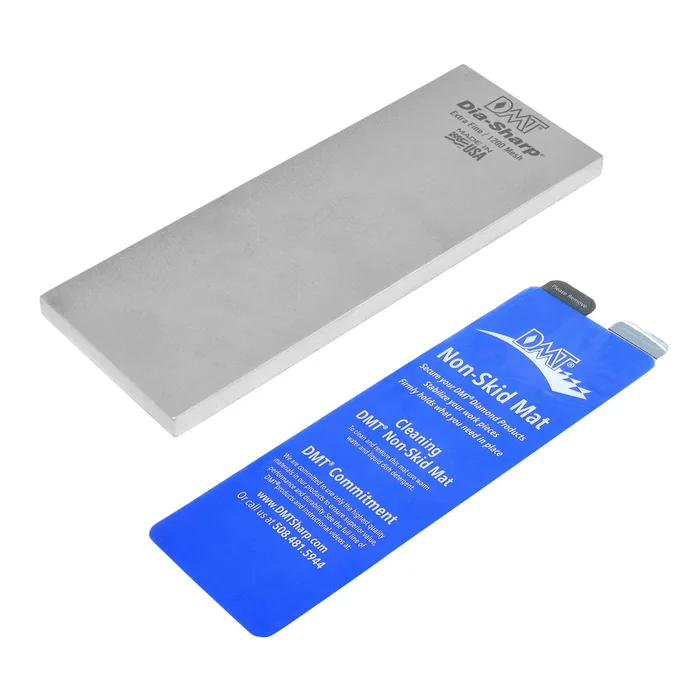
- Buy DMT 8 in Dia-Sharp Double-Sided Bench Stone (D8E/F) A double-sided diamond plate that sharpens wet or dry, needs no flattening, and is labelled in microns so you can actually compare it to something. Amazon
- Buy SHARPAL 162N Dual-Grit Diamond Whetstone 8 x 3 in A wide 8 by 3 inch diamond plate with a coarse and an extra-fine side, a storage box that works as a non-slip base, and an angle guide included. Amazon
- It depends Shapton Kuromaku Professional Series 1000 (Orange, K0702) The splash-and-go ceramic waterstone that most Japanese knife owners end up on, and the one that will make you buy a flattening plate. Amazon
- Skip Sharp Pebble 1000/6000 and 3000/8000 Sharpening System (Sharpen & Hone Set) Four grits of soaking corundum sold as a complete system, at money that buys a diamond plate which stays flat by itself.
What actually matters
- Grit standard - The number on a stone belongs to whichever grading system its maker uses, and Japanese JIS, American ANSI and CAMI mesh, and European FEPA grades are not interchangeable. Two stones marked 1000 can carry noticeably different abrasive sizes, so the number only ranks stones within one maker's own range.
- Micron size - Micron is the median diameter of the abrasive particle and it is the one figure that means the same thing everywhere. DMT and SHARPAL publish micron values, and using those instead of grit numbers removes most of the confusion in the category.
- Flatness - A stone wears fastest under the pressure of your hands, which is the middle, so it goes hollow and starts grinding a curved bevel. Keeping the face true is the difference between a technique problem and an equipment problem, and it is why makers sell correcting stones and lapping plates.
- Soak or splash - Porous soaking stones must be saturated before they cut properly, while splash-and-go stones and diamond plates only need water on the surface, or in some cases nothing at all. Makers publish the soak time, so follow the instruction for your stone.
- Stone hardness against steel hardness - Hard modern and Japanese blade steels cut slowly on soft stones and wear them out of flat quickly. Harder ceramic stones and diamond plates handle hard steels far better, which is why the stone that suits a soft European chef's knife may frustrate you on a Japanese one.
- Working surface - A short or narrow stone forces you to sharpen a wide blade in sections, which introduces inconsistency at exactly the point where consistency matters. Roughly 200 mm long and 60 mm or more wide is a comfortable minimum for kitchen knives.
- What comes in the box - A base or holder, an angle guide, and a case are worth real money if you are starting from nothing. Some stones ship with all three and some ship with a rubber mat, and that gap is often larger than the price difference.
The specs, in plain English
Green flags vs red flags
Green flags
- The maker publishes a micron or particle size next to the grit number.
- Stated dimensions for the stone itself, not just the box.
- Clear instructions on soaking, drying and storage on the product page.
- A named abrasive and bond type rather than just the word premium.
- The maker also sells a flattening plate or correcting stone, which means they expect you to keep the face true.
Red flags
- Grit numbers with no scale, no micron figure and no dimensions anywhere on the listing.
- A bundle of four or more stones aimed at kitchen knives, where one medium stone would do.
- Claims that a bonded stone stays flat and needs no maintenance.
- No instruction at all about whether the stone needs soaking.
- Grit comparisons drawn between different brands as if the numbers were equivalent.
Who's who: the brands
- Shapton - Japanese maker of splash-and-go ceramic stones, colour coded by grit in the Kuromaku line, and labelled by a class number that approximates the median particle size in micrometers.
- DMT - American diamond specialist in Marlborough, Massachusetts, that labels every plate in micron as well as mesh and guarantees its Dia-Sharp surfaces not to hollow or groove.
- SHARPAL - Diamond plates, guided systems and accessories, usually sold with a base and angle guide included and with micron sizes stated alongside grit numbers.
- Naniwa - Osaka abrasives maker with several waterstone lines and a diamond range.
- King (Matsunaga Stone) - The classic budget Japanese soaking waterstone, with the maker's own instruction to soak about three minutes and to wash and dry the stone in the shade after use.
How to read a listing without getting fooled
Start at the bottom of the listing, not the top. Find the stone's actual dimensions, and check whether they describe the stone or the box, since a bundle will often quote the packaging. Then look for a micron or particle size next to the grit number; if the maker publishes one, that is the figure to compare against other products, and if they do not, treat the grit number as meaningful only within that brand. Next, find the water instruction: soak time, splash and go, or dry. Then check what comes with it, because a base, an angle guide and a case are worth real money. Finally, look at whether the maker sells a flattening plate for their own stones, which tells you how they expect the product to be maintained.
How much should you spend?
Budget stones tend to be soft bonded waterstones, often sold as multi-grit kits, and they will cut adequately while dishing quickly and demanding the most maintenance. Mid-range covers the useful middle: a single quality ceramic waterstone in a common medium grit, or a double-sided diamond plate with a base and guide included, which is where most home buyers get the best result per unit of hassle. Premium buys either a hard, fast, long-lived plate from an established diamond maker, or a professional-grade waterstone in a fine finishing grit. Remember to add a lapping plate to the total for anything other than diamond, since that is a second purchase the listing will not mention, and it can cost as much as the stone.
Questions, answered
Can I use oil on a water stone?
Sometimes, but it is a one-way decision. Shapton says its stones are waterstones that can also be used as oilstones, and that once you have used oil on a stone you should keep using that stone with oil only. The oil fills the pores and the stone will not take water properly afterwards. For kitchen use, water is simpler and cleans up better.
How do I know when the stone is flat again?
Draw a grid of pencil lines across the whole face before you start lapping. Work the stone on the flattening plate until every line has gone, which means the plate has touched the entire surface rather than just the high spots. Shapton describes exactly this check in its own guidance. It takes seconds and it is the only reliable way to tell.
Do diamond plates wear out?
They do, but they wear differently. The diamond layer gradually loses its bite so the plate cuts more slowly over time, while the plate itself stays flat because the steel underneath does not erode. That is the opposite of a bonded stone, which keeps cutting well but changes shape. Light pressure and cleaning the surface after use extend the working life considerably.
What about natural stones?
Natural stones are quarried rather than manufactured, so hardness, grit and consistency vary from piece to piece and pricing reflects rarity as much as performance. Skilled users value the finish that a good finishing stone gives on traditional Japanese blades. For anyone still learning, a synthetic stone or a diamond plate is more predictable, easier to replace and far cheaper to get wrong.
Or jump to the head-to-head: DMT 8 in Dia-Sharp Double-Sided Bench Stone (D8E/F) vs SHARPAL 162N Dual-Grit Diamond Whetstone 8 x 3 in.