Explained
Upright Vacuums, Explained
You will know which upright vacuum specs predict a genuinely clean carpet and which ones are just numbers on a box.
In this guide
An upright vacuum is a motor, a brushroll, and a dust container stacked into one body you push across the floor. Almost everything that separates a great one from a frustrating one comes down to four things: how the dirt is collected, how well the machine holds the air it sucks in, what the brushroll does with hair, and how heavy the whole thing feels on stairs. Spec sheets bury those four under a pile of invented units and badge words, so this guide translates them.
The 30-second version
- Bagged versus bagless is a running-cost and allergy decision. Bagless never asks you to buy anything, but you empty dust at close range and clean filters often. Bagged costs a little forever and keeps the dust sealed until it is in the bin.
- A HEPA filter without a sealed body is close to meaningless. Air takes the easiest route. If the machine leaks around the bin, the lid, or the hose joints, fine dust bypasses the filter entirely and blows straight back into the room.
- Most suction numbers are not comparable. Amps, watts, and Pa figures come from different places and different test conditions. Air watts at the cleaning head is the closest thing to a useful number, and independent testing beats every box claim.
- The brushroll decides your pet-hair experience. A self-detangling or hair-clearing head keeps working through long hair. A plain bristle roller works fine until you are cutting a wrapped mat off it with scissors every month.
- Weight is a feature, not a footnote. A machine you dread carrying gets used less. A lift-away pod or a lighter body matters more in a two-story home than any suction figure on the label.
The products this guide is about
Our verdict on each, with the full reasoning on the companion review.
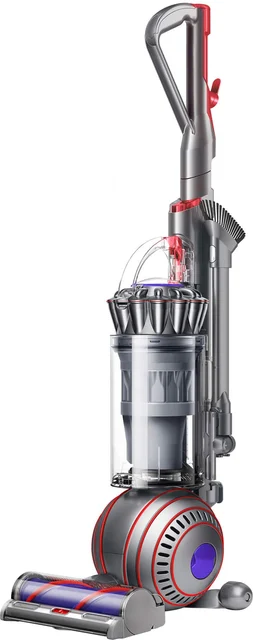
- Buy Dyson Ball Animal 3 The deepest carpet and pet-hair clean here, if you can handle the weight and the price.
- Buy Shark Navigator Lift-Away Deluxe Lighter, cheaper, and lift-away versatile: the corded upright most homes should buy.
- It depends Miele Dynamic U1 A sealed, bagged tank built to outlast everything else, aimed squarely at allergy households.
- Skip Bissell CleanView Swivel Pet The cheap pet-vac everyone grabs at the store, and the one most likely to wear out first.
What actually matters
- A genuinely sealed filtration path because that is what stops fine dust and dander leaking out of joints and seams. It is the difference between filtering the air and merely owning a filter, and it is the single most oversold spec in the category.
- Deep-carpet pickup, not surface pickup because embedded grit and hair sit below the pile where only good airflow plus an aggressive, well-sealed head can reach. Bare floors are easy; carpet is where uprights earn their keep.
- Hair management at the brushroll because a head that wraps is a head you maintain by hand. Long human hair and pet shedding are the top real-world cause of suction complaints.
- Weight and how it steers because uprights are pushed, lifted, and carried. Swivel steering, ball steering, and a detachable pod change how often you actually reach for the machine.
- Height adjustment for your floors because a head set too low on thick carpet chokes airflow and stalls the roller, and one set too high on low pile skims over the dirt. Manual settings or a self-adjusting head both work; no adjustment at all is a compromise.
- Filter and bin maintenance you will realistically do because bagless suction fades fast when foam and pleated filters clog. Check how many filters there are, how they are cleaned, and how long they take to dry.
- Durability of the plastics and the warranty behind them because uprights get knocked into furniture and dragged upstairs. The cheapest models tend to crack, lose seal, and lose suction well before a mid-range one does.
The specs, in plain English
Green flags vs red flags
Green flags
- The listing describes a sealed or complete-seal system, not just a HEPA filter
- A self-detangling or anti-tangle brushroll, especially if you have pets or long hair
- A brushroll shutoff or automatic floor detection if your home has hard floors
- A lift-away pod or a body light enough to carry upstairs without dread
- Clear, specific maintenance instructions: washable filters, stated drying time, easy-access brushroll
- A longer warranty and a steady supply of replacement filters, belts, and bags for the model
Red flags
- A giant Pa or amps figure used as the headline performance claim
- HEPA-style, HEPA-type, or allergen filter wording with no mention of sealing
- No height adjustment and no brushroll shutoff on a machine sold for mixed flooring
- Owner reports of suction fading within months, which usually means filters clog fast or seals leak
- Bagged machines where the bags are proprietary, hard to find, or rarely stocked
- A long accessory list standing in for any real filtration or head-design detail
Who's who: the brands
- Shark - Best known for Lift-Away and anti-tangle designs at mid-range prices, with capable cleaning in a relatively light body.
- Dyson - Premium bagless cyclonic machines with sealed filtration and self-detangling heads; strong deep-carpet reputation, heavier and pricier than most.
- Miele - Bagged, sealed, quiet, and built for longevity, aimed squarely at allergy households willing to keep buying genuine bags.
- Bissell - Broad budget and pet-focused range that is easy to find in stores; filtration and long-term durability vary a lot by model.
- Hoover - A long-standing mainstream name spanning budget to mid-range uprights, with widely available parts and belts.
- Sebo - Commercial-leaning bagged uprights favored for serviceability and carpet performance rather than styling or features.
How to read a listing without getting fooled
Read a spec sheet backwards. Start with the dust system, because bagged or bagless sets your running costs and your allergy exposure for the life of the machine. Next look for the word sealed, and if the page only offers a filter grade with nothing about the body, assume fine dust escapes. Then find the head: does the brushroll clear hair on its own, can you switch it off for bare floors, and does the height adjust? Only after that should you glance at suction figures, and when you do, compare air watts at the head or nothing at all, since amps, motor watts, and Pa are not interchangeable and each maker picks whichever flatters its product. Finish with weight, whether the pod lifts away, and what routine maintenance the machine demands, then check owner reports for how it holds up after the first year. Accessory counts and cyclone counts are the last things to look at, and usually the loudest on the page.
How much should you spend?
Budget uprights buy you a motor, a bin, and a basic filter, and that is genuinely enough for light, occasional cleaning on low-pile carpet or hard floors. What you give up is sealing, hair management, and plastics that survive being dragged around, which is why the cheapest pet models so often lose suction and develop rattles within a couple of years. The mid tier is where most households should land: sealed filtration, a real anti-tangle head, height adjustment, a lift-away pod, and build quality that lasts. Stepping into premium and flagship territory buys deeper carpet extraction, quieter operation, longer warranties, and in the bagged specialists a machine engineered to run for a decade or more, which pays off if you have thick carpet, heavy shedding, or allergies in the house. Spending more is worth it for sealing, head design, and durability. It is rarely worth it for extra tools, app features, or a bigger number on the box. Whatever tier you choose, count the ongoing cost too: bags and genuine filters are a small permanent expense, and a cheap machine that needs replacing twice is not the cheap option.
Questions, answered
Is bagged or bagless better?
It depends on which cost you would rather pay. Bagless never asks you to buy a consumable, but you release a puff of dust every time you empty the bin and you have to wash and fully dry the filters on a schedule to keep suction. Bagged means you buy bags forever, and in return the dust stays sealed from the floor to the trash can and the filters stay cleaner for longer. For allergy or asthma households, a sealed bagged system is usually the calmer choice.
Does a HEPA filter mean the vacuum is good for allergies?
Not on its own. A HEPA filter only cleans the air that actually goes through it. If the machine is not sealed, air escapes through gaps around the bin, the lid, and the hose joints, carrying fine dust and dander with it. Look for a sealed or complete-seal system described alongside the filter, and be skeptical of HEPA-style or HEPA-type wording, which has no standard behind it.
How do I compare suction between two vacuums?
Carefully, or not at all. Amps and motor watts describe electricity going in, not cleaning coming out. Pa measures sealed suction with no air moving, which is not how vacuuming works. Air watts at the cleaning head is the most meaningful figure, and even then only when both makers quote it the same way. In practice, independent testing of carpet pickup and consistent owner reports tell you more than any number printed on a box.
Do I need a self-detangling brushroll?
If anyone in the home has long hair or you own a shedding pet, yes, it is the feature you will notice most. A conventional bristle roller cleans well but collects wrapped hair into a dense mat that slows the roller, hurts pickup, and eventually needs cutting free with scissors. Self-detangling designs feed that hair into the bin as they work, which removes a chore you would otherwise repeat every few weeks.
How often should I clean the filters, and why does suction fade?
Most bagless uprights want their pre-motor filter rinsed every month or two, and the post-motor or HEPA element cleaned or replaced on the maker's schedule. Fading suction is almost always a clogged filter, a full bin, a blockage in the hose, or hair wrapped around the brushroll, in roughly that order. One rule matters above all: a washed filter must be completely dry before it goes back in, because a damp filter chokes airflow and can leave a musty smell.
Is an upright still worth buying instead of a cordless stick?
Yes if your home has a lot of carpet. A corded upright gives you full power with no runtime limit, a much larger dust capacity, and the airflow needed to pull embedded grit and hair out of deep pile. Cordless sticks win on grab-and-go convenience and quick tidy-ups. Many households end up owning both, but for whole-home deep cleaning the upright is still the machine that does the work.
Or jump to the head-to-head: Shark Navigator Lift-Away Deluxe vs Dyson Ball Animal 3.