Explained
Toaster Ovens, Explained
After reading this you will know why some toaster ovens brown evenly and others do not, and which specs to trust when you shop.
In this guide
A modern toaster oven is really two appliances sharing one box: a toaster and a small convection oven that often air-fries. First-time buyers get dazzled by function counts printed on the front, but even cooking comes from where the heating elements sit and how the fan moves air, not from how many presets the dial lists. This guide decodes the terms so you can judge one oven against another on what actually matters.
The 30-second version
- Function counts are marketing. A "10-in-1" or "13-function" badge tells you nothing about whether the oven browns evenly; element layout and convection do.
- Even heat is the whole game. The best ovens spread heat uniformly across the rack so a tray of food finishes at the same time without rotating.
- Match capacity to your household. A two-rack oven earns its counter space only if you batch-cook; for reheating for one or two it just wastes room.
- Air fry quality varies wildly. Most ovens now include it, but crisping fresh food is easy and crisping frozen fries exposes the weaker units.
- Controls are a durability trade-off. Digital panels give precision and presets; mechanical dials are simpler and tend to outlast touch sensors.
The products this guide is about
Our verdict on each, with the full reasoning on the companion review.
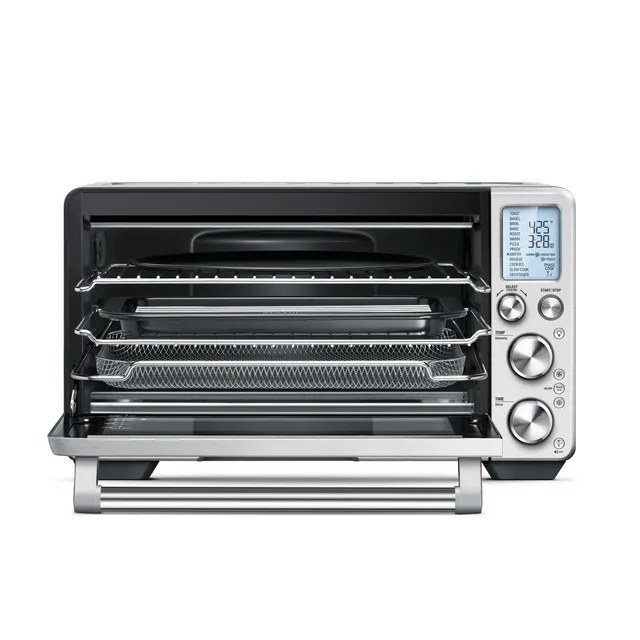
- Buy Breville the Smart Oven Air Fryer Pro (BOV900BSS) The do-everything flagship that replaces several gadgets - if you can stomach the price. Amazon
- Buy Ninja Foodi 10-in-1 XL Pro Air Fry Oven (DT201) Huge capacity and powerful convection for a lot less than the Breville. Amazon
- It depends Cuisinart Air Fryer Toaster Oven with Grill (TOA-70) A capable mid-price hybrid with a bonus grill plate - and a couple of trade-offs. Amazon
- Skip Hamilton Beach Easy Reach Toaster Oven with Roll-Top Door (31123) Cheap and roomy, but uneven cooking makes it hard to recommend, and Hamilton Beach has discontinued it. Amazon
What actually matters
- Even browning is the single most important trait, because hot spots ruin a batch of cookies or vegetables and force you to babysit and rotate food; favor ovens known for uniform results over ones boasting the longest feature list.
- Capacity should fit how you actually cook: a large or two-rack interior is worth the footprint for families who batch-cook, but overkill if you mostly toast and reheat.
- Convection design determines how fast and evenly the oven crisps and roasts; a well-placed fan (sometimes two) circulates hot air so food cooks without cold pockets.
- Air fry performance matters only if you will use it, and it is worth checking how a model handles frozen foods specifically, since that is where weak units fall down.
- Control type affects both precision and longevity, so decide whether you value exact digital temperatures and presets or the simple ruggedness of mechanical dials.
- Footprint and clearance matter because these ovens are deep and tall; measure your counter and the space under your cabinets before buying.
- Build and warranty signal how long the oven will last, since heating elements, door glass, and control panels are the common failure points.
The specs, in plain English
Green flags vs red flags
Green flags
- Consistent praise in independent testing and owner reports for even browning across the whole rack
- A thoughtful element layout (several elements, well placed) rather than just a high function count
- Genuine convection that lets you skip rotating trays partway through
- A control scheme that matches your priorities, whether precise digital or durable mechanical
- A warranty and build reputation that suggest the elements, door, and controls will last
Red flags
- Marketing that leads with the number of functions instead of cooking performance
- Owner reports of front-to-back or side-to-side hot spots that force constant food rotation
- Reports of door glass shattering or heating elements failing during normal use
- A rock-bottom price paired with a thin feature set, which often hints at short lifespan
- A low maximum temperature or a short timer that limits what you can actually cook
- Weak crisping on frozen foods if air frying is a main reason you are buying
Who's who: the brands
- Breville - Premium countertop ovens known for even cooking and feature-dense flagships that can replace several appliances.
- Ninja - Value-focused, big-capacity ovens built around batch cooking and strong convection at a friendlier price.
- Cuisinart - Long-running kitchen brand offering capable mid-price hybrids, often with durable mechanical dials and bonus features like a grill plate.
- Hamilton Beach - Budget specialist making inexpensive, roomy ovens for basic toasting and reheating rather than precision cooking.
How to read a listing without getting fooled
When you read a product listing, mentally set aside the biggest number on the box, the function count, because it is the least meaningful spec. Look instead for what the elements and convection are doing: how many heating elements, whether they are on top and bottom, and whether the oven promises genuinely even results or true two-rack cooking. Treat maker claims like "cooks up to 30 percent faster" as directional, not gospel, and cross-check them against how independent testing and owner reports describe real-world evenness and durability. Confirm the dimensions and internal capacity against your counter and the food you actually cook, and note the temperature range and timer limits, which quietly define what the oven can and cannot do. Finally, read the warranty and the pattern of owner complaints; repeated mentions of door glass, elements, or control panels failing tell you more than any headline feature.
How much should you spend?
Spending more mostly buys you even cooking, capacity, and durability rather than a longer list of presets. At the budget end you can get a roomy box that toasts and reheats, but you often accept hot spots, a low temperature ceiling, and shorter-lived parts. The value sweet spot sits in the middle, where you get large capacity, real convection, and air frying that handles fresh food well, which is enough for most families. Paying up to the flagship tier is worth it only if you cook often and want one machine that genuinely replaces your full-size oven with the most even, consistent results, and you have the counter space to justify it. If you mostly reheat for one or two people, the flagship performance and footprint are wasted, so buy down and put the savings elsewhere.
Questions, answered
Do more cooking functions mean a better toaster oven?
No. Counts like 10-in-1 or 13 functions are marketing. Even results come from element layout and convection, not the number of presets. A well-designed oven with a short function list will out-cook a poorly designed one with a long list.
Do I really need air frying?
Only if you will use it. Most modern ovens include it, so it rarely costs extra, but crisping quality varies. If air frying is a main reason you are buying, check specifically how the model handles frozen foods, which is where weaker units disappoint.
Are digital controls or mechanical dials better?
It depends on your priorities. Digital panels give precise temperatures and handy presets, while mechanical dials are simpler and tend to outlast touch sensors that can fail over years. Choose digital for precision baking and dials for long-run durability.
Can a toaster oven really replace my full-size oven?
The larger, feature-dense models can for most everyday tasks like roasting, baking, and air frying, and they preheat faster and use less energy. Very large batches or big holiday roasts may still need the full-size oven, so match the capacity to how you cook.
How much counter space will one take?
More than you expect. Capable ovens are deep and tall, so measure both your counter depth and the clearance under your cabinets before buying, and remember you also need room to open the door and vent heat from the top and back.
Or jump to the head-to-head: Breville the Smart Oven Air Fryer Pro (BOV900BSS) vs Ninja Foodi 10-in-1 XL Pro Air Fry Oven (DT201).