Explained
Spice Racks, Explained
You'll understand every spice rack format, spec, and capacity claim well enough to pick the one that fits your kitchen and your bottles.
In this guide
A spice rack is not really a storage product; it is a retrieval product. Its only job is to let you find the jar you want in one motion and put it back without thinking. What trips people up is buying for capacity or looks and discovering later that half the collection sits behind the other half, or that the rack does not fit the drawer, shelf, or bottles they actually own.
The 30-second version
- The format decides everything. Drawer inserts, cabinet stacks, wall systems, and countertop carousels are four different products solving the same problem, and the right one is simply whichever space you can most afford to give up.
- Advertised capacity is not visible capacity. A rack that holds forty jars but hides twenty behind the front row functionally holds twenty, so count the jars you can read without moving anything.
- Measure the clear interior height, not the drawer or shelf front. Tiered inserts stack jars upward, and the tallest bottle on the back step is the one that catches on the cabinet rail above.
- Empty racks beat prefilled ones. A prefilled set picks your spices for you, and ground spices fade over time, so several jars end up permanent residents you never finish.
- Labels are part of the product, not an accessory. Systems that ship with labels, or that let you write on jars and lids, are the ones people are still using a year later; unlabeled racks drift back into chaos fast.
The products this guide is about
Our verdict on each, with the full reasoning on the companion review.
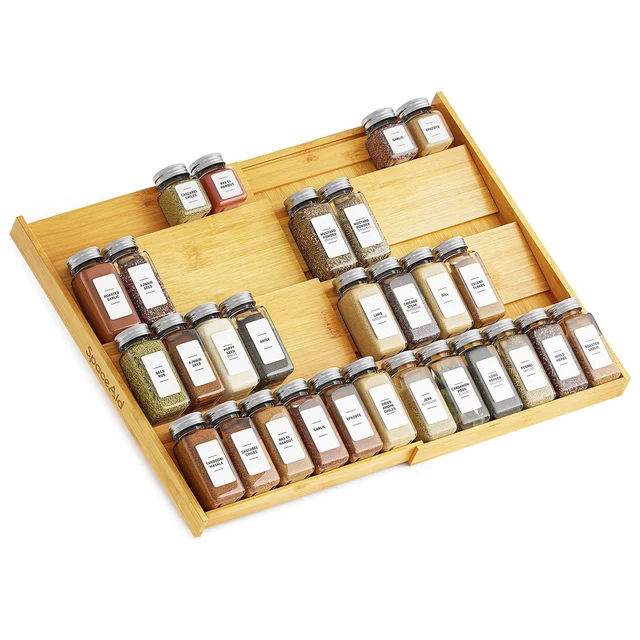
- Buy SpaceAid Bamboo 4 Tier Drawer Spice Organizer The most label-visible way to store spices, provided you can spare a three-inch-deep drawer. Amazon
- Buy YouCopia SpiceStack 24-Bottle Spice Organizer Turns a dead cabinet shelf into three pull-down drawers that show every label at eye level. Amazon
- It depends Gneiss Spice Magnetic Spice Rack with Wall Base, 24 Large Empty Jars Beautiful, refillable, and genuinely space-free, but it asks you to mount steel on your wall and buy spices in bulk.
- Skip Kamenstein Ellington 16-Jar Revolving Countertop Spice Rack A tidy carousel that solves the wrong problem: it fills your counter with sixteen spices somebody else chose. Amazon
What actually matters
- Label visibility in one glance - if you have to lift, rotate, or shuffle jars to identify them, the rack has failed no matter how many it holds. Look for tiered steps, tilt-down drawers, or a single-layer layout.
- The space it consumes - a drawer, a cabinet shelf, a wall, or permanent counter footprint. Counter space is the scarcest surface in most kitchens, so anything that occupies it forever has to earn it daily.
- Fit with the bottles you already own - supermarket bottles, tall grinders, and half-size jars vary wildly. Adjustable dividers accept the mix; fixed slots and decant-only systems mean buying or refilling jars.
- Clear interior height and depth - a frequent reason for returns. Measure the usable opening, then add margin for your tallest bottle and for tiered designs that raise the back row.
- Adjustability - expandable width or movable dividers let one rack fit many kitchens. A fixed-dimension rack fits exactly one drawer and one bottle size, and rattles in everything else.
- Build quality where it carries load - dividers that work loose, shelves that sag under full glass jars, and magnets that weaken are the failure modes that only show up months in.
- Distance from heat and light - spices degrade fastest above the stove or in a sunny window, so a rack that forces a bad location costs you flavor even if the rack itself is fine.
The specs, in plain English
Green flags vs red flags
Green flags
- Every jar is readable without moving another jar, whether by stepped tiers, tilt-down drawers, or a single visible layer
- Adjustable dividers or expandable width, so it fits your drawer and your mismatched bottles rather than one idealized set
- Ships empty, so you fill it with the spices you actually cook with
- Includes printed and blank labels, or jars you can write on directly
- Clear published interior dimensions, not just an outside footprint and a jar count
- Long-term owner reports describing it still flat, tight, and in daily use after years, which is where cheap materials give themselves away
Red flags
- Capacity claims that only work if jars sit behind other jars
- Prefilled with a manufacturer-chosen spice lineup, especially ground spices that may have sat in distribution
- Labels printed only on the lids, so a jar in your hand tells you nothing
- Fixed slot sizes with no listed jar dimensions, which is how tall grinders end up lying on their side
- Wall or door mounts sold as adhesive-only for a rack that will carry a full load of glass
- Refill or warranty programs that require registration, which owners report missing
Who's who: the brands
- SpaceAid - Bamboo drawer organizers, best known for expandable tiered spice inserts.
- YouCopia - Kitchen organization specialist; its cabinet spice stacks use pull-down drawers and adjustable dividers to handle mismatched bottles.
- Gneiss Spice - Small-batch maker of magnetic hexagonal glass jars and steel wall bases, aimed at bulk refillers and small kitchens.
- Kamenstein - Long-running maker of prefilled countertop carousels and wall racks, often bundled with a refill program.
- Copco - Budget-focused turntables and tiered cabinet shelves; simple, widely available, and light on build quality.
- OXO - Mainstream housewares brand whose expandable cabinet and drawer organizers emphasize grippy feet and easy handling.
How to read a listing without getting fooled
Start with the interior dimensions, not the jar count. Listings quote how many jars a rack holds, but that number assumes a particular bottle and often counts jars hidden in a second row, so translate it into a question you can verify: how many labels can I read without moving anything? Next find the clear interior height the rack needs and compare it to your drawer or shelf opening measured from the base to the underside of whatever sits above, then add a small margin, because tiered designs lift the back row and cabinet rails steal height the spec sheet never mentions. Check whether the photos show the manufacturer's own uniform jars; if they do, assume your supermarket bottles will look and pack worse, and look for the phrase adjustable or expandable to confirm it can adapt. Read whether jars are included, because an empty rack plus a jar set is a different purchase than it first appears. Finally, treat the owner reports written months later as the real spec sheet: loose dividers, sagging shelves, weak magnets, and fading prefilled spices are all problems that never appear in a first-week impression.
How much should you spend?
Spice storage is one of the rare categories where the cheapest good format is also the best one. A plain bamboo or plastic drawer insert costs very little and delivers the clearest access of anything on the market, so if you have a spare deep drawer, there is almost no argument for spending more. The next step up buys cabinet systems with pull-down drawers and adjustable dividers, and that premium is worth paying only when you genuinely have no drawer to give, because it is buying you access you would otherwise get for less. Magnetic wall systems sit at the top of the range, and much of that cost is the jars rather than the rack; they make sense for a small kitchen with a drillable wall and a bulk-buying habit, and they are poor value for anyone who would keep using supermarket bottles anyway. What is rarely worth the money is a prefilled rack: you are paying for spices somebody else chose, often ground and already aging, and the same spend on an empty rack plus your own jars buys a system where every slot earns its place. Budget separately for jars and labels if you want a uniform look, since that is usually the hidden half of the real cost.
Questions, answered
Drawer, cabinet, wall, or countertop: which format should I buy?
Pick by the space you can most afford to lose. A drawer insert is the best access if you can spare a deep drawer, because you look down on every lid at once. A cabinet stack with pull-down drawers is a close second and the right answer when drawers are shallow or already full. A wall system wins only when you have neither drawer nor shelf and can drill. Countertop carousels come last, because half the rack always faces away from you and it claims your most valuable surface permanently.
How deep does my drawer need to be?
Measure the clear interior height from the drawer base to whatever is above it when closed, not the height of the drawer front. Tiered inserts generally need around three inches, and the rear step raises those jars higher still. Owners regularly report bottles that clear on paper catching on the cabinet rail in practice, so add a quarter inch of margin and check your single tallest bottle before ordering.
Do I have to buy matching jars?
Not usually. Cabinet stacks with adjustable dividers are designed around mismatched supermarket bottles, so keep what you have. Drawer inserts accept mixed bottles too, though they look and pack much better with one uniform jar size. Magnetic wall systems are the exception: you decant into their jars, which is both part of the cost and an ongoing chore.
Are prefilled spice racks worth it?
Rarely, unless you are buying a gift that has to look complete on day one. The manufacturer chooses the lineup, so the jars you never cook with occupy the rack indefinitely while the ones you use run dry. Ground spices also fade over time, and a prefilled rack may have spent time in distribution before reaching you. An empty rack plus jars you fill yourself costs about the same and matches how you actually cook.
How long do spices actually last once they are in the rack?
Ground spices lose flavor sooner than whole spices, and heat and light shorten the life of both. That argues for keeping the rack away from the stove and out of direct sun, buying smaller quantities more often, and treating clear glass on a bright wall as a tradeoff you are making deliberately. Date the jars when you fill them and the guesswork disappears.
Can I mount a spice rack in a rental?
Cautiously. Adhesive-mounted wall plates and over-the-door racks avoid drilling, but a full load of glass jars is heavier than most adhesive strips are rated for, and a failure takes the whole set down. Inside-cabinet-door racks and freestanding cabinet stacks are the safer rental answers, and a magnetic strip on the side of the fridge gives you wall-style access with nothing to patch when you leave.
Or jump to the head-to-head: SpaceAid Bamboo 4 Tier Drawer Spice Organizer vs YouCopia SpiceStack 24-Bottle Spice Organizer.