

Home & Kitchen
The Best Slow Cookers: 4 Compared (and One to Skip)
We compared four current dedicated slow cookers on tenderness, temperature control, portability, and cleanup to find the best pick for most kitchens.
The short version
For most kitchens, the Hamilton Beach Advanced Temp Tracker 6-Quart is the slow cooker to buy: its probe displays and holds the food's temperature, the clip-tight lid resists spills, and the ceramic pot goes in the dishwasher, at a reasonable price. Step up to the All-Clad Gourmet Plus 7-Quart if you want a built-in sear mode and a ceramic-coated cast-aluminum insert. The Crock-Pot Programmable Cook & Carry is a fine budget choice mainly if you cook big batches and need to transport a finished dish, though it lacks a probe. Skip the Ninja Foodi PossibleCooker PRO if slow cooking is truly all you want, because you are paying for a multi-cooker you will not fully use. Best for: hands-off, repeatable slow-cooked meals with a probe, which the Hamilton Beach delivers better than the rest.
Our picks at a glance
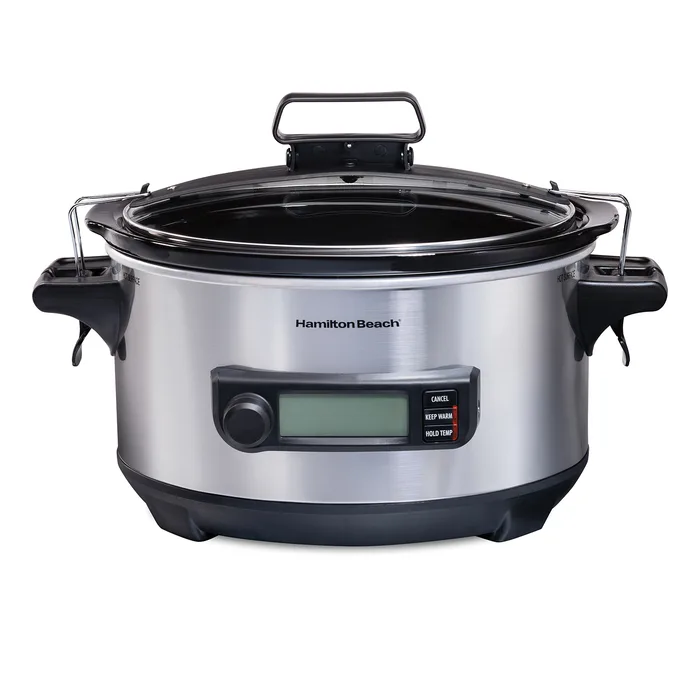
- Hamilton Beach Advanced Temp Tracker 6-Quart Slow Cooker (33867) - Buy. A temperature probe that holds the food at the temperature you set makes this the slow cooker most people should buy.
- All-Clad Gourmet Plus Stainless Steel 7-Quart Slow Cooker - Buy. The premium pick, with a built-in sear mode, buffet keep-warm, and a ceramic-coated cast-aluminum insert.
- Crock-Pot Programmable 7-Quart Cook & Carry Slow Cooker - It depends. The classic large-batch carrier is affordable and dependable, but basic on control.
- Ninja Foodi PossibleCooker PRO (MC1001) - Skip. A capable multi-function cooker, but overbuilt and overpriced if you only want to slow cook.
The verdict in 30 seconds
What mattered most
- Cooking performance
- Capacity
- Temperature probe
- Portability
- Insert & stovetop sear
- Cleanup
A dedicated slow cooker does one job and does it patiently: hold a low, steady temperature for hours so tough cuts turn tender and weeknight meals cook themselves. We looked at four models that are current and buyable in 2026, drawing on independent testing and aggregated owner reports. Two earn a clear recommendation, one is a solid buy only for the right shopper, and one is a capable machine that is simply the wrong tool if slow cooking is all you want.
A temperature probe that holds the food at the temperature you set makes this the slow cooker most people should buy.
Best for: Most households wanting hands-off, repeatable results and a probe for roasts, at a sensible price.
- Patented temperature probe measures and displays the food's current and desired temperature, then holds that temperature
- Hamilton Beach also pitches it for simmering, yogurt and fondue
- Clip-tight sealed lid for spill resistance, and a 6-quart size the maker says fits a 4 lb roast or 6 lb chicken
- Dishwasher-safe ceramic cooking pot
- Hamilton Beach lists no sear function, so browning happens in a separate pan
- Digital panel and probe are more failure points than a simple dial
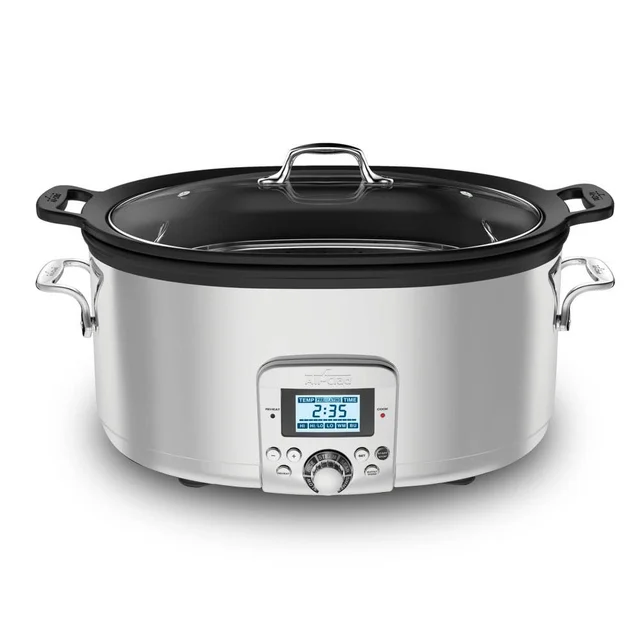
The premium pick, with a built-in sear mode, buffet keep-warm, and a ceramic-coated cast-aluminum insert.
Best for: Cooks who want a multi-mode cooker with a built-in sear mode, and will pay for it.
- 7-in-1 design with slow cook, rice, steam, sear, simmer, reheat, and buffet/keep-warm modes
- Cast-aluminum insert with a nonstick ceramic coating and a built-in sear mode
- Buffet and automatic keep-warm settings hold food at serving temperature, with a programmable timer up to 10 hours
- Stainless exterior, glass lid, and dishwasher-safe insert
- Costs far more than any other model here
- Nonstick ceramic-coated insert needs gentler care than plain stoneware
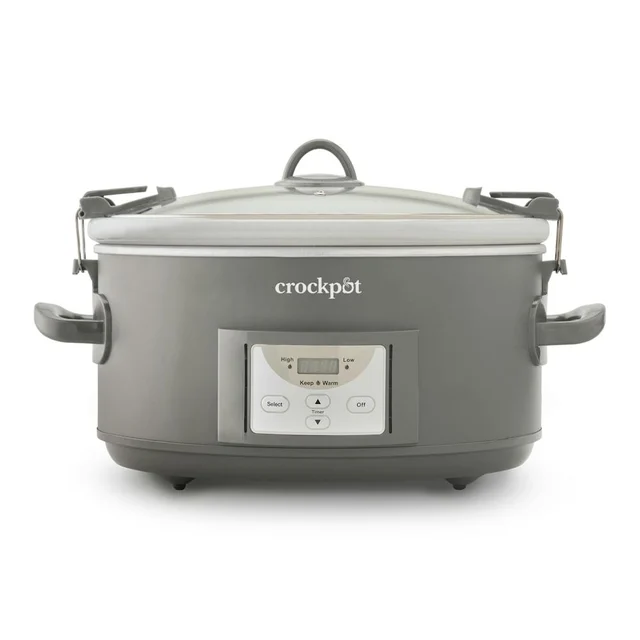
The classic large-batch carrier is affordable and dependable, but basic on control.
Best for: Budget shoppers who cook big batches and mainly want to carry a finished dish somewhere.
- Locking lid designed for transport to potlucks and parties
- Large 7-quart oval crock feeds a crowd
- Simple programmable countdown with automatic shift to warm
- One of the more affordable options here
- No temperature probe, so roasts rely on time rather than doneness
- Owner reports on newer units are mixed on latch durability and seal fit
- Crock is not designed to sear on a burner
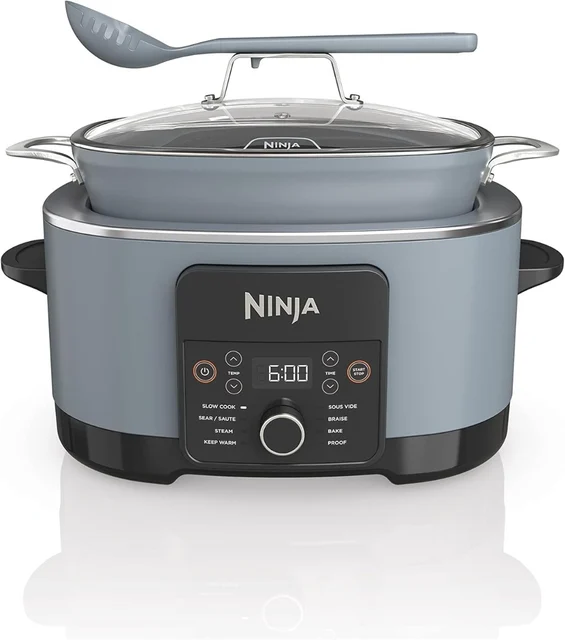
A capable multi-function cooker, but overbuilt and overpriced if you only want to slow cook.
Best for: Buyers who genuinely want a do-everything pot, not shoppers set on a dedicated slow cooker.
- Multi-function cooker that slow cooks alongside other modes
- Large-capacity pot
- Multiple cooking modes in one pot reduce the number of dishes
- It is a multi-cooker, not a dedicated slow cooker, so slow-cook behavior is a mode rather than the focus
- Costs more than a purpose-built slow cooker with a probe
- More settings add complexity for a single job
| Criteria | Hamilton Beach Advanced Temp Tracker 6-Quart Slow Cooker (33867) Top pick Buy it Buy | All-Clad Gourmet Plus Stainless Steel 7-Quart Slow Cooker Buy it Buy | Crock-Pot Programmable 7-Quart Cook & Carry Slow Cooker It depends Buy | Ninja Foodi PossibleCooker PRO (MC1001) Skip it Buy |
|---|---|---|---|---|
| Best for | Most households wanting hands-off, repeatable results and a probe for roasts, at a sensible price. | Cooks who want a multi-mode cooker with a built-in sear mode, and will pay for it. | Budget shoppers who cook big batches and mainly want to carry a finished dish somewhere. | Buyers who genuinely want a do-everything pot, not shoppers set on a dedicated slow cooker. |
| Price tier | $$ · mid-range | $$$$ · flagship | $ · budget | $$$ · premium |
| Cooking performance | Probe holds a set food temperature | Seven modes including slow cook and sear | Programmable countdown with warm | Multi-cooker with slow-cook mode |
| Capacity | 6 quarts | 7 quarts | 7 quarts | Large (not verified) |
| Temperature probe | Yes, displays and holds temperature | Not listed by the maker | No | Not verified |
| Portability | Clip-tight sealed lid | Glass lid | Locking lid | Not verified |
| Insert & stovetop sear | Ceramic pot; no sear function listed | Cast-aluminum insert; built-in sear mode | Stoneware; no stovetop sear | Nonstick pot; sear mode (not verified) |
| Cleanup | Dishwasher-safe ceramic pot | Dishwasher-safe insert | Removable stoneware | Not verified |
| Versatility beyond slow cooking | Simmering, yogurt, fondue | Sear and simmer | Slow cooking focused | Multi-cooker |
| Price tier | $$ · mid-range | $$$$ · flagship | $ · budget | $$$ · premium |
Which one is right for you?
- Most households wanting hands-off, repeatable results and a probe for roasts, at a sensible price. Buy it Hamilton Beach Advanced Temp Tracker 6-Quart Slow Cooker (33867)
- Cooks who want a multi-mode cooker with a built-in sear mode, and will pay for it. Buy it All-Clad Gourmet Plus Stainless Steel 7-Quart Slow Cooker
- Budget shoppers who cook big batches and mainly want to carry a finished dish somewhere. It depends Crock-Pot Programmable 7-Quart Cook & Carry Slow Cooker
- Buyers who genuinely want a do-everything pot, not shoppers set on a dedicated slow cooker. Skip it Ninja Foodi PossibleCooker PRO (MC1001)
How we judged the field
We do not run our own laboratory. Instead, we synthesize independent testing and aggregated owner reports into a single verdict, then sanity-check every model against what buyers can actually purchase in 2026. For dedicated slow cookers, a handful of criteria matter most.
- Temperature consistency: the whole point of a slow cooker is a low, steady heat that renders tough cuts tender without scorching. Units that hold a stable simmer are the goal.
- Control and doneness: a programmable timer with an automatic shift to warm is the baseline; a meat probe that stops cooking at a target internal temperature is a meaningful step up for roasts.
- Insert and cleanup: stoneware is forgiving, while a metal insert may let you sear before you simmer. Both should clean up easily.
- Portability: a gasket or locking lid and sturdy handles matter if you carry finished dishes to gatherings.
- Fit for purpose: we deliberately separated dedicated slow cookers from multi-cookers and pressure cookers, and we weighed whether extra modes justify their cost when slow cooking is the goal.
Hamilton Beach Advanced Temp Tracker 6-Quart Slow Cooker (33867)
Buy itThis is the model we would put in most kitchens, and it is the probe-equipped 6-quart that Hamilton Beach sells now that the Set & Forget 33967 is gone from its site. Its appeal is a patented temperature probe: the display shows the food’s current and desired temperature, and the cooker holds the temperature you set, which Hamilton Beach also pitches for simmering, yogurt and fondue. The clip-tight sealed lid resists spills when you move a full pot, the 6-quart size fits a 4 lb roast or a 6 lb chicken by the maker’s measure, and the ceramic pot is dishwasher safe. The main compromises are that Hamilton Beach lists no sear function, so browning means a second pan, and that a digital panel and probe add more to go wrong than a plain dial. For the price, those are easy trade-offs to accept.
All-Clad Gourmet Plus Stainless Steel 7-Quart Slow Cooker
Buy itWhen the goal is the best possible result rather than the best value, the All-Clad earns its place. Its cast-aluminum insert has a nonstick ceramic coating, and the maker lists a built-in sear mode alongside slow cook, rice, steam, simmer, reheat, and buffet/keep-warm modes, with a programmable timer up to 10 hours. The glass lid and dishwasher-safe insert keep cleanup simple. The catch is the price: it costs far more than anything else here, and the ceramic-coated insert needs gentler handling than plain stoneware. It is a splurge, but a defensible one.
Crock-Pot Programmable 7-Quart Cook & Carry Slow Cooker
It dependsThe Crock-Pot Cook & Carry is the category’s familiar workhorse, and for a specific shopper it is the right call. Its locking lid is designed for transport, the large 7-quart oval crock feeds a crowd, and a simple programmable countdown handles timing before shifting to warm. It is also one of the more affordable options here. The reasons it lands at “it depends” rather than a clear buy: it has no temperature probe, so roasts are cooked by time rather than doneness, and owner reports on recent units are mixed on the durability of the latches and seal. If you mainly cook big batches and carry finished dishes to gatherings, it is a sensible pick; if you want precision, look to the Hamilton Beach.
Ninja Foodi PossibleCooker PRO
Skip itThe Ninja is a genuinely capable machine, and that is precisely why it does not fit this list. It is a multi-cooker with a range of cooking modes, slow cooking among them. But slow cooking is one mode among many rather than its focus, and you pay a premium for functions you will not use if a dedicated slow cooker is what you set out to buy. For a buyer who truly wants a do-everything pot, it is worth a look on its own merits. For this roundup’s purpose, a purpose-built slow cooker with a probe is better matched to the job for less money, so we skip it here.
Hamilton Beach Advanced Temp Tracker vs All-Clad Gourmet Plus: which should you buy?
These are the two strongest choices, and they answer different questions. The Hamilton Beach Advanced Temp Tracker is the value-forward recommendation: it brings the single most useful convenience feature, a probe that holds the food at a set temperature, plus a clip-tight sealed lid, at a fraction of the All-Clad’s cost. The All-Clad Gourmet Plus is the feature-forward option: it has a built-in sear mode and a buffet setting, so you can brown and slow cook in the same vessel, cutting down on dishes. If you want the best everyday slow cooker without overspending, choose the Hamilton Beach. If you cook often and value sear-in-one-pot convenience enough to pay for it, the All-Clad is worth the premium.
What to look for
- A programmable timer with auto-warm: the minimum for hands-off cooking, so food shifts to warm instead of overcooking.
- A meat probe (optional but valuable): cooks larger cuts to a target internal temperature rather than a fixed time.
- The right insert: stoneware is forgiving; a metal insert or sear mode lets you brown before you simmer.
- A secure lid and sturdy handles: a gasket or locking lid and firm grips matter if you transport finished dishes.
- Appropriate capacity: 6 quarts suits most households; step up to 7 quarts or more only if you regularly cook for a crowd, and follow the maker’s fill guidance.
- Simplicity over features: for pure slow cooking, resist paying for multi-cooker modes you will not use.
Our final take
A dedicated slow cooker should make low, steady, hands-off cooking effortless, and the Hamilton Beach Advanced Temp Tracker 6-Quart does that better than the rest for most people, thanks to its temperature-holding probe, sealed lid, dishwasher-safe pot and fair price. Spend up on the All-Clad Gourmet Plus 7-Quart if you want a built-in sear mode and a ceramic-coated cast-aluminum insert. Consider the Crock-Pot Programmable Cook & Carry only if big-batch capacity and easy transport matter more to you than precision. And skip the Ninja Foodi PossibleCooker PRO for this purpose: it is a fine multi-cooker, but the wrong tool if a dedicated slow cooker is what you actually want.
Questions, answered
What is the difference between a dedicated slow cooker and a multi-cooker?
A dedicated slow cooker is built to hold a low, steady temperature for hours and little else, which keeps controls simple and results predictable. A multi-cooker such as the Ninja Foodi PossibleCooker PRO adds searing, steaming, braising, and other modes; it can slow cook, but you pay more and manage more settings for a single task. If slow cooking is your main goal, a dedicated unit is usually the better value.
Do I need a slow cooker with a temperature probe?
A probe is most valuable for larger cuts of meat, because the cooker can work to a target food temperature rather than simply after a set time. For soups, stews, and chili, a programmable timer is sufficient. The Hamilton Beach Advanced Temp Tracker includes a probe; the All-Clad and Crock-Pot models here rely on timed programs instead.
Can I sear meat in a slow cooker before slow cooking?
Only if the cooker is designed for it. The All-Clad Gourmet Plus has a built-in sear mode and the Ninja is a multi-cooker with sear functions. Hamilton Beach lists no sear function for the Advanced Temp Tracker and the Crock-Pot stoneware is not designed for burners, so browning has to happen in a separate pan.
Is a larger capacity always better?
Not necessarily. Larger crocks, such as the 7-quart models here, are ideal for big batches, roasts, and cooking for a crowd, but many manufacturers recommend filling a slow cooker at least about half full. If you usually cook for one or two people, a 6-quart model like the Hamilton Beach is often the more practical size.
Is it safe to leave a slow cooker running while I am away?
Slow cookers are designed for long, unattended cooking, and models with an automatic keep-warm setting help prevent overcooking. As general guidance, place the cooker on a heat-safe surface away from walls and cords, do not overfill it, and follow the manufacturer's instructions and standard food-safety practices for holding and reheating cooked food. This is general product information, not food-safety or health advice; consult a qualified source for specific concerns.
Deciding between the top two? See our head-to-head: Hamilton Beach Advanced Temp Tracker 6-Quart Slow Cooker (33867) vs All-Clad Gourmet Plus Stainless Steel 7-Quart Slow Cooker.
More in Home & Kitchen
Slow Cookers, Explained Plain-English guide → Hamilton Beach Advanced Temp Tracker 6-Quart Slow Cooker (33867) vs All-Clad Gourmet Plus Stainless Steel 7-Quart Slow Cooker Head-to-head →  The Best S'mores Makers: 4 Compared (and One to Skip)
  The Best Snow Cone Machines: 4 Compared (and One to Skip)
  The Best Sourdough Starter Kits: 4 Compared (and One to Skip)
  The Best Sous Vide Immersion Circulators: 4 Compared (and One to Skip)